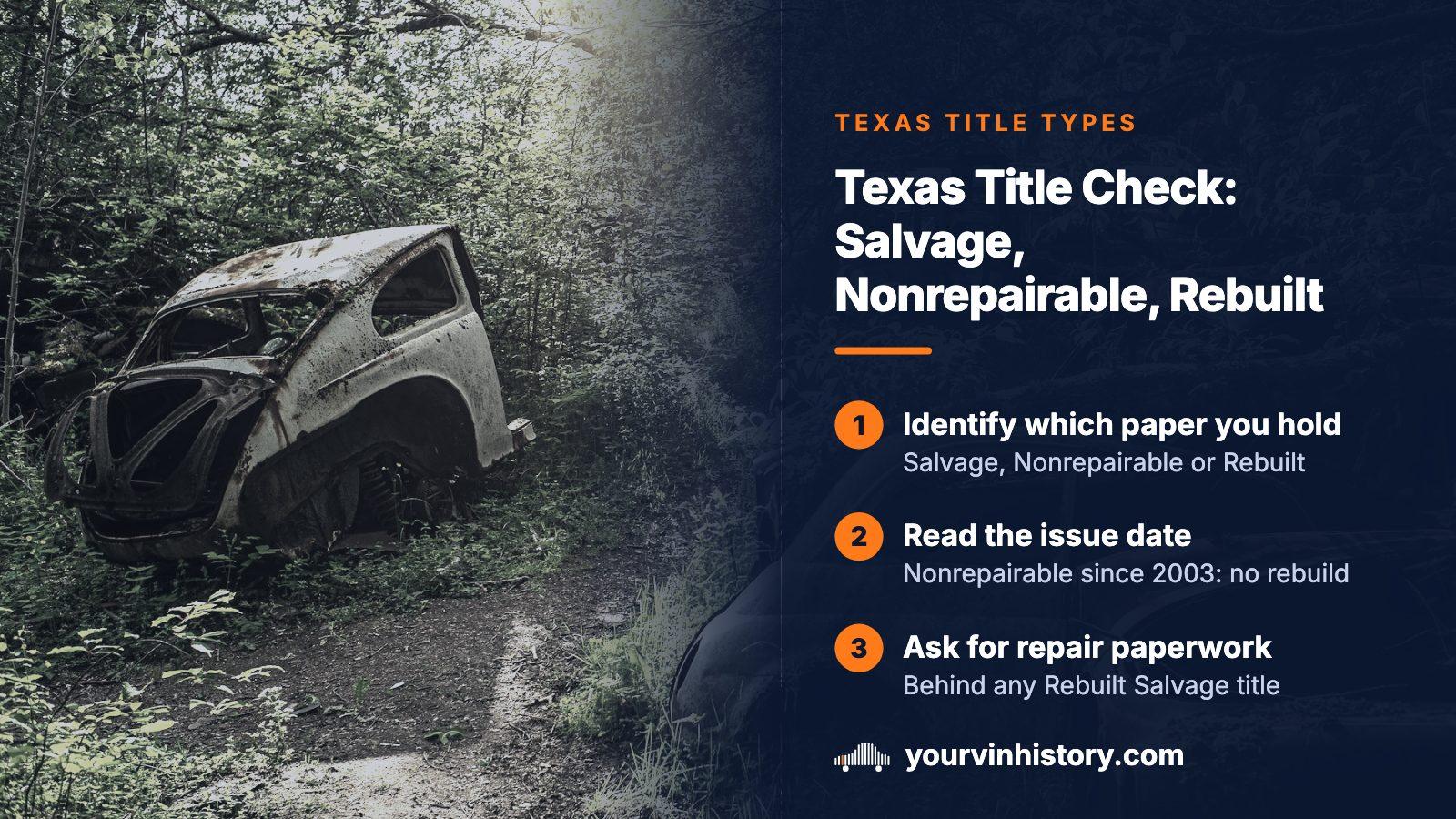
THE SHORT ANSWER
Work out which of three Texas papers you are holding: a Salvage Vehicle Title, a Nonrepairable Vehicle Title, or a regular title branded Rebuilt Salvage. Then read the issue date. Texas calls a car salvage when repairs would cost more than it was worth before the damage. A nonrepairable paper dated September 1, 2003 or later means the car can never be rebuilt, retitled or registered.
- Salvage test
- Repair cost above pre-damage value, so over 100 percent
- Nonrepairable since September 1, 2003
- Cannot be rebuilt, retitled or registered
- Nonrepairable before that date
- Treated as salvage, so rebuilding is allowed
- Flood Damage remark
- Carried forward onto later titles
Three Texas documents, three different futures
Texas has no single catch-all brand. A damaged car comes with one of three papers, and each promises something different about where it may go next.
| Document | What it covers | Road status |
|---|---|---|
| Salvage Vehicle Title (Form VTR-222-S) | A car whose repairs would cost more than its pre-damage value | No registration or road use until the car is fixed and titled anew |
| Nonrepairable Vehicle Title (Form VTR-222-NR) | A car worth only used parts or scrap metal | None, for papers dated September 1, 2003 or later |
| Regular title branded Rebuilt Salvage | A former salvage car that has been repaired and retitled | Registrable, brand repeated on later titles |
The names also date the paper. Before September 1, 2003 the two damage documents were called certificates of title; afterward the word became vehicle. An old-style certificate is not a forgery, just a sign that older rules apply.
How much damage earns a Texas salvage brand
The bar sits above the 75 or 80 percent lines that several other states use. Since September 2003, a Texas salvage vehicle has been one where repairs, parts and labor together, would cost more than the car was worth just before the damage: over 100 percent of actual cash value. A September 2005 amendment added cars missing a major component part. Insurers usually make the call.
Damage means something narrower than it sounds. The state counts sudden harm from a wreck, fire, flood or stripped parts. Gradual damage, hail and paint-only damage do not count, and repainting and sales tax stay out of the repair bill. Major component parts include:
- The engine, transmission and frame
- Fenders, hood, bumpers and quarter panels
- Doors into the passenger compartment, and a deck lid, tailgate or hatchback
- A truck cab or pickup cargo box, or a car's body, roof and floor pan
Treat a clean title as a minimum
Repairs have to beat the car's full value before Texas brands it, so a hard hit can still sit under an ordinary title. A clean title says the test was never met, not that the car was never wrecked.
What a Nonrepairable Vehicle Title shuts off
This is the harshest paper Texas issues. Besides cars left worth only parts or scrap, the category takes in cars arriving under another state's junk or parts-only paperwork, cars surrendered for dismantling, and cars sold for export only. The form states its limits on its face:
- No repairs, no rebuild and no reconstruction
- No regular certificate of title, ever
- No registration and no operation on Texas roads
- Used parts or scrap metal as the only permitted use
Two further rules close loopholes. The body and frame of a nonrepairable car cannot be used to build or repair another vehicle, and a title stamped FOR EXPORT ONLY blocks any later Texas title or registration. A running car offered with one of these papers is a contradiction, and the safest response is to leave the deal.
Same word, opposite outcome: read the issue date
Texas redefined nonrepairable effective September 1, 2003. Certificates issued before that day are treated as salvage, so the car may be repaired and retitled. Later titles are a dead end. A certificate from 2001 and a title from 2010 can both say nonrepairable and mean opposite things.
| Paper in hand | Issued | Can it be rebuilt and registered? |
|---|---|---|
| Salvage Certificate or Salvage Certificate of Title | Before September 1, 2003 | Yes, after rebuilding, inspection and retitling |
| Nonrepairable Certificate of Title | Before September 1, 2003 | Yes, it is treated as salvage |
| Salvage Vehicle Title | On or after September 1, 2003 | Yes, by the same route |
| Nonrepairable Vehicle Title | On or after September 1, 2003 | No, never |
Insurance settlements follow the same line. If an insurer paid on a nonrepairable car before the change and the owner kept it, Texas issues a Salvage Vehicle Title instead, preserving the right to rebuild.
Why salvage paper from 1996 to 2003 proves little
Between March 1996 and September 2003, Texas ran a different system that reached only cars under seven years old. Insurers sorted a loss into a lower percentage band for salvage and a higher one for nonrepairable, instead of applying today's over-100-percent test. The department also issued salvage certificates in that stretch to vehicles that never reached either classification.
The lesson cuts both ways. An old salvage certificate says less about how bad the damage was than a modern salvage title does, and an old nonrepairable certificate lacks the finality the same word carries now. Treat the document as a lead, not a verdict, and pay an independent shop to establish what happened.
Reading the wording on a Rebuilt Salvage title
A Rebuilt Salvage title is an ordinary title for a car that once held a salvage document, or a nonrepairable certificate from before September 1, 2003, and has since been repaired. It is road legal, and the brand rides along on every later title. The extra wording shows which document the car held before the rebuild.
| Document surrendered for the rebuilt title | Brand printed on the rebuilt title |
|---|---|
| Salvage Certificate issued before September 1, 2003 | REBUILT SALVAGE - LOSS UNKNOWN |
| Salvage Certificate of Title issued before September 1, 2003 | REBUILT SALVAGE - DAMAGED |
| Nonrepairable Certificate of Title issued before September 1, 2003 | REBUILT SALVAGE, with the top loss band named |
| Salvage Vehicle Title dated September 1, 2003 or later | REBUILT SALVAGE - DAMAGED |
| Out-of-state salvage document that permits rebuilding | REBUILT SALVAGE - ISSUED BY, then the state |
The loss-unknown line deserves the most follow-up, since its wording concedes the size of the loss is not on record.
Ask to see the repair paperwork behind a rebuilt car
Texas does not retitle a rebuilt car on the owner's word alone. The application includes a Rebuilt Vehicle Statement describing the car and the repairs. If donor parts went in, it also lists each major component part, the identification number federal law requires on it, and the number of the vehicle it came from. A rebuilder who cannot supply those numbers must go through a tax assessor-collector's hearing or a bonded title.
An owner who bought the car already rebuilt may write Repairs unknown in the work section, which the rules allow. For you, that signals this owner cannot say what was done. Ask who did the work, whether donor cars supplied parts, and whether receipts exist.
One ordering rule works as a tripwire. After a salvage car is rebuilt, the owner must get the Rebuilt Salvage title in their own name before reselling, and a dealer cannot simply reassign the old salvage document. A repaired car offered on a plain salvage title has skipped a step.
The Flood Damage remark and how long it lasts
Flood is a remark, not a separate brand. When the damage was caused exclusively by flood, Texas prints Flood Damage on the salvage or nonrepairable title, and the remark is carried forward onto later titles, including a Rebuilt Salvage one. A water loss big enough to qualify as salvage or nonrepairable brings the same restrictions as any other cause.
Texas also bars using electrical or mechanical components from a flooded vehicle to assemble another one. The caution fits the problem: corrosion in connectors and modules is hard to spot on a walk-around.
The word exclusively matters. A car hurt by both water and a collision, or one whose flood loss fell short of the repair-cost line, may carry no remark at all. Treat a missing remark like a missing brand, and check carpet seams, under-dash wiring and the trunk floor yourself.
What a brand does to registration and driving
Texas will not issue any form of registration, whether initial, renewal or temporary, for a car whose record shows a salvage or nonrepairable document. A salvage car becomes eligible only after it has been rebuilt, inspected, and its owner has applied for the Rebuilt Salvage title. Any registration the car held before the damage is invalidated once a salvage or nonrepairable title is issued, or once an insurer reports that the owner kept the car.
Driving is covered separately. The owner may not operate such a car on a public highway until it has been rebuilt, retitled and properly registered. For a buyer, that rules out the drive home on a temporary tag, so plan for a flatbed. The paper itself moves easily, since an unrepaired salvage document can be assigned by anyone, including an individual.
A five-step Texas title check before you pay
- Name the document and its date, before or after September 1, 2003.
- Compare the VIN on the car with the VIN on the paper, character by character, and check that a decode matches the year, make and engine.
- Pull a national NMVTIS title record from an approved provider, which can surface brands and total losses from other states. A vehicle history report on this site carries NMVTIS title records through ClearVin LLC, an approved provider.
- Search recalls on NHTSA's VIN lookup, which costs nothing, and run the NICB's VINCheck for theft and salvage flags.
- Pay for an independent inspection on any branded or rebuilt car. The title records what was declared; an inspector sees what was done.
TxDMV's own advice for branded purchases is similar: learn the exact damage, weigh insurability and resale value, have a mechanic inspect the car, and get a title history.
Where this information comes from
- TxDMV: Salvage/Nonrepairable Motor Vehicle Manual — Source for the damage tests, the September 2003 and 2005 changes, nonrepairable limits, rebuilt title wording, registration rules and the flood remark.
- TxDMV: Salvage brands — Explains the national brand names Texas reports and gives the department's buying advice for branded cars.
- NMVTIS: Vehicle history record and approved providers — Lists the approved data providers and shows which ones sell to consumers and which serve only commercial buyers.
- NHTSA: Recalls — Where to search a VIN for open recalls, a check that stands apart from title status.
Sources and photos: Facts checked against the sources above in October 2026. Photo by Patrick von der Wehd on Unsplash; diagrams by YourVINHistory.
Keep reading
- Total loss threshold by stateSee how Texas's over-100-percent line compares with other states' tests.
- Buying a rebuilt title carDecide whether a rebuilt car is worth the discount once you have read its title.
- NMVTIS reportLearn what the national record adds to a single state's paperwork.
- Flood-damaged carsLook for water damage that a title may not show.
Frequently asked questions
Is a Texas salvage title the same as a rebuilt title?
No. A Salvage Vehicle Title is the ownership paper issued before repairs, and it carries no registration rights. A Rebuilt Salvage title comes after the repairs, and its brand stays on every later title. A dealer that rebuilds a salvage car must hold the rebuilt title in its own name before retail sale.
Does hail damage give a Texas car a salvage brand?
Not by itself. Texas leaves sudden hail damage and paint-only damage out of its definition of damage, and an insurer's hail payout does not make a car salvage. Storm dents can therefore sit under a clean title, so judge a hail-country car by looking at the panels rather than the paper.
What is an owner-retained vehicle in Texas?
It is a car on which an insurer paid a salvage or nonrepairable claim while the owner kept it. The insurer reports the payout to TxDMV, and the owner must obtain the matching title before selling. Ask any seller of a damaged car whether an insurer ever paid a total-loss claim.
Can I buy a Texas nonrepairable car for parts?
Parts and scrap are the permitted uses, so a parts purchase is lawful. The limits are on what the parts can build: the body and frame cannot go into another vehicle, and electrical or mechanical components from a flooded car cannot be used to assemble one. Businesses dealing in used parts beyond an incidental level need a recycler license.
Where can I get a national title record to go with a Texas title?
The federal NMVTIS site lists every approved data provider. Some serve only commercial customers, so choose from the consumer-facing ones. The national record matters because one state's paper cannot show a brand the car picked up elsewhere before arriving in Texas.
Now check the car itself
The guide explains what to look for. The report shows what this VIN has on record.