THE SHORT ANSWER
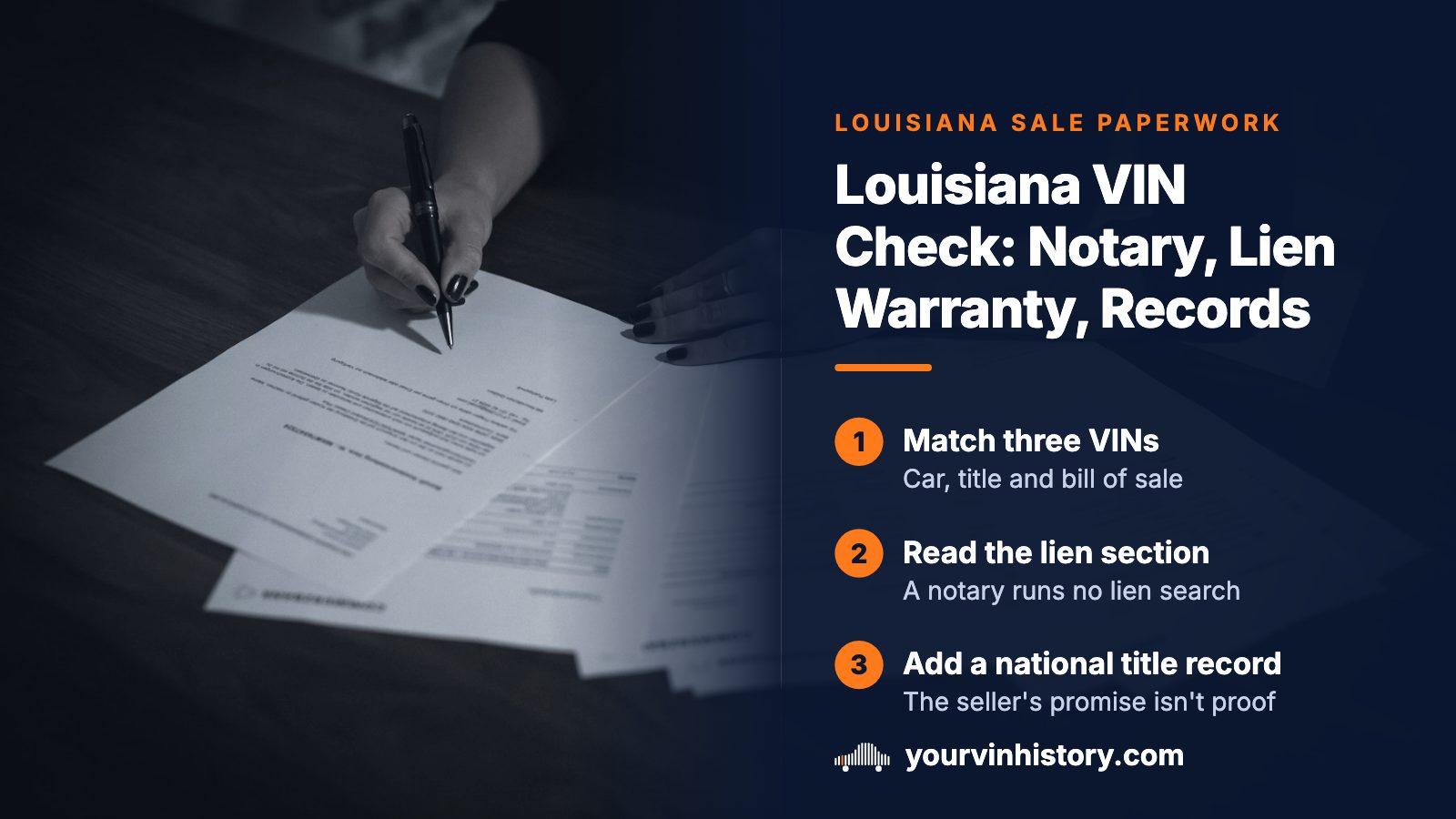
Make sure the VIN on the car, the title and the bill of sale all match. Then decode it, run the NHTSA recall lookup and NICB VINCheck, and pull a national title record from a provider the Justice Department approves. The state form has the seller promise the car is lien free, but the notary only witnesses signatures and searches nothing, so the title's lienholder section and an independent record do the real checking.
- Sale form
- Bill of Sale of a Movable, signed before a notary
- Seller's promise
- No mortgage, lien or encumbrance on the vehicle or its accessories
- Notary's job
- Witnesses signatures, runs no lien search
- Local unit
- Parishes, not counties
What the state's bill of sale form says, line by line
The Office of Motor Vehicles posts a one-page form titled Bill of Sale of a Movable. It opens with the state and the parish, then recites that the parties came before a notary public. The seller sells the vehicle with full and general warranty of title, and a short promise follows: no mortgage, lien or encumbrance of any kind attaches to the vehicle or to accessories fitted on it.
| Part of the form | What it records |
|---|---|
| Parish and state | Where the act is signed |
| Seller and buyer | Two parties of legal age, named by whoever fills in the blanks |
| Make, model, year, VIN | The vehicle being sold |
| Sale price and date | What was paid and when |
| Lien promise | No mortgage, lien or encumbrance of any kind, on the vehicle or its accessories |
| Signature lines | Seller, buyer and notary public |
In many states a private sale is a handshake plus a signature on the back of the title. Here the buyer gets a formal document in which the seller commits, in writing, to the vehicle's financial status. That is worth having. It is not worth trusting alone.
What a notary witnesses and what stays unchecked
Louisiana's legal system grows from civil law rather than English common law, and notaries have a larger role in it than in many other states. A notary confirms who is standing at the table and that those people signed. That is the whole job. The notary does not call a lender, open a lien database or read the title's history.
So whatever the seller says about the car lands on the page without anyone testing it. A seller who is mistaken about a loan, or hiding one, can sign the same form an honest seller signs, with the same stamp underneath.
Why a lien promise does not remove the lender's claim
A lender that financed the car is recorded against the vehicle itself, not against the seller's name. The claim generally rides along with the car into your driveway. Your signed bill of sale does not erase it, and the lender has no duty to accept your side of the story.
What you would hold instead is a claim against the seller for breaking the warranty. That means a dispute with someone who has already spent your money, which can involve a lawsuit, legal fees and no guarantee of recovery. A national title record costs a few dollars. The gap between those two outcomes is the reason to verify first.
Keep the signed original
Photograph the executed bill of sale and store the original with your other vehicle papers. You may need to show it when you register, so hand over a copy whenever an office will accept one.
Read the title first, then match three VINs
Ask to see the paper title well before the appointment. A seller asked early takes it as routine. A seller asked with the notary waiting and cash on the table may bristle, and the buyer may back down just to keep the sale moving. Look for these points:
- Whether a lienholder is printed on the face of the title, and whether a lender's release comes with it.
- Whether the seller's name matches the name on the title and on the seller's photo ID.
- Whether the VIN on the title matches the dash plate, visible through the windshield, and the door-jamb label.
- Whether the form carries that same VIN, character for character.
Those are three VINs: the title, the form and the car. A single wrong character can be an honest typo, and it can also mean the paperwork belongs to a different vehicle. Either way, fix it before anyone signs.
Free lookups worth running before you book the notary
- Decode the VIN and compare the year, engine and body style with the listing.
- Search the NHTSA recall lookup for open safety recalls on that exact VIN.
- Search NICB VINCheck for theft and salvage reports from participating insurers.
All three belong to other organizations and cost nothing. Run them in that order, since the decode confirms you are holding the right car's number before the other two searches mean anything. The recall lookup comes with one caution: ask a dealer which repair terms apply, because the federal remedy rule does not reach every vehicle and very old ones fall outside it. An open recall is rarely a reason to walk away, but it is a reason to know before you sign.
The national title record, and what it can miss
NMVTIS, the federal title information system, is the one lookup that reaches past both the seller's word and the state line. The Justice Department does not sell reports itself. Its consumer page lists approved data providers, separates those serving the public from those limited to commercial customers, and shows affiliated sites beneath some of them. Find the business by name on that list before paying anyone.
Expect the record to be strong on title brands, odometer disclosures and junk or salvage reports. Expect it to be weaker on liens. The federal rule that tells states what to send lists the VIN, the description and brands on the title, the owner's name, salvage and junk acquisitions the state collects, and odometer readings. Lienholder details are not on that required list, so a clean national record does not prove the car is unencumbered.
A yourvinhistory report starts with a free preview, then a one-time paid purchase. Its title records come from ClearVin LLC, an approved NMVTIS data provider, and it lists liens and impounds next to accidents, salvage entries and open recalls. Even then, the paper title is where you confirm a lender.
Cars arriving on titles signed in other states
The notary habit does not travel. A title assigned in Texas, Mississippi or another state may have been signed without any notary, and that is normal where it was signed. If you are bringing such a vehicle into Louisiana, ask the Office of Motor Vehicles how it handles the title before you make the drive.
Look up the earlier state's record too. Each state keeps its own lien notation, and the handoff between two state systems is where gaps open. A recent title from a state where the seller does not live proves nothing wrong. It is a prompt to ask why the car moved and to check both records.
Put the real price on the form
The form has a line for the vehicle sale price and another for the date of sale. Sales tax is the usual reason someone suggests writing down a smaller number than the one that changed hands. As a buyer, decline.
The form is your proof of what you paid if the sale is ever disputed. A figure that disagrees with your bank record weakens your position when you need it most, and it puts your signature, beside a notary's, under a number that is not true. Pay by a traceable method and keep a receipt showing the same amount that the form states.
Floods, hidden repairs and the gap no record fills
The lien promise says nothing about condition. A vehicle can sit in Gulf Coast water, be dried out and cleaned privately, then sell on a perfectly valid bill of sale that never mentions water. Titles can read clean after a flood, so paper is a weak guide here. Smell the carpet, lift the trunk liner, look for silt along the seat rails and under the dash, and test the electrical items that corrode first.
Collision repairs paid out of pocket and plain mechanical neglect leave no trace in these documents either. Book a pre-purchase inspection with a mechanic who works for you, not for the seller. It is the one check no database replaces.
A sequence that fits a Louisiana sale
- Ask for the title, or a clear photo of it, and read the lienholder section.
- Decode the VIN and compare the build with the listing.
- Run the NHTSA recall lookup and NICB VINCheck.
- Buy a national title record from a provider on the Justice Department list.
- Have a mechanic inspect the car, including a hunt for water damage.
- Match the VIN across title, form and car, then book the notary.
- Sign with the true price, pay traceably and keep the signed original.
Everything before step six is cheap and changes nothing about the deal. Everything after it is hard to undo.
Where this information comes from
- Louisiana OMV: Bill of Sale of a Movable — The state's own form, which shows the notary block, the warranty of title and the seller's promise about liens and encumbrances.
- U.S. Department of Justice: NMVTIS vehicle history reports — Lists the approved data providers and tells consumers which ones serve the public.
- NHTSA: Recalls — The federal VIN lookup for open safety recalls, which a title record does not carry.
Sources and photos: Facts checked against the sources above in October 2026. Photo by Dimitri Karastelev on Unsplash; diagrams by YourVINHistory.
Keep reading
- Vehicle lien checkShows how a lender's claim stays on the car and how to confirm it is released.
- NMVTIS reportExplains what the federal title record includes, who may sell it and what it leaves out.
- Flood-damaged carsCovers the water-damage signs a clean title and a notarized sale will not mention.
- Louisiana platesAdds what a Louisiana plate lookup can and cannot tell you about a car.
Frequently asked questions
Does Louisiana require a notary for a private car sale?
The state's bill of sale form is built around a notary public: the parties appear before one, and the seller, buyer and notary all sign. Treat the notarized form as the expected paper for a private sale, and confirm current requirements with the Office of Motor Vehicles before you set the appointment, since offices can change their procedures.
Is a car lien free just because the seller signed the warranty?
Not necessarily. The signature shows the seller promised in writing that no lender is involved. Whether that is true depends on the lender's records, not on a signature. If the promise proves false, you hold a claim against the seller, while the lender can generally still pursue the car. Verify through the title and an independent record first.
What is the best way to look for a lender on a Louisiana car?
Read the lienholder section on the paper title, ask for a lender's release if one is named, and compare the seller's name with their photo ID. A national title record adds brands and odometer history, though it may leave out lender details. A letter from the lender showing a zero balance outranks anything the seller says.
What if the seller still owes money on the car?
Such sales can work if the lender is paid directly. Get a written payoff quote with an expiry date, send that amount to the lender and only the remainder to the seller, using a traceable method. Treat the deal as finished once the state record shows the lien released and your name as owner.
Is a clean national title record enough to buy?
No. It is a solid check on brands, odometer entries and salvage reports, but it cannot show repairs paid for privately, flood exposure that never reached an insurer or the car's mechanical state. Pair it with the title, the recall and theft lookups and an independent inspection. A clean result lowers the risk without replacing the inspection.
Now check the car itself
The guide explains what to look for. The report shows what this VIN has on record.