THE SHORT ANSWER
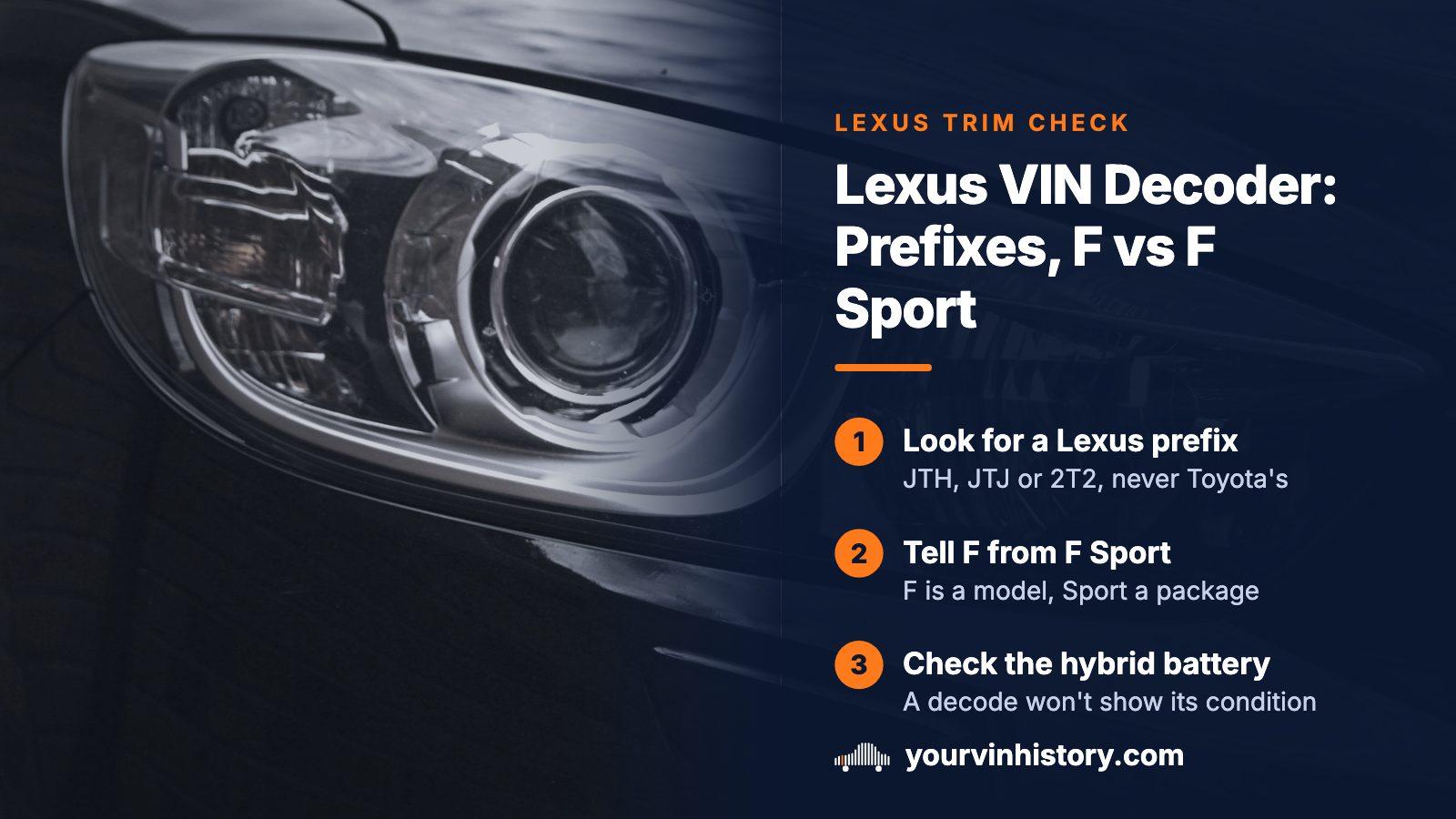
A Lexus VIN begins with a Lexus-only prefix such as JTH, JTJ or 2T2, never a Toyota one. Positions 4 to 8 describe the car, position 9 is the check digit, 10 gives the model year, 11 the plant, and 12 to 17 the serial number. The decode also settles the biggest trim question: an F is a model of its own, while F Sport is only an option package fitted to an ordinary one.
- Lexus prefixes
- JTH, JTJ and 2T2 are among the codes Lexus holds
- Toyota prefix
- Does not appear on a genuine Lexus
- Trim trap
- F is a model; F Sport is a package
- Hybrid battery
- Condition is not shown by a decode
Three characters that name Lexus: JTH, JTJ and 2T2
Start at the left edge of the number. The first three characters are the world manufacturer identifier, which says who built the vehicle and where. Lexus is assigned codes of its own, so the prefix on a real Lexus will not be one that Toyota uses.
| Prefix | What it points to |
|---|---|
| JTH | A Lexus assembled in Japan |
| JTJ | A Lexus assembled in Japan, spread across several model lines |
| 2T2 | A Lexus assembled in Canada, at a Toyota plant in Ontario that turns out certain SUVs |
A 2T2 on an SUV is not a warning sign. Some Lexus SUVs come out of North America rather than Japan. Lexus also holds codes beyond these three, so an unfamiliar prefix calls for a full decode, not a quick verdict.
Reading everything after the prefix
The remaining characters follow the standard layout used on every 17-character VIN, Lexus included. Past the prefix, each group of positions narrows the car down from a brand to one specific vehicle.
| Positions | What they carry |
|---|---|
| 1 to 3 | Manufacturer and country |
| 4 to 8 | Model, body style and engine descriptors |
| 9 | The check digit |
| 10 | Model year |
| 11 | Plant where it was assembled |
| 12 to 17 | Production sequence |
To find the number, check the driver's side of the windshield, down at its base, or the sticker on the door jamb. Read it off the car itself, then compare it with the listing and the title paperwork before you trust any decode.
What a free decode returns, and what it cannot
Lexus files its VIN structure with NHTSA, and the agency's vPIC decoder reads from what manufacturers report. Enter the 17 characters and you need no account and no payment. The result describes the car as built:
- Model year, model and body class
- Engine displacement, cylinder count and fuel type, hybrid systems included
- Drivetrain layout, whether rear, front or all-wheel drive
- The restraint system fitted at the factory
- Plant and country of manufacture
The tool is aimed at vehicles meant for sale or import into the United States, so a Lexus that started life in another market may return limited results. It also says nothing about what happened after the car left the factory. Title brands, accidents and odometer readings sit in other records.
F versus F Sport: the badge is not the car
Lexus sells two things that look related but are not. An F is a full performance model. F Sport is an option package layered over an ordinary model. The badges and body kits resemble each other closely enough that listings blur them, sometimes by accident and sometimes on purpose, and the price gap between the two is large.
| The car is | The decode shows | What is actually on it |
|---|---|---|
| A genuine F | A separate model designation of its own | Engine and chassis work specific to the F |
| An F Sport package car | The standard model | Appearance parts, wheels, seats and suspension tuning on a regular car |
| A standard car wearing F Sport badges | The standard model | None of the package; an owner added the badges |
Confirming an F claim before you talk price
Nothing is wrong with an F Sport as long as it is priced as one. These steps sort out which car is in front of you:
- Decode the VIN and read the model it returns. A true F comes back as its own model, not as a trim note.
- Have a Lexus dealer check the VIN against the build the factory recorded.
- Look at the engine yourself instead of trusting the badge on the tailgate.
- Compare the brakes and suspension hardware with what that model should carry.
- Price the car as whatever the decode says it is.
A seller who is sure of the car's build has no reason to object to a dealer confirming it.
Hybrid Lexus models: the VIN shows the system, not the battery
Hybrids run through most of the Lexus range, and they make up a big share of what is for sale used. From the decode you learn that the factory built a hybrid and which powertrain it carries. It cannot report the condition of the traction battery, which is the part that moves the price.
Those batteries fade gradually. The first signs are less time on electric power and worse fuel economy, long before a warning light appears. The hybrid systems are shared with Toyota, so advice for Toyota hybrids carries over. Questions to ask:
- Has the traction battery ever been replaced, and is there an invoice?
- How much hybrid-system coverage is left? That term outlasts the basic warranty.
- Does the car move off on electric power alone at low speed?
- Does observed economy match the EPA rating for that exact configuration on fueleconomy.gov?
- Has the battery cooling intake been cleaned? It works like a filter and is often ignored.
How much of a Lexus can be fixed with Toyota hardware
Because the engineering overlaps, a good share of the mechanical parts have a Toyota counterpart, often the identical component sold under another part number at another price. An independent shop that already services Toyotas can handle most of a Lexus competently, at rates below dealer pricing.
| Area | How much crosses over |
|---|---|
| Engine and drivetrain | Often shared outright, so Toyota parts knowledge applies |
| Suspension and brakes | Frequently shared at the platform level, though specifications can differ by model |
| Electronics and infotainment | Mostly Lexus-specific and priced accordingly |
| Interior trim and badges | Lexus-specific |
| Air suspension, if fitted | Model-specific and costly; find out whether the car has it |
A parts counter can match a part to your VIN. Ask before you accept a repair quote.
Open recalls on a Lexus, searched by VIN
Recalls attach to ranges of VINs, not to a model name, which is why a search by VIN beats a search by model. A single campaign can sometimes cover Lexus and Toyota vehicles together when a shared component is involved, so a Lexus can turn up in a recall that reads like a Toyota story.
NHTSA's recall page lets you enter the VIN and see open campaigns on that exact car at no charge. Inside the federal age limit, the manufacturer fixes the defect without charging the owner. That limit is a real cutoff: the free-repair rule does not reach a vehicle first bought more than 15 calendar years before the recall notice. A very old Lexus can fall outside it, so ask a dealer to confirm what is covered before you count on a repair costing nothing.
Certified pre-owned and the history it leaves out
Lexus runs a certified pre-owned program. The program layers extra coverage over whatever new-car warranty is left, with the manufacturer standing behind it at Lexus dealers. A certification speaks to the car's condition when it was certified, not to its past. Depending on the program's rules, a certified car can still have an accident on record.
So run the VIN anyway. A yourvinhistory report lists title brands, accidents with a damage map, odometer readings, salvage and auction records, liens and open recalls. Then read the service file. A Lexus that has been maintained on schedule tends to last, and gaps in the paperwork deserve a question.
Where this information comes from
- NHTSA: vPIC VIN decoder — Shows that decoding draws on VIN patterns the manufacturers report, and that coverage targets vehicles built for sale or import into the U.S.
- NHTSA: Recalls lookup — The place to enter a VIN and see whether a repair is still outstanding on that exact car.
- EPA and DOE: Fuel Economy — Official economy ratings and hybrid comparisons to hold a used car's real-world mileage against.
Sources and photos: Facts checked against the sources above in October 2026. Photo by Tristan Beischel @Autoily.com on Unsplash; diagrams by YourVINHistory.
Keep reading
- ToyotaThe parent brand's side of the shared-engineering story, hybrids included.
- Hybrid battery replacement costWhat to ask about a hybrid pack once the decode has confirmed one.
- VIN warranty checkHow to see which factory coverage, hybrid parts included, still applies.
- How to read a VINThe full walk through all 17 characters, position by position.
Frequently asked questions
How do I decode a Lexus VIN for free?
Copy the 17 characters from the base of the windshield or the door jamb sticker into NHTSA's vPIC decoder. It returns the model year, body class, engine, fuel type, drivetrain and plant from manufacturer filings. Check one detail against the car, such as the engine, because a decode describes the original build and not later changes.
Does a Lexus VIN start with the same letters as a Toyota?
No. Even when a Lexus shares a platform and engine with a Toyota, the two marques are assigned separate prefixes. If a car sold as a Lexus decodes under a Toyota prefix, treat it as a discrepancy until the seller explains it. Canadian-built Lexus SUVs open with a different code than Japanese-built cars, which is normal.
How can I tell a real Lexus F from an F Sport?
Decode the VIN. A true F returns its own model designation, while an F Sport returns the standard model. Then have a dealer confirm the factory build and inspect the engine yourself. A car that decodes as a standard model but is advertised at F money has a pricing problem, whatever the badge says.
Can I put Toyota parts on a Lexus?
Often for mechanical pieces, since the engineering overlaps, though the Toyota part may carry a different number and price. Interior trim, badges and most electronics are Lexus-specific. A parts counter can match a part to your VIN, which is worth doing before you approve a repair estimate.
Will a VIN decode show accidents or hybrid battery health on a used Lexus?
Neither. A decode tells you the factory built a hybrid and lists its powertrain. Accidents come from history records, while battery health comes from the service file, any replacement invoice and how the car behaves on a test drive. Ask for the invoice if the pack was ever changed.
Now check the car itself
The guide explains what to look for. The report shows what this VIN has on record.