THE SHORT ANSWER
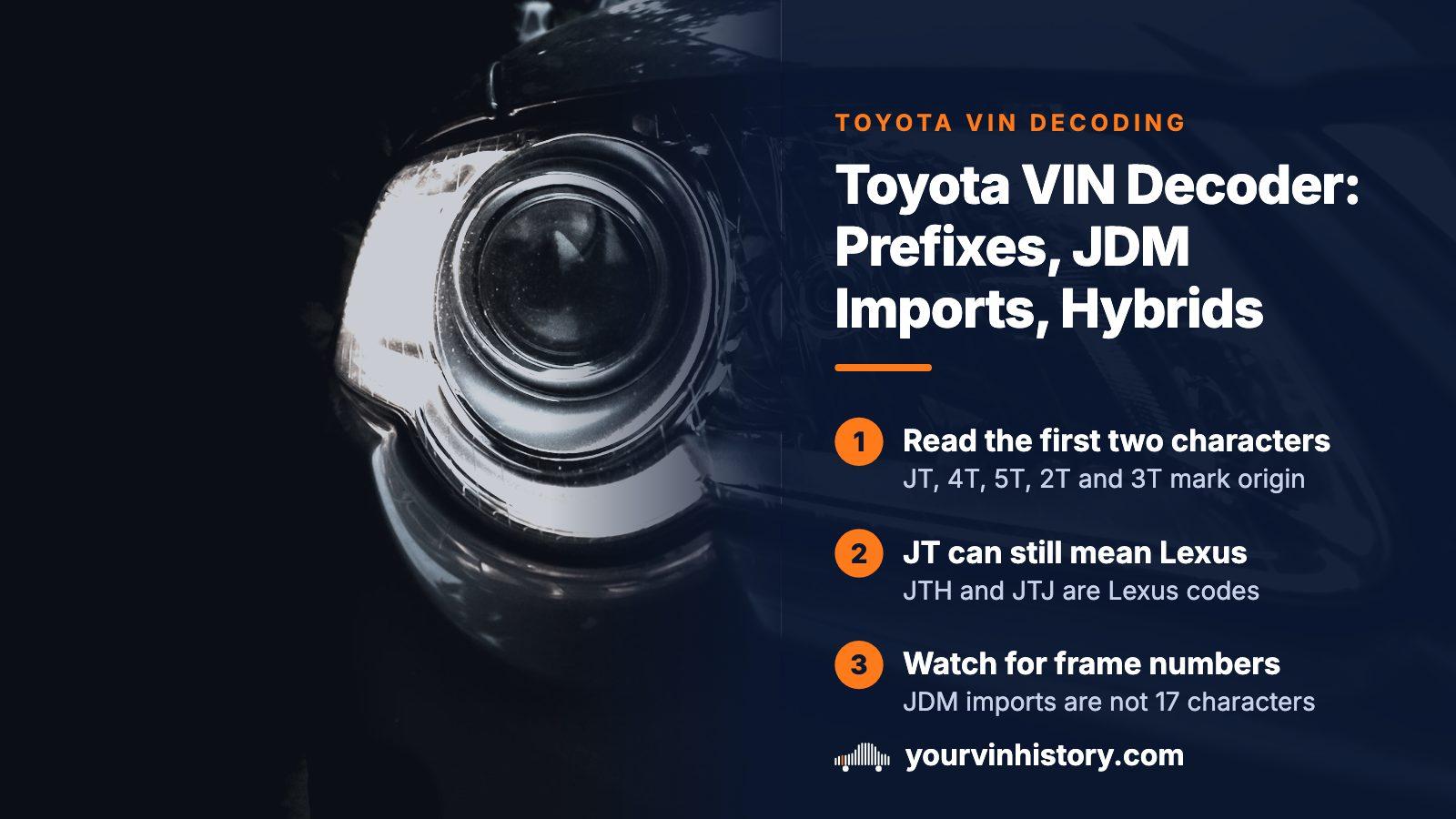
Read a Toyota VIN in blocks. Characters one and two usually read JT for Japan, 4T or 5T for the United States, 2T for Canada and 3T for Mexico, though JT also covers some Lexus models. Four to eight hold Toyota's model and engine coding. After a check digit come the model year, the plant and a six-character serial. A Japanese-market import has a shorter frame number that US decoders cannot read.
- Prefixes
- JT Japan, 4T and 5T US, 2T Canada, 3T Mexico
- Lexus overlap
- JTH and JTJ are Lexus codes under the JT start
- JDM imports
- A frame number, not a 17-character VIN
- Model year
- 10th character, on a 30-year letter cycle
The first three characters say who built it and where
Toyota does not use a single prefix. NHTSA's vPIC database lists a separate three-character code for each pairing of plant and vehicle class, and the first two characters narrow the field fast: JT for Japan, 4T or 5T for the United States, 2T for Canada, 3T for Mexico.
| Prefix | Registered to | Vehicle class |
|---|---|---|
| JTD, JTN, JT2 | Toyota Motor Corporation, Japan | Passenger car |
| JT3, JTM | Toyota Motor Corporation, Japan | Multipurpose vehicle |
| JT4 | Toyota Motor Corporation, Japan | Truck |
| 4T1, 4T3 | Toyota Motor Manufacturing, Kentucky | Car, multipurpose vehicle |
| 5TD | Toyota Motor Manufacturing, Indiana | Multipurpose vehicle |
| 5TF, 5TE | Toyota Motor Manufacturing, Texas (5TF) and California (5TE) | Truck |
| 2T1, 2T3 | Toyota Motor Manufacturing Canada | Car, multipurpose vehicle |
| 3TM, 3TY | Toyota plants in Baja California and Guanajuato, Mexico | Truck |
A North American prefix on a mainstream Toyota is ordinary. It becomes a question only when a seller calls the car Japan-built and the number says otherwise.
Why a JT start does not prove the badge
A manufacturer code names a registrant and a vehicle class. It does not name the brand on the grille. The same vPIC lookup lists Lexus cars under JTH and Lexus SUVs under JTJ, so a Lexus can open with the same two letters as a Toyota. Some codes are shared outright: JTE and 5TD list Lexus alongside Toyota, and JTM and JTE list Subaru as well.
Decode the whole string and read the make field in the result instead of guessing from the prefix. If it disagrees with the badge, the title or the listing, settle that before any money moves. The Lexus decoder guide on this site covers that brand's own quirks.
Positions four to eight, and the digit that polices them
Toyota fills characters four through eight itself. They record the model line and body, the grade, the engine and the restraint equipment, and the company has recycled codes between generations. A chart written for one era can therefore misread a car from another, so a decoder reads them alongside the model year and manufacturer code.
Position nine is the check digit, a calculation run on the other sixteen characters. Mistype one and the arithmetic usually fails, so the decoder warns you instead of describing a car that does not exist. Positions twelve to seventeen are the serial that separates your vehicle from every other with the same coding.
The year letter, the plant character and the date that counts
The tenth character gives the model year and the eleventh the assembly plant. Years skip the letters I, O, Q, U and Z.
| Position 10 | Model year |
|---|---|
| A to H | 2010 to 2017 |
| J to N | 2018 to 2022 |
| P | 2023 |
| R, S, T | 2024, 2025, 2026 |
Before 2010 the scheme used digits for 2001 through 2009. Earlier still, A stood for 1980 and Y for 2000. On that 30-year cycle one letter can fit two decades, so the body style and paperwork have to break the tie.
Model year is also not the build date. A model year can start before its calendar year, and the sticker in the driver's door frame prints the real month and year of manufacture. Use that date when a recall is limited to one plant and a production window, and let the decoder translate the plant letter, since plant codes have been reassigned over time.
A Japanese-market Toyota has a frame number instead of a VIN
Cars built for sale in Japan were never given a 17-character VIN. The plate shows a frame number, typically a short model code, a hyphen and a serial. It is shorter than a VIN and laid out for Japanese records.
That is why a US decoder returns nothing useful. NHTSA says vPIC is built around vehicles meant for sale or import into the United States, and searching for others gives only limited data. A blank result on a JDM car is the expected answer, not a fault in the number and not evidence against the car.
- Photograph the plate up close and note where it sits.
- Keep the model code before the hyphen. It opens up Japanese-market references, but it names a configuration shared by many cars, while the frame number singles out one.
- Ask for the documents the car arrived on and compare their number with the plate.
- If a seller offers a 17-character number instead, ask who assigned it and where it appears on the vehicle.
The 25-year rule clears less than sellers imply
Once a vehicle reaches 25 years of age it can usually be brought into the country without conforming to federal safety standards, which explains the steady supply of older JDM Toyotas. That age test belongs to the safety side only. Emissions and customs each have their own paperwork, and the imported-car guide on this site covers all three agencies.
- Ask for the entry papers and read them against the plate on the car.
- Check that the title and registration carry the same number as the plate.
- Ask your state motor vehicle agency what inspection or VIN verification it requires for an import.
- Walk away if the seller cannot explain how the car came in.
Frame rust: the check a decode cannot make
On body-on-frame Toyotas, meaning the pickups and older SUVs, the steel frame sets the working life of the whole vehicle. The manufacturer has at times run corrosion programs on certain ones. A decode places the truck in a generation, but it cannot say whether the truck spent winters on salted roads, and that history outweighs almost any spec. Programs end, so ask a dealer to check the VIN rather than trusting a seller's memory.
- Put the truck on a lift and follow both frame rails end to end.
- Orange dust on an old frame is ordinary. Scale that peels in layers, or holes, is the worry.
- Press and tap doubtful spots; solid steel stays firm.
- Check the rear spring hangers, the crossmembers and the frame over the rear axle.
- Ask for proof of any frame inspection or corrosion repair.
- Treat fresh undercoating as a reason to look harder, since it can hide scale.
Frame beats odometer
A high-mileage truck with a solid frame is usually a safer buy than a lower-mileage one with a weakened frame. Frame repair rarely makes economic sense, and a weak frame is a safety problem, not a cosmetic one.
Hybrid Toyotas: the VIN names the system, not its health
Toyota has sold hybrids in volume for years, so a large share of used Toyotas carry a battery pack with real age on it. A decode can confirm the car was built as a hybrid and describe its powertrain. It cannot report how much capacity the high-voltage battery has left. Packs wear gradually, and weaker fuel economy or less electric-only driving tends to show well before a warning light.
- Ask whether the traction battery was ever replaced, and request the invoice.
- Have a dealer confirm by VIN what hybrid-system coverage remains, instead of relying on the seller.
- On the drive, see whether the car stays on battery power at parking-lot speeds.
- Look up the EPA rating for that exact year and configuration on EPA's fuel economy site and compare it with what the car actually returns.
- Pay a shop that works on hybrids regularly to scan the system.
Same badge, different pack
Hybrids of one model year can sell for very different prices, because pack condition varies. Neither a decode nor a history report shows which one you are looking at.
Recalls attach to the VIN, so run the lookup
Recall campaigns cover VIN ranges, not whole model names, so a news story about a Toyota recall does not tell you whether your car is in it. NHTSA's recall lookup is free and answers that for one exact VIN. An unrepaired open recall is a safety issue and a fair point to raise with the seller.
For most vehicles the manufacturer must do the remedy without charge, however many owners the car has had. That free-repair rule has an age ceiling, though. A vehicle first sold more than 15 calendar years before the recall notice falls outside it, so a very old Toyota may not qualify. Ask a dealer about the specific campaign and the car's age instead of assuming either way.
A sensible order of checks on a used Toyota
- Read the VIN off the car itself: the plate seen from outside at the driver's corner of the dash, and the sticker on the door frame. Both should match each other and the title.
- Decode it and compare year, engine and drivetrain with the listing.
- Compare the prefix with the seller's account of where the car was built. A mismatch needs an explanation, not an accusation.
- Run the recall lookup on that exact number.
- Inspect what the number cannot: a truck's frame, a hybrid's battery.
- Pull a history report for what a decode never shows.
A decode describes the car as Toyota built it. Title brands, accidents and odometer readings sit in other records. A history report from this site starts with a free preview, and the full report is a one-time purchase.
Where this information comes from
- NHTSA: vPIC VIN decoder — The federal decoder behind the prefix table, and the source of the warning that vehicles not meant for US sale return limited data.
- NHTSA: Recalls lookup — The no-cost open-recall search by VIN used in the recall section.
- EPA: Fuel Economy — Official mileage ratings by model year, with hybrid listings and a side-by-side tool for checking a hybrid's economy.
Sources and photos: Facts checked against the sources above in October 2026. Photo by Rafał Karoń on Unsplash; diagrams by YourVINHistory.
Keep reading
- Toyota chassis numberSeparates frame numbers, chassis codes and VINs when a Japanese-market car is involved.
- Imported car VIN checkShows what the 25-year age rule clears and what other agencies still decide.
- Toyota warranty by VINExplains how to see what coverage, including any frame program, a specific Toyota VIN still has.
- LexusPicks up where the shared JT prefixes leave off, for Lexus.
Frequently asked questions
How do I decode a Toyota VIN for free?
Type the 17 characters into NHTSA's vPIC decoder, which needs no account. It returns what Toyota filed: model year, model, body class, engine, drivetrain, restraint system and plant. It does not return trim marketing names, accidents, owners or title brands, so it describes the car as built, not how it has lived.
Does a Toyota VIN show the exact trim level?
Only partly. The coding for model line, body and grade often narrows the choices, but the names used in brochures are not written into the VIN as such. Treat the decode as a shortlist, and ask a dealer for the factory build record if the exact trim affects the price you are being asked to pay.
Can a VIN tell me whether a hybrid battery is healthy?
No. It can show the car was built with a hybrid system, but battery health depends on age, use and repairs, none of which the number encodes. Ask for service records and any replacement invoice, and have a hybrid-experienced shop read the system. An original pack on an older car is a fair reason to haggle.
Can the VIN tell me where my Toyota was built?
Yes, at two levels. The first character gives the country and the eleventh gives the assembly plant, though a decoder translates the plant letter more reliably than a chart does. For the date, read the door-frame sticker, which shows the month and year of manufacture, since a model year can start before the calendar year.
Why does my Toyota's VIN fail the decoder?
Check three things: a mistyped character, which the check digit usually exposes; a mismatch between the plate and the paperwork; and the length of the string. A shorter number with a hyphen is a Japanese-market frame number, which US decoders cannot read. If the length is right but the result is empty, compare the windshield plate with the door sticker.
Now check the car itself
The guide explains what to look for. The report shows what this VIN has on record.