THE SHORT ANSWER
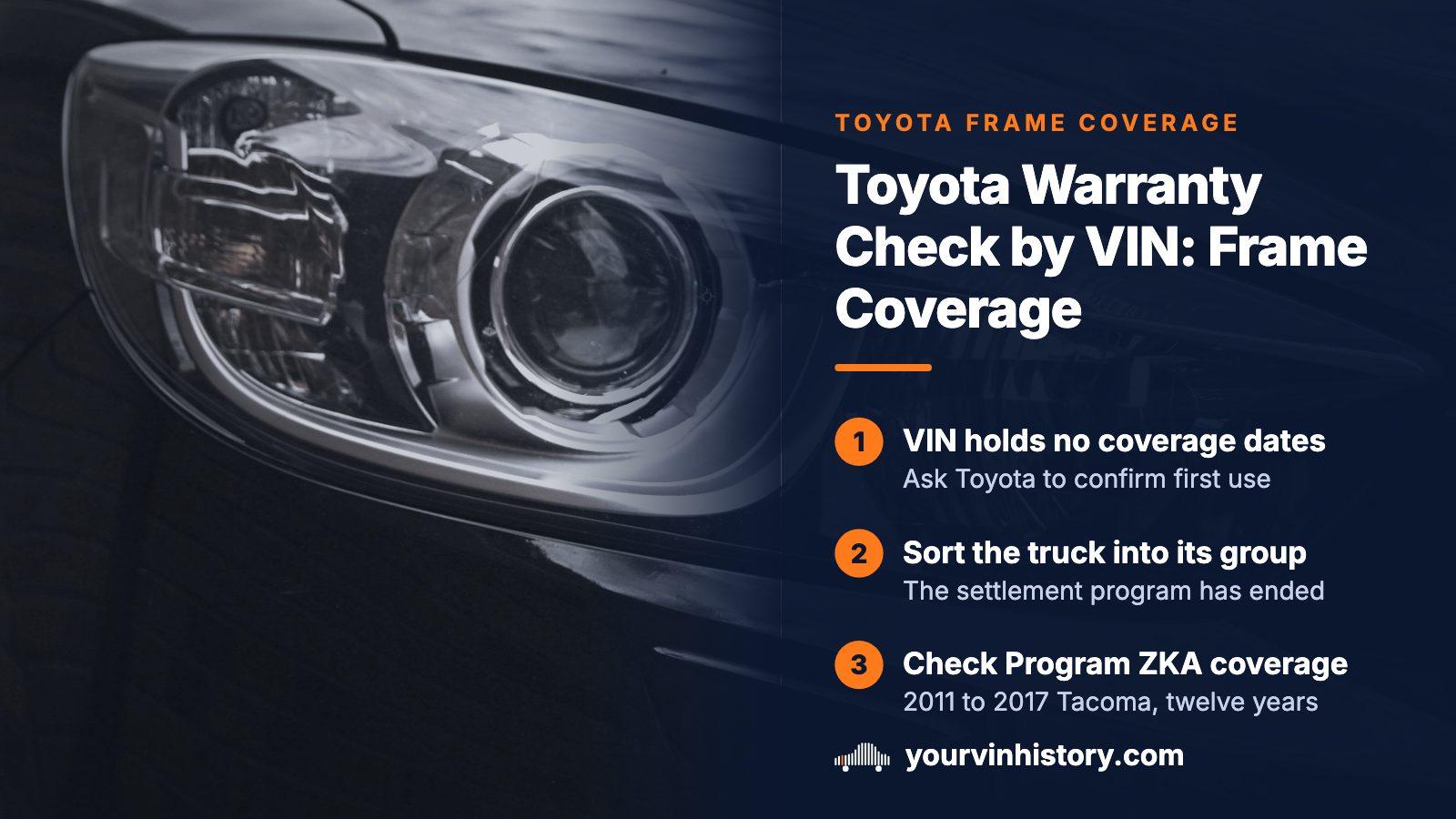
The seventeen characters of a VIN identify the truck but carry no coverage dates, so ask Toyota or a dealer to confirm the first-use date and any frame program for that number. The court-approved frame program for 2005–2010 Tacoma, 2007–2008 Tundra and 2005–2008 Sequoia is over. Program ZKA, covering 2011–2017 Tacoma, has a twelve-year term with no mileage cap, but cold-state trucks that never received the corrosion spray may have lost it.
- Settlement program
- Ended; January 31, 2019 was the earliest possible end date
- Program ZKA
- 2011–2017 Tacoma, twelve years, no mileage cap
- Covered condition
- Frame perforation, not surface rust
- Cold-state condition
- The K0D corrosion spray decides eligibility
What a VIN lookup can and cannot tell you about Toyota coverage
The seventeen characters identify a truck: who built it, what it is and which model year it carries. They do not record when a Toyota was first sold or what a dealer has done under a warranty program. That information sits in Toyota's own records, keyed to the VIN, and a dealer service department can read it for you.
So a warranty check by VIN is really a conversation with Toyota or a dealer, and the useful part is knowing what to ask. Every clock starts on the date of first use, meaning the day the vehicle entered service, not on the model-year badge. Toyota's dealer letters describe the basic New Vehicle Limited Warranty as 3 years or 36,000 miles, and an older used Toyota has usually passed both marks. What is still worth chasing on an older truck is the frame-rust coverage Toyota layered on top.
Sort the truck into one of four groups before reading any fine print
Toyota dealt with frame corrosion in separate waves, on different models and different terms. Match the model and year on the VIN to a row first, then read only the section that applies.
| Model and years | Program | Term as printed | Where it stands |
|---|---|---|---|
| 2005–2010 Tacoma, 2007–2008 Tundra, 2005–2008 Sequoia | Class action settlement program | Whichever is later: twelve years after first use, or January 31, 2019 | Ended |
| Same models, cold-state trucks whose frames passed inspection | Corrosion spray, campaign H0F | Expired May 21, 2019 | Ended |
| 2011–2017 Tacoma | Customer Support Program ZKA | Twelve years from first use, no mileage cap | Depends on the truck's first-use date and, in cold states, on the spray |
| Every other Toyota | Basic new-vehicle warranty | 3 years or 36,000 miles | Usually spent on a used unit |
The settlement program that is no longer available
The older coverage grew out of a class action. A court approved the settlement on May 21, 2017, and Toyota's dealer letters set up frame inspections and, where a frame met the court's rust standard, replacement at no charge. The Tundra group alone was put at 341,200 trucks built from late October 2006 to mid-August 2008, and the Tacoma and Sequoia lists reached back to 2005.
The term was whichever ended later, either twelve years after the truck entered service or January 31, 2019. For any ordinary first-use date on those models, the twelve-year leg has run out by now. The spray campaign that rode along with it stopped on May 21, 2019, and reimbursement for earlier out-of-pocket repairs went through a settlement administrator, not a dealer counter.
A seller who says a 2007 Tundra still has its frame warranty is describing something Toyota's own letters show as over. Whether the work was already done is the better question, and the dealer record answers it.
Program ZKA: what Toyota promised on 2011 to 2017 Tacomas
Toyota announced Customer Support Program ZKA in a dealer letter first published on September 5, 2019. It reaches roughly 1,102,200 Tacomas, with production running from late June 2010 to early June 2017. Toyota's FAQ states that no other Toyota, Lexus or Scion model is included.
The covered condition is narrow: perforation of the frame, meaning corrosion that has gone through the metal. When a dealer's inspection confirms it against Toyota's Rust Perforation Standard, the remedy is a new frame at no charge to the owner. The inspection looks at the frame rails and the crossmember mounting points, and the letter sets replacement at a perforation of 10 mm or larger.
Two details matter to a buyer. Toyota's FAQ says outright that this is not a recall, so a recall search is the wrong tool for it. And the coverage is fully transferable to later owners for the condition and terms in the notification letter, so a second or third owner stands where the first one did.
Counting twelve years from the right date
The clock runs from the date of first use, the day the truck went into service. It does not run from the model year and it does not restart when you buy. A Tacoma first used in 2017 stays inside the term into 2029, while one first used early in the production run passed its twelfth anniversary some time ago.
To test a particular truck, count back twelve years from the day you are shopping. A first-use date after that point means time remains; a date before it means the term is over, whatever the odometer reads. The program has no mileage limit, which suits a work truck that has covered serious distance.
Model year is not first use
Delivery timing can put first use well away from the model-year label. Ask Toyota for the date on its record instead of assuming it from the badge or the title.
The cold-state catch tied to the rust-spray campaign
Toyota names the cold-climate states as DC, CT, DE, IL, IN, KY, MA, MD, ME, MI, MN, NH, NJ, NY, OH, PA, RI, VA, VT, WI and WV. Trucks there do not get a shorter term, since the twelve years apply everywhere. They get a condition instead.
Toyota set up a separate campaign, K0D, to spray corrosion-resistant compound on frames of trucks registered in those states. The dealer letter says a cold-state truck stays eligible for ZKA only until K0D expires, and afterward one that never had the spray is marked expired under ZKA. The owner letter gave those owners two years from their K0D notice, and the rollout was scheduled region by region from late 2019.
That letter promised at least two years, and nothing reviewed for this guide shows whether Toyota stretched it. Until Toyota says otherwise in writing, treat a cold-state Tacoma with no K0D on its record as probably outside ZKA. Toyota sorts trucks by the latest registration or title information from state motor vehicle agencies, so ask which group the VIN sits in.
What a claim involves, and what stays on the owner
ZKA pays out when the condition appears. Toyota's FAQ tells owners who have not seen perforation to file the letter with the manual and carry on, so an old truck does not earn a preventive frame swap.
- Work must happen at an authorized Toyota dealer; an independent shop cannot perform covered work.
- Inspecting the frame takes about an hour, and a replacement takes about a week, with a loaner offered during the swap.
- Other parts that break during the job are judged case by case: bolts and similar hardware can be covered, while maintenance items such as shocks and brakes may fall to the owner.
- Abuse, accidents, theft and vandalism are excluded, as under the standard warranty.
- Aftermarket parts that block Toyota's frame-swap instructions can lead a dealer to decline, or to charge extra for removing and refitting them.
Putting the frame in front of a mechanic
Records say what was done; only the steel says what is left. Scale on a truck that spent winters on salted roads is normal, and the program never aimed at it. Corrosion that has gone through the metal is the aim. Have a shop raise the truck and look hardest at the frame rails and the crossmember mounting points, the places Toyota's own inspection names.
A replaced frame tends to look cleaner and more uniform than the parts bolted to it. Ask the seller for the dealer repair order instead of trusting appearance, because a dealer that did the work would have a record of it.
If a truck sits outside every program and the frame is perforating, treat replacement as your own cost. Toyota's labor schedule for the job runs close to forty shop hours, and the price should reflect that.
Where title history changes the answer
The settlement program carried exclusions that read like a title search. It did not apply to vehicles with flood-damaged titles, or to vehicles sent to a salvage yard, junkyard or wreckage facility. That program is over, yet it shows how a brand on the record can switch off a manufacturer's goodwill.
The ZKA paperwork reviewed for this guide does not repeat that wording, but it does exclude accident damage, so a crash history still matters. A yourvinhistory report lists title brands, salvage and auction records and accident history, plus open recalls, and the NHTSA recall lookup covers the recall side by itself at no cost.
A short routine for checking one specific Toyota
- Copy the VIN from the windshield plate and the door jamb label, and confirm both match the title.
- Ask Toyota or an authorized dealer for the date of first use and which, if any, frame program lists that VIN.
- On a Tacoma registered in a cold-climate state, ask whether K0D was performed, as a separate question from age.
- Ask what work is already on record, including any frame replacement.
- Have a shop inspect the frame on a lift before you agree to a price.
- Run the VIN through the NHTSA recall lookup, a separate system from a support program.
- After buying, update the ownership details on Toyota's owner site using the full VIN, since Toyota builds its mailing lists from state registration and title records.
Where this information comes from
- NHTSA: Toyota Customer Support Program ZKA dealer letter — Covered Tacoma years and build dates, the term, the inspection standard, the cold-state list, the K0D condition and the statement that it is not a recall.
- NHTSA: Toyota Warranty Enhancement Program dealer letter — The settlement-era terms for Tacoma, Tundra and Sequoia, the ending date, the spray campaign expiry and the title-related exclusions.
- NHTSA: Recalls lookup — Where to search a VIN for open safety recalls, a separate step from checking a manufacturer support program.
- NHTSA: Recalls and safety issues — Background on how recalls differ from other manufacturer campaigns and support programs.
Sources and photos: Facts checked against the sources above in October 2026. Photo by Alexandru Goman on Unsplash; diagrams by YourVINHistory.
Keep reading
- VIN warranty checkHow the in-service date is found and which parts of a warranty pass to a buyer.
- TSB vs recallWhy a support program is not a recall and what each one owes you.
- ToyotaFrame rust, hybrid models and frame numbers for the same Toyota.
- Pre-purchase inspectionWhat a shop inspection covers before you hand over money.
Frequently asked questions
Can a Toyota frame still be replaced under a program?
On certain trucks only. The court-approved program for older Tacoma, Tundra and Sequoia models is over. Program ZKA covers 2011–2017 Tacoma within twelve years of first use, and cold-state trucks also need the K0D spray on record. A dealer can inspect a frame you are worried about, and a written statement of program status protects you better than a verbal one.
Does Program ZKA cover Tundra or Sequoia frames?
No. Toyota's FAQ for ZKA says no other Toyota, Lexus or Scion model is covered beyond the 2011–2017 Tacoma. The Tundra and Sequoia groups sat under the settlement program, which has ended, and neither dealer letter names a newer model of either truck.
Does the frame coverage transfer to a second owner?
Yes. Toyota's FAQ calls ZKA fully transferable to later owners for the condition and terms in the notification letter. The clock does not restart at the sale, though. It keeps counting from the original date of first use, so a used buyer inherits only the time that remains.
Will the NHTSA recall lookup show Toyota's frame program?
Do not expect it to. Toyota's own FAQ says ZKA is not a recall, so the lookup is silent about it. Run the search anyway, because open safety recalls are a separate matter, then ask a dealer or Toyota to read the VIN for program status and work already performed.
How do I find a Toyota's date of first use?
Ask Toyota or an authorized dealer to read it from the VIN. The owner letter also came with a tear-off sheet with blanks for the VIN and the date of first use, meant for the back of the owner's manual, so ask the seller whether that sheet is still in the owner's manual.
Now check the car itself
The guide explains what to look for. The report shows what this VIN has on record.