THE SHORT ANSWER
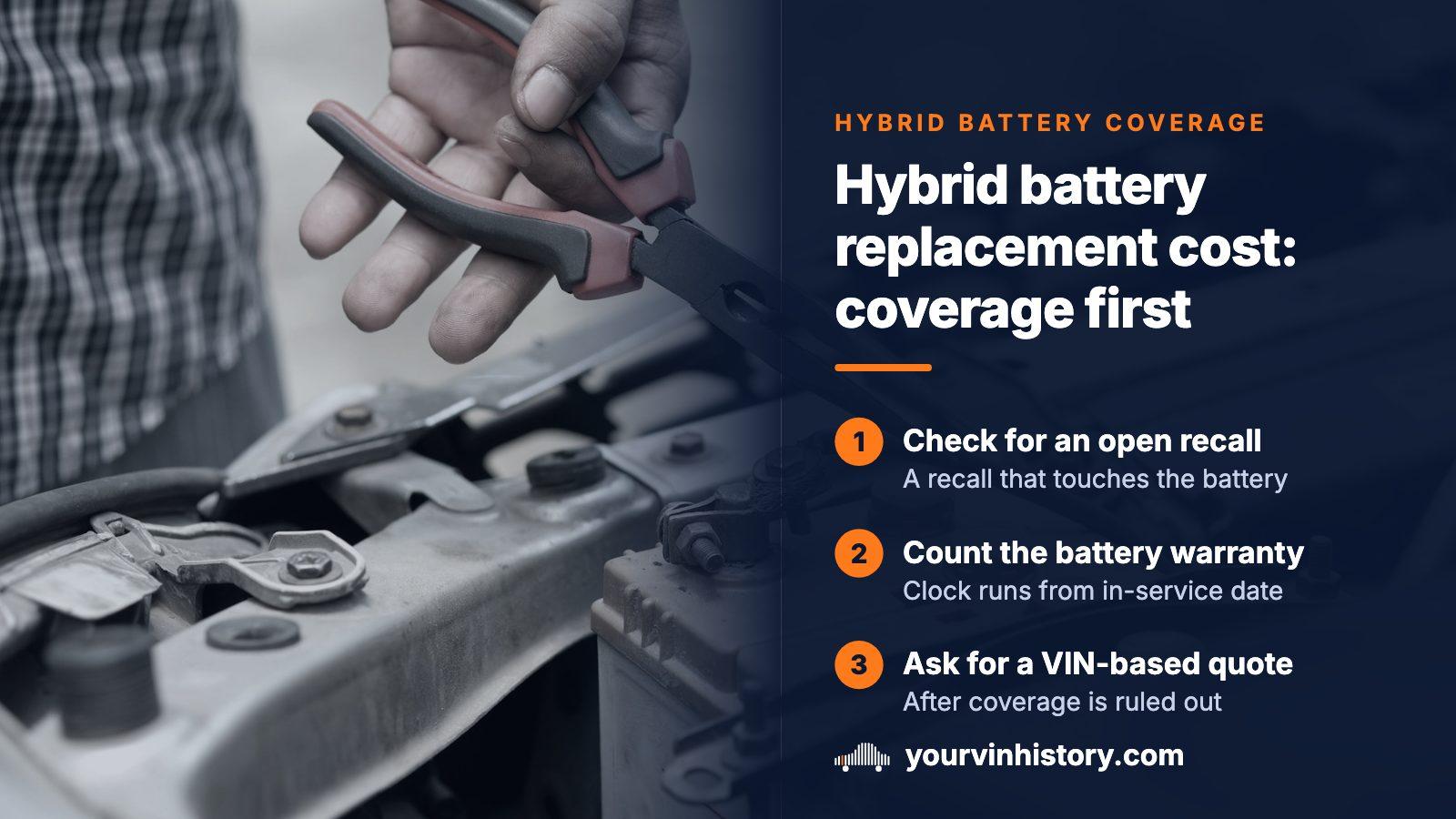
No single price holds up, because pack design, repair method, part source and local labor all move the total. Before collecting quotes, check three things that can shift the bill to someone else: an open recall, the manufacturer's battery warranty counted from the in-service date, and the federal emission warranty, which names electric and plug-in vehicles and is optional before model year 2027. Then ask for a VIN-based quote.
- Federal default
- 24 months or 24,000 miles for emission defects
- Longer term, listed parts
- 8 years or 80,000 miles
- Battery paragraph
- Optional before model year 2027
- Clock starts
- First delivery or in-service date
Why this guide stops short of a dollar figure
Search this topic and you get a pile of ranges, almost none traceable to a source you can check. They tend to be dealer quotes from unknown cities and dates, copied from page to page until they read like facts. A number you cannot trace is a guess, and a poor basis for negotiating.
The actual invoice is assembled from several moving parts:
- The pack itself: its size, and whether the design changed partway through a generation
- The repair method: one failed module or the whole assembly
- The part source: new, remanufactured, and whether a core charge is added
- Labor: hours needed to reach the pack on that model, times the local rate
With that much spread, find out who owes the bill first. Its size comes second.
Four parties who may owe the repair before you do
A used hybrid can arrive with the battery cost already assigned to someone else. Work down this list, quickest check first.
- An open safety recall on the high-voltage system. The repair costs the owner nothing, subject to an age limit covered below.
- The manufacturer's own battery coverage. The term is printed in the warranty booklet for that model year and is frequently longer than anything federal.
- The federal emission warranty, which reaches traction batteries only in narrow cases.
- State rules. Several states set their own battery terms for vehicles sold there.
If none applies, the repair lands on you, and that is the moment to collect quotes.
What the federal emission warranty promises for batteries
Under 40 CFR 85.2103, light-duty vehicles get an emission defect warranty of 24 months or 24,000 miles, unless the part sits on a short list that earns 8 years or 80,000 miles:
- Catalytic converters, SCR catalysts and related parts
- Particulate filters and traps
- Exhaust gas recirculation parts on compression-ignition engines
- The emission control module
- The traction battery of an electric or plug-in hybrid vehicle, treated as an energy storage system
The final entry also takes in the parts needed to charge the system, store the energy and send power to the wheels, so a covered repair can reach past the pack itself. Coverage ends at the first age or mileage limit reached.
Why the eight-year line often misses a used hybrid
Two qualifiers sit inside the battery entry, and online summaries drop both.
The first is timing. For light-duty cars and trucks, a manufacturer may skip the paragraph for any model year before 2027 when the vehicle weighs 6,000 pounds GVWR or less. For heavier vehicles the exemption lasts until their first Tier 4 certification, with model year 2031 as the outer limit. Some makers adopt the longer term voluntarily, but nobody is forced to.
The second is vehicle type. The wording names battery electric vehicles and plug-in hybrids, and a hybrid that never plugs in is neither.
| Vehicle type | Named in the battery paragraph? |
|---|---|
| Battery electric vehicle | Yes |
| Plug-in hybrid | Yes |
| Conventional hybrid, no charge port | No |
| Mild hybrid with a small assist pack | No |
A plug-in has a charge port beside the fuel filler, while a conventional hybrid has only the filler. Trim names in listings are the weakest clue, so look at the car.
The warranty clock starts at first delivery, not at your purchase
Federal warranty periods count the vehicle's age and its odometer reading, and coverage ends at the first limit reached. Counting begins the day the car went to its first retail buyer, or the day it entered service if it began as a demonstrator or company car. A sale resets nothing.
The definitions section counts the first buyer and every later buyer as an owner, so a second owner is not excluded. What that owner receives is whatever time remains. A demo car starts aging on its first day in service, well before any retail sale.
Pinning down the start date
A franchised dealer for the make can look up the date from the VIN, and the original warranty paperwork shows it too. Compare it with today's date and the odometer, then read the battery term for that model year.
Defect coverage and performance coverage are separate promises
The regulation sets up two emission warranties that people often merge. The defect warranty applies when a covered part is faulty, on the terms above. The performance warranty applies when a car does not pass an approved emissions test at any point in its useful life and the owner would face a penalty or lose the right to drive it.
In that second case the manufacturer must correct the problem at no cost to the owner, and if a listed major component caused it, the longer period of 8 years or 80,000 miles applies. Anyone in a testing state whose hybrid fails should read the failure against this provision before paying for diagnosis. A separate guide on smog check history explains the testing record.
How a carmaker can refuse a battery claim
Under 40 CFR 85.2104, a manufacturer may deny a claim when the owner ignored the written maintenance and use instructions. The rule fences that power in: evidence can be demanded only for instructions the maker has an objective reason to think were skipped, and only where skipping them could have pushed the vehicle past emission standards.
A thin service history is therefore not the legal test. The test is which instruction was missed and whether that omission could have caused this failure.
Battery vehicles get one extra provision. Written instructions may name behavior expected to shorten battery life unreasonably or artificially, and the regulation offers exceeding towing capacity as an example. A maker should not call something improper use if the car could have been designed to prevent it.
Three ways to prove the car was looked after
| Proof | What it shows |
|---|---|
| Validated log book | Service recorded at about the specified intervals and validated by someone who services cars for a living |
| Scheduled-service evidence | The car was submitted to a business that regularly does that work, at about those intervals |
| Owner's statement | You did the work yourself at about those intervals, bought and used proper parts, and can do it properly if asked |
Intervals are described as approximate throughout, so a service done slightly late is not an automatic forfeit. For a buyer, the seller's paperwork matters: a folder of dated receipts is the evidence the rule has in mind, and it belongs in the sale.
The no-charge route: a recall that touches the battery
Federal safety law requires a manufacturer to correct a recalled defect without charging the owner, so an open campaign on the high-voltage system usually means a repair is waiting. The duty has an age cutoff: it does not apply when the vehicle was first purchased more than 15 calendar years before the earlier of the recall notice or a federal order, so a very old car may be left out. Remedies vary, from a software limit on charge level up to a replacement pack.
Checking takes only the VIN. NHTSA's recall search is free, and a yourvinhistory report also lists open recalls beside odometer readings and ownership records.
An open campaign should not end your interest in the car by itself, because it is unfinished work attached to the vehicle. Ask the seller why it was never done, and read the guide on buying with an open recall before settling on a price.
Four questions that produce a real quote
- Give a franchised dealer's parts desk the VIN, not the model name, and ask for the pack part number and price. Packs can change within one generation.
- Ask whether a single module can be replaced on that model instead of the whole assembly. That answer usually moves the total most.
- Ask whether a remanufactured pack exists, what it costs, and whether a core charge applies.
- Ask the service department for the labor time on that exact model, then multiply by the local hourly rate.
Get the figures in writing and take them to a second shop that works on hybrids. The result is a number that belongs to the car in front of you.
Turning the answers into a purchase decision
Your findings will land in one of three places. If coverage is still running, most battery risk is transferred, so confirm the terms in writing. If coverage has ended and the quote is small next to the car's market value, negotiate it into the price. If coverage has ended and the quote is large, the car needs a lower price, or you need a different car.
The battery is just one entry in a longer ledger. A pre-purchase inspection covers the mechanical side, while a history report adds odometer readings, owner count and any title brand, each of which changes what the car is worth.
Get these in writing
The in-service date, the manufacturer's battery term for that model year, and the dealer's confirmation that no recall remains open on the VIN.
Where this information comes from
- eCFR: 40 CFR 85.2103, Emission warranty — Source for the default and longer warranty terms, the battery paragraph with its model year 2027 condition, and when the clock starts.
- eCFR: 40 CFR 85.2104, Owners' compliance with maintenance instructions — Covers the limits on denying a claim, the three kinds of maintenance evidence and the improper-use paragraph for battery vehicles.
- eCFR: 40 CFR 85.2102, Definitions — Supports the point that a later buyer counts as an owner, not only the first one.
- NHTSA: Recalls — The federal place to search a VIN for open safety recalls, including high-voltage battery campaigns.
Sources and photos: Facts checked against the sources above in October 2026. Photo by Towfiqu barbhuiya on Unsplash; diagrams by YourVINHistory.
Keep reading
- VIN warranty checkShows how to find out what factory coverage is still running on a specific vehicle.
- Buying a car with an open recallExplains what to do when the battery repair is already waiting as unfinished recall work.
- Pre-purchase inspectionThe cheaper check that comes before any battery quote.
- Used electric car checkCovers the plug-in and fully electric side of buying a used car with a traction battery.
Frequently asked questions
How much does it cost to replace a hybrid battery?
No honest single number exists, so this guide declines to print one. The total depends on the pack for your model year, whether a module repair is possible, whether a remanufactured unit exists, any core charge and local labor. Send the VIN to a dealer parts desk, get the part price and labor time in writing, then compare a second quote from a hybrid specialist.
Is there a federal warranty on hybrid batteries?
Only in a narrow sense. The federal emission rule gives eight years or 80,000 miles to batteries in electric and plug-in hybrid vehicles, but the paragraph is optional before model year 2027 and does not name conventional hybrids. A charge port is the quick tell for a plug-in. For everything else, the manufacturer's booklet and any state rule decide what you get.
Does a hybrid battery warranty transfer to a second owner?
Under the federal rule a later buyer counts as an owner, so a second owner is not shut out. What that buyer inherits is the remaining time, since the clock started at first delivery or, for demonstrators, at in-service. Manufacturer coverage can carry its own transfer terms, so confirm them in the booklet or with a dealer before you buy.
Can a dealer refuse a battery claim because I skipped services?
Only in limited circumstances. The manufacturer needs an objective reason to believe the specific service was skipped and that skipping it could have caused the failure. If challenged, you can answer with a validated log, proof the car went in for scheduled work, or your own statement backed by receipts for proper parts. Dated receipts are stronger than recollection.
Is it worth replacing a hybrid battery on an older car?
That depends on the quote compared with what the car is worth, and on the condition of everything else. Get the all-in figure first, including labor and any core charge, then weigh it against a recent market value for the same trim and mileage. If it would eat a large share of that value, ask about a module repair or a remanufactured pack.
Now check the car itself
The guide explains what to look for. The report shows what this VIN has on record.