THE SHORT ANSWER
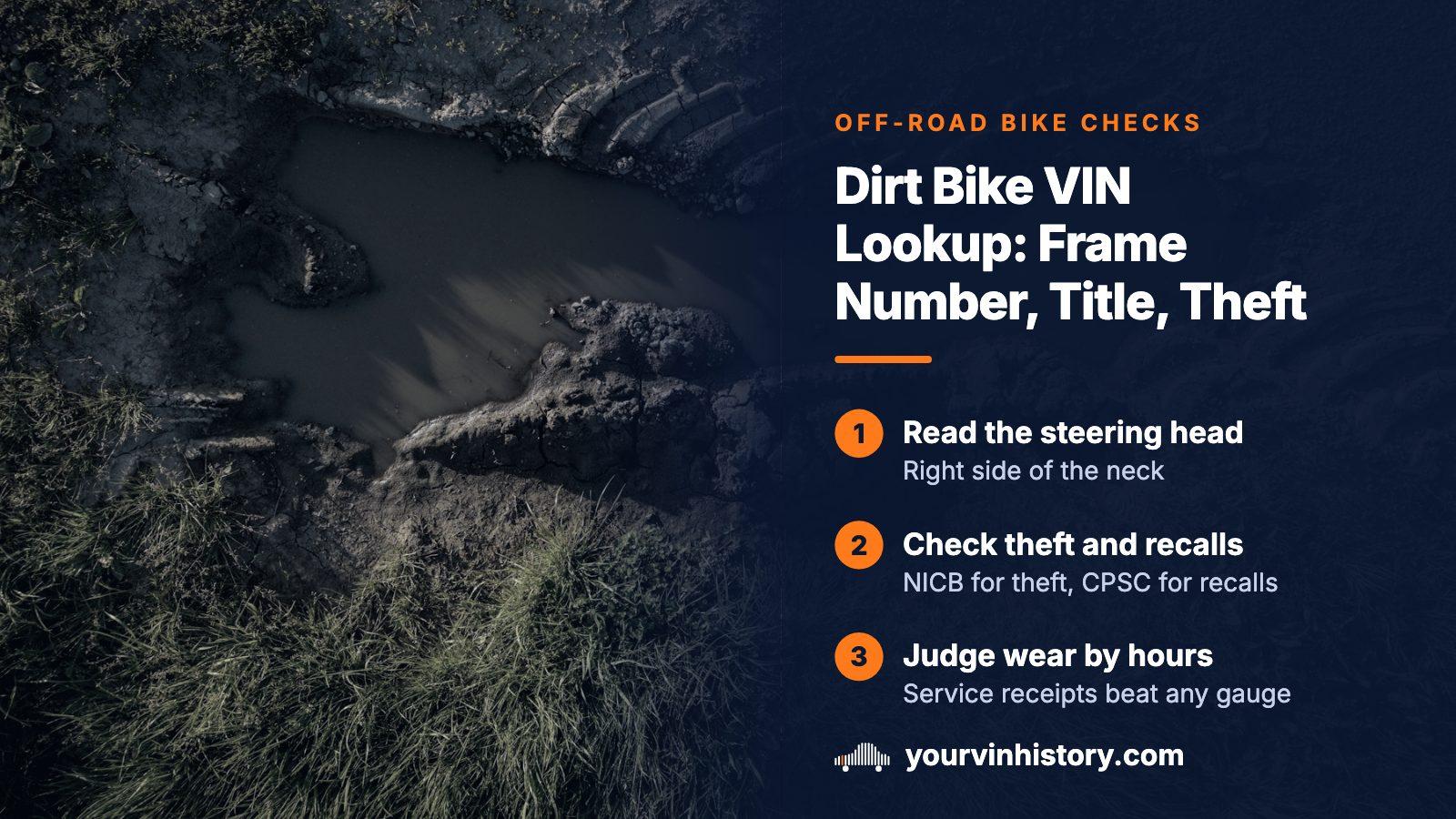
Read the stamping on the steering head, usually on the right side of the neck below the handlebars. Street-legal dual-sports carry a 17-character VIN, while closed-course competition bikes often have a shorter frame number and may have no title at all. Check theft with NICB, check recalls with the CPSC (NHTSA for dual-sports), and judge wear by hours and service receipts, since there is no odometer to trust.
- Where to look
- Right side of the steering head
- No title
- Normal on many competition bikes
- Recalls
- CPSC off-road, NHTSA for dual-sports
- Wear
- Hours and rebuilds, not miles
Sort the bike into a category before anything else
The phrase dirt bike covers three kinds of machine, and each comes with its own numbering, its own paperwork and its own recall agency. Sellers rarely volunteer which one they are offering, so work it out from the lights, the mirrors and the stamping.
| Category | Identifier you will usually see | Paper to expect |
|---|---|---|
| Competition (closed course) | Often a short frame number instead of a full VIN | Frequently no title, because many states do not title this class |
| Trail or recreational off-road | Usually a 17-character number | Depends on the state |
| Dual-sport | Standard 17-character VIN | Title and registration like any other motorcycle |
Do not assume a motocross bike can be plated later. Some states let a closed-course machine become road-legal and others effectively do not, and fitting a headlight is the smallest part of the job. Ask your state's motor vehicle agency before you pay.
Where the identifying number lives on the frame
- Steering head: the tube the fork legs pass through, just under the handlebars. Swing the bars to one side and read the right face of the neck. Most makers stamp the number here.
- Downtube: a few makers stamp lower on the frame, closer to the engine mounts.
- Frame label: a sticker or plate that repeats the number and sometimes shows the model year. Years of pressure washing strip these off.
- Engine cases: a separate serial that belongs to the motor and does not identify the bike.
Mud and roost bury stampings, and a bike hosed down every weekend can look as if it never had a number. A rag, a wire brush and a flashlight held at a low angle bring most of them back. Photograph the stamping with the light raking across the metal, then compare it on a screen instead of copying it by hand.
The frame number and the engine serial are separate records
The frame is the bike. A title, a registration or a theft report attaches to the frame stamping, while the motor wears its own serial and can end up in a different chassis. On a raced or rebuilt dirt bike an engine swap is routine, so a mismatch alone does not make the seller a crook.
What counts is whether the seller can explain it and whether the frame number agrees with whatever documents exist. Write the two numbers down in separate lines so they never get mixed up in a text message or a form.
- Ask whether the motor is the one the bike left the factory with.
- Request receipts for any replacement or swap.
- Match the frame number to the paperwork one character at a time.
- Look for grinding, filing or fresh paint around the stamping.
- Walk away from a frame whose number has been altered, whatever story comes with it.
A missing title is not always a warning sign
Car buyers learn to treat a missing title as a stop sign. On a competition bike that habit misfires, because many states never issued titles for closed-course machines, so no document is actually missing. The worrying cases are narrower: your state does title this class and the seller has nothing, or the bike is a dual-sport, which should always have one.
- Pin down the category: competition, recreational off-road or dual-sport.
- Read the rules of the state where you will register the bike, not the seller's state.
- Insist on a written bill of sale showing the frame number, the date, both names and addresses, and the price.
- Ask for the original dealer invoice, which ties you back to the first sale.
- Run a theft check before paying, since no title exists to verify the seller against.
A dual-sport with no paper needs an answer
A street-legal bike offered without a title should come with a full explanation before any money moves. Read up on what branded titles mean first, because a missing document sometimes covers for one.
Off-highway permits are a separate system from road plates
Many states run an off-highway vehicle program apart from road registration, usually a decal that lets you ride on public land and marked trails. Emissions often drive the rules: machines that meet a certain standard may ride freely, while others are held to particular seasons or areas.
- Find out whether your state requires an OHV decal where you plan to ride.
- Ask whether the seller's current registration passes to a new owner.
- Read the land manager's rules for the trails you actually plan to ride.
- Price in any restriction, since a limited-use bike is worth less to someone who wants open access.
Recalls live at the CPSC for off-road bikes, NHTSA for dual-sports
The Consumer Product Safety Commission treats off-highway machines as consumer products, while NHTSA oversees motor vehicles, and a trail or competition bike lands on the CPSC side. The CPSC recall search has a category for two-wheeled powered off-road vehicles, which is where to look for a trail or competition bike. Street-legal dual-sports fall under NHTSA, and its recall lookup works from the VIN the same way it does for a car.
A blank NHTSA result proves nothing here
NHTSA does not hold records for competition or trail bikes, so a search there comes back blank even when a recall is on file elsewhere. Search the CPSC list by make and model, and ask a dealer to run the frame number for open campaigns.
Theft is the risk a thin paper trail will not catch
Dirt bikes rank among the more frequently stolen powersports items. Two people can lift one, it holds its value, it sleeps in a shed or garage, and it is often unregistered, which makes it hard to trace and easy to resell. Without a title in the picture, a buyer has less to lean on than with a car.
- Search NICB's VINCheck before you hand over cash. It draws on records from participating insurers and is built around VINs, so a short competition frame number may not return anything useful.
- Study the steel beside the stamping for signs of grinding, filing or touch-up paint.
- Match the seller's name to any paperwork that exists.
- Be cautious if the seller wants to meet anywhere other than their home.
- Treat a price far under market, paired with a vague story, as a warning.
- After you buy, photograph the stamping and store the picture away from the bike.
Hours matter more than miles, and nobody records either
A dirt bike has no road mileage worth comparing. An hour on a motocross track works an engine harder than a long day on pavement, so an hour meter, where one is fitted, is the best wear number on offer. It is also easy to doubt: many are aftermarket, they get reset, and they migrate from one bike to another.
- Find out if the meter is original equipment and whether anyone has zeroed it.
- Learn how the bike was used, since trail riding and track racing load an engine very differently.
- Find out whether it was raced, and at what level.
- Compare the reading with the wear on the chain, sprockets, grips and seat. Low hours with chewed-up contact points mean the meter is not telling the truth.
Rebuild receipts outrank any gauge
On a competition four-stroke, engine work is scheduled maintenance rather than repair. A bike with a timely top end is a cared-for bike, not a damaged one. If a seller swears a high-hour race machine has never had the motor apart, the maintenance was skipped.
| Service item | What to ask the seller |
|---|---|
| Top end (piston, rings) | When was it last done? Race bikes need it more often than trail bikes. |
| Bottom end (crank, bearings) | The interval is longer and the job is bigger. When was it last inspected, and when was it last done? |
| Valve service | Were clearances checked on the four-stroke? Skipping it causes costly damage. |
| Suspension (forks, shock) | When were they last rebuilt? This is often put off. |
Ask for receipts rather than reassurance. A documented service file says more about how the bike lived than any meter reading.
Why the records stay quiet, and what only you can inspect
On a car, a history report draws on claims, title brands, odometer readings and transfers. Most of that machinery never touches a dirt bike. Crashes seldom produce an insurance claim, many bikes have no title to brand, odometer disclosure does not apply, and engine swaps, frame welds and racing use appear nowhere unless the owner kept proof.
- Frame and swingarm: hunt for cracks and repairs near the headstock, at the footpeg mounts and where the shock bolts on.
- Welds: anything that is not a factory finish needs an explanation.
- Stampings: confirm the number is original and untouched.
- Service file: read it before you read the price.
For a dual-sport with a standard 17-character VIN, a yourvinhistory report adds title brands, accident and salvage records and open recalls, which is worth seeing before you buy. For a competition bike, the inspection and the folder of receipts are the history, and a seller with a complete file deserves a better offer than one without.
Where this information comes from
- CPSC: Recalls — Searchable recall list for consumer products, with a category heading for two-wheeled powered off-road vehicles.
- NICB: VINCheck — Theft lookup built from records that participating insurers submit.
- NHTSA: Recalls — Recall lookup that applies to street-legal dual-sports carrying a standard VIN.
Sources and photos: Facts checked against the sources above in October 2026. Photo by Bernd 📷 Dittrich on Unsplash; diagrams by YourVINHistory.
Keep reading
- Motorcycle VIN lookupThe street-bike side of the same question, including how a full VIN decodes.
- ATV VIN lookupFour-wheelers share the CPSC recall route and the thin VIN data.
- Report a stolen carThe same first steps apply if a bike goes missing.
- Bill of sale for a carYour ownership evidence when a bike comes with no title.
Frequently asked questions
Do dirt bikes have a VIN?
Street-legal dual-sports carry a standard 17-character VIN, and trail bikes usually do too. Pure competition models often have a shorter frame number, since nobody planned to title or plate them. A decoder only reads a standard number, so a short one has to be confirmed through a dealer for that make.
Where is the VIN on a dirt bike?
Check the right side of the steering head, the tube behind the front forks. If it looks blank, clean it, then try the downtube near the engine mounts and the frame label. The engine cases carry a different serial that belongs to the motor, so do not read that number to a theft database as the bike's identity.
Can I buy a dirt bike without a title?
Often yes, when it is a competition model in a state that does not title that class. Get a detailed bill of sale and, if it still exists, the dealer invoice, and confirm how your state registers the bike before you pay. A dual-sport with no title is different and needs a clear explanation.
How do I check a dirt bike for recalls?
For competition and trail bikes, use the CPSC recall search and look under the category for two-wheeled powered off-road vehicles. For a dual-sport, NHTSA's lookup works by VIN. A blank result at the wrong agency means nothing, so use the right one and ask a dealer to confirm with the frame number.
How many hours is too many on a used dirt bike?
No single figure fits every bike. The meter reading is one clue, weighed against how the bike was used, the level it was raced at and the wear on the chain, sprockets, grips and seat. A high-hour bike with documented top-end and bottom-end service can beat a low-hour one with no records.
Now check the car itself
The guide explains what to look for. The report shows what this VIN has on record.