THE SHORT ANSWER
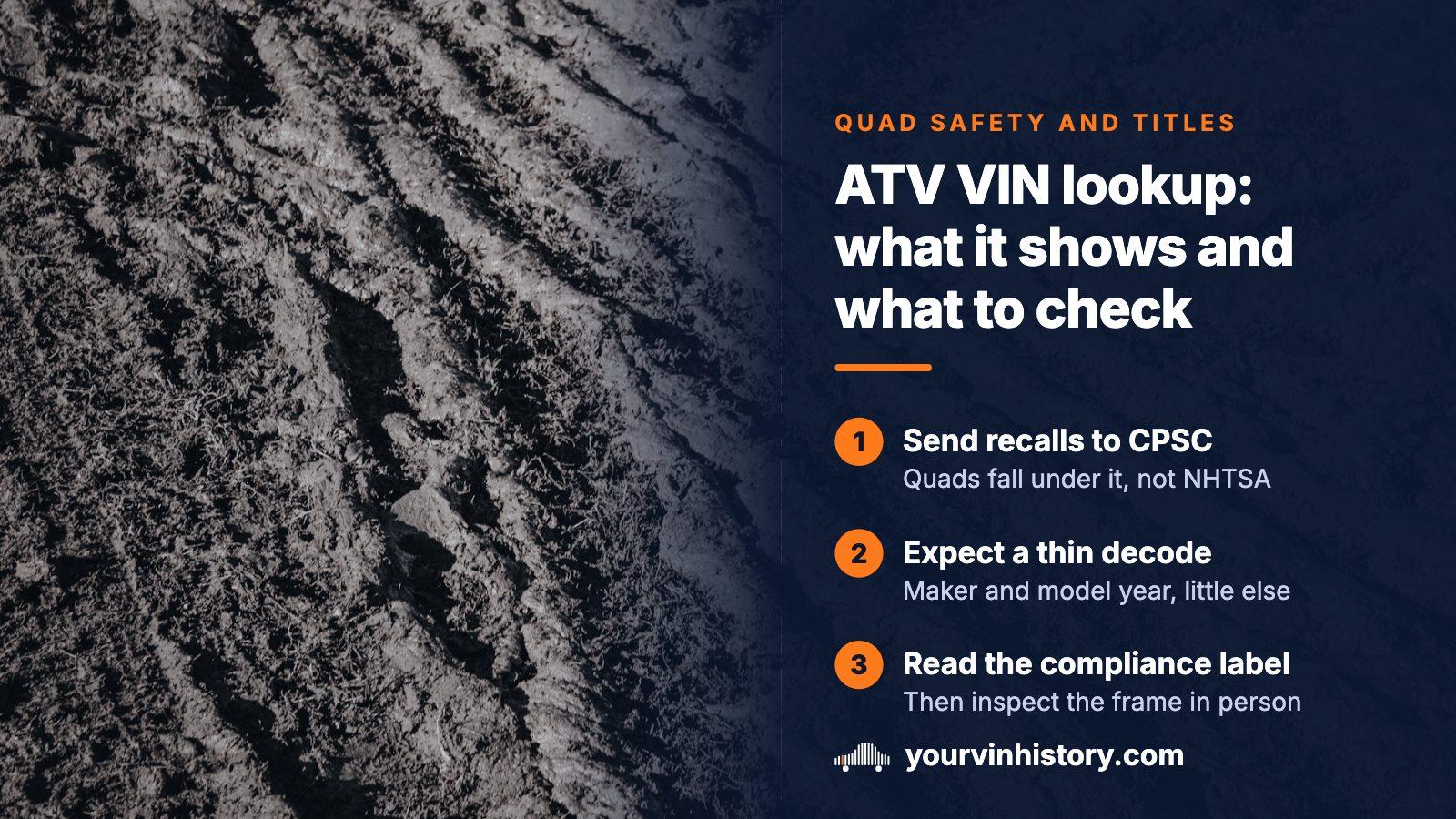
A VIN decode on an ATV normally returns the manufacturer and model year, with most specification fields blank. Quads are overseen by the Consumer Product Safety Commission, not NHTSA, so recall searches go to CPSC. To vet a used machine, read the compliance label, run the NICB theft screen, search CPSC recalls, learn your state's title rule, and inspect the frame in person.
- Regulator
- CPSC, not NHTSA
- Federal definition
- 3 or 4 wheels, straddle seat, handlebars
- Standard switch
- ANSI/SVIA 1-2023 for machines built on or after January 1, 2025
- Typical decode
- Maker and model year, little else
Why a quad is not handled like a car
Federal law sorts road and off-road machines by agency. Cars, trucks and street motorcycles answer to NHTSA, whose VIN rules shape every field a car's decode can fill. An all-terrain vehicle is a consumer product overseen by the Consumer Product Safety Commission, so the road-vehicle numbering scheme was never built around it.
Four things follow from that one classification. The decoder returns less. Recall searches go to a different agency. Construction standards come from an industry document that federal rule makes mandatory. And the paperwork depends on the state far more than it does for a car.
The number itself is also less uniform. Many newer quads carry a 17-character VIN because dealers, insurers and state agencies expect one, yet older and imported machines vary. A shorter frame number alone does not make a quad suspect; one that disagrees with the paperwork does.
What the federal definition covers
The definition sits in 16 CFR 1420.2: a motorized, off-highway vehicle built to travel on three or four wheels, with a seat meant to be straddled and handlebars for steering. Every part of that wording shuts out a machine that gets confused with quads.
| Machine | Counts as an ATV? |
|---|---|
| Four-wheeler with handlebars | Yes, the core case |
| Three-wheeler | Yes by wheel count, though new ones cannot be sold here |
| Dirt bike | No: only two wheels |
| UTV or side-by-side | No: a steering wheel, and a seat that is not straddled |
This matters whenever you read something labeled ATV, whether a safety statistic, a state statute or a recall notice. A rule written for ATVs may not reach the side-by-side parked beside the quad.
What a decode actually returns for a quad
Run a quad's VIN through the NHTSA decoder and the usual result is a manufacturer and a model year, then blank fields where a car would show engine type, body class and restraint systems. The decoder says what it displays is reported by the manufacturer, so a field is only as full as what the maker submitted.
The manufacturer identifier, the first three characters, shows how awkwardly quads fit the catalog. Four examples from the decoder:
| Identifier | Manufacturer on file | Vehicle type reported |
|---|---|---|
| 4XA | Polaris Industries | Motorcycle |
| 3NS | Polaris Industries | Motorcycle |
| 5AS | Polaris Industries | Low Speed Vehicle |
| 4UF | Arctic Cat | Off-Road Vehicle |
None of these labels is a data-entry mistake. Each matches a category that existed when the identifier was registered, and a quad fits none of them cleanly. Use the decode for the narrow job it does well: checking that the maker and model year match the advertisement.
The compliance label and the standard it certifies
Road vehicles meet the Federal Motor Vehicle Safety Standards. A new four-wheel ATV instead has to meet a voluntary industry standard that 16 CFR 1420.3 makes mandatory, with the edition set by its build date.
| Edition | Approved | Applies to machines built |
|---|---|---|
| ANSI/SVIA 1-2017 | June 8, 2017 | Before January 1, 2025 |
| ANSI/SVIA 1-2023 | March 17, 2023 | On or after January 1, 2025 |
The dividing line is the build date, not the model year. A quad made near the changeover can carry a model year that hints at one edition while its build date points to the other; the label settles it. The rule also requires a label that certifies compliance and states who made, imported or private-labeled the machine and which action plan covers it.
The owner's manual carve-out
One exception: Section 4.21, covering the owner's manual, stays on the 2017 edition even for newer builds. Both standards are incorporated by reference, so the rule says which edition applies while the Specialty Vehicle Institute of America supplies the document itself.
Action plans and the age label on youth models
Part 1420 also ties each ATV to an action plan: a written plan or letter of commitment in which the maker or distributor says how it will promote safety. The maker must follow it. Plans can cover:
- Rider training offered to purchasers
- Safety information handed out with sales
- Age recommendations for the machines
- Policies on marketing and selling the ATVs
- Monitoring of those sales
The age recommendation on a youth quad comes out of that commitment, not out of a dealer's house rule. A new buyer meets the arrangement at the showroom. A private buyer meets none of it: nobody runs training, hands over safety material or monitors who rides.
CPSC's safety guidance says riders under 16 should use only youth-model ATVs. On a used youth machine, read the age recommendation off its own label, and ask for the owner's manual. Ask also whether the speed limiter is fitted and untouched; removing one can leave no trace, so the quad may be faster than its label implies.
Three-wheelers and the rule that ended new sales
The federal definition includes three-wheel machines, yet they are scarce, and 16 CFR 1420.4 explains why. New three-wheelers cannot lawfully be brought into the country or sold through commerce here until a mandatory safety standard for them takes effect. That is not a ban with an end date, since it lifts only if such a standard is written, and new three-wheelers have not been sold here for decades.
The prohibition targets new machines moving through commerce. Owning one is not unlawful, and a private sale of an old machine is not stopped. For a buyer the point is age: a three-wheeler is necessarily old, so parts, tires and surviving paperwork are questions before condition. It also never sat inside the four-wheel framework of dated standard, compliance label and action plan.
Where the numbers live on a quad
A quad spreads its identity across several places, and the engine carries a number of its own.
| Item | What it establishes | Where to look |
|---|---|---|
| Frame VIN | The machine's identity | Stamped into the frame, often near the steering head or at the left rear |
| Compliance label | Standard met and build date | A durable label on the machine, placed differently by each maker |
| Engine serial | The engine's own history | Cast or stamped into the engine case |
| Model and specification decal | Model and configuration | Usually beneath the seat or in a fender recess |
Take clear photos of the frame number and the label before price comes up; neither can be disputed later. Note the engine serial separately. Engine swaps are common on used quads and are no defect in themselves, but a seller who volunteers one stands differently from a seller whose engine number fails to match the paperwork.
A stamping that looks wrong
Corrosion is normal on a frame kept outdoors. Grinding, filing, uneven spacing between characters or a plate that seems newer than the frame around it are not. Quads are stolen often, and a tampered number is reason enough to walk away.
Recalls and theft screens that suit a quad
Recalls for ATVs come from the Consumer Product Safety Commission. Its recall search can be filtered by category, and the category list includes All Terrain Vehicles (ATV), so a search by maker gets you to the right notices.
The same quad run through NHTSA's recall lookup will usually come back empty. That blank is not a clean bill of health. The agency simply has no jurisdiction over the machine.
For theft, the National Insurance Crime Bureau runs a no-cost VINCheck that accepts powersports numbers. It returns theft and total-loss records reported by participating insurers, so a clean result is useful rather than conclusive. Quads attract thieves: they sit in sheds and yards, load easily into a pickup, and many were never titled.
Titles depend on the state
State practice falls into three groups: quads titled like cars, quads registered but never titled, and quads with no state record at all, where a bill of sale carries ownership. That spread is wider than anything in the road-car world.
As a result, "no title" is an ordinary thing to hear about a used ATV in one state and a serious problem in the next. Only your own state's rule says which. Settle it before agreeing on a price, since an unregisterable quad is worth less to you than the same model you can register. Questions for your state's motor vehicle agency:
- Does the state title ATVs, register them only, or do neither?
- If there is no title, what document proves ownership?
- What must a bill of sale contain to be accepted?
A buying order that stops problems early
Each step can end the deal before you spend time on the next.
- Photograph the frame number and the label before price comes up.
- Decode the VIN and compare the maker and model year with the advertisement.
- Run the NICB VINCheck screen on the number.
- Search CPSC recalls by maker and model, not NHTSA.
- Ask your state agency what title or registration a quad needs.
- Inspect the machine, or pay a mechanic who knows quads: cracks near the frame welds, bent axle shafts, water or milky oil in the engine, torn CV boots.
No lookup sees any of the damage in that last step. If the sale also includes a pickup to haul the quad, that vehicle is a different case: a vehicle history report by VIN, showing title brands, accidents and odometer readings, is built around road vehicles.
Where this information comes from
- eCFR: 16 CFR Part 1420, Safety standard for all-terrain vehicles — Source for the ATV definition, the two dated ANSI/SVIA editions, the label and action plan duties, and the limit on new three-wheelers.
- CPSC: Recalls — The recall search for quads, with an ATV category filter and email alerts.
- NHTSA: vPIC VIN decoder — The federal decoder, whose results are reported by manufacturers, and the source of the identifier lookups in the table.
- NICB: VINCheck — No-cost theft and total-loss screen that accepts powersports numbers.
Sources and photos: Facts checked against the sources above in October 2026. Photo by Sean Foster on Unsplash; diagrams by YourVINHistory.
Keep reading
Frequently asked questions
Does every ATV have a 17-character VIN?
No. Many newer machines do, because dealers, insurers and state agencies expect that format, but older and imported quads vary. A shorter number is not a red flag by itself. Copy it exactly as stamped, compare it with every document the seller has, and treat a mismatch, not the length, as the warning.
Why does my ATV decode say motorcycle or low speed vehicle?
The decoder files each manufacturer identifier under the category in force when the maker registered it, and a quad fits none of them well. One maker can appear as a motorcycle producer under one identifier and a low speed vehicle producer under another. The type shown says little about your machine, so rely on maker and year only.
Where do I check ATV recalls?
Use the Consumer Product Safety Commission's recall search and filter to the All Terrain Vehicles category, then look for your maker. CPSC also sends email alerts for new recalls. An NHTSA search usually finds nothing for a quad because that agency does not regulate it, so an empty NHTSA result says nothing about whether recalls exist.
Is a side-by-side covered by ATV rules?
Generally no. The federal definition requires a straddle seat and handlebars, and a side-by-side has a steering wheel and a bench or bucket seat. A standard, age recommendation or recall written for ATVs may not reach it. CPSC's recall filter lists recreational off-road vehicles and utility vehicles as separate categories.
What if the compliance label is missing or the frame number is unreadable?
Rust alone is normal, so photograph what is there and compare it with the paperwork. A missing label removes the easiest proof of build date and standard, so lean on the frame stamping and any decal under the seat, and weigh the gap in the price. A number you cannot reconcile with the documents is a reason to walk.
Now check the car itself
The guide explains what to look for. The report shows what this VIN has on record.