THE SHORT ANSWER
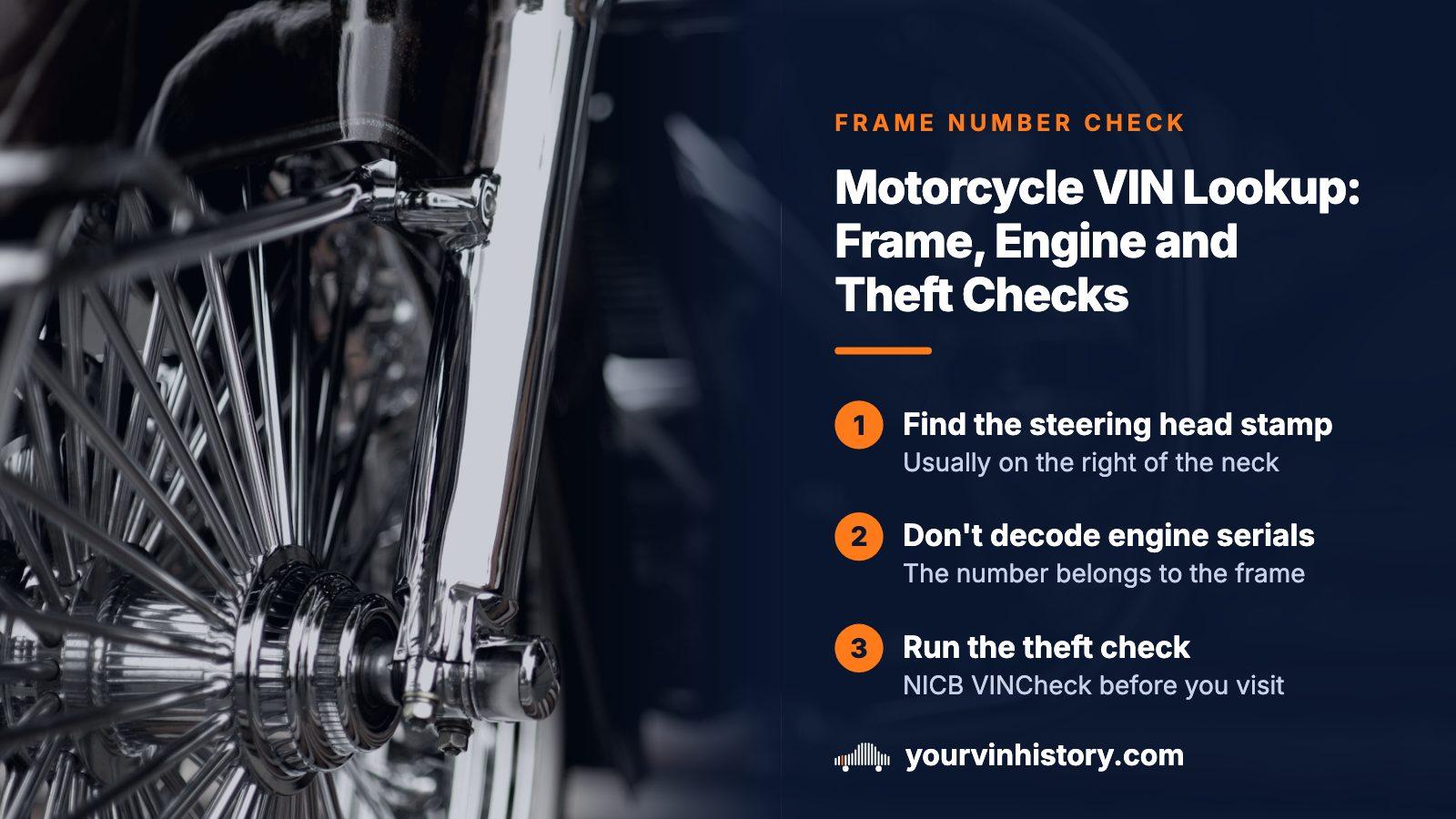
Look for the frame stamping at the steering head, normally on the right side of the neck: 17 characters, never I, O or Q. Enter it into NHTSA's decoder and recall lookup for the maker, model year, engine, body class, plant and any open recall. The number belongs to the frame, so an engine serial will not decode. Run NICB's VINCheck for theft before you visit the bike.
- Whose number
- Identifies the frame, not the engine
- Last four characters
- Always digits on a motorcycle
- Power figure
- Federal rule requires encoded horsepower
- Sample prefix
- JYA is Yamaha motorcycles
Four quick tests to tell a VIN from an engine serial
Sellers read out all sorts of numbers: a frame stamping, an engine serial, a code from a parts book. Four tests sort them in a minute.
| Test | What the result tells you |
|---|---|
| Count the characters | A VIN on a bike built since 1981 has 17. Fewer points to an engine or part number, or to an older machine. |
| Scan for I, O and Q | None of the three is ever used in a VIN, so a number carrying one is not a VIN. |
| Read the last four | On a motorcycle they are digits. A letter there rules the number out. |
| Match it to the title | The frame VIN is printed on the title. An engine serial is not. |
Do the title test first. Paper and frame have to agree exactly. Whether the engine is original is a different matter.
Where a bike keeps its number
- Steering head: the tube the forks pass through, just under the handlebars. With the bars on full lock, read the right side of the neck; that is where most bikes carry the stamping.
- Frame downtube: some makers stamp lower, along the tubes near the engine mounts. Check there if the neck shows nothing.
- Certification label: a printed label, usually on the frame by the steering head or beneath the seat. It is easier to read than a stamping and gives the build date.
- Under the seat or tank: a few makers hide the label there. You will want the seat up anyway, to see the battery.
Frame stampings collect road grime, and the neck sits right behind the front wheel. Wipe it, shine a light across it, and photograph it instead of copying it by hand.
Frame number, engine number, and why they look nothing alike
A car's engine and body stay together for life. A bike's engine is routinely pulled, rebuilt, moved to another frame or sold on its own. That is why the two serials are kept apart.
The VIN exists because federal rule demands it: 17 characters, no I, O or Q, a check digit, and a required list of facts. The engine serial is the maker's own part number. No federal rule sets its length, format or position, so it varies by make and is usually shorter.
Some makers match the two
A few makers copy part of the VIN, or a linked sequence, onto the crankcases. Where a make does this, a mismatch shows the engine did not leave the factory in that frame. Worth knowing before you pay, whatever you decide.
- Ask if the engine is original to the frame.
- Ask to see receipts for any engine or frame replacement.
- Check that the displacement fitted matches the decode, because the insurer and the registry may rely on it.
What the federal rule makes a bike's VIN carry
49 CFR 565.15 lists what positions four to eight must make decipherable, vehicle type by vehicle type. Set the car row beside the motorcycle row.
| Vehicle type | Positions 4 to 8 must make decipherable |
|---|---|
| Passenger car | Line, series, body type, engine type, and every restraint device with its location |
| Motorcycle | Net brake horsepower, engine type, line, kind of motorcycle and make |
A bike's row has no restraint devices and no body type, so those drop out. In their place come the style of bike (street, off-road or dual-purpose) plus a power figure. No other vehicle type in the table has to encode horsepower.
The rule gives that figure some slack. The encoded value may differ from true net brake horsepower by up to 10 percent, and a bike making 2 hp or less must encode no more than 2, while a stronger one must encode more than 2. A small gap against the spec sheet is therefore expected.
Prefixes you will meet on motorcycles
The first character is the country: 1 or 5 for the United States, J for Japan, W for Germany, Z for Italy. The first three name the maker. Each of these returns the vehicle type Motorcycle in NHTSA's database.
| Maker | Prefix | NHTSA vehicle type |
|---|---|---|
| Harley-Davidson | 1HD | Motorcycle |
| Honda motorcycles | JH2 | Motorcycle |
| Yamaha | JYA | Motorcycle |
| Suzuki | JS1 | Motorcycle |
| Kawasaki | JKA | Motorcycle |
| Ducati | ZDM | Motorcycle |
| BMW Motorrad | WB1 | Motorcycle |
Big makers hold several prefixes. NHTSA files 5HD under Harley-Davidson as well as 1HD, so an unfamiliar code is a reason to look it up, not to doubt the bike.
A Yamaha sample, decoded
Take JYARJ16E6FA000001, a string assembled for illustration, not read off a real frame. NHTSA's decoder returns a Yamaha YZF-R6, sport body class, model year 2015, with a four-cylinder liquid-cooled gasoline engine, built at Iwata, Japan. Error code 0 means a clean decode with a correct check digit.
| Position | Characters | Reading |
|---|---|---|
| 1-3 | JYA | Japan, Yamaha motorcycles |
| 4-8 | RJ16E | Yamaha's own code for model, engine and kind of bike |
| 9 | 6 | Check digit |
| 10 | F | Model year 2015 |
| 11 | A | Plant: Iwata, Japan |
| 12-17 | 000001 | Serial; the last four are digits, as the rule requires |
Change the ninth character from 6 to 7 and the same string returns error code 1, a check digit failure. Position seven here is a digit. On a car that would push the F back to the older run of years, but the car-only rule does not reach bikes, and NHTSA still reads 2015. It also warned that the year might be wrong, so confirm it against the certification label.
Year letters, low miles and bikes older than 1981
The tenth character gives the model year on a thirty-year cycle that skips I, O, Q, U and Z. Recent codes: P is 2023, R 2024, S 2025 and T 2026. The digits 1 to 9 cover 2001 to 2009.
Bikes often sit unsold or barely ridden for years, so low mileage on an older model year is common. It raises different questions than it would on a car: stale fuel deposits, perished rubber, a tired battery.
The 17-character standard became mandatory with the 1981 model year. Earlier bikes use shorter maker formats, often a model prefix and a serial, with no check digit and no standard year character. NHTSA's database leaves them out, so go to maker-specific references, factory parts catalogs and owner clubs.
Run the theft check before the road trip
Bikes are light, easy to move and quick to strip for parts, and private cash sales with no dealer involved are normal. Nobody runs the checks for you.
- Search NICB's VINCheck from home, before you travel to see the bike.
- Compare the frame stamping with the title, character by character.
- Check the seller's name against the title.
- Be suspicious of any bike offered without a title, whatever story comes with it.
- Look for grinding, filing or re-stamping around the steering head.
- Treat a price far below market as a warning, not a bargain.
Recalls attach to VIN ranges
Motorcycles fall under the same recall system as cars. Once a maker decides a safety defect exists, it must fix it at no charge to the owner, and a private sale does not cancel that duty. The exception is a very old bike, which the federal free-repair rule no longer covers.
Campaigns cover ranges of VINs, so a search by model name can show recalls that do not apply to your bike. Enter the VIN itself into NHTSA's lookup. An unrepaired open recall means booking a dealer visit, not panic, and it is a fair point to raise on price.
Salvage, rebuilt and bent frames
Bikes are easy to total. There is no crumple zone, and fairings alone can cost more than an older machine is worth. Tip-overs that would hardly scuff a car can generate a repair quote higher than the bike is worth, so salvage brands are fairly common and the damage behind them is often modest.
A bent frame is not cosmetic
The frame is the structure, the suspension mount and the steering geometry in one piece. On any bike with a salvage or rebuilt brand, pay someone who can check alignment to look at it, not just the paint.
What the number cannot tell you
- Crashes, even drops that never reached an insurer
- Title brands: salvage, rebuilt, flood
- Real mileage, or whether the odometer was replaced
- Owner count
- Service records, such as valve checks and chain or belt wear
- Modifications, and whether they were fitted competently
Maintenance and modification quality decide much of what a used bike is worth, and neither is encoded anywhere. A yourvinhistory report adds the paper trail the decode lacks, such as title brands, accidents with a damage map and odometer readings, with a free preview before you buy.
Where this information comes from
- NHTSA: vPIC VIN decoder — Decodes motorcycles alongside cars; the maker prefixes and the Yamaha sample were checked here.
- eCFR: 49 CFR Part 565, Vehicle Identification Number requirements — Source for the motorcycle row, the horsepower tolerance and the rule that the last four characters be digits.
- NHTSA: Recalls — Free search of open recalls by VIN; the repair costs the owner nothing.
- NICB: VINCheck — Theft and salvage lookup built from participating insurers' records.
Sources and photos: Facts checked against the sources above in October 2026. Photo by Steve Smith on Unsplash; diagrams by YourVINHistory.
Keep reading
- Harley-DavidsonThe 1HD prefix in detail, and why the engine stamping must agree with the frame.
- Where is the VIN number?Every place to look for the number on bikes, cars and trailers.
- NICB VINCheck explainedWhat the free theft search covers and where it goes blind.
- Motorcycle value by VINWhy low mileage on a bike can be a red flag rather than a bonus.
Frequently asked questions
Why won't my motorcycle VIN decode?
Count the characters first: fewer than 17 usually means an engine or part number, or a bike older than 1981. Then look for I, O or Q, which cannot appear. A wrong ninth character returns an error instead of a model. NHTSA's database also covers vehicles meant for sale or importation into the US, so some foreign-market bikes return little.
Can I trust a clean decode on a motorcycle VIN?
A clean decode means the characters fit the maker's filed pattern and the check digit works. It does not prove a frame exists with that number. The Yamaha sample here decodes cleanly yet was assembled by hand. Always compare the stamping on the frame, the certification label and the title.
How does a motorcycle VIN lookup differ from a history report?
A lookup reads the factory record: maker, year, engine, body class, plant and recalls. A history report draws on records created after the bike left the factory, such as title brands, insurance records and odometer entries. The lookup tells you what the bike should be; the report tells you what has happened to it.
Can I check whether a motorcycle is stolen using only the VIN?
Yes, through NICB's VINCheck, which covers vehicles reported stolen and not recovered. It only sees what participating insurers submitted, so a clear result is not a guarantee. Pair it with a check that the seller's name matches the title and that the frame stamping looks untouched.
What if the frame stamping looks ground down or re-stamped?
Treat it as a serious problem. Grinding, filing or fresh stamping around the steering head can mean an altered identity. Compare the certification label and the title, ask the seller for paperwork that explains the work, and walk away if the explanation is thin. Do not hand over money on a promise to sort it out later.
Now check the car itself
The guide explains what to look for. The report shows what this VIN has on record.