THE SHORT ANSWER
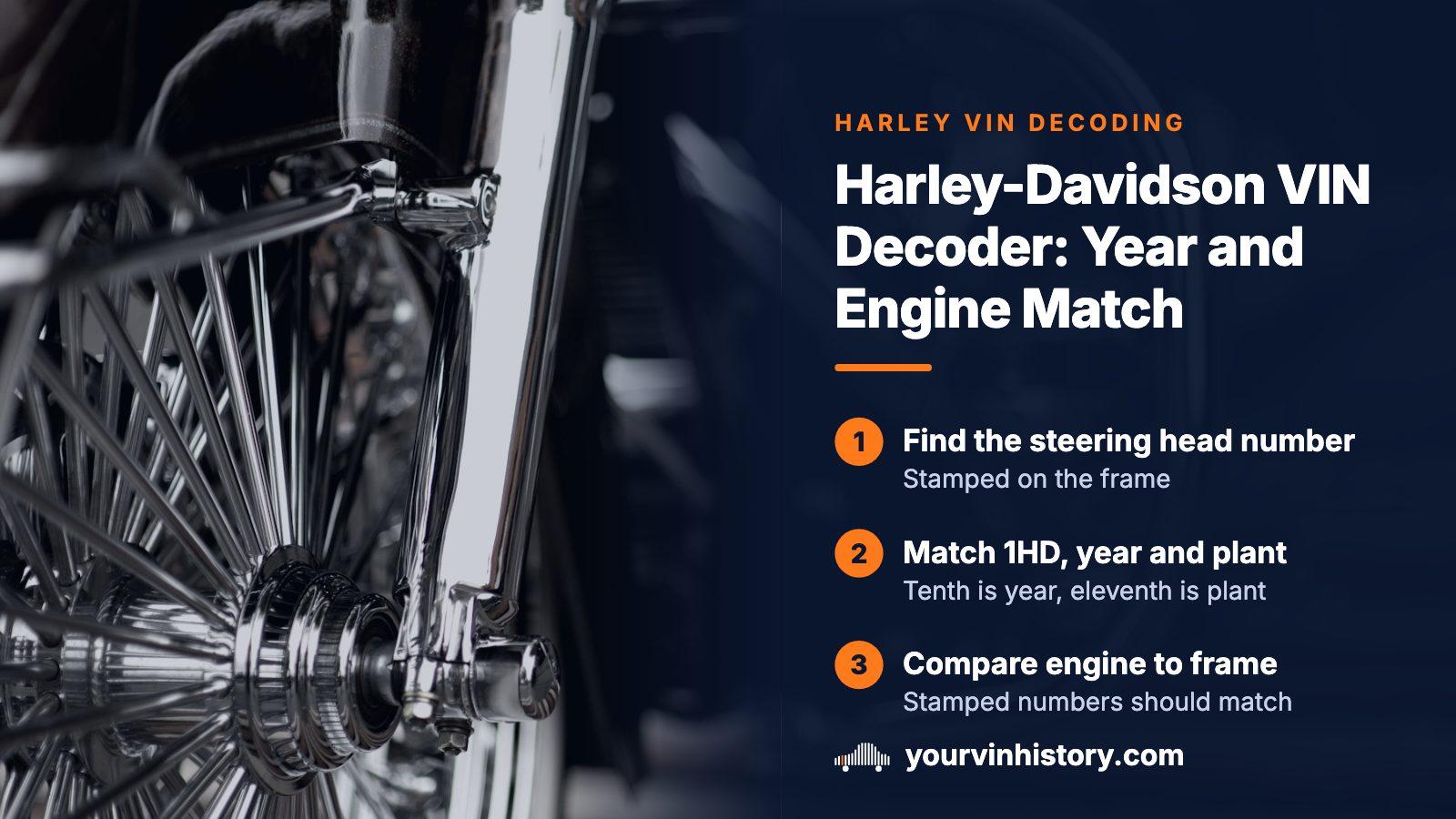
Find the 17-character number on the frame's steering head and run it through NHTSA's VIN decoder. A US-built Harley opens with 1HD, the tenth character gives the model year, and the eleventh gives the plant. The decode shows the bike as built at the factory, so also compare the engine's stamping with the frame number, then run the recall and theft lookups.
- US-built prefix
- 1HD, listed by NHTSA for Harley-Davidson Motor Company
- Model year
- Tenth character of the VIN
- Decoder coverage
- Model year 1981 and later
- Last four characters
- Always digits on a motorcycle
A decode describes the bike the factory built, not the one in the driveway
Run a Harley's frame number through a decoder and you get a factory baseline: the maker, the model year, the engine the bike left with and the plant that assembled it. That baseline counts for more on a Harley than on most vehicles. Owners rebuild, customize and re-engine these machines as a matter of routine, so the bike you are looking at can differ a great deal from the one that rolled off the line.
- The model year in the advert should agree with the tenth character of the frame number.
- The engine described by the decode should agree with what the seller says is installed.
- A recall lookup on the same number shows which campaigns apply to this exact bike.
A decode cannot reveal the owner's modifications or show that the original engine is still installed. Those answers come from the engine stamping, covered below, and from receipts.
Where the number sits, and how to read a grimy stamping
The legally significant number is cut into the steering head, the frame tube that the front forks pass through. Swing the handlebars to full lock to open up the metal; the stamping is usually on the right side of the neck. A printed certification label on the frame repeats the VIN and adds the build date.
- Steering head: the primary location, stamped into the metal.
- Certification label: printed, easier to read, and it carries the build date.
- Title, registration and insurance card: the frame number has to agree with all three.
- Engine cases: a separate stamping, handled in its own section further down.
The neck sits right behind the front wheel and collects road film and chain lube. Wipe it with a rag, rake a flashlight across it at a low angle, and photograph it so you can read it calmly at home.
The 17 characters, block by block
Federal rules give each position a job on a motorcycle VIN.
| Position | What it holds |
|---|---|
| 1 to 3 | World manufacturer identifier, such as 1HD for a US-built Harley-Davidson |
| 4 to 8 | The maker's descriptor: make, type, line, engine type and encoded horsepower |
| 9 | Check digit, a number or X worked out from the other characters |
| 10 | Model year code |
| 11 | Plant of manufacture |
| 12 to 17 | Production number; positions 14 to 17 are digits on a motorcycle |
The federal rule requires the horsepower encoded in positions four to eight to stay close to the bike's actual net brake horsepower, so that block says something real about the engine. The maker chooses those five characters, so a chart written for one era can misread another. Decoding against the patterns NHTSA holds for the exact model year avoids that.
The 1HD prefix, and what to make of any other opening
In 1HD, the 1 stands for the United States and HD for Harley-Davidson. NHTSA's decoder lists 1HD against Harley-Davidson Motor Company as a motorcycle manufacturer, so treat it as the expected opening for a US-built bike.
A different opening is not automatically a problem. The same NHTSA database lists 5HD for Harley-Davidson motorcycles too, and it carries a separate identifier for Harley's Brazilian company. Bikes built outside the United States use other prefixes.
One limit applies. NHTSA's data covers vehicles intended for sale or import into the United States, so a gray-market import may return thin results.
Position nine: a built-in typo detector
The ninth character is arithmetic rather than description. Each character converts to a value, gets multiplied by a weight tied to its position, and the products are added up. The remainder after dividing by eleven becomes the check digit, and a remainder of ten is written as X.
If the number fails the check, suspect your own reading first, since you are squinting at metal rather than paper. No VIN uses the letters I, O or Q, so an apparent O is really a zero and an apparent I is a one. Correct those and run the check again.
A pass proves less than it seems
A passing number is internally consistent, nothing more. It does not show that the number was stamped at the factory or that it belongs on this frame.
Reading the model year from character ten
The tenth character is a code for the model year. Here is the recent run.
| Model year | Tenth character |
|---|---|
| 2015 | F |
| 2016 | G |
| 2017 | H |
| 2018 | J |
| 2019 | K |
| 2020 | L |
| 2021 | M |
| 2022 | N |
| 2023 | P |
| 2024 | R |
| 2025 | S |
| 2026 | T |
The sequence runs on a thirty-year cycle and leaves out I, O, Q, U and Z. Before the stretch above, the digits 1 through 9 stood for 2001 through 2009, and the letters A through Y stood for 1980 through 2000. A lone letter cannot settle the year, so use the family and styling to decide which cycle the bike belongs to. The certification label's build date shows when it was made, which can fall in a different calendar year from the model year.
The engine stamping and the numbers-matching question
Harley stamps identifying characters into the engine cases. On an original bike those characters relate to the frame VIN, so a buyer can see whether the engine now in the frame came with it from the factory. Ask the seller, or a Harley dealer, where the stamping sits on that model year, then compare it with the frame.
| At the engine cases | Implication |
|---|---|
| Engine stamping lines up with the frame number | A numbers-matching bike: worth more to collectors, especially on older models, and usually the easiest to title and insure. |
| Engine stamping does not line up | The engine has been changed. This turns up often on high-mileage and older bikes; it is no defect by itself, yet the seller should disclose and document it. |
| Stamping shows grinding, filing or re-cutting | Stop the deal. Tampered identification numbers belong with the police, not in a price discussion. |
A swapped engine is a pricing issue, not a verdict
Plenty of Harleys are re-engined competently, often to a larger displacement. The thing to avoid is learning about the swap after you paid a numbers-matching price. Disclosure, paperwork and price should all tell the same story.
Harleys from before the 17-character era
The 17-character format begins with the 1981 model year. Earlier Harleys carry shorter factory numbers, usually a model prefix plus a serial, with no check digit and no standard year character.
NHTSA describes vPIC as intended for model year 1981 and forward, and says vehicles built before the 17-character standard are not part of its decoding capability. A vintage number will not decode there. The useful tools are factory parts books, marque references and owner-club registries, which are well developed for Harley. Expect to work by hand, and expect the paper trail to count heavily when the price is set.
Theft and salvage checks before you travel
Harleys hold their value and strip down into parts people want, so check a private-sale bike for theft before you drive out. NICB's VINCheck is a no-cost lookup fed by participating insurers. A clean result means only that none of them has reported that number as stolen or as a salvage loss.
- Confirm the frame stamping matches the title character for character.
- Check that the title is in the seller's name.
- Look at the metal around the steering head for grinding, filing or uneven character depth.
- Be wary of any bike offered without a title, whatever reason is given.
A salvage brand on a Harley does not always point to a bad wreck. Paint, chrome and fairings are costly enough that a modest tip-over can top an older bike's value and become a total loss, so what you need to learn is whether the frame is straight. A paid vehicle history report on the frame VIN, including the one on this site, can add title, salvage and auction records that VINCheck does not hold.
Recalls follow the frame number, not the model name
Recall campaigns cover specific VIN ranges, so searching by model name can surface notices that never touched your bike. Enter the frame number in NHTSA's recall lookup, which costs nothing to run.
Federal law generally requires a manufacturer to repair a safety defect at no charge to the owner, but the rule has an age cutoff. If the first buyer purchased the motorcycle more than 15 calendar years before the manufacturer's notice, the no-charge requirement does not apply. A very old Harley can therefore carry an open recall that the maker need not fix without charge. On a newer bike, raise any open recall with the seller, because booking the repair takes time.
A numbers-first checklist for buying a used Harley
- Ask for a sharp photo of the steering head stamping before you travel. A seller who hesitates has told you something.
- Decode it and compare the model year, engine and plant with the advert.
- Compare the engine stamping with the frame number, and ask when and why any engine was changed.
- Run NHTSA's recall lookup and NICB's VINCheck on the frame number.
- Look for grinding, filing or uneven spacing on both the frame and the engine cases.
- Get receipts for exhaust, cams, fuel mapping, suspension and wheels. Documented work adds value; undocumented work is a reason to bargain.
- For a branded or high-value bike, pay for a professional look at frame alignment.
Where this information comes from
- NHTSA: vPIC VIN decoder — The federal decoder for a frame number. Its own text sets coverage at model year 1981 and forward and says it relies on manufacturer-supplied patterns.
- NHTSA: Recalls — Where to check one VIN for open recall campaigns, instead of searching by model name.
- NICB: VINCheck — A no-cost lookup of theft and salvage reports from participating insurers.
Sources and photos: Facts checked against the sources above in October 2026. Photo by Steve Smith on Unsplash; diagrams by YourVINHistory.
Keep reading
- Motorcycle VIN lookupThe general version of this check, covering every make and the frame-versus-engine number question.
- How to read a VINA position-by-position walk through the check digit and the year chart used on every vehicle.
- NICB VINCheck explainedWhat the no-cost theft and salvage lookup finds, and what it misses.
- Motorcycle value by VINThe next question once the numbers agree: what the bike is worth.
Frequently asked questions
How can I decode the VIN on my Harley-Davidson?
Copy all 17 characters from the steering head into NHTSA's vPIC decoder. Check that the first three read 1HD, then take the model year from the tenth character and the plant from the eleventh. If the tool rejects the number, look for a misread O or I before you suspect the bike.
Is the engine number the same as the VIN on a Harley?
No. The VIN is the 17-character frame number printed on the title. The engine cases carry their own stamping, which on an original bike relates to the frame number. A decoder reads only the frame number, so compare the engine stamping by eye and ask for receipts if the engine was ever replaced.
My Harley's tenth VIN character is a digit. What year is it?
A digit from 1 through 9 stands for 2001 through 2009, because the digits followed the older letter run that went from A for 1980 to Y for 2000. Confirm the year against the build date on the certification label, which also shows which recall batch the bike falls into.
Will NHTSA's decoder read a pre-1981 Harley?
No. NHTSA says vPIC is intended for model year 1981 and forward, and that vehicles built before the 17-character standard are not part of its decoding capability. A vintage number simply returns nothing useful. For an older bike, lean on factory parts books, owner-club registries and the title.
Can I trust a clean VINCheck result on a used Harley?
It tells you no participating insurer has reported that number as stolen or salvage. It cannot see a theft nobody reported to an insurer, damage that never reached one, or a frame whose stamping has been altered. Pair it with a close look at the stampings.
Now check the car itself
The guide explains what to look for. The report shows what this VIN has on record.