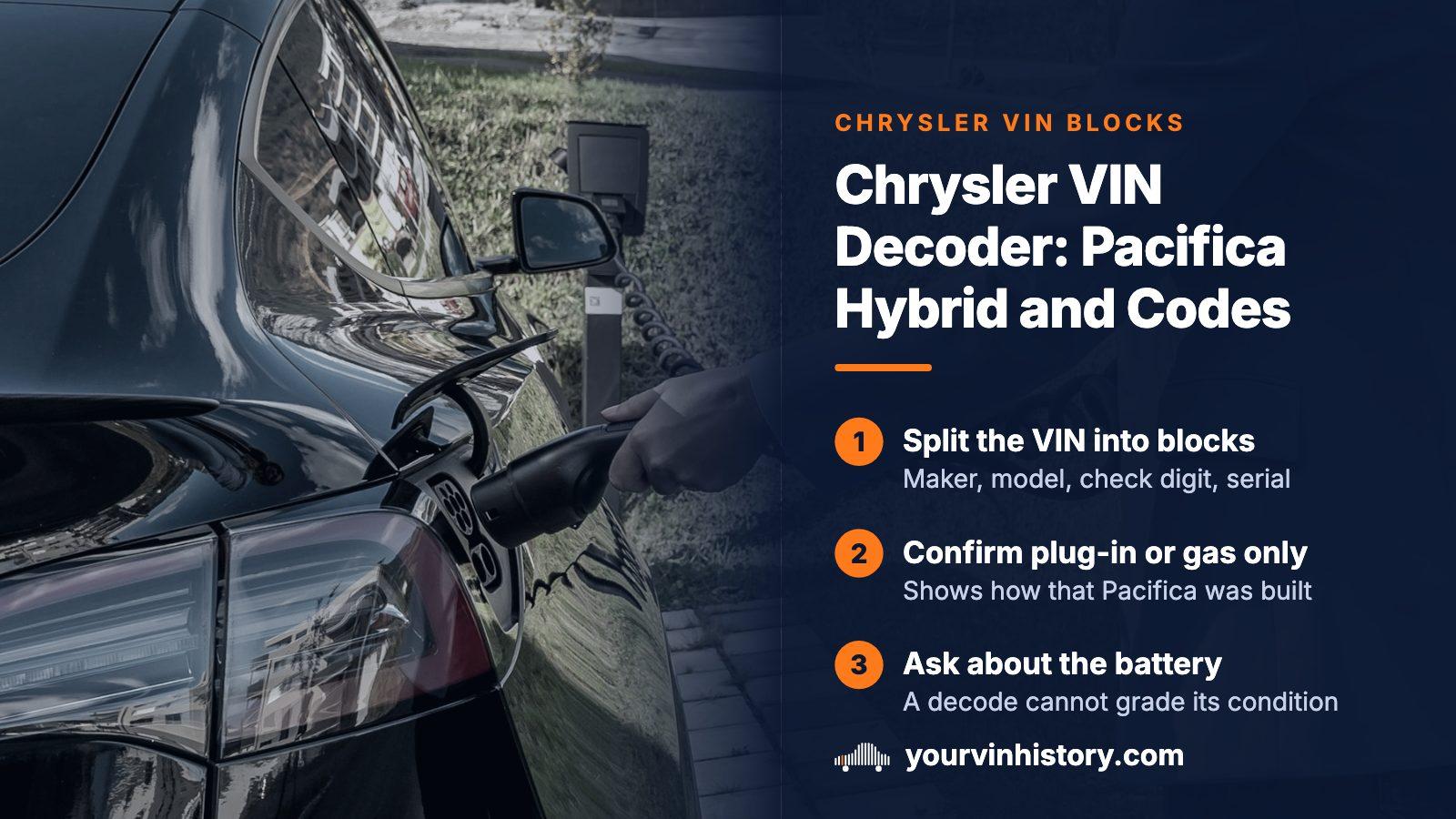
THE SHORT ANSWER
Read a Chrysler VIN in blocks. Characters one to three give the maker and country, four to eight describe the model, body and engine, nine is a check digit, ten is the model year, eleven is the assembly plant, and twelve to seventeen are the serial number. The decode shows if a Pacifica was built as the plug-in model, but it cannot grade the battery. Run the number through NHTSA's recall lookup before you pay.
- Car prefixes
- 1C3 (United States) and 2C3 (Canada)
- Minivan prefixes
- 2C4 and 2A4, both listed under FCA Canada
- Check first
- Pacifica plug-in hybrid or gas-only
- Not in a decode
- Hybrid battery condition
How the 17 characters split up on a Chrysler
Chrysler uses the same 17-character format as every maker selling in the United States, so nothing about the layout is brand specific. The first three characters are the world manufacturer identifier, which names the builder and the country. Characters four through eight carry the model, body style and engine, the part each maker defines in its own filing. Character nine is the check digit, a calculated value that catches mistyped or invented numbers. Character ten is the model year, eleven is the plant that assembled the vehicle, and twelve through seventeen are the sequence number.
To find the number, look through the glass at the lower corner of the dash on the driver's side, then compare it with the sticker on the door jamb and the number printed on the title. All three should agree character for character.
The five Chrysler prefixes and what vPIC says about each
NHTSA's decoder database lists a handful of Chrysler prefixes. Each tells you who built the vehicle and in which country, and the table below follows vPIC's own entries.
| Prefix | Builder and vehicle type in vPIC |
|---|---|
| 1C3 | FCA US, passenger car |
| 2C3 | FCA Canada, passenger car |
| 2C4 | FCA Canada, multipurpose vehicle |
| 2A4 | FCA Canada, multipurpose vehicle |
| 3C4 | Chrysler de Mexico, Toluca, multipurpose vehicle |
Minivans are classed as multipurpose vehicles rather than passenger cars, which is why they carry 2C4 or 2A4 instead of the car codes. Canadian assembly is long established for them, so a 2 at the start of a Pacifica or Voyager VIN is expected, not a warning sign.
One prefix, several badges
vPIC registers 2C4 and 3C4 against more than one make, Dodge, Jeep and Ram among them. The prefix alone does not prove the badge, so treat it as a first clue and read the whole decode.
What a decode returns, and what it leaves out
Chrysler files its VIN patterns with NHTSA, and the public vPIC tool reads your number against them in seconds, with no account. For a typical Chrysler you can expect:
- Model year, model and body class
- Engine size, cylinder count and fuel type, with a second fuel listed for plug-in hybrids
- An electrification level, where the maker reported one
- Front-, rear- or all-wheel drive
- The restraint equipment fitted at the factory
- Plant city and country
The limits matter as much as the list. A decode describes the vehicle as it left the factory, so it says nothing about accidents, repairs, mileage or a swapped part, and some fields can come back empty when the maker did not report them. The history side, meaning title brands, damage and odometer readings, comes from a vehicle history report instead.
Pacifica: gas minivan or plug-in hybrid
Buyers meet the Pacifica in two forms, a regular gasoline minivan and a plug-in hybrid, and on the used market they are different purchases with different risks. Settle which one you are looking at before you drive across town. The decode answers it from the powertrain data the maker filed, using the engine, fuel type and electrification fields.
What it cannot tell you is how healthy the hybrid system is. The battery is the largest single swing in what a used plug-in is worth, and nothing in seventeen characters records how it was treated, how often it was charged or whether it has ever been replaced.
Questions to put to the seller of a plug-in hybrid
A plug-in hybrid will run on gasoline alone, so a car that looks well used may have rarely touched a charger. Fueleconomy.gov notes that such a vehicle misses its maximum range and economy, yet it still hauls the extra hardware everywhere. Ask directly.
- Find out if the last owner plugged it in often, and where.
- Ask how much battery and hybrid-system coverage remains, and whether it passes to a second owner.
- Ask whether the traction battery has been serviced or replaced, and request the paperwork.
- Compare the electric range the car shows with the EPA figure for that model year.
- Check that the sale includes the charging cable and any wall equipment.
For the range comparison, the EPA publishes separate estimates for gasoline-only driving and for electric or mixed operation. For the coverage question, a dealer can look up what is left from the VIN, which beats trusting memory.
Where a hard-used minivan shows its age
Whatever sits under the hood, a used minivan has usually spent years hauling kids, groceries and gear. A decode cannot see that kind of wear, so inspect it yourself. Operate each sliding door several times from both sides, and watch for rough travel, grinding or a door that hesitates at the latch. Fold and restore every rear seat that is built to fold, and make sure the latches seat firmly. Where doors or seats are power operated, test every switch and the key fob button too. Then drive over a rough patch and listen for clunks from the suspension, which carries more weight on a family hauler than the spec sheet suggests.
The Chrysler 300 and its Dodge Charger cousin
The 300 is a rear-drive sedan that shares its platform and a good deal of engineering with a Dodge counterpart, the Charger. They are separate models with separate identifiers, different styling and different trim structures, yet the hardware underneath overlaps heavily.
That overlap helps your research. A service interval, a known failure or a parts price tied to the shared powertrain tends to apply to both cars, so look up the engine and the platform, not just the model name. The sedan you are shopping for may be a 300, but the longest owner threads about its engine could sit under the other badge.
Get the build sheet before you agree on a price
The factory build record lists every option a vehicle left the plant with. A dealer parts or service department can pull it from the VIN, and for a minivan it matters more than most buyers expect: seating layout, rear entertainment, safety packages and towing equipment can all differ within a single trim name.
Ask for the record before you negotiate, then walk the vehicle against it item by item. Anything on the car that the record does not list was added afterward.
Badge versus record
Badges and aftermarket parts can make a lower trim look like a higher one. The factory record is the fair referee when an ad and the car disagree.
Recall status belongs to the VIN, not the model
Recalls are issued against ranges of VINs, which is why reading about a model tells you little about the specific car in front of you. NHTSA's lookup takes your 17 characters and returns any recall on that vehicle that has not yet been repaired.
When a defective component is shared, the group often files matching campaigns for Chrysler, Dodge, Jeep and Ram, so a headline about a sibling brand is a prompt to check, not proof that your car is affected. Under the federal rule a manufacturer repairs an open recall without charge to the owner, though very old vehicles can fall outside it. If the lookup shows an open item, ask the seller to have a dealer complete it before you buy, or get the repair date in writing.
A VIN-first checklist for a used Chrysler
- Decode the VIN first, and on a Pacifica pin down the powertrain.
- Ask a dealer for the factory build record and compare it with the car.
- On a plug-in, check the remaining battery coverage and how often it was charged.
- Research faults by engine and platform, not only by the Chrysler model name.
- Test the sliding doors, folding seats and suspension on any minivan.
- Run the NHTSA recall lookup on the exact VIN.
- Pull a history report for what a decode cannot see.
A yourvinhistory report picks up where the decode stops, with title brands, accidents and a damage map, odometer readings, and salvage or auction records. Start with the free preview, then buy the report only if the car is still on your list.
Where this information comes from
- NHTSA: vPIC VIN decoder — The federal catalog behind the prefixes, plant data and powertrain fields discussed here, built from the VIN patterns manufacturers file.
- NHTSA: Recalls — The lookup that matches a single VIN to any open recall on that vehicle.
- U.S. DOE and EPA: Fuel Economy — Government mileage and electric-range estimates, plus plain notes on how plug-in hybrids behave when they are not charged.
Sources and photos: Facts checked against the sources above in October 2026. Photo by smart-me AG on Unsplash; diagrams by YourVINHistory.
Keep reading
- DodgeThe Charger's side of the 300 story, plus what is left of Dodge once the trucks split off.
- VIN warranty checkHow to find remaining battery and powertrain coverage, and what passes to you.
- Hybrid battery replacement costWhat to expect if a used plug-in's battery needs work.
- Recall check by VINWhy a search by model and a search by VIN give different answers.
Frequently asked questions
Can I decode a Chrysler VIN for free?
Type the 17 characters into NHTSA's vPIC decoder, a federal tool with no charge and no sign-up. It returns model year, model, body class, engine, drivetrain and plant based on what Chrysler filed. Anything that happened after the factory, such as accidents or title brands, needs a separate history report.
Does the VIN tell me if a Pacifica is a hybrid?
Yes, the powertrain data in a decode separates the plug-in hybrid from the gasoline-only minivan. It cannot show how the battery has aged, how often the car was charged or what coverage remains. Settle those with the seller's records and a dealer lookup on the VIN.
Is a Chrysler 300 the same car as a Dodge Charger?
No. They are separate models with their own identifiers, styling and trims, but both sit on the same rear-drive underpinnings and swap many components. That is why mechanical parts and known faults often carry across, and why searching by engine finds more owner reports than searching the Chrysler name alone.
Why does my Chrysler VIN start with a 2?
In these prefixes, 1 is the United States, 2 is Canada and 3 is Mexico. A leading 2 fits a minivan, since vPIC lists both 2C4 and 2A4 under FCA Canada as multipurpose vehicles. It is also normal on a 2C3 sedan. Verify the plant position and the rest of the decode before you read anything into it.
Do Chrysler recalls also apply to Dodge, Jeep and Ram?
Each campaign names specific brands and VIN ranges. When a shared part fails the group often files matching campaigns across several brands, but yours may or may not be included. Enter your own VIN in NHTSA's lookup rather than inferring from a story about a sibling vehicle, and check again right before you sign.
Now check the car itself
The guide explains what to look for. The report shows what this VIN has on record.