THE SHORT ANSWER
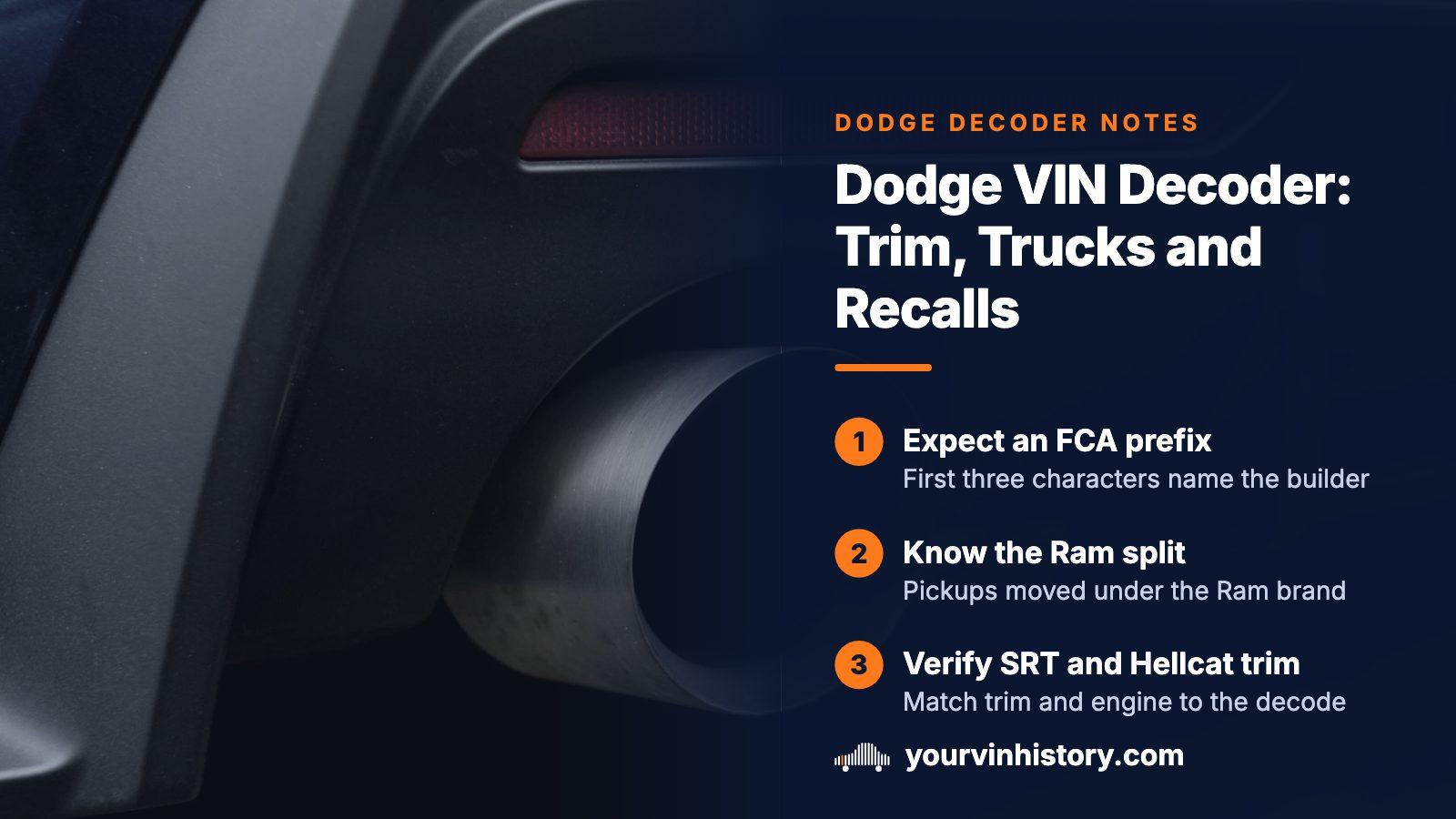
Enter the 17 characters into NHTSA's vPIC decoder and it returns the model year, model, body class, engine, drivetrain and assembly plant. The first three characters name the builder, which on a Dodge is an FCA company, not the badge. Pickups from model years 2010 to 2012 are filed as Dodge Ram; from 2013 they sit under Ram. On a Charger or Challenger, match trim and engine to the decode before talking price.
- Truck split
- Ram brand from model year 2010; federal data moves pickups at 2013
- Shared prefixes
- 1C3 and 2C3 cover Dodge, Chrysler, Fiat and Lancia
- Trim to verify
- SRT and Hellcat on Chargers and Challengers
- Free lookups
- NHTSA vPIC, NHTSA recalls, NICB VINCheck
What a Dodge VIN decode gives you
Every position has a job. Characters one to three name the builder and the country. Four to eight describe the vehicle and carry the engine code. Nine is the check digit, ten is the model year, eleven is the assembly plant, and twelve to seventeen are the serial number.
Dodge files its numbering pattern with NHTSA, so the agency's vPIC tool can read a Dodge VIN with no fee and no account. A typical result lists:
- Model year, model and body class
- Engine displacement and cylinder count
- Rear-wheel or all-wheel drive
- Restraint equipment fitted at the factory
- Country and plant of assembly
Find the number on the plate visible through the glass at the driver's corner of the dashboard, and again on the sticker on the door jamb. Both should match the title, character for character.
Why a Dodge VIN opens with a code that does not say Dodge
The first three characters are the world manufacturer identifier, and it names the company that built the vehicle. Badges belong to brands, not to that code. NHTSA's lookup for Dodge prefixes returns an FCA company, or a Chrysler affiliate in Mexico, as the manufacturer, so a decoder that prints a corporate name has not made a mistake.
| Prefix | Manufacturer in vPIC | Makes listed |
|---|---|---|
| 1B3 | FCA US LLC | Dodge |
| 2B3 | FCA Canada Inc. | Dodge |
| 1C3 | FCA US LLC | Dodge, Chrysler, Fiat, Lancia |
| 2C3 | FCA Canada Inc. | Dodge, Chrysler, Fiat, Lancia |
| 3C3 | Chrysler de Mexico Toluca | Dodge, Chrysler, Fiat, Lancia |
The leading digit is the country of assembly: 1 for the United States, 2 for Canada, 3 for Mexico. No single prefix marks every Dodge, and an unfamiliar one on an older car usually reflects a different era of the group's ownership. Federal decodes of Charger and Challenger numbers point to Brampton, Ontario, so a leading 2 on those cars is expected.
Where the Dodge pickups went, and when the data followed
The truck line was spun off as its own brand, Ram, beginning with the 2010 model year. The federal database did not follow right away. In vPIC, a pickup pattern for 2010, 2011 or 2012 decodes to make Dodge, model Ram. The same style of number for 2013 decodes to make Ram.
| Model year | How vPIC files a pickup |
|---|---|
| 2010 to 2012 | Make Dodge, model Ram |
| 2013 and later | Make Ram |
That gap trips up searches. Anyone who assumes Dodge trucks vanished when Ram appeared will come up empty searching for a 2011 pickup that never moved. Read the model year from position ten first, then search under the brand that year uses. A recall search by VIN skips the naming question altogether.
What remains under the Dodge name in NHTSA's list
Comparing NHTSA's Dodge model lists for 2012 and 2013 shows how much left at once. A name's presence only reflects what was filed for that year, not that production ran all twelve months, so use the list to decide where to search, not to date a build.
| Model name | Listed for 2012 | Listed for 2013 |
|---|---|---|
| Ram | Yes | No |
| Ram Chassis Cab | Yes | No |
| Dakota | Yes | No |
| Caliber | Yes | No |
| Nitro | Yes | No |
| Dart | No | Yes |
| Viper | No | Yes |
| Charger | Yes | Yes |
| Challenger | Yes | Yes |
| Durango | Yes | Yes |
Charger, Challenger and Durango appear in both years, which is where most of the checking below applies.
Confirming an SRT or Hellcat before you discuss price
High-output Chargers and Challengers sell for a large premium compared with the plain versions they resemble, and the parts that make one look like the other are easy to buy: badges, grilles, hoods, wheels, spoilers, interior trim, even an exhaust note. What nobody can buy is the build the factory recorded against the VIN.
On these cars vPIC commonly returns a trim line such as SXT, R/T or SRT Hellcat beside the engine size and cylinder count. When the seller's claim and the decode disagree, believe the decode until someone shows a factory record that says otherwise.
- Decode the number before any conversation about money.
- Open the hood: the engine should match the decode, and a supercharger is not subtle.
- Compare the brakes with what that model should carry.
- Check that the interior equipment fits the claimed trim.
- Set your offer by what the decode returns, not by the badge on the trunk.
A decode answers only for the number you typed
If the plate, the door sticker and the title carry different numbers, the decode may be describing some other car. Settle that mismatch first.
HEMI is a family name, not a specification
Dodge has stamped the HEMI name on engines of several sizes and strengths, from naturally aspirated units in mainstream cars to supercharged ones in the top-output models. A seller who says only HEMI has told you very little.
The engine character inside the descriptor block is what separates them. On Chargers and Challengers it changes when the engine does, and the federal decode converts it into displacement and cylinders. Then look under the hood to confirm. Swaps turn up here more often than on the average car, and one that was never disclosed can change the insurance, the emissions status and the resale value.
Theft rates and the insurance quote
The high-output Chargers and Challengers are stolen more often than the average car, and insurers price that in. The premium can add up to more than the purchase price implies, so find out before you commit.
- Request an insurance quote using the exact VIN.
- Run NICB's VINCheck, a no-cost theft search, before any money moves.
- Match the VIN at both locations on the car to the title.
- Ask what anti-theft measures the current owner relies on.
- Think about where the car will sleep at night, since that affects both risk and premium.
A clean VINCheck result is reassuring, not final, so keep the physical comparison of plates and paperwork going.
Asking for the factory build record
The factory keeps a record of the options on each car it ships, and you can ask a dealer's parts department to retrieve it from the VIN. On a performance car it backs up an equipment claim. On any Dodge it shows which package content was really fitted.
Request it before the price is settled, not after the papers are signed. A seller without a copy may simply not know how to get one, which is no warning sign on its own, but it means the verifying falls to you.
Treat the record as the baseline. Anything on the car that it does not list, such as wheels, a hood or an exhaust, was added by an owner. That is acceptable when it was disclosed and priced as an add-on instead of as factory equipment.
Recalls follow the VIN, and so does the repair question
Recall campaigns are written against VIN ranges, not whole model lines, and a campaign sometimes spans several brands when a shared part is involved. NHTSA's lookup is a no-cost search by VIN, so it tells you whether one particular Dodge has an open item, whatever brand name the listing uses.
Who pays for a recall repair
Under federal law, the maker must fix a recalled defect at no charge when the first purchase came no more than 15 calendar years before the notice. The current owner does not change that rule, but the age of the vehicle does. On an older car, ask the dealer what the repair will cost before assuming anything.
A used Dodge checklist, in the order that saves money
- Decode before you travel, and confirm that year, engine and drivetrain agree with the listing.
- On a pickup from 2010 to 2012, expect Dodge in federal data. From 2013, expect Ram.
- Verify trim and engine on any Charger or Challenger sold for its performance badge.
- Ask a dealer for the factory build record tied to the VIN.
- Get the insurance quote, then run the NICB and NHTSA lookups.
- Ask what has been modified. Receipts turn changes into history; missing ones are grounds for a lower offer.
A decode shows how the car was built. A vehicle history report by VIN covers what happened afterward, including title brands, accidents, odometer readings, salvage and auction records, theft and open recalls, so read both before you pay.
Where this information comes from
- NHTSA: vPIC VIN decoder — The federal catalog behind the prefix lookups, the model lists by year and the Charger and Challenger trim and engine decodes described here.
- NHTSA: Recalls lookup — Where to enter a VIN and see whether a specific Dodge has an open recall.
- NICB: VINCheck — A no-cost theft lookup to run on any high-output Dodge before money changes hands.
- GovInfo: 49 U.S.C. 30120, remedies for defects and noncompliance — The statute that sets when a manufacturer must repair a recalled vehicle at no charge, including the age cutoff.
Sources and photos: Facts checked against the sources above in October 2026. Photo by Dain Lindo on Unsplash; diagrams by YourVINHistory.
Keep reading
Frequently asked questions
Is there a no-cost way to decode a Dodge VIN?
Type the 17 characters into NHTSA's vPIC tool. It needs no account and returns what Dodge filed about the pattern. If it flags a check digit problem, recheck your typing before blaming the car. A decode describes the vehicle as built, so repairs, swaps and damage need a history report and a hands-on inspection.
Why does my Dodge decode as Chrysler or FCA?
The first three characters identify the manufacturer, and Dodge vehicles are built by FCA companies. Some federal records also carry a common name of Chrysler for those prefixes. Neither is a sign of a wrong or altered VIN. What would deserve questions is a manufacturer from outside the group entirely.
Is a 2011 Ram pickup a Dodge?
In NHTSA's database it is filed under Dodge with Ram as the model, because the brand change for 2010 was not mirrored there until 2013. Titles and listings may say either name. Rely on the VIN: decode it, and run the recall lookup by number, not by brand.
How do I tell which HEMI a Dodge has?
Decode the VIN and read the engine details, because the descriptor block records the engine the car left the plant with. That sorts the standard versions from the supercharged ones. Then check the engine bay, since a swap would not show in the number, and ask for service records that name the engine.
Will a dealer repair a Dodge recall at no cost?
Often yes, when the vehicle falls within the federal rule, which looks at how long ago the first buyer purchased it. A change of owner does not end the obligation. Very old vehicles can fall outside the rule, so run the VIN first and ask the dealer for the cost in writing.
Now check the car itself
The guide explains what to look for. The report shows what this VIN has on record.