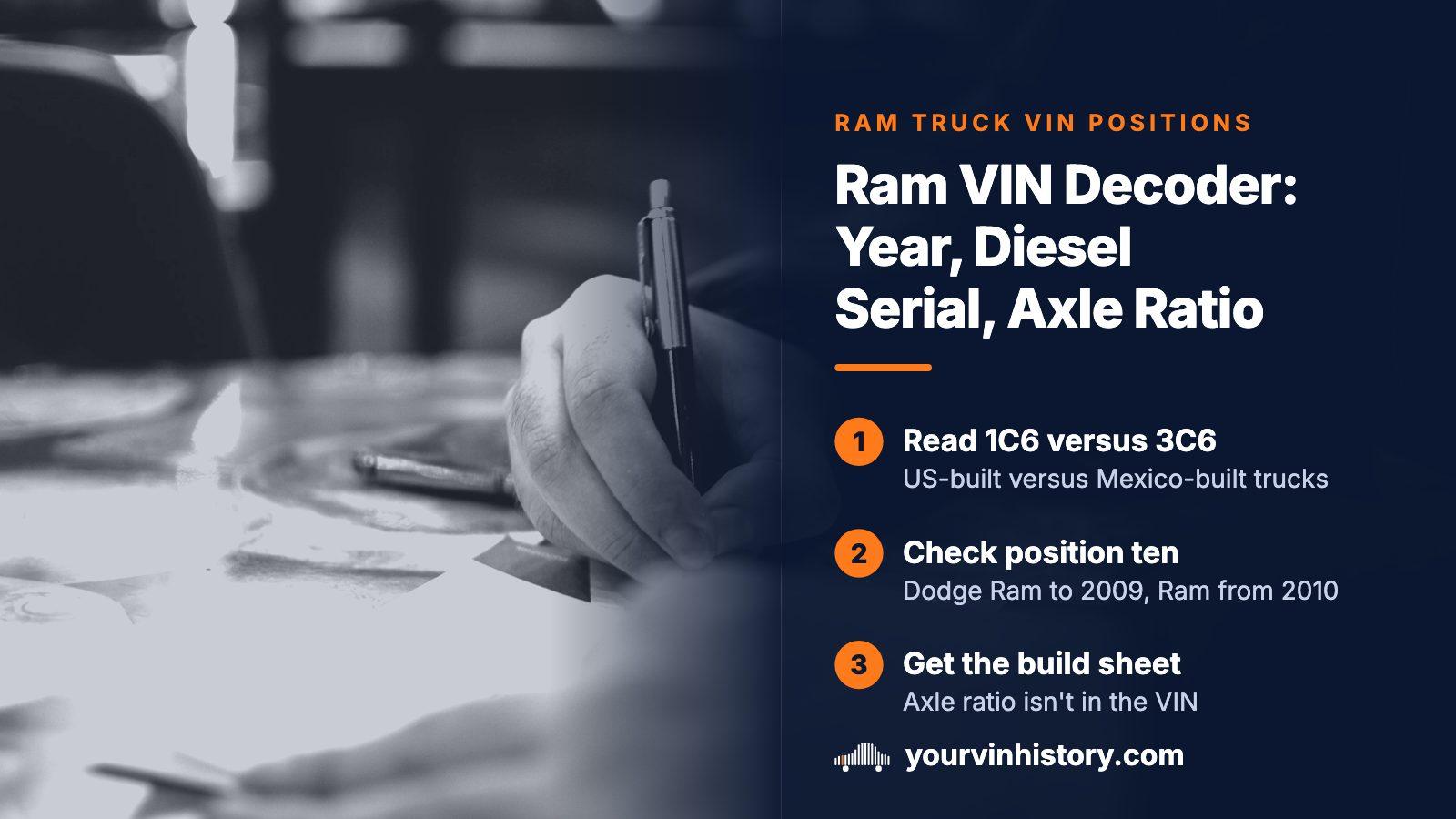
THE SHORT ANSWER
Positions one to three name the maker and country: 1C6 means a Ram truck built in the US, 3C6 one built in Mexico. Four to eight describe series, cab, weight class and engine, ten is the model year and eleven the plant. Position ten also shows the brand, Dodge Ram through 2009 and Ram from 2010. A diesel's engine has its own serial, and the axle ratio is on the build sheet.
- Brand split
- Dodge Ram through 2009, Ram from 2010
- Prefixes
- 1C6 US-built, 3C6 Mexico-built
- Diesel
- Engine carries its own serial
- Axle ratio
- On the build sheet, not the VIN
Three places a Ram shows its VIN
Start outside the truck. On the driver's side, look through the glass at the lower corner of the windshield, where the full 17 characters can be read without opening anything. Then read the label on the driver's door jamb, which also prints the gross vehicle weight rating.
Heavy-duty trucks add a third copy stamped into the frame rail, so on a 2500 or 3500 crouch down and see whether it agrees with the other two. Then compare all three against the title and registration. A single mismatched character is a question for the seller, not a detail to wave through.
How the 17 characters divide on a Ram
| Position | What it tells you on a Ram |
|---|---|
| 1 to 3 | World manufacturer identifier: the maker and the country of assembly |
| 4 to 8 | Ram's own codes for series, cab style, weight class and engine |
| 9 | Check digit, calculated from the other characters |
| 10 | Model year character |
| 11 | Assembly plant |
| 12 to 17 | Production sequence number |
The outer blocks follow a layout shared by every maker. The middle block is Ram's own, so a rule of thumb from another brand will mislead you there. Ram files its VIN patterns with NHTSA, which is why the public decoder reads that block the way the manufacturer wrote it.
Position ten and the Dodge-or-Ram line
Ram pickups wore a Dodge badge for decades. Starting with the 2010 model year the truck line became a brand of its own, so a 2009 pickup is a Dodge Ram and a 2010 is simply a Ram. Position ten carries the model year character, and for this pair it reads 9 for 2009 and A for 2010.
| Model year | Brand | Where to research it |
|---|---|---|
| 2009 and earlier | Dodge Ram | The Dodge sections of parts catalogs, forums and classified ads |
| 2010 and later | Ram | Ram listings, Ram catalogs and Ram's own trim lineup |
The split is more than a badge swap. A search using one name will return trucks from the other era, and price comparisons that mix them tell you little. Go by the model year character, not the date on a listing.
1C6, 3C6 and the Mexico question
- 1C6 marks a Ram truck assembled in the United States.
- 3C6 marks a Ram truck assembled in Mexico, which accounts for a large share of production.
- 1C4 and 2C4 belong to other vehicles from the same corporate family, including SUVs and vans.
A Mexican prefix is ordinary on a Ram and says nothing against the truck. The group uses many identifiers across its brands, so decode the whole number rather than judging by a prefix you do not recognize. Position eleven then names the assembly plant, a detail worth recording when two trucks you are comparing came off different lines.
What the NHTSA decode returns, and what it skips
NHTSA's vPIC decoder prints what the manufacturer filed, so the result is only as detailed as Ram's filing. For a pickup that normally means the model year, model and body class, engine displacement, cylinders and fuel type, the drive layout, cab and series, the weight class that separates a 1500 from the heavy-duty trucks, and the plant.
Two details from the decoder's own page help. It accepts partial VINs, and if you type a model year into the optional box, it ignores the year encoded in the VIN. Leave that box empty when you want the number to speak for itself.
A decode skips the truck's life story and option sheet: axle ratio, equipment by trim, a diesel engine's service record, and anything about title brands, accidents or mileage. A vehicle history report by VIN, such as the one sold on this site, covers the title and accident side, and the preview is free.
A diesel Ram carries two serial numbers
The diesel in a heavy-duty Ram comes from Cummins, a separate manufacturer, and the engine is identified apart from the truck. The chassis VIN shows that a diesel was installed at the factory, but it will not open the engine's records. For that you need the engine's own serial number.
The engine is usually the costliest component on the truck, so before money changes hands:
- Find the serial on the data plate on the engine block and photograph it.
- Send it to the engine manufacturer and ask for the service history it has on file.
- Ask the seller if the engine was ever rebuilt or swapped, and get any paperwork.
- Ask what emissions-system work has been done, because diesel running costs cluster there.
- Look up engine campaigns by that serial, since they are listed apart from vehicle recalls.
Deleted emissions equipment on a diesel
Some diesel pickups have had their emissions equipment removed or defeated. That is unlawful, a deleted truck cannot pass emissions tests where they are required, and putting the parts back is pricey. A seller's answer is only the starting point, so check the truck itself and ask for the service invoices that show who did what.
Ask, then look
Put the question to the seller in plain words, then inspect the exhaust components yourself and read the repair paperwork. If the answers and the hardware disagree, price the repair into your offer or walk away.
Cab, bed, drivetrain and axle ratio: what you can verify
On a pickup, configuration moves the price more than almost anything else. Three of these four items can be checked with your own eyes, and the fourth cannot.
| Spec | Where the answer lives | How to confirm it |
|---|---|---|
| Cab configuration | The decode, and the truck itself | The cab styles are not worth the same; count doors and seats |
| Bed length | The decode, and the truck itself | Measure it with a tape; ads get this wrong often |
| Drivetrain | The decode | Check the cab for four-wheel-drive controls and look underneath for a front driveshaft |
| Axle ratio | The build sheet only | Nothing visible tells you; it governs towing ability and fuel economy |
Axle ratio is the one buyers skip. A truck geared for economy and one geared for pulling look the same in a driveway, so if you plan to tow, get the ratio in writing before agreeing on a price. EPA's fueleconomy.gov lists rated economy by engine and drivetrain for the models it covers.
1500, 2500 and 3500 are weight classes, not only badges
The number on the tailgate sorts the truck into a weight class, and the class brings consequences beyond capability: some states register heavy-duty trucks differently, and inspection rules, insurance and licensing can differ too. Check your state's rules before buying a 2500 or 3500.
- The gross vehicle weight rating on the jamb label is the governing figure.
- Payload is that rating minus what your truck actually weighs, so a brochure number can overstate it.
- Towing capacity comes from several specs combined, namely gearing, cab and drivetrain, so no single decoded field gives it to you.
- The federal mileage disclosure rule exempts vehicles above a weight threshold, so on the heaviest trucks the odometer reading may have less paperwork behind it. Lean on service records there.
The build sheet settles trim and options
The factory record for a VIN lists what the truck was delivered with: axle ratio, tow package contents and trim equipment. The parts counter at a dealer can pull it up. For a pickup it plays the role a window sticker plays for a car.
Trim names such as Tradesman, Big Horn, Laramie, Rebel and Limited imply equipment that a badge does not prove. Get the record first, then walk the truck against it line by line. A gap between sheet and truck needs an explanation before you pay for the higher trim.
Running the recall check on a Ram
Recalls attach to VIN ranges rather than model names, so the check has to use the full number, and NHTSA's lookup does exactly that at no charge. Some campaigns span several brands in the group when a shared part is involved, and others are software only: the Uconnect campaign showed that code in a truck's electronics can count as a safety defect.
Open recalls are normally repaired by a dealer at no charge to the owner, but that federal rule does not reach every vehicle, and very old ones fall outside it. Treat the lookup as the list of what is open, and a call to a dealer as the confirmation of what the repair would cost on your truck.
An order of operations for a used Ram
- Decode the VIN and settle Dodge Ram versus Ram from the model year.
- Confirm cab, bed and drivetrain on the truck, not in the listing.
- Read the jamb label for the weight rating and decide whether the class fits your use.
- Ask a dealer for the build sheet and write down the axle ratio.
- On a diesel, photograph the engine serial and request its service history.
- Inspect the emissions equipment instead of relying on the seller's word.
- Run the recall lookup, then ask about engine campaigns.
- Look for signs of heavy use, such as bolt holes from a fifth-wheel mount, a worn hitch, aftermarket wiring and sagging springs.
Before payment, a history report adds title brands, accident records with a damage map, odometer readings and auction records, none of which the steps above can reveal.
Where this information comes from
- NHTSA: vPIC VIN decoder — The public decoder fed by manufacturer filings; supports what a decode returns, its optional model year box and the plant details.
- NHTSA: Recalls lookup — Where to check open safety recalls by VIN before buying, including campaigns that span several brands.
- EPA and DOE: fueleconomy.gov — Official rated fuel economy by engine and drivetrain, plus a diesel section, for comparing configurations.
Sources and photos: Facts checked against the sources above in October 2026. Photo by Owen Michael Grech on Unsplash; diagrams by YourVINHistory.
Keep reading
- DodgeCovers the Dodge side of the 2009 split and what to check on those trucks.
- Ram recallsWalks through Ram's recall history, including the Uconnect software campaign.
- Axle ratio by VINExplains how to get a truck's real axle ratio instead of trusting the ad.
- Buying a deleted dieselGoes deeper on the emissions tampering rule that applies to modified diesels.
Frequently asked questions
Can I decode a Ram VIN without paying?
Yes. NHTSA's public vPIC decoder costs nothing and needs no account. Type the 17 characters and leave the optional model year box empty so the decoder reads the year from the VIN. For anything it leaves out, such as the axle ratio, ask the manufacturer or a dealer.
Are Dodge Ram and Ram the same truck?
Not for 2010 and newer trucks. When an ad calls a late-model pickup a Dodge Ram, the seller is using an old habit, not the correct brand. Read position ten of the VIN, and if the listing's year or name does not match, ask which truck is actually for sale before you compare prices or order parts.
Can a VIN show that a Ram has the Cummins diesel?
A decode reports the engine as built, so it shows whether a diesel went in at the factory. It cannot show what is under the hood today, and the engine has its own serial. Compare the data plate on the block with the seller's description; that plate also leads to the engine's service history.
How can I find out a Ram's axle ratio?
Ask a dealer parts department to pull the build sheet for the VIN. The ratio cannot be seen from outside the truck, and listings often get it wrong. If a seller advertises towing ability but cannot produce the ratio in writing, treat the claim as unverified.
Does a 3C6 VIN mean a Ram is a risky buy?
No. The 3C6 prefix marks a Ram truck assembled in Mexico, and a large share of production comes from there, so the prefix alone is not a defect. Judge the truck on its records, its recall status and an inspection, and ask the seller if the country on the VIN does not match the listing.
Now check the car itself
The guide explains what to look for. The report shows what this VIN has on record.