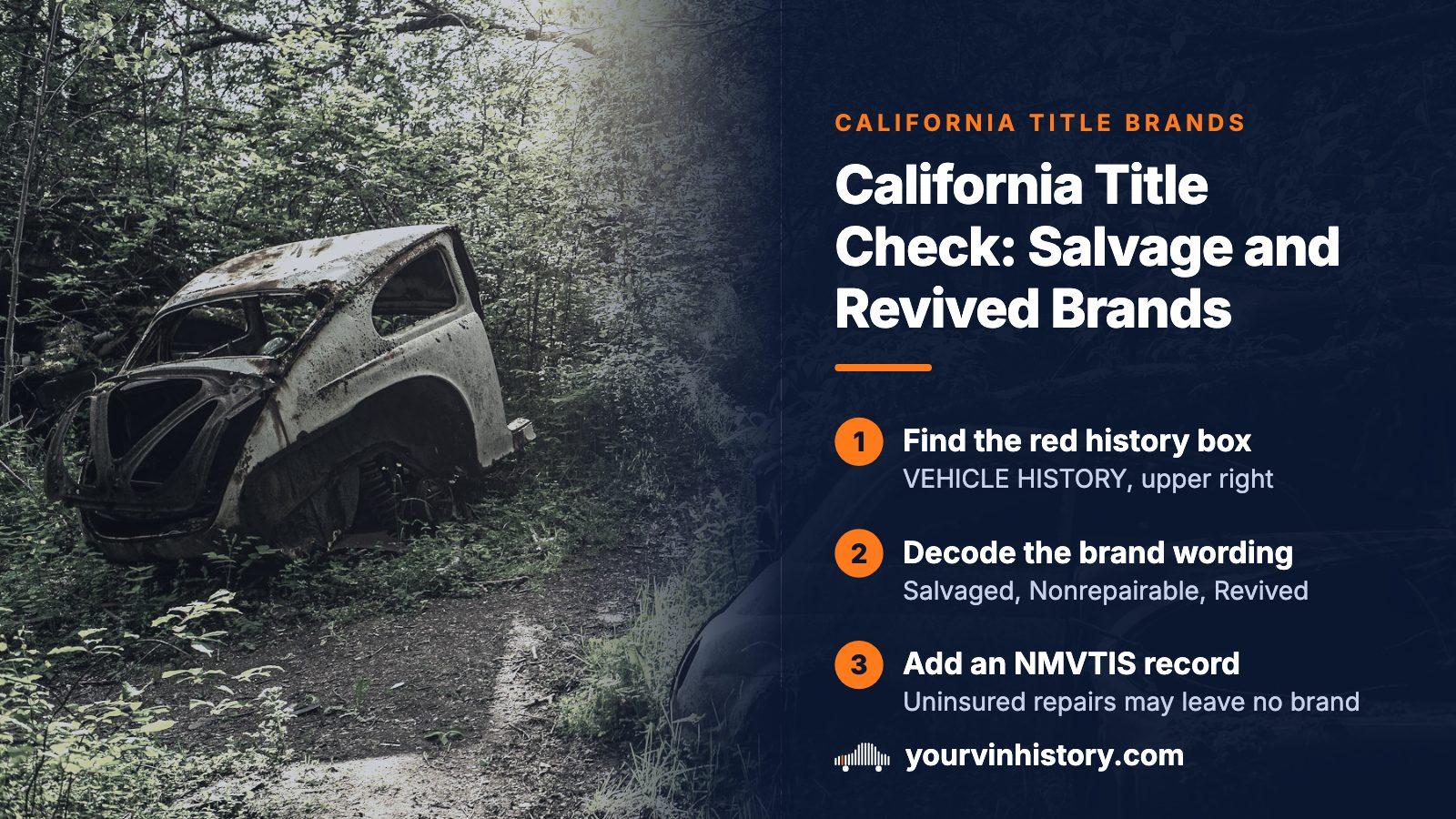
THE SHORT ANSWER
Look for the brand in the red VEHICLE HISTORY box near the upper right of a California title or salvage certificate. Salvaged means a wreck or other major damage, flood and vandalism included. Nonrepairable means parts-only, stripped or burned. Revived salvage means a total loss that was repaired and registered again. Then add a national NMVTIS record, because a repair that never involved an insurer may leave no California brand at all.
- Where the brand sits
- Red VEHICLE HISTORY box, upper right of the title
- Salvage test
- Owner or insurer judges repair uneconomical; no percentage
- Certificate deadline
- 10 days from an insurance settlement
- Rebuilt equivalent
- Revived salvage
Start with the red box marked VEHICLE HISTORY
California puts its brand where a buyer can find it. On a California Certificate of Title and on a Salvage Certificate, the DMV prints the brand in a red box labeled VEHICLE HISTORY, near the upper right-hand corner of the page. Check that corner before you read anything else, because a seller's summary or a listing headline may describe the car in softer words.
An empty box does not prove the car was never damaged. It only means the state has no brand on file. Titles also reach buyers as photocopies or phone pictures that crop exactly that corner, so ask to see the whole page. And before you trust any of it, compare the VIN on the document with the VIN on the car, character by character.
Why there is no percentage to calculate
Many states settle the total-loss question with arithmetic: repair cost divided by pre-damage value, compared with a cutoff somewhere around 70, 75 or 80 percent. California does not use that formula. Its statute defines a total loss salvage vehicle by a decision. The owner or the insurance company decided repair was uneconomical, and as a result the car was not repaired for the owner.
For a buyer, that removes a shortcut. You cannot take a repair estimate, run the division and predict whether the DMV branded the car. The brand follows the decision and the paperwork that came after it. Two cars with identical damage can end up with different records if one owner's insurer wrote the car off and the other owner simply paid a body shop.
The 10-day clock, and the owner nobody tracks
Once an insurer settles a total loss with the owner, the insurer is expected to obtain the salvage certificate within 10 days of the settlement. The DMV notes that self-insured owners can apply as well. Who carries the duty depends on how the loss was handled.
| Situation | Who gets the certificate |
|---|---|
| Insurer pays a total loss settlement | The insurer, on a 10-day deadline that starts at settlement |
| Owner has a total loss and no insurance settlement | The owner |
| Owner is self-insured | The owner may apply, depending on the circumstances |
Where the gap opens
The second row is where a clean California title can mislead. Nothing prompts an owner who drives away from a serious wreck, pays a shop and never calls an insurer. The state puts the duty on that owner, but a duty without a monitor does not produce a record. Treat a clean title on a car with visible repair work as an open question, not as reassurance.
One salvage brand, four possible stories
The DMV describes the salvaged brand broadly. A vehicle carries it after an accident, or after considerable damage from another source, and the examples the agency gives are flood and vandalism. The brand also reaches vehicles that were dismantled in the past, which California calls junk vehicles.
- Collision damage
- Flood or other water damage
- Vandalism
- A previously dismantled junk vehicle that was later put back together
Because every one of those wears the same label, the title cannot tell you which story you are in. Ask for the settlement letter, the repair invoices and photos taken before the work. Flood deserves extra suspicion, since it shows less on the outside than a crash does. Look for silt under the seat rails, damp or musty carpet and corroded electrical connectors.
Nonrepairable means the road ends here
The DMV treats a nonrepairable vehicle as a separate category from salvage. A vehicle fits when its owner declares it solely a source of parts or scrap metal, when it has been completely stripped (the DMV calls this a surgical strip), or when it is a burned shell with nothing usable or repairable left. After the nonrepairable certificate is issued, the vehicle cannot be titled or reregistered as a junk or revived salvage vehicle.
The practical reading is blunt. A salvage certificate describes a car that might return to the road. A nonrepairable certificate describes one that will not. If a seller hands you a nonrepairable document with a car that starts and drives, either the paper belongs to a different vehicle or the story is wrong. Hold the deal until someone explains it in writing.
Revived salvage is California's word for rebuilt
A search for a California rebuilt title usually ends at the phrase revived salvage. The DMV applies it to a vehicle that was reported as a total loss by the owner or the insurer, was repaired and then registered again. A listing that says rebuilt may be borrowing another state's vocabulary, so match the term on the California document to what the seller says.
The DMV also attaches a warning that every buyer should read twice. Some revived salvage vehicles were improperly repaired and may be dangerous, and some were repaired with stolen parts. If stolen parts turn up, the vehicle cannot be registered, and the vehicle or the parts can be seized. The person holding the car at that moment is the buyer who skipped the inspection.
Price the car as a rebuilt vehicle from the start, and expect the brand to come up again when you sell it.
What a revived salvage car goes through to be registered
The DMV's procedure for putting a salvage vehicle back on the road has several parts, and a buyer can ask a seller to show each one:
- A physical verification of the vehicle, done through a verifier or a CHP inspection
- An electronic vehicle safety systems inspection certificate
- Smog certification, where it applies
- Proof of ownership, such as a bill of sale or transfer paperwork from a licensed dismantler
A vehicle that was earlier reported as dismantled follows a similar route as a revived junk vehicle. Read the list as a registration gate, not a grade on the repair. Nothing in it tells you how well a frame was straightened or whether the airbags were replaced with working units. Ask for the repair invoices and pay an independent mechanic to look underneath.
Brands that describe use, not damage
Not every entry in the VEHICLE HISTORY box is a wreck story. The DMV lists several brands that flag how a vehicle was built or used, and each one changes the questions you should ask.
| Brand | What the DMV says it marks |
|---|---|
| Original/Prior Taxi | A former vehicle for hire, usually with high mileage |
| Original/Prior Police | A former law enforcement vehicle, usually with high mileage |
| Non-USA (gray market) | Built for sale outside the U.S., then converted to meet federal and California safety and emissions standards |
| Warranty Return (Lemon Law Buyback) | Returned to the manufacturer under California's Lemon Law |
| Remanufactured | Built by a licensed remanufacturer using reconditioned or used parts |
A taxi or police history is not damage, but long hours of idling and hard use belong in the price. A lemon law return was taken back over a defect, so ask which defect and whether it was fixed.
What the California paper cannot show you
A California certificate reflects what California recorded. If a car was totaled and branded in another state before it was titled here, the national title database is the place that can reveal it. NMVTIS carries title brand and total loss data across state lines, and the federal site lists the approved providers who sell reports to consumers. A yourvinhistory report draws its title records through ClearVin LLC, an approved NMVTIS data provider, and sets accident, odometer and salvage auction entries beside them.
Two free checks from others round it out. The NHTSA recall search takes a VIN and lists open safety recalls whatever the title says. The NICB's VINCheck screens for theft and salvage reports, though it has gaps, so a blank result is not a verdict.
A sequence for checking a California car before you pay
- Compare the VIN on the car with the VIN on the document.
- Find the VEHICLE HISTORY box and name the document: title, salvage certificate or nonrepairable certificate.
- If the brand reads salvaged, ask for the cause, the settlement papers and the repair invoices.
- Run the NHTSA recall search and the NICB VINCheck on the VIN.
- Pull a national NMVTIS record from an approved provider to catch brands applied in other states.
- Pay an independent mechanic to inspect the car, with extra attention to flood signs and structural repair.
Steps one and two take ten minutes and cost nothing. Skipping them is how buyers end up discovering the brand at the registration counter.
Where this information comes from
- California DMV: Total loss salvage and nonrepairable vehicles — Who obtains the salvage certificate, the 10-day deadline after a settlement, and the conditions that make a vehicle nonrepairable.
- California DMV: Branded titles — What the salvaged brand covers, the other brands California prints, and where the red VEHICLE HISTORY box sits.
- California DMV: Revived junk or salvage vehicles — How a revived salvage or revived junk vehicle gets verified and registered again.
- California Vehicle Code, Section 544 — The statutory definition of a total loss salvage vehicle, which turns on a judgment rather than a percentage.
- NMVTIS: Official vehicle history record — The national title record, and the list of approved data providers that sell reports to consumers.
- NHTSA: Recalls lookup — VIN-based search for open safety recalls, which is separate from any title brand.
Sources and photos: Facts checked against the sources above in October 2026. Photo by Patrick von der Wehd on Unsplash; diagrams by YourVINHistory.
Keep reading
- Total loss threshold by stateSee how the percentage tests in other states compare with California's judgment test.
- Salvage certificateLearn why a salvage certificate is not a title and what it allows.
- What is a rebuilt title?Revived salvage is California's version, so read what it means for value and insurance.
- Flood-damaged carsThe salvaged brand covers flood, so learn how to spot water damage the title will not describe.
Frequently asked questions
Does California have a total loss percentage?
No fixed percentage appears in the definition. A vehicle is a total loss salvage vehicle when the owner or the insurer judges repair uneconomical and the car is therefore not repaired for the owner. Insurers weigh that case by case, so two similar cars can end up with different records. The only reliable way to learn one car's status is through its documents and records.
Who is responsible for getting a California salvage certificate?
When an insurer pays a total loss settlement, the insurer must obtain the certificate within 10 days of the settlement. With no insurance settlement, the owner is responsible, and self-insured owners may apply too. If a seller says a badly damaged car never went through insurance, ask whether anyone ever applied for the certificate.
Is revived salvage the same as a rebuilt title?
In everyday use, yes. California's term covers a vehicle that was reported as a total loss, repaired and registered again, and registration involves a physical verification plus an electronic safety systems inspection certificate. Lenders and insurers may handle these cars differently from unbranded ones, so ask both before you agree to a price.
Can a car with a nonrepairable certificate be registered?
No. Once the DMV issues that certificate, the vehicle cannot be titled or reregistered as a revived salvage or junk vehicle. The category exists for vehicles declared solely as parts or scrap, completely stripped, or burned down to a shell. If you meet one for sale as a driver, check the VIN against the document.
Does a clean California title mean the car was never totaled?
No. A brand depends on a total loss being reported to the DMV. A car totaled in another state, repaired privately after a crash, or never claimed through an insurer can arrive with no California brand. A national NMVTIS record, a service history and a mechanic's inspection cover what the state paper does not.
Now check the car itself
The guide explains what to look for. The report shows what this VIN has on record.