THE SHORT ANSWER
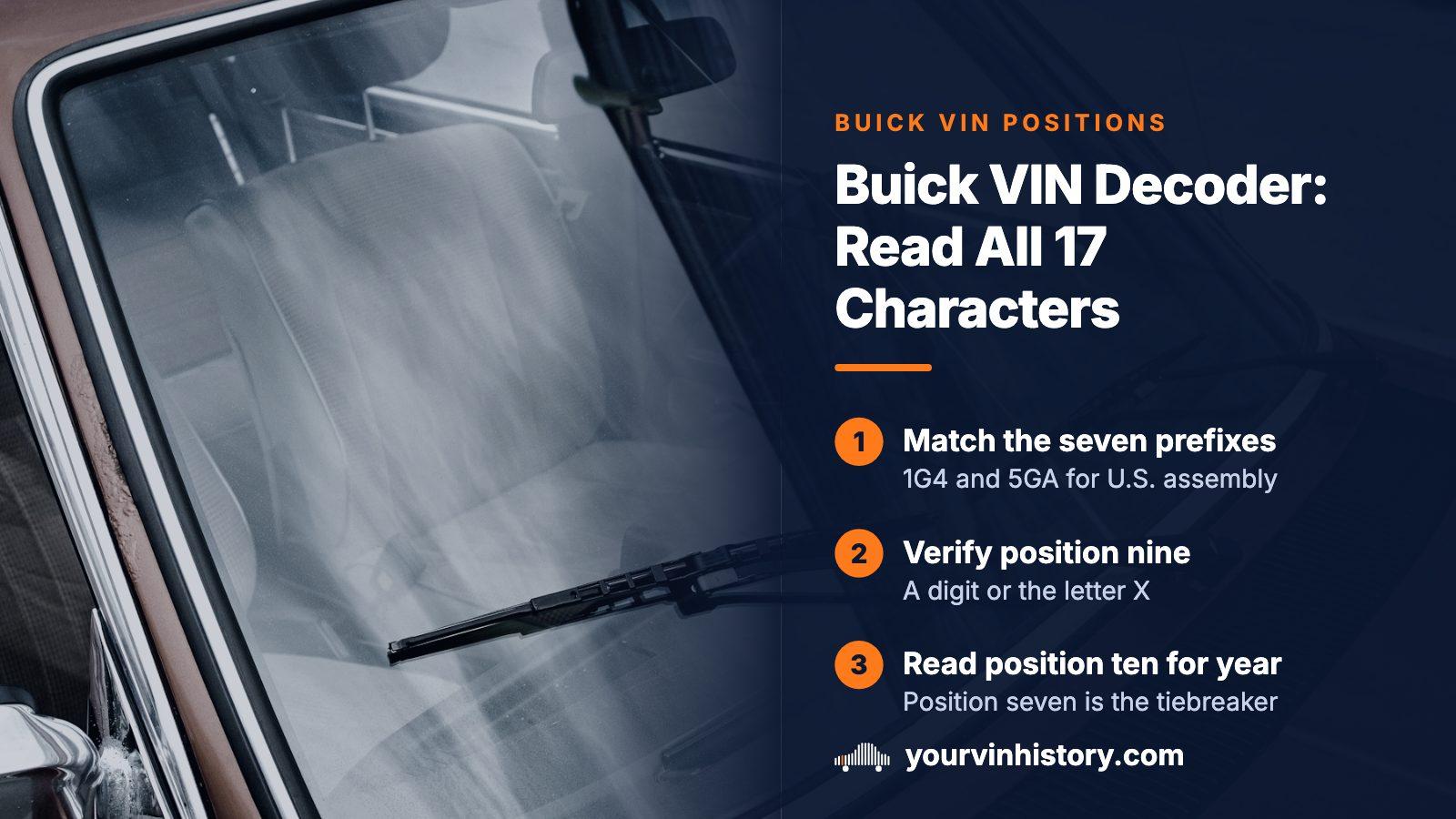
Positions 1 to 3 name the maker and the vehicle type. Buick uses 1G4 (passenger car) and 5GA (multipurpose vehicle) for U.S. assembly, plus 2G4 for Canada, 3G4 for Mexico, KL4 for South Korea, LRB for China and W04 for Germany. Positions 4 to 8 are General Motors' own description, 9 is a check digit, 10 is the model year, 11 is the plant and 12 to 17 are the production number.
- Buick prefixes
- Seven, two of them for U.S. assembly
- Check digit
- Position 9, a digit or the letter X
- Model year
- Position 10, with position 7 as the tiebreaker
- 17-character format
- Standard from the 1981 model year
Read the VIN off the car before you decode it
Federal rules require a Buick's VIN to sit inside the passenger compartment, legible through the glass from beside the driver's side windshield pillar. In practice that means the plate on top of the dashboard. Copy it from there rather than from an ad, because listings get typed by hand and a decoder will happily process the wrong car.
- Copy all 17 characters in order, with no spaces.
- Distrust any I, O or Q you think you see. Those letters are never used in a VIN, so an O-shaped character is a zero and an I-shaped one is a one.
- Compare the plate with the driver's door jamb label, which repeats the VIN and shows the month of manufacture.
- If the two disagree on even one character, get an explanation before any money changes hands.
The seven Buick prefixes and where each one was assembled
The first three characters are the manufacturer identifier. Run through NHTSA's vPIC lookup, these seven all return Buick as the make and General Motors as the common name. The country column comes from the first character, a convention explained in the next section.
| Prefix | Vehicle type in the federal record | Assembly country |
|---|---|---|
| 1G4 | Passenger car | United States |
| 5GA | Multipurpose passenger vehicle | United States |
| 2G4 | Passenger car | Canada |
| 3G4 | Passenger car | Mexico |
| KL4 | Multipurpose passenger vehicle | South Korea |
| LRB | Multipurpose passenger vehicle | China |
| W04 | Passenger car | Germany |
The badge tells you far less about origin than these three characters do. Note two oddities in the record. LRB lists both Buick and Cadillac as makes, so the prefix alone does not say which badge is on the car. And the formal manufacturer behind LRB is Shanghai General Motors, while W04 names Adam Opel AG. A prefix missing from this table is not automatically a problem; decode the whole number.
Why one brand needs several identifiers
An identifier names a manufacturer and a type of vehicle. Part 565 defines a type as a class of vehicles sharing traits such as design and purpose, and it files passenger cars and multipurpose passenger vehicles as separate types. That is why Buick holds 1G4 for U.S.-built cars and 5GA for U.S.-built multipurpose vehicles. A crossover can be filed as an MPV while a sedan from the same brand is a passenger car.
The country letter is a convention
Part 565 never uses the word country. It says only that the first section identifies the manufacturer and the type. Pairing 1 with the United States, 2 with Canada, 3 with Mexico, K with South Korea, L with China and W with Germany is a long-standing practice that holds up well, but it is not wording you can cite from the regulation. NHTSA has contracted SAE International to coordinate identifier assignments for manufacturers in the United States.
What a Korean, Chinese or German prefix means in a used-car deal
A letter in the first position points to assembly outside North America: K for South Korea (KL4), L for China (LRB), W for Germany (W04). None of that makes the car a lesser Buick. Age, upkeep and driving habits predict wear better than the country of assembly.
It matters in narrower ways. Parts for an older German-built model can come through a different supply chain than a domestic Buick's, so give the parts counter the full VIN. Recalls can also be limited to one plant, covered further down.
Positions 4 to 8: General Motors' own description of the car
These five characters use a code that General Motors designs. GM has to file the key with NHTSA so the characters can be deciphered. For a Buick passenger car the five positions must cover:
- Make and model line
- Series
- Body type, such as sedan or hatchback
- Engine type
- Restraint devices and where they sit in the car
A multipurpose passenger vehicle adds its gross vehicle weight rating. Because the arrangement is GM's choice, no universal chart can read it; a decoder fed by the manufacturer's filing can. On cars, multipurpose vehicles and light trucks built to the current layout, position 7 must be a letter, a detail that returns below.
Position 9: the check digit and what it can prove
The ninth character is a digit from 0 to 9 or the letter X. The manufacturer works it out last. Each character becomes a number, gets multiplied by a weight tied to its position, and the sum is divided by 11. The remainder sets the check digit, with a remainder of 10 written as X.
Its job is catching transcription errors. If a VIN from an ad fails the calculation, a mistyped character is the likeliest cause, and a photo of the plate usually settles it. Passing is a lower bar than it sounds: a valid check digit shows the number is internally consistent, not that the car wearing it is honest.
Position 10: model year, and how position 7 separates the decades
Letters stand for model years from 2010 onward and skip I, O, Q, U and Z. The digits 1 through 9 cover 2001 to 2009. The recent stretch looks like this:
| Code | Model year | Code | Model year | Code | Model year |
|---|---|---|---|---|---|
| F | 2015 | K | 2019 | P | 2023 |
| G | 2016 | L | 2020 | R | 2024 |
| H | 2017 | M | 2021 | S | 2025 |
| J | 2018 | N | 2022 | T | 2026 |
The same letters were used a generation earlier, so a letter alone is ambiguous. For cars, multipurpose vehicles and light trucks, the federal rule settles it with position 7: a letter there puts the tenth-position code in the 2010-and-later cycle, while a digit means a year from 1980 through 2009.
Model year is not build date. A Buick with R in position 10 is a 2024 model that may have rolled off the line in 2023, and the door jamb label shows the real month.
Positions 11 to 17: the plant, then the serial for that one car
Position 11 names the assembly plant. General Motors assigns the plant characters, and sites open, close and change products over the years, so a fixed chart goes stale. Positions 12 through 17 are the sequence number the manufacturer gave the car in production, which makes the full VIN unique to that one vehicle.
Plant and build date matter most for recalls. A manufacturer sometimes scopes a recall to vehicles built at named plants between two dates, since that is how a bad batch of parts reaches the line. Two Buicks of the same year and trim can land on opposite sides of the cutoff. Learning that a recall skips your car is useful as well, since it spares you a pointless dealer visit.
Checking a Buick for open recalls
Recalls attach to specific vehicles, so the useful question is whether this VIN has an open one, not whether the model was ever recalled.
- Read the VIN from the car and confirm it against the door jamb label.
- Enter it in NHTSA's recall lookup, a free federal tool that lists open recalls for that VIN.
- If something appears, ask a dealer what the remedy is and whether parts are ready. Where the notice names plants and build dates, compare them with your car.
Cost deserves a careful sentence. Federal law requires the manufacturer to remedy a covered defect at no charge to the owner, but only within an age limit: a vehicle first bought at retail more than 15 calendar years before the recall notice went out falls outside the federal free-repair rule. Inside that window an open recall is the manufacturer's bill. Outside it, talk to the manufacturer before booking work.
What a Buick VIN decode cannot tell you
A decode describes the car as it left the factory. Everything afterward sits in other records:
- Accidents, insurance claims and structural repairs
- Title brands such as salvage, rebuilt, flood and lemon
- Odometer readings and signs of rollback
- Previous owners and how the car was used
- Whether a recall repair was ever carried out
- Liens, impounds and theft records
A vehicle history report built on the VIN fills those gaps. A yourvinhistory.com report covers title brands, accidents with a damage map, odometer readings, salvage and auction photos, liens, theft and open recalls, and it begins with a preview before the one-time paid report. NICB's VINCheck, a free lookup of theft and salvage records from participating insurers, makes a handy cross-check.
Buicks built before the 17-character format
The standardized 17-character VIN begins with the 1981 model year. An earlier Buick carries a shorter number in General Motors' own scheme, and NHTSA's public decoder generally does not cover it, so an empty result for a vintage Buick is normal, not a warning sign.
For those cars the useful evidence is physical and documentary: the number plate, the cowl tag and any surviving build paperwork. Make sure the number on the car matches the title. The classic car VIN decoder and GM build sheet guides on this site explain what the older tags contain.
Where this information comes from
- NHTSA: vPIC manufacturer identifier lookup — The federal database used to see the make, vehicle type and formal manufacturer name behind each Buick prefix.
- eCFR: 49 CFR Part 565, VIN requirements — The rule behind the position-by-position layout, the check digit, the model year codes and the definition of vehicle type.
- NHTSA: Recalls — The federal lookup that reports open safety recalls for a specific VIN.
- NICB: VINCheck — A cost-free theft and salvage lookup fed by participating insurers, used as a cross-check on a Buick.
Sources and photos: Facts checked against the sources above in October 2026. Photo by Max Tokarev on Unsplash; diagrams by YourVINHistory.
Keep reading
- General MotorsShows how the same positions point to the division across all of General Motors.
- GM build sheetThe next step if you want the factory options and codes a VIN decode leaves out.
- Where was my car made?Reads assembly origin from the VIN across manufacturers, not just Buick.
- Recall check by VINGoes deeper on searching recalls by VIN rather than by model.
Frequently asked questions
Can a VIN tell me my Buick's model and engine?
Yes, through a decode rather than by eye. Positions 4 to 8 hold General Motors' coded description of the model line, series, body type, engine and restraint equipment, and a decoder using the manufacturer's filed key returns them in plain terms. Factory options are not part of that description, so check the car for equipment.
Does a Buick VIN that starts with a letter mean it was not built in America?
By convention, yes: K points to South Korea, L to China and W to Germany. On the Buick codes, 1 and 5 are U.S. assembly, 2 is Canada and 3 is Mexico. The letter records where the car was put together. It is not a defect and it carries no stigma.
What if the VIN on the dash and the door label do not match?
Hold off buying until it is explained. A mismatch can be as harmless as a replaced part or as serious as a swapped identity, and a seller guessing cannot tell you which. Photograph both numbers, ask for the title and service paperwork, run each through a recall lookup, and consider an official VIN verification through your state.
Can I still run a recall check on a Buick that is more than 15 years old?
Run it anyway, because the lookup works from the VIN. What changes with age is who pays: federal law requires the remedy at no charge only for vehicles first sold within 15 calendar years of the recall notice. An older Buick may fall outside that rule, so ask the manufacturer what it will cover before booking work.
Will a VIN decode show accidents or title problems?
No. A decode reads the build data tied to the VIN, so it cannot show crashes, title brands, odometer readings or owners. Those live in separate sources such as title records, insurers and auctions, and a history report pulls many of them together.
Now check the car itself
The guide explains what to look for. The report shows what this VIN has on record.