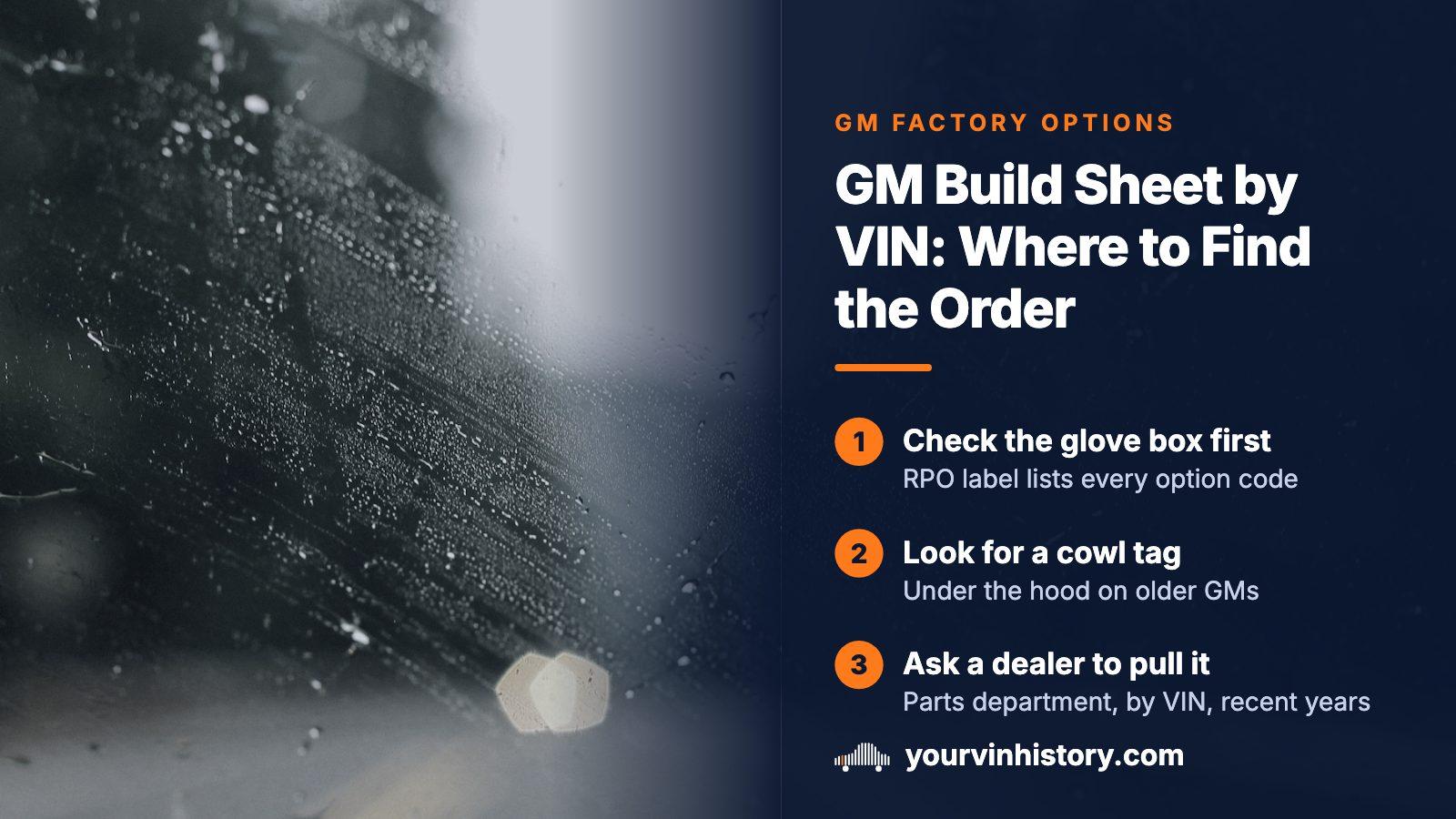
THE SHORT ANSWER
Check the vehicle first. A modern GM car carries a Service Parts Identification label, usually in the glove box, that lists every factory option by RPO code. Older cars have a cowl tag under the hood. For a recent model year, a dealer parts department can pull the factory record by VIN. Older records thin out, so the paperwork on the car becomes the main evidence.
- Modern GM vehicles
- RPO label, glove box first
- Classic GM vehicles
- Cowl tag under the hood
- Public VIN decode
- Identifies the vehicle, not its option list
- Legally required record
- Incomplete Vehicle Document, 49 CFR Part 568
Which GM document fits the age of the car
People say build sheet and mean several different things. GM has used more than one kind of record, and the one you can hold depends mostly on model year. NHTSA's public vPIC decoder pins down year, model and plant, which tells you where to look. It does not list the equipment.
| Record | Typical vehicle | Where it is |
|---|---|---|
| RPO label (Service Parts Identification) | Modern GM vehicles | Glove box first, then the console lid or cargo area |
| Cowl tag, also called body tag or trim tag | Classic GM vehicles | Cowl area under the hood |
| Assembly-line paper sheet | Any age, if it survived | Tucked inside the body during assembly |
| Dealer-retrieved factory record | Reasonably recent vehicles | Pulled from GM's systems by a parts department |
| Incomplete Vehicle Document | Chassis completed in stages, such as cutaway vans | Handed along with the chassis under a federal rule |
The RPO label is the first thing to photograph
Regular Production Option codes are GM's shorthand for factory equipment. A label stuck to the vehicle prints the whole set as three-character codes, and most owners have never taken it out of the glove box. The scheme is shared by Chevrolet, GMC, Buick and Cadillac.
- Open the glove box first, since that is the usual home for the label
- Try the console lid, the cargo area and the space beneath the spare tire cover
- Capture the full label in your photo, not only the codes you happen to recognize
- Find the paint code and the axle ratio, which are both listed, and ask a dealer about any code you cannot place
Older GM cars: the cowl tag under the hood
Before labels came a metal plate fastened to the body, known as the cowl tag and sometimes as the body tag or trim tag. Look at the cowl, the panel at the back of the engine bay below the windshield.
The plate records the body style, the paint, the interior trim, the date it was built and the plant. The abbreviations shifted between divisions and years, so a code means nothing until you check it with a guide written for your division and model year.
No online decoder reads these
Cowl tag codes were never placed in a public database. Marque guides, restoration manuals and owner clubs are the working route. The classic car VIN decoder guide covers the serial numbers issued before 1981.
The paper sheet that sometimes rides inside the body
Assembly-line paperwork followed each car down the line, and workers did not always take it out again. Restorers find these sheets decades later. A surviving one is the factory's own instruction for what to fit, with nothing to decode.
- Inside or under the seat springs, the most frequently reported spot
- Lying on the gas tank, just under the trunk floor
- Behind door trim panels
- Beneath the carpet or under the rear seat
- Over the headliner on certain body styles
Old paper tears easily, so photograph a sheet where it lies before you move it. On a restored classic, ask the seller whether one ever turned up. Owners who find one tend to keep it, and it backs up the asking price.
Having a dealer pull the factory record
For a reasonably recent vehicle, a GM dealer can ask its parts counter to pull the original build record from the manufacturer's files. Keyed to the VIN, the lookup returns the option content with no label in hand, which suits a buyer shopping from a distance.
Coverage fades going back in time. Records for older vehicles turn patchy and then vanish, and the label, tag or sheet on the car carries the weight. Ask for the result on paper or as a photo so no one copies the codes by hand.
Why the codes carry more weight than the badges
Grille inserts, wheels, trim and badges can all be changed after a vehicle leaves the factory, and so can an engine. A code recorded while it was being built cannot be changed. That is the difference between a seller's claim and a documented fact.
| The claim | What the record settles |
|---|---|
| Top trim level | Whether the equipment for that trim was logged at build or the badges came later |
| Off-road or tow package | Whether the factory fitted the suspension, differential and cooling hardware |
| Performance model | Which engine and drivetrain it left the plant with |
| Original paint | The factory color code, set against what the body wears today |
| Rare classic configuration | Whether the advertised combination matches what the tag and sheet record |
A buying sequence that uses the right document
- Decode the VIN to confirm the model year, since that decides which document applies.
- For a modern GM vehicle, ask the seller for a clear photo of the RPO label before you drive out.
- For a classic, photograph the cowl tag and look it up in a reference matched to that division and year.
- On a restored car, ask whether an original paper sheet was ever found.
- Where the vehicle is recent enough, ask a dealer to pull the factory record.
- Walk the vehicle against the paperwork. Equipment claimed but absent from the codes was added later.
- Pay for authentication on anything priced for a rare configuration.
Equipment is only half of what a buyer needs. A vehicle history report by VIN covers title brands, accidents, odometer readings and open recalls, which no build document records. The preview is free before you decide to buy.
The one build record a federal rule requires
Everything so far is paperwork GM chose to produce. One build document exists because a regulation says it must: the Incomplete Vehicle Document, set out in 49 CFR Part 568 and keyed to the VIN.
You will not meet it on an ordinary car. Part 568 governs vehicles finished in two or more stages: a cutaway van, a chassis-cab, a bare chassis that leaves the plant with no body. Under the definitions in 49 CFR 567.3, an incomplete vehicle is a base assembly of frame, power train, steering, suspension and brakes that still needs more manufacturing. A chassis-cab adds a finished occupant compartment and needs only cargo-carrying or work-performing parts. The final-stage manufacturer is whoever completes the job.
What the Incomplete Vehicle Document must say
Section 568.4(a) requires the chassis maker to furnish the document for each incomplete vehicle at or before delivery. It lists nine statements in a fixed order, much like a build sheet.
| Item in 568.4(a) | What it covers |
|---|---|
| (1) and (2) | The maker's name and address, plus the month and year of its last operation on the chassis |
| (3) | The VIN or group of VINs covered, so the document can be matched to a vehicle after being separated from it |
| (4) and (5) | The weight rating of the finished vehicle and of each axle, listed front to rear |
| (6) | Which kinds of vehicle the chassis may become, such as truck, bus or trailer |
| (7) | Each applicable federal safety standard, followed by a conformity grade running from Type 1 to Type 3 |
| (8) and (9) | A summary of those standards, plus a certification that later manufacturers may rely on the statements |
Item (3) deserves a second look. The rule expects the document to get separated from its vehicle and demands the VIN so the two can be reunited, the very problem a loose classic sheet has.
The three grades form a ladder of certainty. Type 1 says the finished vehicle will meet the standard if identified components are left alone. Type 2 says it will if the final builder follows stated conditions. Type 3 says conformity cannot be judged from the parts supplied, and the chassis maker makes no claim.
Buying a converted GM chassis: who built what
Badge, VIN and driving feel all point to GM, yet much of a finished two-stage vehicle came from someone else. Under 568.5, a company working between chassis and final stage passes the document on, with an addendum if its work makes any statement untrue. Under 568.6, the final-stage builder meets the standards in force on a date it picks, from the chassis build date to completion. Under 568.7, a maker that accepts full legal responsibility skips this paperwork, and a label under 567.5(f) or 567.5(g) is used instead.
A well-documented conversion can arrive with a small stack: the chassis maker's document, an addendum from each intermediate builder, and the final-stage certification label. Ask the seller:
- Who was the final-stage manufacturer, by name, and not only who made the chassis
- Did the Incomplete Vehicle Document come with the vehicle
- Does the certification label show a second manufacturer beside the chassis maker
- Is the body or conversion treated as separate equipment with its own history
What this cannot do
This is a rule for manufacturers, not a public lookup. No database of these documents exists, a VIN will not retrieve one, and they do not appear on a vehicle history report. The only route is asking the seller.
Where this information comes from
- eCFR: 49 CFR Part 568 — The federal rules for vehicles built in two or more stages, including the roles of intermediate and final-stage manufacturers.
- eCFR: 49 CFR 568.4 — The nine statements an Incomplete Vehicle Document must carry, including VIN identification and the Type 1, 2 and 3 conformity grades.
- eCFR: 49 CFR 567.3 — Where the terms incomplete vehicle, chassis-cab and final-stage manufacturer are defined.
- NHTSA: vPIC VIN decoder — A public decode that confirms the vehicle's basic identity before you go looking for build documents.
- NHTSA: recalls lookup — Government tool for checking open recalls by VIN.
Sources and photos: Facts checked against the sources above in October 2026. Photo by Dylan Michaud on Unsplash; diagrams by YourVINHistory.
Keep reading
- ChevroletExplains how RPO codes work, which applies to every GM division.
- Classic car VIN decoderCovers pre-1981 serial numbers, clones and restamped tags, the world cowl tags belong to.
- Window sticker by VINAnother document that records how a vehicle was equipped when new.
- General MotorsShows how the VIN itself points to the division and build details.
Frequently asked questions
Can I get a GM build sheet with only the VIN?
Sometimes. A dealer parts department can often retrieve the factory record for a reasonably recent vehicle, so bring all 17 characters and check them against the number on the vehicle. Public decoders identify the vehicle but do not list its options. On older vehicles, the label, tag or sheet is the better source.
What is the difference between an RPO label and a build sheet?
The RPO label is fixed to the vehicle and lists option codes you can read yourself. A build sheet is the assembly paperwork written for one car, and it survives inside the body or sits in the manufacturer's records. The two overlap in content but come from different places.
What does a GM cowl tag tell me?
Stamped codes covering body style, paint, trim, build date and plant. The scheme differs by division and model year, so you need a matching reference. Photograph the whole plate in good light, since one misread character sends you to the wrong row.
Does a build sheet prove a GM car is genuine?
It is strong evidence and nothing more. A reproduction plate looks convincing, and a paper sheet can travel between cars. On a high-value vehicle, back the documents with a hands-on inspection, and add a marque authenticator when the premium is large.
Does a GM cutaway van or chassis-cab have different paperwork?
Yes. Because another company finishes it, federal rules call for an Incomplete Vehicle Document from the chassis maker and a certification label from the final-stage builder. Ask the seller for both, and for the body builder's name, since the RPO label describes the chassis alone.
Now check the car itself
The guide explains what to look for. The report shows what this VIN has on record.