THE SHORT ANSWER
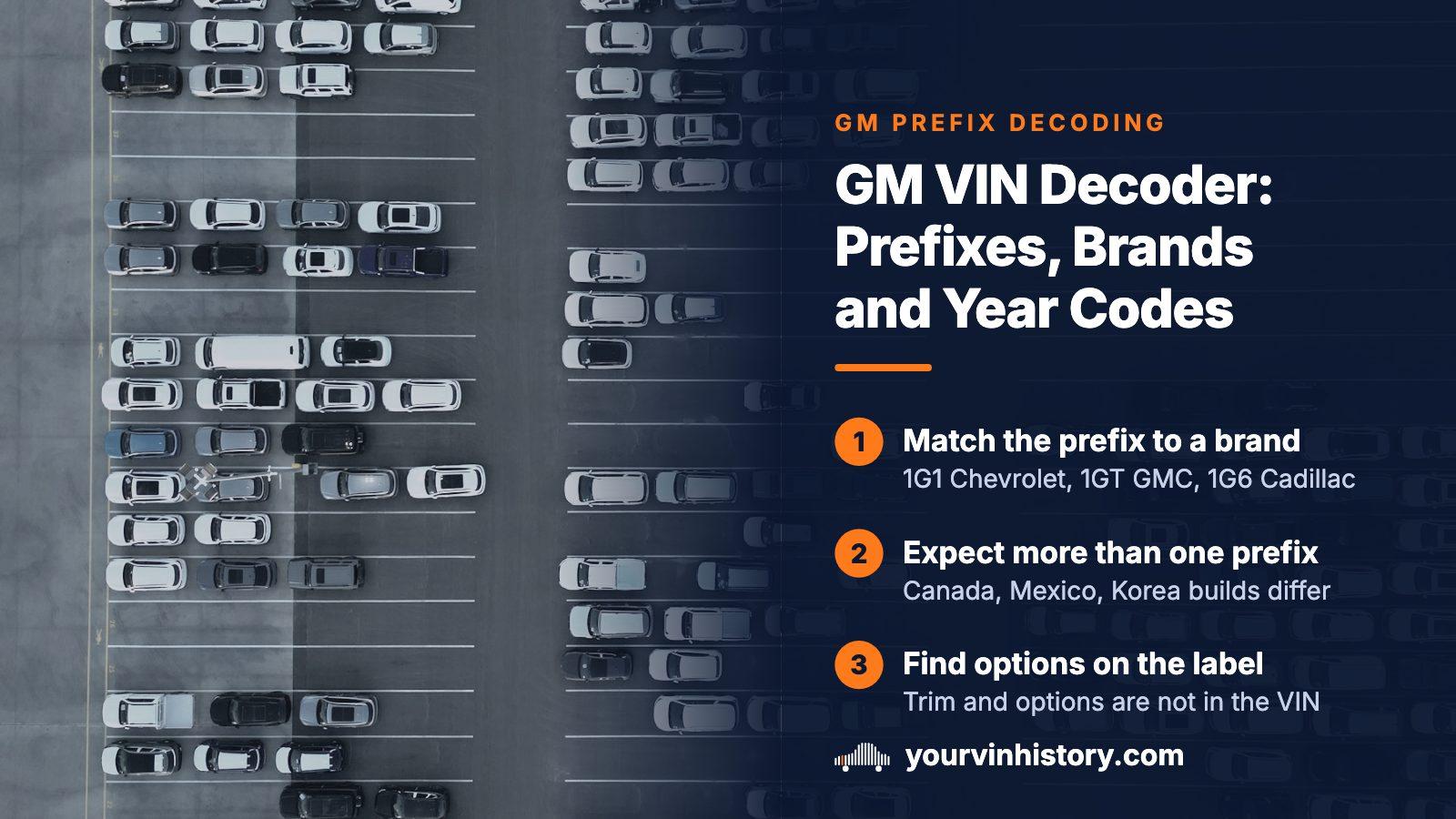
Paste the 17 characters into NHTSA's vPIC decoder. Prefixes such as 1G1 (Chevrolet car), 1GT (GMC truck), 1G6 (Cadillac car) and 1G4 (Buick car) all resolve to General Motors LLC. One brand can show different prefixes when it was built in Canada, Mexico or South Korea. Positions four to eight are GM's own code, and option content lives on a separate label, not in the VIN.
- Chevrolet car prefixes
- 1G1, 2G1, 3G1 and KL8, by build country
- Manufacturer of record
- General Motors LLC on every prefix tested
- Positions 4 to 8
- Coded by GM, not fixed by federal rule
- Options
- On the RPO label, not in the VIN
Why a Chevrolet can start with 2G1 or KL8
Plenty of web charts state flatly that Chevrolet means 1G1. A shopper then meets a listing that begins 2G1 or KL8, decides the number is bogus, and passes on a sound car. The chart was the problem, not the VIN.
The first three characters form the world manufacturer identifier, and they pack in two facts. One is who built the vehicle. The other, through the opening character, is the region where it was assembled. The United States uses 1, 4 and 5, Canada 2, Mexico 3, and South Korea letters in the K range. Chevrolet has built cars in all four countries, so one brand lands under 1G1, 2G1, 3G1 and KL8.
Treat an unexpected first character as a prompt to check the assembly plant, not as a fraud signal. Treat a familiar one just as cautiously: a leading 1 says only that the vehicle was assembled in the United States, and many unrelated makers share it. All three characters together name the builder.
The GM prefixes, as NHTSA's register lists them
Each prefix below was run through NHTSA's manufacturer register instead of being copied from a chart. All of them name General Motors LLC as the manufacturer. The selection is not exhaustive, since the register also holds bus entries and a few partner nameplates.
| Make | Prefix | Class in the register |
|---|---|---|
| Buick | 1G4 | Passenger car |
| Cadillac | 1G6 | Passenger car |
| Cadillac | 1GY | Multipurpose passenger vehicle |
| Chevrolet | 1GN | Multipurpose passenger vehicle |
| Chevrolet | 1G1 | Passenger car |
| Chevrolet | 2G1 | Passenger car built in Canada |
| Chevrolet | 3G1 | Passenger car built in Mexico |
| Chevrolet | KL8 | Passenger car built in South Korea |
| Chevrolet | 1GC | Truck |
| GMC | 1GK | Multipurpose passenger vehicle |
| GMC | 1GT | Truck |
| GMC | 1GD | Incomplete vehicle |
| Holden and Oldsmobile | 1GH | Multipurpose passenger vehicle |
| Oldsmobile | 1G3 | Passenger car |
| Pontiac | 1G2 | Passenger car |
| Pontiac | 1GM | Multipurpose passenger vehicle |
| Saturn | 1G8 | Passenger car |
Look at 1GH. One identifier, two makes, because identifiers are issued to a manufacturer and not to a showroom brand. A code and a badge do not map one to one in either direction.
The last prefix character sorts cars, trucks and multipurpose vehicles
Inside a single division, GM uses the third character to separate vehicle class. GMC trucks decode under 1GT while GMC multipurpose passenger vehicles decode under 1GK. Chevrolet follows the same pattern with 1G1 for cars, 1GC for trucks and 1GN for multipurpose vehicles.
Multipurpose passenger vehicle is the federal category that covers most SUVs and many vans. Class matters because the rules are written around it. Under 49 CFR § 565.15, a car's VIN must let the maker decipher make, line, series, body type, engine type and restraint devices, while a truck's must cover items such as cab type, brake system and gross vehicle weight rating.
- Car prefixes such as 1G1, 1G6 and 1G4 point to passenger cars.
- Truck prefixes such as 1GC and 1GT point to pickups and other truck-class vehicles.
- MPV prefixes such as 1GN, 1GK and 1GY point to SUV and van territory.
- 1GD marks an incomplete vehicle: a chassis sold without its final body, so someone else may finish it.
Positions four to eight are GM's own code
After the prefix, federal rules step back. The regulation hands the next five characters to the manufacturer, who chooses which characters to use and where they sit, provided the required attributes can be deciphered from information the company supplies to NHTSA. On a car, or on an SUV, van or truck with a weight rating up to 10,000 pounds, the seventh position must be a letter.
That freedom is why printed charts mislead. A table that reads a 1990s Chevrolet truck correctly will produce confident nonsense on a recent Cadillac, because no rule forced GM to hold those five characters constant across divisions and generations. Twelve of the seventeen positions mean the same thing on any GM vehicle built to the standard. These five do not, and they are the ones carrying model and engine information.
Check digit, model year and plant: positions nine to eleven
Position nine is arithmetic, not a GM choice. Every other character is turned into a number, multiplied by a weight tied to its position, and the sum is divided by 11. The remainder sets the digit, with an X standing in when it reaches 10. A VIN that fails the test was mistyped or altered. One that passes is merely consistent, not proven genuine.
Position ten is the model year character, covered in the next section. Position eleven is the assembly plant, and GM assigns those plant codes itself, which is why vPIC reports the plant country for you instead of leaving you to guess from a letter. The final six positions are the serial number within that plant's output.
Reading the year character on an older GM vehicle
The year sequence uses letters and digits, skips characters that look like numbers, and repeats every thirty years. A stood for 1980 and the letters ran to Y for 2000. The digits 1 to 9 then covered 2001 to 2009, and the letters started over at A for 2010.
| Position 10 | Year it stands for |
|---|---|
| A | 2010 with a letter in position 7, 1980 with a digit |
| L | 2020 with a letter in position 7, 1990 with a digit |
| R | 2024 with a letter in position 7 |
| T | 2026 with a letter in position 7 |
| 1 through 9 | 2001 through 2009 with a digit in position 7 |
| Y | 2000 with a digit in position 7 |
The regulation supplies a tiebreaker. For cars and for lighter SUVs, vans and trucks, a numeric seventh position puts the year between 1980 and 2009, and a letter puts it between 2010 and 2039. Heavier vehicles, including incomplete chassis such as 1GD, fall outside that rule. It matters on GM because Pontiac and Saturn both built vehicles into 2010, right where the sequence wrapped back around to A.
Pontiac, Oldsmobile, Saturn and Holden still decode
GM has retired more nameplates than most manufacturers ever launched. Their prefixes stay in the register because the vehicles stay on the road, and vPIC still lists General Motors LLC as the maker behind each one.
| Retired brand | Prefixes in the register | Detail |
|---|---|---|
| Oldsmobile | 1G3 for cars, plus 1GH | Stopped building in 2004 |
| Pontiac | 1G2 for cars, 1GM for multipurpose vehicles | Built vehicles into 2010 |
| Saturn | 1G8 for cars | Built vehicles into 2010 |
| Holden | 1GH, shared with Oldsmobile | GM's Australian marque |
A dead brand can still have a recall record
Put a Pontiac or Saturn VIN into NHTSA's recall lookup the same way you would a current model. The repair duty follows the manufacturer, not the badge. Federal law does end the no-charge requirement when the first buyer purchased the vehicle more than 15 calendar years before the recall notice, so ask a GM dealer what applies to an older car.
Twin badges share parts, so search recalls by VIN
GM sells many trucks and SUVs in pairs: shared hardware, different badge, different dealer network. The prefix tells you which badge a vehicle wears, 1GC for a Chevrolet truck or 1GT for a GMC, but it does not tell you the underlying parts differ. A defect found on one often produces a campaign on the other.
That is why recall searches belong on the VIN, not on a brand name. NHTSA's lookup matches the number to open campaigns on your exact vehicle, whichever division the news coverage named. If owner reports make you rule out one model year of a Silverado, give the same year of a Sierra the same hard look. Complaints filed with NHTSA can lead to an investigation, and sometimes a campaign follows.
Trim and options sit on a label, not in the VIN
Ask what a listing's trim package actually contains and the VIN stays silent. GM records installed equipment as regular production option codes, called RPO codes, on a label inside the vehicle, typically in the glovebox or the trunk area. That label is the document to hold an advertised trim, axle ratio, paint or package against.
When the codes and the advertisement disagree, you have a conversation to start before any money moves. Reading the label is a second step after decoding, not something the 17 characters can replace.
A short routine for a used GM vehicle
- Copy the VIN from the vehicle itself and compare it with the title and the listing.
- Decode it in vPIC and confirm make, model year, plant country and body class.
- Look at the third prefix character and make sure the class matches the ad.
- Run the same VIN through NHTSA's recall lookup.
- Find the RPO label and compare its codes with what the seller claims.
What a decode cannot say about the car's life
A decode describes the factory order. It is silent on collision damage, title brands, odometer accuracy and liens, and a clean result proves nothing on those points. The number records how the vehicle left the plant, not what happened afterward.
Part of that gap closes with other free tools: NICB's VINCheck covers theft and salvage records, and NHTSA's lookup covers open recalls. Title records sit in NMVTIS, which approved providers sell to the public for a few dollars. A yourvinhistory report adds title brands, accident records with a damage map, odometer readings, salvage and auction records, and liens. The preview costs nothing, the full report is a one-time purchase, and its title records come from ClearVIN LLC, an approved NMVTIS data provider.
Where this information comes from
- NHTSA: vPIC VIN decoder — The public decoder and manufacturer register used to read back each GM prefix, its make and its vehicle class.
- NHTSA: Recalls — The VIN-based open-recall search, which also works for vehicles from retired GM brands.
- NHTSA: Report a safety problem — Where an owner files a defect complaint that the agency can turn into an investigation.
Sources and photos: Facts checked against the sources above in October 2026. Photo by Iain on Unsplash; diagrams by YourVINHistory.
Keep reading
- ChevroletChevrolet is the biggest GM division, and its RPO label settles most trim disputes.
- GMCThe truck twin to Chevrolet, including how to verify a high-trim GMC.
- GM build sheetThe next step if you want the original factory order, not just the decode.
- How to read a VINWalks every one of the 17 positions, with the year chart and check digit.
Frequently asked questions
How can I decode a GM VIN?
Enter all 17 characters into NHTSA's vPIC decoder. For GM vehicles it returns make, model, model year, plant country and body class without payment or registration. It will not list the options on the car or anything about its past, so pair it with the RPO label and a history check before you buy.
Is a GMC the same as a Chevrolet in the VIN?
No. Both list General Motors LLC as the manufacturer, but the register keeps separate prefixes and makes. A Chevrolet truck decodes under 1GC and a GMC truck under 1GT. Shared hardware means recalls often overlap, yet each vehicle's record stays under its own badge, so search by VIN.
Why does 1GH show two makes?
Identifiers are issued to a manufacturer, not to a marque, so one code can carry more than one nameplate. NHTSA lists Holden and Oldsmobile for 1GH. When a decode returns two makes, lean on the model, model year and paperwork to know which one you are holding.
Can a GM VIN be fake even if the prefix is real?
Yes. Anyone can start a number with a genuine prefix. The check digit catches many typing errors, but a forger who recalculates it will pass. Look for a decode that matches the car's year, plant and body, and make sure the dash plate, door sticker and title all show the same characters.
What if the decoder rejects my GM VIN?
Count the characters first; there should be 17. The letters I, O and Q never appear in a VIN, and the federal check-digit table gives them no value, so a typed I is probably a 1 and an O a 0. If it still fails, re-read the number from the vehicle.
Now check the car itself
The guide explains what to look for. The report shows what this VIN has on record.