THE SHORT ANSWER
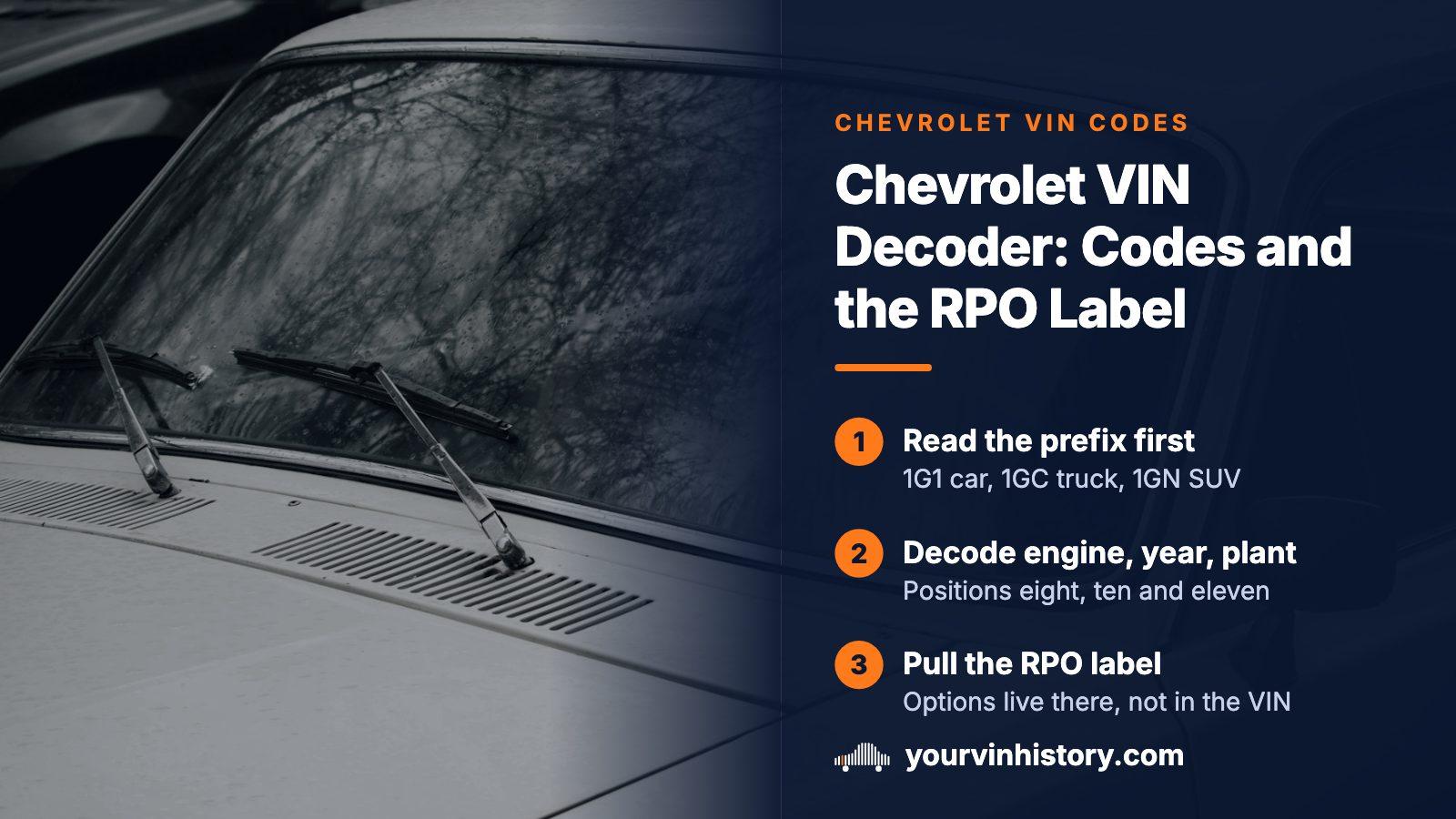
A Chevrolet VIN opens with a prefix such as 1G1 for a US-built car, 1GC for a truck or 1GN for a multipurpose vehicle like an SUV. Position eight is the engine, position ten the model year and position eleven the plant. Options are not in the VIN. They are on the RPO label, usually in the glove box, which settles claims about packages, paint and axle ratio.
- US-built car prefix
- 1G1, with 1GC for trucks and 1GN for SUVs
- Engine
- 8th VIN character
- Model year
- 10th VIN character, P for 2023
- Option list
- RPO label, usually in the glove box
Two documents, two jobs: the VIN and the RPO label
A Chevrolet keeps two records of what it is. The VIN is the legal identity, laid out in a federal format that NHTSA reads into a public decoder. The RPO label is the equipment list: General Motors prints each factory option as a short code on a Service Parts Identification sticker.
Listing claims sort along the same line. Model year and engine are VIN questions. A locking rear differential or an off-road package is a label question. Sort the claim first, and you know which document to ask the seller for.
| Claim | Settled by |
|---|---|
| Model year | VIN position ten, matched to the title |
| Engine | VIN position eight, then the engine bay |
| Assembly plant | VIN position eleven |
| Open recalls | NHTSA lookup on the full VIN |
| Paint, axle ratio, packages | The RPO label alone |
Chevrolet prefixes and what an unfamiliar one means
The first character gives the country: 1 or 5 for the United States, 2 for Canada, 3 for Mexico, K for Korea. The second is G for General Motors, and the third separates the division and the vehicle type. NHTSA's manufacturer database lists each prefix below under the Chevrolet make.
| Prefix | NHTSA classification |
|---|---|
| 1G1 | Passenger car, US assembly |
| 1GC | Truck, US assembly |
| 1GN | Multipurpose passenger vehicle, the class that holds the Tahoe, Suburban and Traverse |
| 2G1 | Passenger car, Canadian assembly |
| 3G1 | Passenger car, Mexican assembly |
| KL1 | Passenger car built by GM Korea |
GM registers far more prefixes than these six, split by plant and weight class. One missing from the table is no cause for alarm. Run it through the decoder and see what comes back.
A Malibu VIN taken apart, character by character
Take the sample VIN 1G1ZD5ST4PF233170. NHTSA's vPIC decoder returns a 2023 Chevrolet Malibu sedan, assembled at Fairfax Assembly in Kansas City, Kansas, and calls the decode clean.
| Position | Characters | Reading |
|---|---|---|
| 1 | 1 | Built in the United States |
| 2-3 | G1 | General Motors, Chevrolet passenger car |
| 4-7 | ZD5S | GM's descriptor for body, series, restraints and platform |
| 8 | T | Engine: in-line four-cylinder, gasoline |
| 9 | 4 | Check digit, reported by NHTSA as correct |
| 10 | P | Model year 2023 |
| 11 | F | Plant, resolved to Fairfax Assembly |
| 12-17 | 233170 | Production sequence, unique to this car |
Change the ninth character from 4 to 5 and NHTSA still names a 2023 Malibu, but the status line warns that the check digit does not calculate properly. Watch for that warning when a seller types a VIN from memory.
Clean is not the same as genuine
A clean decode shows only that the characters agree with each other and with GM's filed codes. A cloned car wears a real VIN and decodes just as cleanly.
Positions eight and eleven: the engine and the plant
In a General Motors VIN the eighth character is the engine, and one Chevrolet line often offered several in a model year. GM has redefined the codes over the decades, so a chart from the wrong era names the wrong engine. Read the character against the model year, then lift the hood to confirm. An engine swap nobody mentioned can complicate an insurance claim, an emissions test and the resale price.
The eleventh character names the assembly plant, and the plant matters for recalls. A campaign is usually defined by build dates and often by a single plant, so two Chevrolets that look the same can face different exposure. In the sample, the F resolves to Fairfax Assembly.
Position ten: the model-year letter and its thirty-year loop
Position ten is the model year. Letters start at A for 2010 and end at T for 2026, skipping I, O, Q, U and Z, while the digits 1 to 9 covered 2001 to 2009.
| Code | Year | Code | Year |
|---|---|---|---|
| A | 2010 | K | 2019 |
| B | 2011 | L | 2020 |
| C | 2012 | M | 2021 |
| D | 2013 | N | 2022 |
| E | 2014 | P | 2023 |
| F | 2015 | R | 2024 |
| G | 2016 | S | 2025 |
| H | 2017 | T | 2026 |
| J | 2018 |
The code repeats on a thirty-year cycle, so a letter alone can mislead. T means 2026 here, yet the same letter appeared on a Chevrolet from the nineties. The previous run began with A in 1980 and ended with Y in 2000. For anything older, place the car by generation before trusting the letter.
Finding the RPO label
The label is a block of three-character codes. Its position varies by model, so check in this order.
- Glove box. It is the most common place across the Chevrolet range.
- Trunk or cargo area. Look under the trunk lid, beneath the cargo floor and under the spare tire cover.
- Center console. A few trucks and SUVs put it under the console lid.
- Photograph all of it. Copying only the codes you recognize loses the rest, and the rest is what you will need later for parts orders or a sale.
If the label is gone from every spot, equipment claims can be tested only by inspecting the car piece by piece, and the price should reflect that.
Common RPO codes, and why paint color lives here
Listings lean on a handful of RPO codes, out of hundreds.
| Code | What it tells you |
|---|---|
| Z71 | Off-road package for trucks and SUVs: suspension and shocks |
| G80 | A locking rear differential, a real difference in capability and a frequent claim |
| LS and LT names | Engine family names enthusiasts use, which trace back to option codes |
| BC and CC entries | The base coat and clear coat codes for the factory paint |
| Axle ratio codes | The final drive ratio the car left the factory with, which affects towing and mileage |
No manufacturer puts paint color in the VIN, so the label records it. Give a paint supplier the code rather than the marketing name, since one name can stand for several formulas over the years. If the color on the car differs from the label, the car has been repainted and the seller should explain it.
GM reuses codes
An entry that means one thing on a 1998 truck may mean another on a 2024 one, so read each code against the model year.
Trucks and SUVs: what to confirm before a long drive
A Chevrolet truck carries a truck-class prefix, and its descriptor characters record cab configuration and weight-rating class as well as body and engine. Cab, engine and drivetrain drive the price most, and listings misstate them often enough to verify.
- Cab style: regular, extended and crew cabs sell at different prices.
- Bed length as built, which follows from the cab.
- Engine: the eighth VIN character, then a look in the engine bay.
- Drivetrain: two- or four-wheel drive, proven by the transfer case selector in the cab.
- Axle ratio: on the RPO label, which matters if you plan to tow.
- Weight rating: on the door jamb label.
To test a mileage claim, find the same engine and drivetrain in the EPA ratings on the government's fuel economy site.
GMC, Buick and Cadillac share parts, not VINs
GM sells near-twin vehicles through several divisions. The Silverado and the Sierra are platform twins, as are some SUVs across the brands. Each division carries its own prefix: NHTSA files 1GT under GMC, so a Sierra's VIN can never be mistaken for a Silverado's.
| Situation | What to do |
|---|---|
| Cross-shopping | Price the sibling too. Compare RPO lists, since trim names differ. |
| Parts | Mechanical parts tend to carry across; trim and interior pieces do not. |
| Known faults | A problem on one model may apply to its twin. |
Badge and prefix must agree
Trim badges are easy to swap, but a division is fixed by the VIN. If the exterior wears one division's name and the prefix belongs to another, the vehicle was rebadged, and the seller needs to explain that before you pay.
Recalls follow the VIN range, not the model name
Recalls attach to ranges of VINs, so a search by model name can return campaigns that do not apply to your car. NHTSA's recall lookup takes the full VIN and costs nothing to use. Run it on the VIN you read off the car, not the one in the listing.
Within the federal rule, a manufacturer must fix an open safety recall at no charge to the owner, and the duty follows the vehicle rather than the first buyer. The rule has an age limit: for a vehicle first sold more than 15 calendar years before the recall notice, the federal free-repair requirement does not apply, so on an older Chevrolet ask the dealer what GM will cover. On a newer used car, an open recall is a fair item to raise with the seller.
An order of operations for a used Chevrolet
- Decode first. Match model year, engine and drivetrain to the advert before you spend gas on the trip.
- Request a photo of the RPO label up front. A seller who cannot supply one may not know what the car carries.
- Read the VIN in both places, the windshield plate and the door-frame sticker, and compare them with the title.
- Take the label to the car. Anything claimed but missing from the codes was fitted after the factory, whatever the badge says.
- Enter the full VIN in the NHTSA recall lookup, and put any open campaign to the seller.
- Pull a vehicle history report on the same VIN. The decode and the label hold no accident, title brand, odometer or lien data; a report ties those records to the car.
Where this information comes from
- NHTSA: vPIC VIN decoder — The public decoder and manufacturer database behind the prefix lookups and the sample Malibu decode, built from VIN specifications manufacturers file with the agency.
- NHTSA: Recalls — Where a full VIN is checked against open safety recalls on a car you are considering.
- Fuel Economy.gov: EPA ratings — Federal fuel economy ratings to hold a listing's mileage claim against for the same engine and drivetrain.
Sources and photos: Facts checked against the sources above in October 2026. Photo by Tigran Shishmanyan on Unsplash; diagrams by YourVINHistory.
Keep reading
- GM build sheetHow to retrieve the original factory order for a Chevrolet from its VIN.
- Chevrolet recallsThe recall side in detail, including how one campaign widened over time.
- Chevy trucksOlder C/K trucks, where the glovebox sticker matters even more.
- GMCThe sibling division, and how to check that a Denali is real.
Frequently asked questions
Can I decode a Chevrolet VIN for free?
Yes. NHTSA's vPIC decoder costs nothing and needs no account. Enter all 17 characters and it returns the year, make and model, body class, engine, drivetrain, plant and any decode warning. Trim packages, paint and axle ratio are not in that data; they live on the RPO label.
What does the 1G1 prefix on a Chevy VIN stand for?
The 1 is the country, the G is General Motors, and the last 1 marks a passenger car. Change the third character and the class changes: 1GC is a Chevrolet truck and 1GN a multipurpose vehicle. GMC trucks begin 1GT, so a Sierra and a Silverado never share a prefix.
Can I find a Chevrolet's options if the RPO sticker is gone?
A factory build record keyed to the VIN can list the options the car was ordered with, which helps when the label is missing or unreadable. Treat it as a second source. If the record and the car disagree, ask the seller why before any money changes hands.
Does the VIN reveal a Chevrolet's paint color?
No. Color is not encoded in any manufacturer's VIN, so the 17 characters will not help. The factory color sits on the RPO label as a base coat and a clear coat entry. Match touch-up paint to that code, because a marketing name alone can lead to the wrong formula.
Is a clean VIN decode enough to buy a used Chevrolet?
No. A clean decode only confirms the characters agree with GM's filed codes. It is silent on wrecks, title brands, odometer rollbacks and liens, and a cloned VIN decodes as cleanly as the original. Add the label, a check of both VIN locations on the car and a vehicle history report.
Now check the car itself
The guide explains what to look for. The report shows what this VIN has on record.