THE SHORT ANSWER
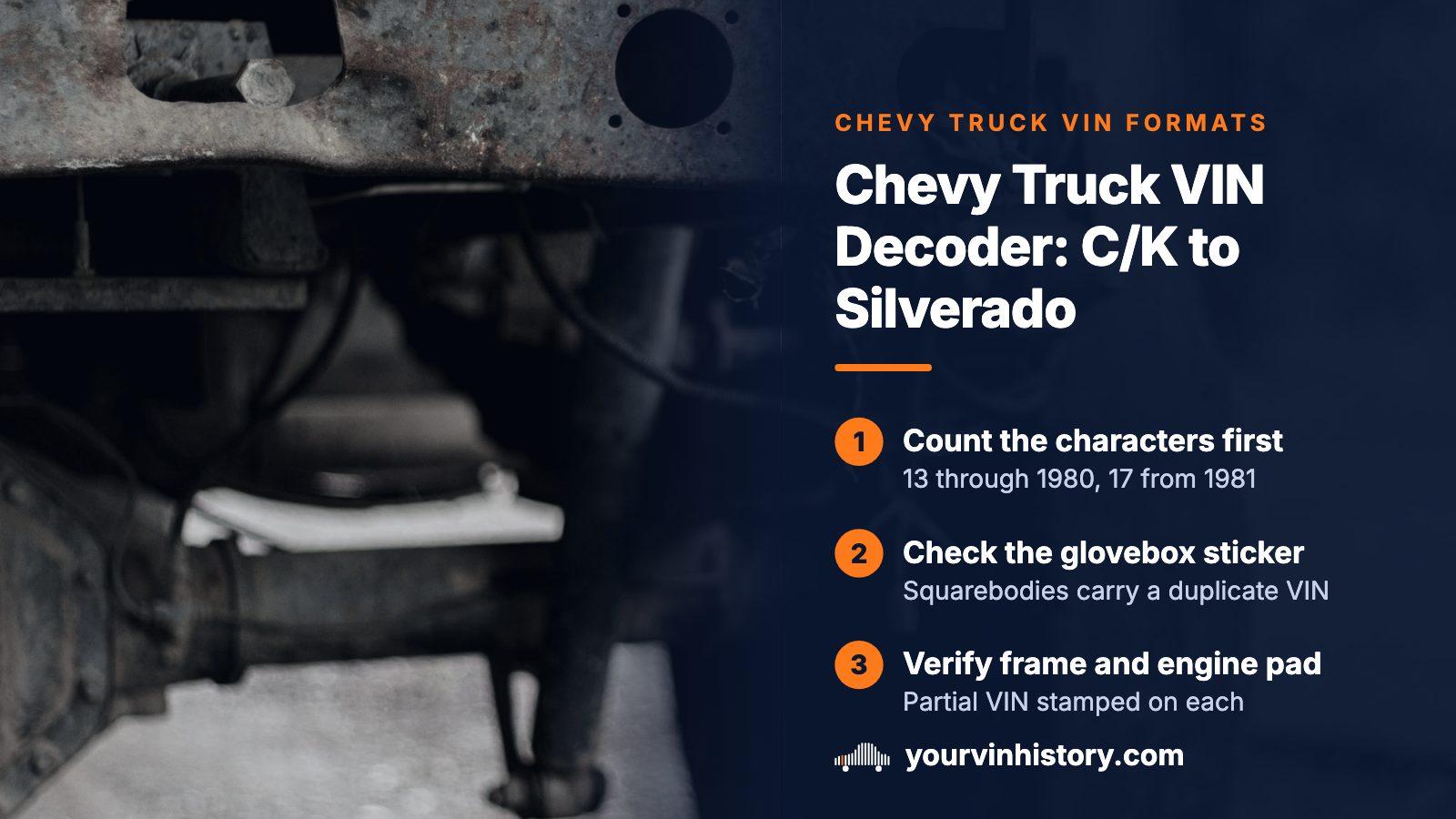
Count the characters first. A 1981 or later Chevy truck has a 17-character VIN: positions 4 to 8 describe the truck, 9 is the check digit, 10 is the model year and 11 is the plant, and NHTSA's decoder reads it. Older C/K and squarebody trucks use shorter formats, 13 characters through 1980, which a federal decoder cannot match. For those, compare the plate with the glovebox sticker, the frame stamping and the engine pad.
- Format break
- 13 characters through 1980, 17 from 1981
- Squarebody extra
- A duplicate VIN sticker inside the glovebox
- Frame check
- Partial stamping on the upper face of the frame rail
- Engine check
- Partial VIN on the block pad in front of the passenger-side head
Start by counting the characters on the plate
A Chevy truck might be a workhorse from the Action Line years or a late-model Silverado, and the VIN on each is a different kind of object. The federal rule behind modern numbers fixes the length at 17 characters, drawn from digits and letters, with I, O and Q never used. Chevy trucks from model year 1981 follow it. That makes the length your first filter.
- 17 characters: run it through NHTSA's decoder, because a federal record should exist for the truck.
- 13 characters: a number from the 70s or the early squarebody years, to be read against GM's era layouts rather than a modern tool.
- Shorter than that: a truck from the 60s or before, where the serial is brief and the plant convention does the decoding.
- 17 characters on a truck advertised as older than 1981: ask for a documented explanation before going further.
NHTSA's model lists show the same boundary. Its Chevrolet list comes back empty for 1980, then returns 49 entries for 1981.
Inside a 17-character Chevy truck VIN
Federal rules divide the number into blocks, and a truck is held to its own list of what the middle block must let the maker identify.
| Position | What it carries on a truck |
|---|---|
| 1 to 3 | Maker and vehicle type. NHTSA files 1GC, 2GC and 3GC under Chevrolet as trucks |
| 4 to 8 | Line, series, chassis, cab type, engine type, brake system and weight rating; GM puts the engine code at 8 |
| 9 | Check digit, a guard against typing errors |
| 10 | Model year |
| 11 | Assembly plant |
| 12 to 17 | Production sequence number |
Cab type, engine and brakes are all named in the federal table for trucks, so a decode of a current-era Chevy should report them. Paint, axle ratio and option packages are not on that list. GMC trucks share platforms with Chevrolet, yet the prefix separates the two: NHTSA files 1GT under GMC, so a Sierra can never pass as a Silverado on its number.
Dating the truck without being fooled by the year character
Position 10 holds the model year, and on a current truck the letter T stands for 2026. The trap is that year characters repeat. For light trucks, the federal rule reads position 10 together with position 7: a digit there places the year in the older 30-year run that began with the 1980 model year, and a letter places it in the run that follows. One year character can therefore describe two trucks 30 model years apart.
The 13-character numbers have the same weakness on a tighter cycle. The year digit comes around every decade, so a 4 means 1974 only inside the layout of that era.
Read the date from the whole number
Length, the position 7 test and the body style must agree before a year character means anything. A truck that dates itself differently in each of those is worth a closer look.
Which numbering to expect from each generation
Place the truck in a generation first and the format follows. This is why no single chart serves a whole collection.
| Model years | Generation | Number to expect |
|---|---|---|
| 1955 to 59 | Task Force | Brief serial on a door-pillar plate |
| 1960 to 66 | First C/K | Pillar plate and a short number; C for two-wheel drive, K for four |
| 1967 to 72 | Action Line | 13-character era, with pillar plate and frame stampings |
| 1973 to 87 | Squarebody | 13 characters to 1980, then the full 17 |
| 1988 to 98 | OBS, GMT400 | Standard 17 characters, build detail on the glovebox label |
| 1999 on | Silverado, GMT800 and later | Standard decode |
Squarebodies carry two numbering systems in one body
Park a 1979 truck beside a 1983 and the two are hard to tell apart, yet their numbers follow different rules. Through 1980 the order runs drive letter (C or K), weight-class digit for the 10, 20 or 30 families, engine letter, year digit, plant letter, then the serial.
From 1981 the truck carries the standard 17 characters with a check digit, a year character and a full plant code. The buying consequence is simple. If a 1983 truck will not decode, treat that as a warning sign. If a 1979 truck will not decode, the tool wanted a longer number than the truck ever had, so switch to the era tables and stop retyping.
Where the VIN sits on each kind of Chevy truck
Trucks hid their identity in more spots than cars did, and the list depends on age.
- 60s and early 70s trucks: a metal plate at the driver's side, either the door jamb or the hinge pillar.
- From 1968: a plate on the dash, readable through the windshield.
- Squarebodies: the dash plate plus a duplicate sticker inside the glovebox.
- Frame: partial stampings along the upper face of the rail, toward the front.
- V8 engines: a partial VIN on a pad on the block.
On a current light truck, the federal rule requires the number to be readable through the glass from outside, at the driver's side pillar. A riveted plate is among the easiest parts to swap, so a plate on its own never settles the question. Expect every location the era used to agree, and when two disagree, ask for the explanation in writing.
The glovebox sticker and the label that holds the options
On a squarebody, the sticker inside the glovebox repeats the VIN, which gives you a second reading to hold against the dash. Open the box and read it. A sticker that disagrees with the plate, or has gone missing, is a finding rather than a detail.
From the 1988 OBS trucks onward, the glovebox also holds an RPO label, GM's service-parts record. It lists axle ratios, gear packages and paint codes as short codes. A VIN cannot supply those, so a listing that boasts about a rear axle or an original color is a question for the label.
What a decoder cannot see
Axle ratio, paint and gear packages sit on the label, not in the number. Photograph the label before you travel to see the truck.
Frame stampings and the engine pad
GM stamped a partial identifier into many truck frames, most often along the upper face of the rail, close to the steering box. Decades of undercoating can bury it, so bring a wire brush and a flashlight. Of all the places a number appears, the frame is the anchor the others are measured against.
On old GM V8s, the block carries a partial VIN plus an application suffix, stamped on a pad in front of the passenger-side head. Matching that partial to the truck's VIN is the numbers-matching test. A pad that is clean or has a different sequence points to an engine swap, which is ordinary in a working truck and a pricing matter in a collector truck.
Paper and database checks for a truck that has outlived its states
A truck that has lasted for decades has usually been titled in more than one state. NMVTIS is the federal title information system built to protect buyers from fraud and unsafe vehicles, and its records reach you through approved providers. NICB's VINCheck is a free search of insurer theft reports, worth running on any truck whose numbers look disturbed.
Older trucks also have a documentary layer. GM Heritage Center publishes vehicle information kits for older GM vehicles, so ask what it holds for your truck before relying on a seller's account.
For a 17-character truck, a vehicle history report built from the VIN adds title brands, accident and salvage records and odometer readings, none of which a decode contains. The free preview shows what exists before you buy anything.
A buying order for an old Chevy truck
- Count the characters and sort the truck into its generation.
- Read every location the era used and compare the numbers character by character.
- Date the number inside its own layout before trusting the year character.
- If the ad claims matching numbers, read the engine pad and compare it with the VIN.
- Run the title and theft checks on the number you read off the truck, not the one in the ad.
- Judge the metal last, but give it the final say: rust around the cab corners, rockers, bed mounts and frame webs outweighs any paperwork.
Make the title describe the truck you are buying
Rebuilds with assigned VINs and retitled frames are common in the old-truck market. The paper trail has to explain the metal, and a truck with a story should be priced as one.
Where this information comes from
- NHTSA: VIN requirements, 49 CFR Part 565 — The federal rule that fixed the 17-character format and the roles of the check digit, year and plant positions.
- GM Heritage Center: vehicle information kits — GM's own archive entry point for factory documentation on older vehicles.
- NMVTIS: National Motor Vehicle Title Information System — The federal title system, useful for brands and title history on trucks that crossed state lines.
- NICB: VINCheck — A no-cost theft and salvage lookup from the insurance industry.
Sources and photos: Facts checked against the sources above in October 2026. Photo by Zoshua Colah on Unsplash; diagrams by YourVINHistory.
Keep reading
- ChevroletThe brand-wide 17-character structure, cars and SUVs included.
- GM build sheetHow to recover the RPO label and the factory order behind a truck.
- Classic truck VIN decoderWhy decoders return nothing for trucks built before 1981.
- Custom & state-assigned VINsWhat to expect when a rebuilt truck wears a state-assigned number.
Frequently asked questions
Why does my Chevy truck VIN fail in a decoder?
Start with the length. A 13-character number from the 70s is outside the federal data, so the tool returns nothing. On a 17-character number, look for a typing error: the letters I, O and Q never appear in a real VIN, and a wrong character will also break the check digit. Compare what you typed with the plate, character by character.
How can I tell a Chevy truck VIN from a GMC one?
Read the first three characters. NHTSA files 1GC, 2GC and 3GC under Chevrolet as trucks and 1GT under GMC, so the prefix identifies the division even if the badges were swapped in a restoration. On shorter, older numbers, the era tables and frame stampings do the same job.
What does the check digit in a truck VIN actually do?
It sits in position 9 and catches transcription errors. The maker weights each character by its position, adds the results and divides by 11, and the remainder produces a digit from 0 to 9 or the letter X. A passing check digit shows the characters are consistent with each other. It does not prove the truck is genuine.
Which years count as a squarebody Chevy truck?
Collectors use the name for the C/K generation built from 1973 to 87. Because that run straddles the 1981 break, name the exact model year when you ask for a decode, a parts match or a quote, since two trucks from the same generation can be numbered under different rules.
Can I check a 70s Chevy truck for recalls by VIN?
NHTSA's recall search is built around 17-character numbers, so a short truck number generally has nothing to match. An empty result on an older truck tells you the lookup found no record to search, not that no safety campaign exists. Ask a GM dealer or a marque club what applies to your truck.
Now check the car itself
The guide explains what to look for. The report shows what this VIN has on record.