THE SHORT ANSWER
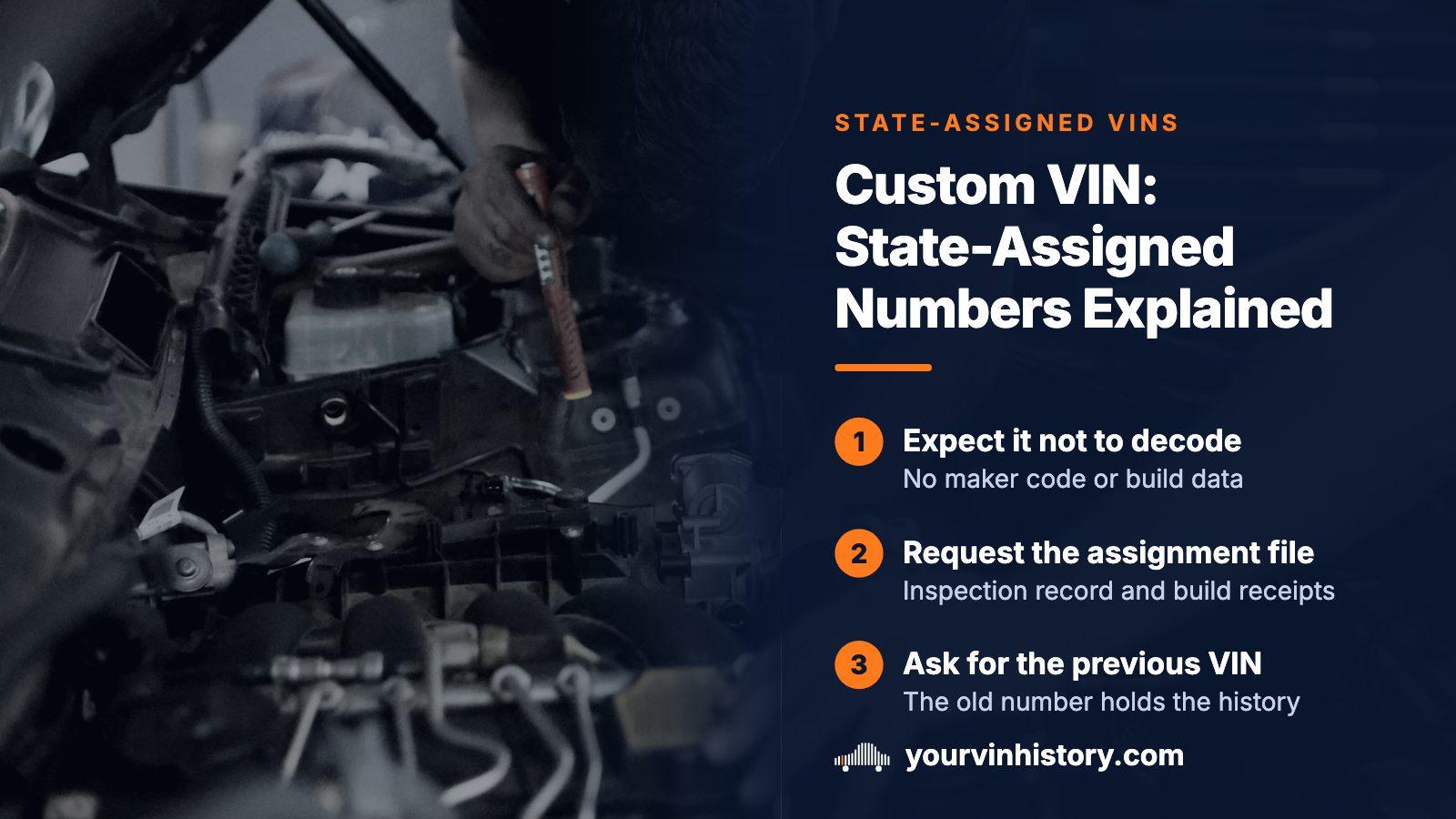
A state-assigned VIN is an identification number a motor vehicle agency gives a vehicle that has no valid manufacturer number, usually after an in-person inspection. It generally will not decode, because it holds no maker code or build data. Judge it by the file behind it: the assignment record, the inspection, the build receipts, and the number the vehicle carried before.
- Issued by
- The state, after a physical inspection
- Decodes?
- Generally not; no maker code or build data
- Federal law
- Tampering with a VIN is an offense under 18 U.S.C. 511
- Ask for
- The assignment file and the previous VIN
A VIN the state wrote because the factory never did
A vehicle built by a manufacturer leaves the plant with a seventeen-character number the maker assigned. A custom or state-assigned VIN is what a motor vehicle agency issues when a vehicle has no valid number of that kind. Titles may call it a replacement or state-issued VIN, depending on the state.
The number does one job: it lets the state title and register the vehicle. It does not tell you the maker, plant, engine or year the way a factory number does, and it usually arrives only after an examiner has seen the vehicle in person. Treat it as a record number with an inspection behind it, not a code to be read.
Five situations that end with a state-issued number
States differ on the details, but the same handful of circumstances recur.
| Situation | Why the factory number falls short |
|---|---|
| Kit car or homebuilt | No maker ever serialized the finished vehicle |
| Replica on a reproduction body or frame | New parts carry no identity from the car being copied |
| Classic with a missing or rotted tag | The original number cannot be read, so the state re-establishes identity |
| Frame or body structure replaced in a repair | The part that carried the number is gone |
| Recovered theft with a defaced number | Police and the state must verify the vehicle before renumbering it |
Three of the five involve a vehicle assembled from parts of different origins. The other two involve a number that was lost, destroyed or removed. Either way, someone had to prove on paper what the vehicle is, and that proof is part of what you are buying.
What the state asks for before it issues the number
Procedures vary, but the outline is familiar. The applicant describes the vehicle and its parts, supplies receipts and titles for major components such as the engine, frame and any donor body, and presents the vehicle for physical inspection, often to state police or a specialized DMV examiner.
Passing is about provenance, not craftsmanship. The examiner is confirming that nothing on the vehicle is stolen and that no earlier number was ground off to make the build possible. Then the state issues the number and plate and titles the vehicle, usually as specially constructed, assembled or reconstructed. The model year is often the year the work was finished.
The file is the birth certificate
The assignment paperwork and the inspection record are the only proof of what the vehicle is. Without them, the plate on the dash proves very little.
Why a decoder shrugs at these numbers
Federal rules shape the factory format. Part 565 of the safety regulations calls for seventeen characters, a check digit in the ninth position and a manufacturer identifier at the start. Those features let a decoder pull a plant, model line and engine out of the string.
A number from a state's own series generally does not follow that scheme, so the decoder has nothing to read. A failed decode is the expected result, not a warning sign by itself, and not reassurance either. The answers must come from documents: the assignment record for identity, the title for ownership, and the builder's file of parts receipts, donor titles and photographs for what the vehicle is made of. A donor's own factory number may still carry a history worth looking up separately.
What the federal VIN rule covers and what it leaves to the states
The federal VIN regulation is written about the people who make vehicles. It applies to passenger cars, multipurpose passenger vehicles, trucks, buses, trailers, incomplete vehicles, low speed vehicles and motorcycles.
- A vehicle made in one stage gets a number assigned by its manufacturer.
- A vehicle made in several stages gets its number from the incomplete vehicle manufacturer.
- A company that alters a finished vehicle keeps the original maker's number.
- An importer keeps the original maker's number.
Notice what is missing: any instruction telling a state how to number a vehicle with no usable number. The regulation also defines a manufacturer broadly, as a person who manufactures or assembles vehicles, so a garage builder's federal status is not something to guess at. Each state therefore writes its own procedure.
Why a plate fitted in the garage is a legal problem
Two federal criminal statutes sit behind the inspection. Under Section 511 of Title 18, deliberately defacing, removing or changing the identification number on a vehicle or a vehicle part is a federal felony, punishable by up to five years in prison. Section 2321 reaches anyone who buys or holds a vehicle or part intending to sell it while aware its number has been altered or removed; the ceiling there is ten years.
Both laws carve out exceptions, and those explain the system. Section 511 spares someone who restores or replaces a number in accordance with state law, and a repairer for whom the change is reasonably necessary. Section 2321 does not apply to damage caused by collision or fire. So the lawful route to a new number runs through the state. A plate fitted privately sits outside that protection, and a buyer who knows it and plans to resell takes on legal risk. This is a summary, not legal advice.
When the record stays behind under the old number
Every VIN lookup assumes the number stays with the vehicle for life. Recalls, title brands, total-loss entries and odometer readings are all filed against that one string. A state-assigned number breaks that expectation: the vehicle keeps going under a new identifier, and records written under the former number do not follow it by themselves.
The trap catches anyone who reads a thin report as a clean one: a newly assigned number can come back nearly empty simply because it is young.
Kentucky's paperwork shows how it happens. Its application to junk a title warns that a vehicle reactivated later must go through the rebuilding process, receive a Kentucky-assigned VIN under KRS 186A.090(1)(b), and carry a permanent rebuilt brand. Same vehicle, new number, and the earlier record sits under the old one.
Thin is not clean
Where a state assigned the number, read an empty history as a blank, not a pass. Ask what number the vehicle carried before and search that too.
Trailers: where honest builds and counterfeit plates overlap
Homemade trailers are a common reason ordinary people apply for an assigned number, and also a favorite vehicle for fraud. Both follow from the same traits: a trailer is simple to build, easy to move and has no engine number to trace. The federal VIN rule names trailer kits, defining one as a trailer delivered complete but unassembled and designed to go together without special machinery or tools. A kit from a manufacturer is expected to carry the manufacturer's number.
The National Insurance Crime Bureau has described trailers turning up with counterfeit numbers and falsified titles. For a built trailer, a few habits help.
- Ask for receipts covering the axle, the frame steel and the coupler.
- Be wary of a cheap trailer wearing a bright new plate.
- Verify the number with the issuing state itself rather than relying on the seller's copy of the paperwork.
Replicas that come with a maker's VIN instead
Not every replica is a garage project. Federal rules now let low-volume manufacturers build and sell completed replicas of older cars in small numbers, and those vehicles wear a VIN from the replica maker, not a number from a state. The VIN regulation even has terms for them: the original model year of the car being copied, and the replica model year, which is the calendar year the replica was manufactured.
A decoder can usually read a maker-assigned replica number, which puts these cars back on ordinary ground. The question is which kind of replica you are looking at, and the answer sits in the paperwork, not the styling. A titled turnkey replica and a garage-built kit are different legal categories, and a seller who blurs them is telling you something.
A walkthrough before you pay for a vehicle with an assigned number
- Ask for the state's assignment paperwork and confirm its number matches the plate on the vehicle. No file, no deal, whatever the story.
- Get the number the vehicle carried before and search it too, since the earlier records sit there.
- Look at the plate. It should have been fitted by the state or under its authority, and documented. Rivets from a hardware store are a reason to walk away.
- Read the build documentation: component receipts, donor titles and inspection records.
- Compare the title class with reality. A vehicle put together from parts should not be titled as an ordinary factory car.
- Check the donor's number separately. NICB's VINCheck screens a number for theft and salvage records at no charge, and NHTSA's recall lookup belongs on the original manufacturer's number.
- Ask the state to confirm it issued the number.
A vehicle history report from this site can be run on any number you supply, including the donor's and the previous one. It shows NMVTIS title records, open recalls and other record types. On the new number alone, a sparse result still means unproven.
Where this information comes from
- eCFR: 49 CFR Part 565, VIN requirements — The federal VIN format, plus who assigns the number for single-stage, multi-stage, altered and imported vehicles, and the definition of a trailer kit.
- DOJ: Altering or removing motor vehicle identification numbers — The federal offenses for tampering with a VIN and for trafficking in vehicles or parts whose numbers were altered.
- Kentucky Transportation Cabinet: Form TC 96-351 — A state form warning that a reactivated junked title means a state-assigned VIN and a permanent rebuilt brand.
- NHTSA: Replica vehicles — Background on the federal path for low-volume makers of completed replica vehicles.
- Bureau of Justice Assistance: NMVTIS for consumers — The national title database whose records begin from the number a vehicle is titled under.
- NICB: VINCheck — A theft and salvage screen worth running on donor and former numbers.
Sources and photos: Facts checked against the sources above in October 2026. Photo by Nina Mercado on Unsplash; diagrams by YourVINHistory.
Keep reading
- VIN inspectionThe hands-on exam that comes before a state issues a number.
- Classic car VIN decoderWhat to do when an old tag is missing or the car predates the 17-character format.
- TrailersHomebuilt trailers go through the same assignment process.
- VIN cloningHow counterfeit plates get past a lookup, and why paperwork is the defense.
Frequently asked questions
Can I choose my own VIN for a custom build?
No. The state issues the number from its own series after inspecting the vehicle, and the applicant has no say in the characters. A license plate with a personalized message is a different thing and has no connection to the identification number the state records on the title.
What if my classic's VIN tag is missing or unreadable?
Do not fabricate or order a replacement plate. Federal law treats a privately altered number as a crime, yet it leaves room for a number restored or replaced under state law. Contact your state's titling office, ask what inspection and proof of ownership it wants, and bring any records that tie the vehicle to its earlier number.
Why does the model year on a kit car title look odd?
Many states record the year the vehicle was finished, not the year of the design it imitates, because the state is certifying a newly assembled vehicle. Federal definitions for manufacturer-built replicas follow a similar logic, with the replica model year kept apart from the model year being copied. Compare the title with the build file.
Do recalls apply to a vehicle with a state-assigned VIN?
Recall lookups work from manufacturer-assigned numbers, so an assigned number can return nothing even when donor components may have been recalled. If you can identify the original or donor number, run it through NHTSA's recall lookup, which costs nothing, and ask the seller for the donor's title.
How can I research the history of a kit or custom vehicle?
Start with the paper: the title under the assigned number, the assignment record and the build receipts. Then search the previous number and the donor's number, since records were filed under those. A history report from this site can be run on each one, and a thin result on the new number means unproven, not clean.
Now check the car itself
The guide explains what to look for. The report shows what this VIN has on record.