THE SHORT ANSWER
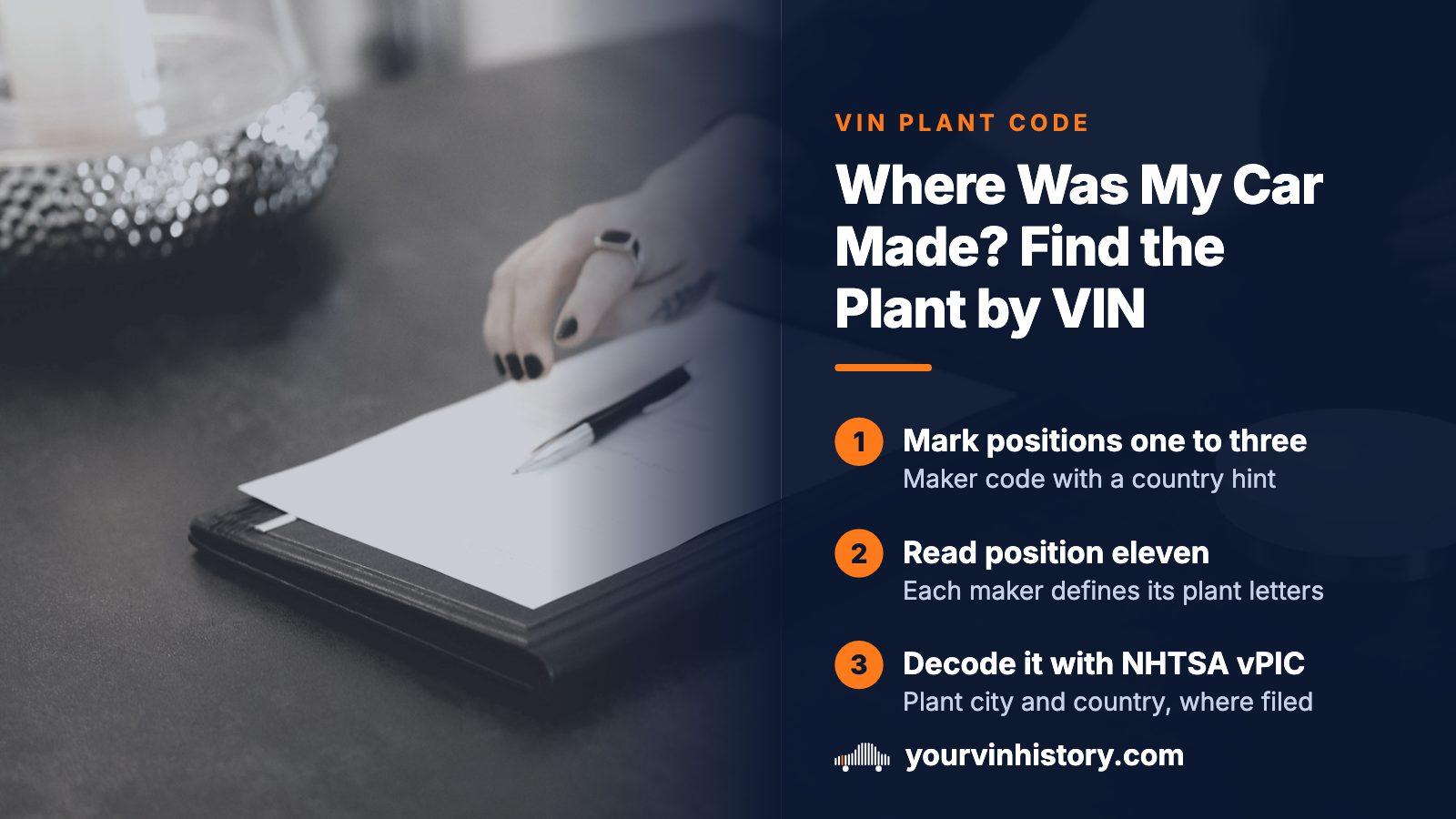
Look at two places in the 17-character VIN. Positions 1 to 3 identify the manufacturer, and the first character leans toward a country or region. Position 11 is the plant code, defined by each maker, so one letter can mean different factories on different brands. To read it, enter the VIN in NHTSA's free vPIC decoder, which shows the plant name, city and country when the maker has filed them.
- Maker code
- Positions 1 to 3, issued through SAE International
- Plant code
- Position 11, defined by each manufacturer
- Free decoder
- NHTSA vPIC lists plant city and country where filed
- Small builders
- Positions 1 to 3 plus 12 to 14 name the maker
Start with the VIN and mark two spots
You need all 17 characters, copied exactly from the dashboard plate, the door jamb label or the title. One wrong character sends a decoder to a different car or to no car at all, so check what you typed against the original before you trust anything it returns.
- Write the VIN out in a row and count to 17.
- Circle characters 1 to 3, the manufacturer identifier.
- Circle character 11, the plant code.
- Enter the whole VIN in a decoder and compare its plant answer with what the seller told you.
If the dashboard number and the door label disagree, stop here. That mismatch deserves questions before any decoding does.
Characters 1 to 3: the maker and a country hint
Federal rule 49 CFR 565.15 reserves the first three characters for the manufacturer. For a high-volume builder, those three alone identify the maker and the type of motor vehicle, so two vehicle types from the same company can open differently.
The country link is a convention, not a federal list. The rule text never names countries; the association comes from how identifiers are allocated internationally, and the leading character works as a regional marker. In vPIC results, a 1 lines up with the United States, a 3 with Mexico and a J with Japan. Treat those three as examples, not a complete chart.
In the Toyota decodes covered below, the 3 and the J match the plant's country rather than the brand's home market. That is the pattern to expect: the marker follows the factory.
Position 11 is the plant of manufacture
The same rule splits positions 10 through 17 into a fourth section and says the second character of that section represents the plant of manufacture. Count it out and you land on position 11.
| Where in the VIN | What it tells you |
|---|---|
| 1 to 3 | Who built it, plus the country hint |
| 10 | When: the model year code |
| 11 | Where: the assembly plant |
| 12 to 17 | Which one: the production serial for a high-volume maker |
One character cannot spell out a factory, so the plant slot can only ever be a code. Each manufacturer decides what its own characters stand for and reports the decoding details to the agency, which is why no single table covers every brand.
Turn the plant code into a named factory
NHTSA's vPIC decoder does the translation. Take the sample number 1G1ZD5ST4PF233170, a Chevrolet Malibu. Its eleventh character is F, and vPIC answers with Fairfax Assembly in Kansas City, Kansas, United States, under General Motors.
Put a Ford full-size pickup number with an F in the same slot into the decoder and it resolves to Dearborn, Michigan. The letter is identical and the factory is not.
One letter, two factories
Do not carry a plant chart from one brand to another. F pointed to Fairfax Assembly on the General Motors sample and to Dearborn on the Ford one. A list that claims universal letters is a convenience at best.
vPIC shows plant details where the maker filed them, so a blank plant field means nothing was on file to show. It does not mean the VIN is wrong.
Same badge, different country
A brand name tells you where the company is from. It does not tell you where your car was bolted together. Makers spread one nameplate across several countries and shift production between factories during a model's life, so the badge alone cannot give you an origin.
Toyota shows it well. Fed into vPIC, a Tacoma number pattern that opens 3TY resolves to a plant in Guanajuato, Mexico. A Prius pattern that opens JTD resolves to Toyota City in Aichi, Japan. Both wear the same badge on the grille, and the first character is what differs.
Two cars of one model on a single lot can therefore come from different plants, and sometimes different countries. Nothing in the paint, the seats or the brochure photos will say so.
Small builders split the maker code in two
Everything above assumes a high-volume manufacturer. The rule treats a low-volume manufacturer differently: positions 1 to 3 combine with positions 12 to 14 to identify the maker and vehicle type, and positions 15 to 17 carry the sequence number. Anyone decoding such a VIN has to read both ends.
The warning sign is a 9 in position 3. The rule places a 9 there when the manufacturer identifier is six characters long, so a decoder that stops at the third character is working with an incomplete identifier.
This matters for a small-production vehicle. The plant slot still sits at position 11 and still follows that builder's own scheme, but you cannot name the maker without the second half of its code.
Who issues the maker codes
People assume a federal number is handed out by a federal office. This one is not. NHTSA has an agreement with SAE International to coordinate manufacturer identifiers for U.S. makers, and the codes cost the maker nothing.
A request goes to SAE's identifier coordinator, and anything that reaches NHTSA is forwarded there. SAE compares each requested identifier with those already assigned or reserved. Once SAE confirms an assignment in writing, the maker does not have to file it again with the agency.
The practical upshot is a split in reliability. The maker code is registry data, checked for conflicts. The plant code is the manufacturer's own labeling, defined in the decoding details that rule 49 CFR 565.16 requires makers to file, and it only makes sense inside that company's records.
Why a buyer should care about the origin
Curiosity is a fine reason to look. The answer also bears on real decisions.
- Parts: cars built in different plants or for different markets can take different components, so a counter working from year and model alone may hand you the part for the more common build. Give them the VIN instead.
- Specifications: equipment levels, and sometimes body structure, differ from market to market, so a listing written for another country may not describe the car in front of you.
- Recalls: a recall notice is sometimes limited by build range or plant. NHTSA's lookup by VIN is free and shows whether that exact number has an open recall.
- Claims: if an ad says the car was built somewhere in particular, the VIN lets you test that statement yourself.
Built abroad is not the same as imported
A car assembled in another country for sale here is perfectly ordinary. A car built for a different market and brought in afterward is another matter: parts availability and equipment can differ, and the paperwork has to support the import.
The VIN speaks to the first situation far more directly than the second. It names a plant, not the market the car was meant for. To settle that, read the certification label on the vehicle and ask for the import documents that came with it.
A vehicle history report, including the one on this site, covers a separate question: what happened after the car left the factory, such as title brands, odometer readings and open recalls. The plant code will never tell you any of that.
A short checklist before you rely on the answer
- Copy the VIN from two places on the car and confirm they match.
- Read positions 1 to 3 and note whether position 3 is a 9.
- Read position 11 and treat it as a code that belongs to that maker only.
- Run the VIN through vPIC and read the plant city and country, not just the make.
- Compare the result with the ad, the seller's story and the paperwork.
- Never guess a country from the badge, the paint or the interior trim.
- Treat market specification and import status as separate questions.
A plant that differs from what you were told is not proof of anything on its own, because production moves between factories. It is a reason to ask where the claim came from.
Where this information comes from
- Code of Federal Regulations: 49 CFR 565.15, VIN content requirements — Sets out the four VIN sections, the 9 in position 3, the plant character in the fourth section and the low-volume layout.
- Code of Federal Regulations: 49 CFR 565.16, reporting requirements — Describes how SAE International coordinates manufacturer identifiers at no charge and what makers must file.
- NHTSA: vPIC VIN decoder — The federal decoder where the plant city, state and country appear when the maker has filed them.
- NHTSA: recall lookup — Checks a VIN for open recalls, useful because a notice can be limited to certain builds.
Sources and photos: Facts checked against the sources above in October 2026. Photo by A n v e s h on Unsplash; diagrams by YourVINHistory.
Keep reading
- How to read a VINWalks through the other positions, the model year chart and the check digit.
- NHTSA VIN decoderShows how to use the federal decoder that names the plant.
- Imported car VIN checkThe next step if you suspect the car was built for another market.
- Parts by VINExplains how the build and plant change which part fits.
Frequently asked questions
How do I find out which country my car was built in?
Read the first character as a regional marker, then confirm it with the plant country in a decoder. In the vPIC results used here, a 1 matched the United States, a 3 matched Mexico and a J matched Japan. The decoder's plant country is the better answer, because it comes from what the manufacturer filed rather than from a letter chart.
What does it mean if the decoder shows no plant or an error?
A blank plant means nothing was on file for that pattern. An error about the ninth character is a different problem: the check digit does not calculate, which usually points to a mistyped character. In a test run, changing only the last digit of the Malibu number kept the plant but raised that flag. Retype the VIN from the car and compare it with the title.
Does the assembly plant say anything about quality?
Not in the VIN rule. The eleventh character only identifies the plant of manufacture, and none of the federal sources used for this guide rate plants against one another. If quality is the worry, look at the individual car: its recalls, its title and accident records, its mileage and a hands-on inspection.
Why do two cars of the same model and year show different eleventh characters?
Because position 11 records the plant that built that individual car. When a maker builds one model in more than one factory, or moves production partway through a run, the maker and model characters can match while the plant character differs. Compare your own number with the decoder, not with a screenshot of someone else's.
Do I need to buy a report to see where a car was made?
No. NHTSA's vPIC decoder costs nothing and shows the plant where the maker has filed it. A paid history report answers a different question: what has happened to the car since, including title brands, accident records, odometer readings and open recalls. Use the decoder for origin and a report for history.
Now check the car itself
The guide explains what to look for. The report shows what this VIN has on record.