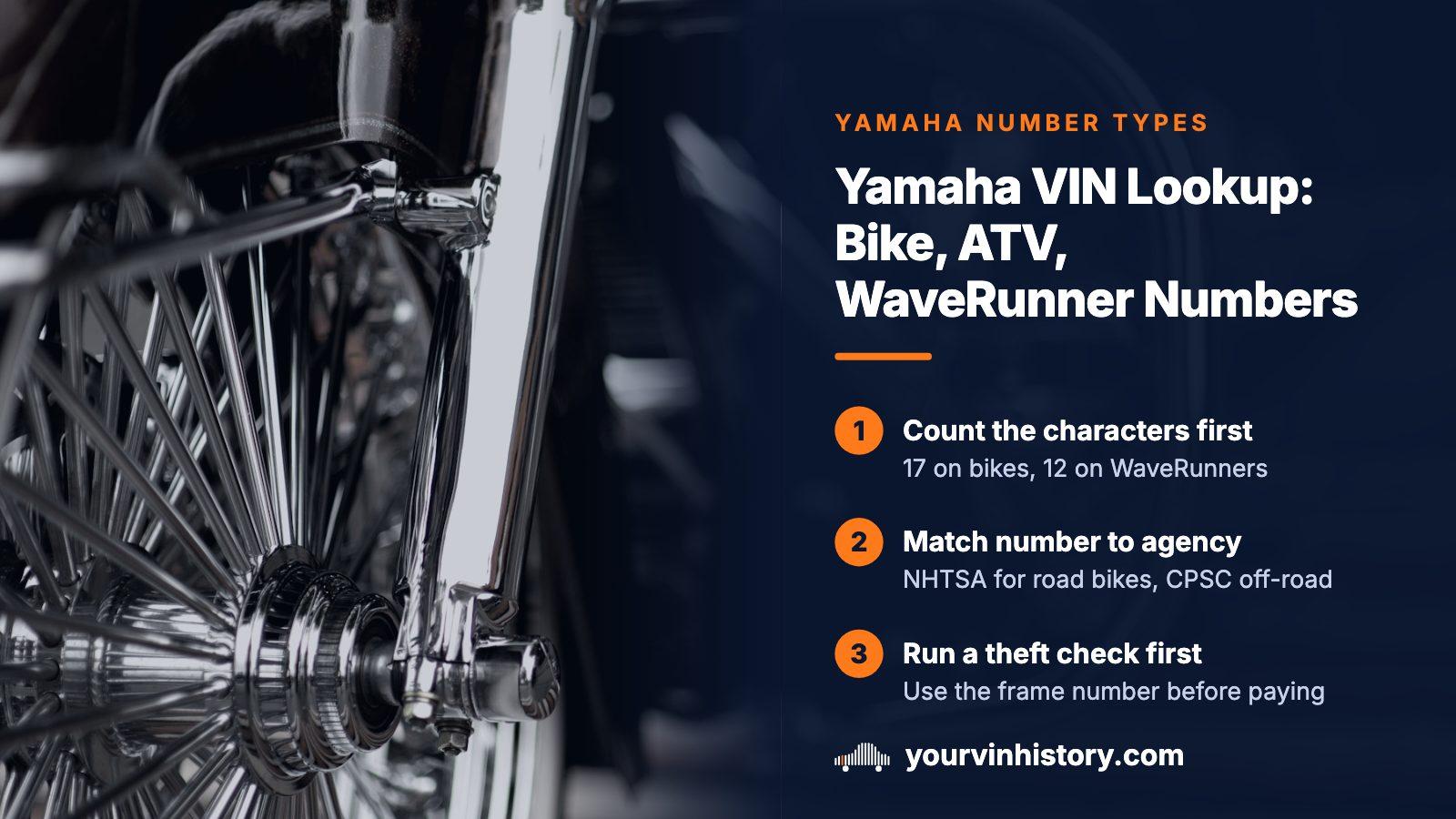
THE SHORT ANSWER
A street Yamaha motorcycle has a 17-character VIN stamped into the steering head, usually on its right side, and it decodes in ordinary databases. ATVs, side-by-sides and snowmobiles carry frame-stamped numbers, WaveRunners carry a hull identification number, and outboards carry a model and serial plate. NHTSA lists recalls for road bikes, while the Consumer Product Safety Commission handles the off-road machines. Run a theft check on the frame number before you pay.
- Street bikes
- 17-character VIN on the steering head
- WaveRunners
- 12-character hull number, not a VIN
- Outboards
- Model and serial on a bracket plate
- Off-road recalls
- CPSC, not NHTSA
Count the characters before you pick a tool
Yamaha builds enough kinds of machine that no single lookup method covers them all. Read what is physically on the machine and match it against the table below. Seventeen characters points to a vehicle identification number. Twelve characters, found high on the back of a hull, points to a hull identification number. A short model designation with a serial beside it, on a small metal plate, points to an engine rather than a vehicle.
| Machine | What identifies it | Where to look |
|---|---|---|
| Street motorcycle | 17-character VIN | Steering head, plus a certification label |
| ATV or side-by-side | Frame-stamped number, often 17 characters | Frame near the front of the chassis |
| Snowmobile | Frame or tunnel stamping | Frame or tunnel, with a label repeating it |
| WaveRunner | 12-character hull identification number | Rear of the hull, starboard side |
| Outboard motor | Model designation and serial number | Plate on the mounting bracket |
Street bikes: the steering head and the sticker
A road-legal Yamaha motorcycle falls under the same federal VIN rules as a car, so its 17-character number decodes in the same public tools. The identity lives on the frame. Title and registration are issued against that frame number, never against the engine.
- Swing the handlebars to full lock so the right side of the steering head faces you, then look just below the bars for the stamping.
- Find the certification label, normally on the frame close to the neck or under the seat. It prints the same number plus the build date.
- Treat the number on the engine cases as a separate item. It helps with parts but does not identify the motorcycle.
- If the stamping looks gummed up, wipe it with a rag and use a flashlight. Road film collects behind the front wheel, and most hard-to-read numbers turn legible after cleaning.
NHTSA's manufacturer register lists several prefixes for Yamaha motorcycles, among them JYA for Japan and 5Y4 for the United States. Because a street bike has a genuine VIN, a vehicle history report can show title brands, salvage and auction records and odometer readings before you drive out. The preview step is free; the full report is a paid one-time purchase.
ATVs, side-by-sides and snowmobiles
Off-highway Yamahas are identified by frame stamping. On an ATV or side-by-side the number sits on the frame toward the front of the chassis, and a certification label repeats it alongside the build date. Many of these numbers run to 17 characters, and NHTSA's register includes JYE as a Yamaha prefix for off-road vehicles built in Japan. A snowmobile follows the same pattern, with the stamping on the frame or the tunnel.
Two things change once you leave the pavement. Safety recalls come from a different agency, covered further down, and titling depends on your state. States split three ways: a title is issued, only a registration is issued, or neither exists. A seller's only document may therefore be a bill of sale, so learn what your state expects before you agree on a price.
WaveRunners use a hull identification number
For regulatory purposes a personal watercraft is a boat, and its identity is a hull identification number. That number is 12 characters long with no spaces or hyphens. The first three characters are a manufacturer code, characters four through eight are a serial, and the rest encode a date and the model year.
On most hulls the main number sits high on the starboard side at the stern, within about two inches of the top of the transom. A second matching number is hidden inside the hull or beneath a fitting, which helps if the visible one has been sanded off. Registration runs through the state boating authority, not the motor vehicle office.
The trailer is a separate purchase
A WaveRunner on a trailer means two identified items. The trailer carries its own VIN and paperwork, while the hull number and a separate registration cover the watercraft. Check both before you commit.
Outboards are engines, so they carry a serial
An outboard is identified as a component, not a vehicle. The plate on the mounting bracket, sometimes on the transom clamp, gives a model designation and a serial number, and a parts counter wants both. No vehicle database will decode that pair, and it has no connection to the hull number of the boat the motor hangs on.
Copy the model and serial exactly and compare them with the seller's paperwork, since service campaigns are issued by the maker against the serial. Then press for details on these points:
- Hours on the motor, and the service history that backs them up
- The date the impeller and water pump were last replaced
- Any time the motor has spent in salt water
- Confirmation of the boat's hull number on its own, apart from the motor
Which agency holds the recall for which Yamaha
The office that tracks safety recalls follows the product category, not the brand. Searching the wrong database returns an empty result whether or not a recall exists.
| Machine | Where to check |
|---|---|
| Street motorcycle | NHTSA recall lookup, searched by VIN |
| ATV or side-by-side | CPSC recall search, in its all-terrain and recreational off-road vehicle categories |
| Snowmobile | CPSC recall search, in its snowmobile category |
| Dirt bike built only for off-road use | CPSC recall search, which has a category for two-wheeled powered off-road vehicles |
| WaveRunner | Boating safety channels, not the lookups above; a marine dealer can check the hull number |
| Outboard motor | Maker campaigns, matched to the motor's serial |
A blank NHTSA result proves little on an off-road machine
NHTSA's rules leave out ATVs, side-by-sides and snowmobiles. An empty answer there means only that you asked the wrong office. Use the CPSC search for those, and read each notice for the remedy it offers and the units it covers, because terms differ from one recall to the next.
When a decode comes back empty
A blank result is rarely a sign of fraud. Most of the time the number is the wrong kind: a hull identification number pasted into a VIN decoder, an outboard serial typed where a frame number belongs, or the engine case number copied in place of the stamping on the steering head. The decoder is doing its job by rejecting something that was never a VIN.
Work through the causes in order. Confirm the machine type, confirm you copied the frame stamping and not the engine number, then compare each character against a photo taken in good light. Worn stamping is the other common culprit, and cleaning solves most of it. If the characters still will not resolve, slow down, since an unreadable number blocks every check that follows.
Run the theft check on the frame number first
Powersports machines attract thieves. They hold their value, they load onto a trailer in minutes, they often sit outside a locked garage, and many are never registered. The NICB's VINCheck is a free lookup supplied by participating insurers. It takes a VIN, so it fits a street bike and any off-road machine with a full 17-character number. Run it before any money moves.
- Match the stamping to the paperwork, character for character.
- Make sure the seller's name is the name on that paperwork.
- Check the surrounding metal for signs of grinding, filing or new paint.
- Be wary of an undocumented machine priced well under the going rate.
- After you buy, photograph the number and store the picture somewhere other than the machine.
What the hour meter and the season tell you
A decode describes how the factory built the machine, not how it has aged. On off-road models the hour meter says more than a mileage reading would, so photograph it and ask for service records that explain the figure. On a side-by-side, ask about belt and clutch work, and inspect the underside for dents from impacts, bent parts and cracked mounts.
Snowmobiles add a seasonal twist. A sled left idle from spring through autumn each year wears in its own way: fuel system deposits, perished rubber and a tired battery develop whatever the hours say. On a street bike, valve service and oil history count for more than how many seasons it has seen.
Paperwork, then the order to do things in
Ask for the original dealer invoice if one survives, and write a bill of sale that records the identification number and the details of both parties. A street bike is titled against its frame VIN, a WaveRunner is registered through the boating authority, and an off-highway machine follows your state's rules. This sequence keeps the cheap checks ahead of the irreversible ones.
- Get a clear photo of the stamping or plate before you travel.
- Decide which kind of number it is: VIN, hull number or serial.
- Search the recall agency that matches the machine.
- Run the theft lookup on the frame number.
- In person, compare the stamping with the photo and the paperwork, then inspect the metal around it.
- Settle title and registration requirements, then pay against a written bill of sale.
Where this information comes from
- CPSC: Recalls — Search here for ATV, side-by-side and snowmobile recalls, which sit under consumer product safety rather than NHTSA.
- NHTSA: Recalls — The federal lookup by VIN for road-legal motorcycles.
- NICB: VINCheck — A theft lookup fed by participating insurers, worth running on a frame number before paying.
Sources and photos: Facts checked against the sources above in October 2026. Photo by Steve Smith on Unsplash; diagrams by YourVINHistory.
Keep reading
- Motorcycle VIN lookupFrame number versus engine number on any bike, and how to tell them apart.
- Boats and HINsThe hull number format a WaveRunner shares with every other boat.
- ATV VIN lookupWhat a thin ATV VIN does and does not tell you, and how to verify the rest.
- TrailersThe separate VIN and paperwork on the trailer that carries a WaveRunner or sled.
Frequently asked questions
Where do I find the VIN on a Yamaha motorcycle?
Look at the steering head, the frame section the forks pass through, typically on the right side below the handlebars. Full lock on the bars makes it easier to see. A certification label elsewhere on the frame prints the same number with the build date. Photograph both and compare them with the title. The engine has its own number, which does not identify the motorcycle.
Does a Yamaha WaveRunner have a VIN?
No. It has a 12-character hull identification number in the boat format, and a VIN decoder will not accept it. The main number sits on the starboard side near the top of the transom, with a second copy hidden elsewhere on the hull. Registration goes through the state boating authority instead of the motor vehicle office.
How do I find the serial number on a Yamaha outboard?
Look on the bracket that clamps the motor to the transom for a metal plate listing the model designation and the serial number together. Write down both, because parts lookups use the pair. The number identifies the engine only, so it will not match anything on the boat's hull, and a vehicle decoder cannot read it.
Where do I look up Yamaha ATV recalls?
Use the Consumer Product Safety Commission recall search, which lists categories for all-terrain vehicles, recreational off-road vehicles and snowmobiles. NHTSA covers road-legal motorcycles, so an ATV searched there comes back empty regardless of its history. Keep the build date from the certification label handy, since a notice may apply to only some units of a model.
How can I tell whether a used Yamaha is stolen?
Enter the frame number into the NICB VINCheck, then compare the stamping with the seller's paperwork one character at a time. Ground, filed or freshly painted metal around the number is a warning sign. Powersports machines often sell privately with thin documentation, so a low price and no paper deserve extra caution. A clean search is one input, not a guarantee.
Now check the car itself
The guide explains what to look for. The report shows what this VIN has on record.