THE SHORT ANSWER
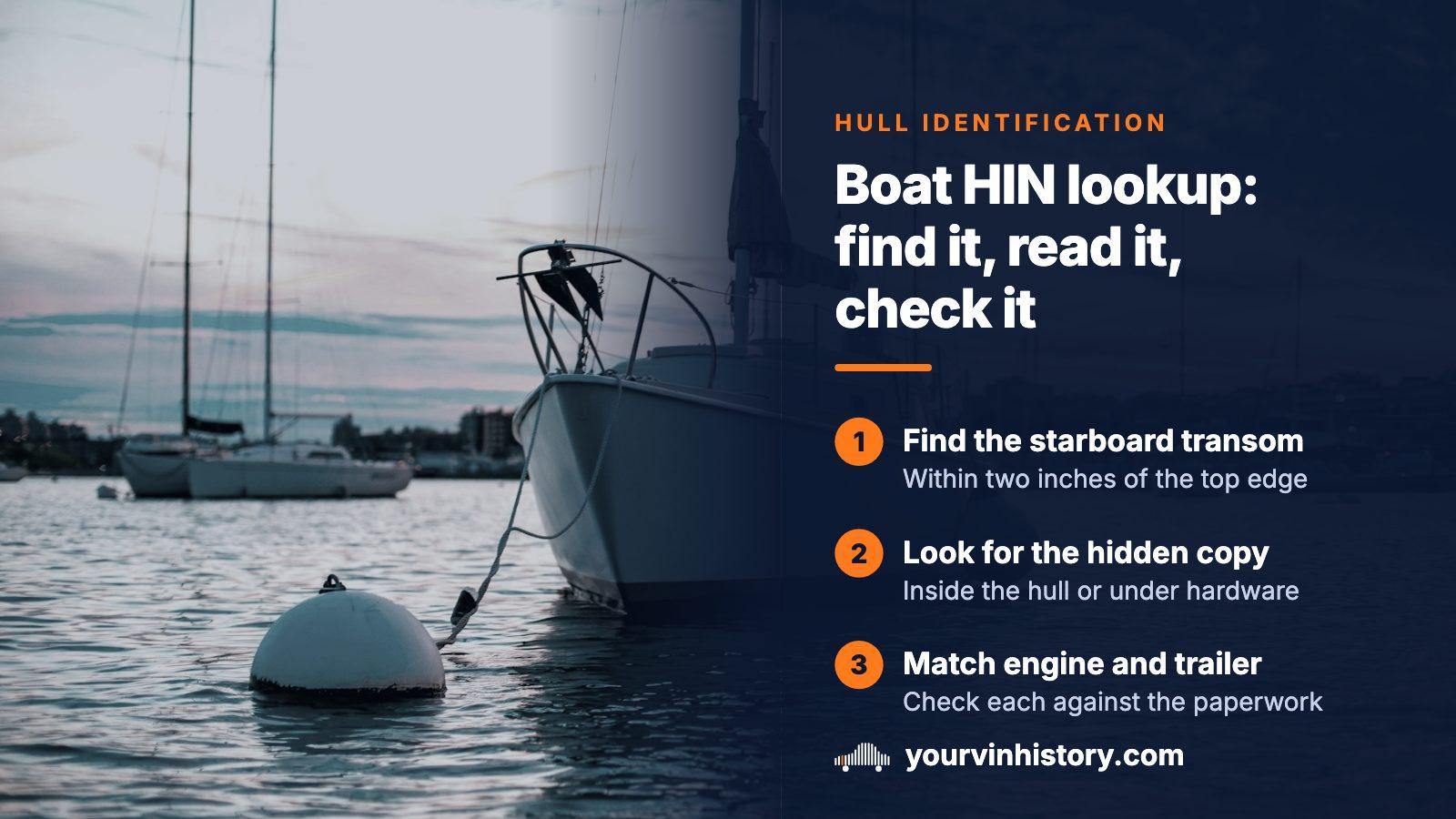
Look on the starboard side of the transom, within two inches of the top edge, for a 12-character HIN. A second copy must be hidden inside the hull or under hardware. Neither will decode in a vehicle VIN tool, because boats sit outside the motor vehicle system. Compare both numbers with the title or registration, check the engine and trailer separately, and request the Coast Guard abstract of title if the vessel is documented.
- Length
- 12 characters, no check digit
- Primary HIN
- Starboard transom, within two inches of the top
- Second copy
- Hidden inside the hull or under hardware
- Federal record
- Abstract of title, documented vessels only
Why a car decoder returns nothing for a HIN
A VIN belongs to the motor vehicle system of NHTSA rules, state motor vehicle agencies and title databases. Boats mostly stand outside it. Federal law defines a motor vehicle as something driven or drawn by mechanical power and built mainly for public roads, and a hull is built for water. Its identifier comes from the Coast Guard, under boating rules.
That identifier is the Hull Identification Number, or HIN, required on boats produced or imported for the American market since the early 1970s. A vehicle decoder returns an error or an empty page for it, which is the tool working as designed and tells you nothing about the boat. A road trailer sits on the vehicle side of the line, so it can carry a VIN when the hull cannot.
Finding the primary number on the hull
The Coast Guard's identification rule fixes the position of the primary number by hull type, always on the starboard side. Starboard is your right as you face the bow.
| Hull type | Where the primary HIN goes |
|---|---|
| Boat with a transom | Outer face of the transom, starboard side, within two inches of the top of the transom, gunwale or hull-to-deck joint, whichever is lowest |
| No usable transom | Starboard side of the hull near the stern, within one foot of it and within two inches of the top of the hull side |
| Catamaran or pontoon boat with replaceable hulls | Aft crossbeam, within one foot of the starboard hull attachment |
The characters must be at least one-fourth of an inch tall and permanent: carved, burned, stamped, molded, bonded, or on a plate that would scar the hull if removed. A number on a removable part fails the rule.
Wipe off wax and grime before calling it missing, and photograph the number rather than copying it by hand. A US- prefix is the country code, not part of the twelve characters.
What the twelve characters tell you
No hyphens, slashes or spaces appear between the twelve characters.
| Characters | Content |
|---|---|
| 1 to 3 | Manufacturer identification code assigned by the Coast Guard; importers receive a designation |
| 4 to 8 | The builder's serial number for that hull, letters or digits, never I, O or Q |
| 9 | Month of certification or manufacture, a letter from A (January) to L (December) |
| 10 | Last digit of that year |
| 11 and 12 | Model year, as the last two digits |
The opening code names the builder, useful when the boat wears a dealer's badge, and the model year is stored apart from the build date, so the two can differ.
There is no check digit. Position nine of a car VIN catches typing errors; in a HIN it holds the month letter. A well-formed number therefore proves nothing alone, and the test is whether it matches the paperwork and the hidden twin. A foreign-built boat may carry another format if the Coast Guard accepted that country's system.
Hull, motor and trailer: three numbers to match
Hull, motor and trailer are each identified on their own, yet they change hands as one package, and the seller may hold paper for just one.
| Item | Its number | Its paperwork |
|---|---|---|
| Hull | 12-character HIN on the transom, plus the hidden copy | State title or registration, or a federal certificate if documented |
| Motor | Serial number on a plate or stamping; outboards often carry it at the mounting bracket | Not covered by the hull's papers |
| Trailer | A VIN, 17 characters on most road trailers; home-built or older ones can differ | Title or registration under state vehicle rules |
The motor can be a large share of an outboard boat's price, so confirm it belongs to the seller and carries no loan of its own. Run the trailer's VIN through NHTSA's vPIC for maker and model year; the boat will not appear there.
State paperwork and the lien question
Boat titling and registration are state matters, and the rules vary widely. Some states title boats, some only register them, and the agency may be a wildlife or natural resources department. Before paying:
- Call the agency in the state where the boat will be registered and ask what it requires
- Ask how the trailer is titled, since it usually follows separate vehicle rules
- Write a bill of sale listing the hull, motor and trailer with every number
- Match the seller's name to each document
- Ask about any loan on the hull, motor or trailer, and get the lender's written payoff and release
Coast Guard documentation: the federal record you can request
Larger vessels can be documented with the Coast Guard, alongside or instead of state registration. Eligibility starts at five net tons with United States citizens as the sole owners, and the rule names pleasure craft outright. Smaller vessels are excluded. Ask the seller whether the boat is documented rather than judging by length.
| Record | Form | Who may ask |
|---|---|---|
| Abstract of Title | CG-1332 | Any person, through the National Vessel Documentation Center |
| Certificate of Ownership | CG-1330 | Any person, through the same office |
The any-person wording matters. You need not own the boat or hold a contract, so you can request the ownership and lien record before money moves. Documentation also lets a vessel carry a preferred mortgage, which is why that record is worth reading.
A documented boat also shows an official number inside the hull, after the letters NO., in block numerals at least three inches high, plus its name and hailing port outside. That number is not the HIN.
Why the federal title database leaves boats out
Inexpensive car history reports lean on NMVTIS, the federal title database. Its rules define automobile and motor vehicle by pointing to Title 49 of the U.S. Code, where a motor vehicle must be built mainly for public roads. A hull is not, so boats fall outside that system.
That is why the boat history market looks scattered: nobody is reselling a government database. Commercial services work from insurance and industry data, and on an expensive boat one can earn its fee if you know what it draws on. NICB's own VINCheck page refers boat researchers to a third-party boat history service.
Documented vessels are the exception
For a documented vessel, the Coast Guard abstract of title is the nearest thing to an official history. Smaller boats have no federal record, only the state file, the hull and a survey.
A yourvinhistory report works from a 17-character VIN, so it suits the tow vehicle, not the hull.
Spotting a stolen or re-identified hull
Boats vanish from driveways, storage yards and marinas, often on their trailers. The HIN ties a hull to its history, so the rules make it hard to remove: nobody may alter or take off a required number without Coast Guard authority. Signs of trouble:
- Tool marks, filler or new gelcoat near the transom number
- A plate that lifts off cleanly, or a number on a part that is removable
- A hidden number that differs, or none found after the builder says where to look
- A seller whose name differs from the title or registration, or a price far below similar boats
- A trailer VIN that disagrees with its own title; stolen trailers under honest boats do turn up
NICB's free VINCheck suits the trailer's 17-character VIN. Treat a clean result as one data point, since it reads only participating insurers' records.
Damage that never reaches a database
The costliest boat problems seldom produce a claim or a brand, so use your hands and eyes:
- Press around the engine mount; a soft transom gives under your thumb
- Wet coring inside the hull or transom
- Cracked or rotted stringers in the bilge
- Gelcoat color changes below the waterline, a clue to old grounding repairs
- Salt-water corrosion on an engine that was not flushed
- Blistering below the waterline on older fiberglass
Pay for a marine survey
A surveyor checks structure, moisture, systems and engine in ways no record search can. On anything beyond a small, inexpensive boat, treat it like a pre-purchase inspection on a car, and add a sea trial to see how the engine, steering and hull behave under load.
Before you drive out, get photos of the transom HIN, the engine plate and the trailer's VIN, and match each to its own document.
Where this information comes from
- eCFR: 33 CFR Part 181, Subpart C, Identification of Boats — Sets the HIN format, the placement of the primary and hidden numbers, and the bar on altering them.
- eCFR: 46 CFR Part 67, Documentation of Vessels — Covers which vessels can be documented, the abstract of title and certificate of ownership anyone may request, and the official number marking.
- eCFR: 28 CFR 25.52, NMVTIS definitions — Shows that NMVTIS terms borrow their meaning from Title 49, which is what keeps boats outside the federal title system.
- GovInfo: 49 U.S.C. 30102, definitions — Defines a motor vehicle as something built mainly for public roads.
- NICB: VINCheck — Describes what the theft and salvage lookup searches, its limits, and where it points boat researchers.
- NHTSA: vPIC VIN decoder — Decodes a trailer's VIN for the maker and model year.
Sources and photos: Facts checked against the sources above in October 2026. Photo by Johnny killroy on Unsplash; diagrams by YourVINHistory.
Keep reading
- TrailersTrailers have their own number and title, and some carry state-issued ones.
- YamahaOutboards and personal watercraft follow their own numbering, worth knowing for the motor.
- NICB VINCheck explainedA closer look at the theft and salvage lookup and the gaps in what it covers.
- Vehicle lien checkA loan can stay attached after the sale, so see how to find one.
Frequently asked questions
Can I look up a boat by its HIN online?
Not through any single public system, because there is no federal title database for boats like the one behind car reports. What exists is patchy: state agency records with their own access rules, the Coast Guard abstract of title for documented vessels, and paid services drawing on insurance and industry data.
Is the Coast Guard official number the same as the HIN?
No. The HIN is assigned when the hull is built and stays with it. The official number belongs to the documentation record of a larger vessel and is marked inside the hull after the letters NO. A documented boat carries both, and each should match its own paperwork.
Does a homebuilt boat have a HIN?
It should. Someone who builds or imports a boat for personal use must obtain the number from the issuing authority for the state where the boat will mainly operate, then affix it under the same placement rules. The number is state-issued, not a factory code. Ask to see the paperwork.
Can an owner replace a HIN that is damaged or missing?
Not on their own. The rule bars anyone from removing or altering a required number unless the Coast Guard commandant authorizes it. A seller who says a worn number was re-stamped, or a shop swapped the transom plate, owes you written authorization. Without it, treat the hull as unresolved until the paperwork explains the change.
Is a clean NICB VINCheck result enough for a boat?
No. NICB says VINCheck covers some watercraft, yet it tells users they need a correct 17-digit VIN to get a match, it draws only on participating insurers, and it does not search law enforcement records. It does not replace the title check, the hidden HIN or a survey.
Now check the car itself
The guide explains what to look for. The report shows what this VIN has on record.