THE SHORT ANSWER
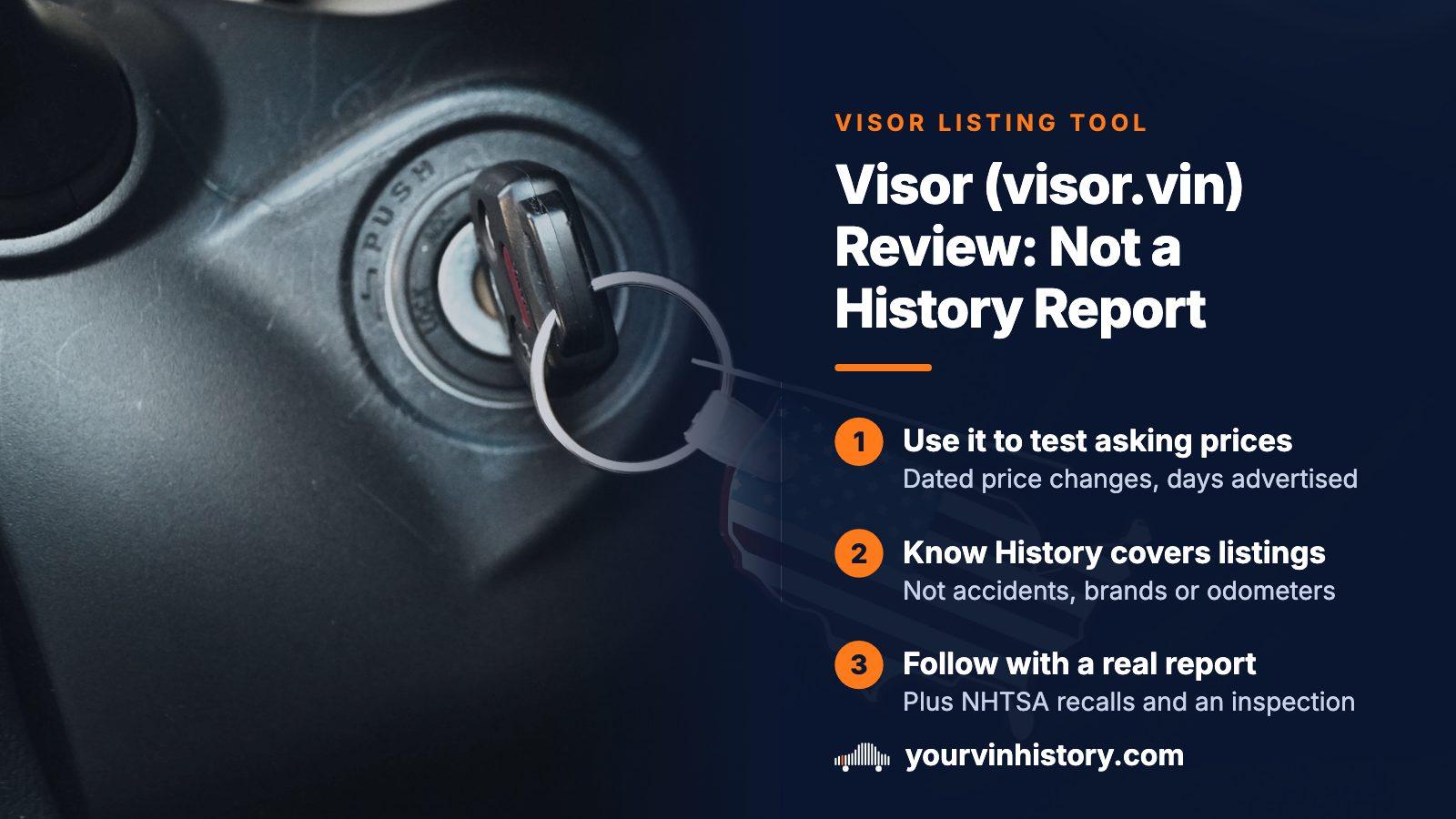
Visor gathers dealer listings and adds market analysis: dated price changes, days advertised and how fast the same specification sells. Its History tab covers the listing, not the car, so it holds nothing on accidents, title brands, odometers or theft. Use it to judge whether an asking price is real, then add NHTSA's recall lookup, a paid history report on one finalist and an inspection.
- What it is
- A search engine for dealer inventory, with price analysis
- The History tab
- Traces the listing, not the vehicle
- Not included
- Accident, title-brand, odometer, theft and lien records
- Paid tier
- Visor Plus, sold weekly, monthly, annually or once
Why a .vin address sets the wrong expectation
A domain ending in .vin suggests records, and a page that opens when you paste seventeen characters suggests a lookup into them. Visor uses the VIN another way: every listing is filed under a web address that finishes with the car's VIN, because the number is a unique handle and a natural key for an inventory database.
What opens is a page for a car on sale, not a file on where it has been, and a tab labeled History adds to the mix-up. Nowhere in the read behind this guide did Visor present itself as a history report, so the confusion comes from habit, not a promise.
What Visor does with the VIN you paste in
Visor is an independent search site that collects dealer listings and lays market analysis over them. It tracks how a given specification is selling, how long such cars sit unsold, and how one listing's asking price has moved since it first appeared. Pages carry no lead-capture form between the visitor and the listing, and no deal-rating badge.
The site sets itself apart from big listing sites on money, not features. By its own account it does not pass shoppers' details to dealers as sales leads and carries no dealer advertising, and a paid tier covers the bills. It says two brothers started it, and it publishes an email address, a changelog and a roadmap. The scale is far from the large data companies that supply most history reports.
The three kinds of data on a Visor listing
A used-car listing read field by field sorts into three groups.
| Group | Examples | Where it comes from |
|---|---|---|
| Decoded from the VIN | Make and model, trim level, model year, engine, drivetrain, fuel type, plant where built | Any VIN decoder returns these |
| From the listing | Asking price, advertised mileage, colors, selling dealer, stock number, photos, days advertised | Published by the seller |
| Computed by Visor | Dated price changes, market velocity, days to sell compared with average | Visor's analysis of listing data |
Only the third group is something a buyer cannot get by reading the ad, and it is the real product. None of the groups holds a record about the vehicle's past. Warranty status, one field on the listing that was read, showed as login-required, so it is described here as gated, not assessed.
Listing history versus vehicle history
Both carry the word history, and they share almost nothing. A buyer who confuses the two ends up reassured and no wiser about the car.
| Point of comparison | Listing history | Vehicle history |
|---|---|---|
| Subject | The ad | The car |
| Clock starts when | The car is listed for sale | The car is built |
| Typical content | Price changes, dates, mileage as advertised | Damage records, title brands, odometer readings |
| After the ad comes down | It resets | It stays attached to the VIN across owners and states |
| What it reveals | The seller's position | The car's past |
One listing examined had been up for ninety-nine days and had its price cut eight times, with the mileage unchanged throughout. That shows a seller who has spent over three months failing to move the car, which gives a buyer bargaining room. It shows nothing about whether the car was ever in a collision.
Market signals, and how to use them at the table
A listing page also carries computed comparisons: recent nationwide sales of that exact specification, the average days they took, how this car stacks up, and an estimated chance of selling within the coming week. The dated price trail, which records mileage at every step, is the most useful, and the ad does not offer it.
- Days advertised, set against the average for that specification
- Each price change, with its date and the mileage at that point
- Whether today's price is the lowest the listing has shown
- For used cars, whether a different dealer listed the same VIN earlier (a Visor Plus feature)
A car listed for triple the typical time, with repeated cuts, deserves a different conversation than an identically priced one posted last week. Treat the numbers as signals. The footer says the data is gathered independently and supplied as is, with no warranty that it is accurate, complete or timely, and calls pricing signals informational, not advice.
New-car analysis and the Deal Check tool
Visor also analyzes new vehicles. Its front page shows how a model's sales split between cars sold while still being built, cars sold in transit and cars sold from a dealer's lot, how long a hybrid trim takes to sell next to the gasoline version in one state, and how competing trucks hold value after three years. Those figures are Visor's own and have not been audited here.
Visor also advertises a free tool called Deal Check, which compares the fees, add-ons and financing lines on a dealer's deal sheet with the local market. During the August 2026 read, the addresses tried for it returned the site's 404 page, so nothing here evaluates how it works. The idea is sound on its face, since dealer add-ons and fees can quietly claw back a discount you negotiated.
Plans, billing shape and the privacy pitch
Visor splits into a no-cost tier and Visor Plus. Visor Plus is offered weekly, monthly or annually, or as a single purchase that does not renew. Each is billed as cancel-anytime, and the site says there are no hidden fees. A weekly plan suits a buyer who shops hard for a short stretch and then stops.
Paid features cover search depth, not records: the previous-seller check on used cars, advanced filter controls, documents the site finds on the web for each listing, installed options displayed on every listing, and filtering by factory-installed options and features.
As for data, the site's stated stance is that shoppers' details are not sold on as leads. That comes from the company itself and has not been checked by anyone for this guide.
What its public disclosures show, and what they do not
- A public changelog listing what changed and when
- A public roadmap that separates plans from shipped features
- A direct email address for the people running the site, shown on every page
- A line above the testimonials saying no review was ever paid for
None of these verifies anything. A changelog covers only what the company decided to post, a no-paid-reviews line is just a claim, and a roadmap is a list of intentions. They do show a company that makes itself easy to check. The same standard fits any service asking for money or a VIN: visitors should be able to see recent changes, find the operators, learn what the data includes and know how cancellation works.
Records a Visor page does not hold
Measured against the worries of a used-car buyer, the tool is silent on most of them. It cannot answer any of these:
- Whether the car was in a collision
- Whether the title was ever branded
- What the odometer read in earlier years
- Whether the car is reported stolen or carries a lien
- Whether the VIN has open safety recalls
- What condition the car is in, which only an inspection reveals
Recalls are the easiest gap to fill. NHTSA runs a lookup by VIN that costs nothing, so nobody needs to pay another service for it. Title and brand data comes from NMVTIS, a federal title database run through the Department of Justice, which approved providers resell in their history reports.
A sensible order of checks around Visor
Order matters more than the choice of tool: each step is cheap enough to justify the next, and any step can end the hunt.
- Decode the VIN and confirm the car matches the ad. A trim or engine that disagrees with the number needs an answer first.
- Run NHTSA's recall lookup. An open recall need not end a purchase by itself, but it is unfinished work worth raising in the negotiation.
- Study the market position in a tool like Visor: days listed, price moves, whether today's price is the low, and how fast the specification sells.
- Buy a history report for the one car you are serious about. This site sells one, covering title brands, accidents and odometer readings among other records. Ordering one for each car you merely browse can cost more than an inspection, which would have taught you more.
- Pay for an inspection. Nothing else in this sequence looks at the car itself, and it is non-negotiable on any car with structural or flood history on its record.
At a dealer, also read the Buyers Guide on the window. The FTC's Used Car Rule, 16 CFR Part 455, sets what the dealer must disclose there, and the window form overrides contrary terms in the sales contract.
What this review could not check
This guide rests on a read of Visor's home page, its subscription page and one live used-car listing in August 2026. No account was created and the paid tier was not tested, so account-gated features are noted as locked, not judged. Nor can it say how complete the listings are in your area, which needs a side-by-side comparison with local inventory, or how reliable the sold and market-speed numbers are, since the underlying sales data cannot be confirmed independently. Pages and features change, so confirm current details on the site before you pay.
The category is the finding
Visor is a search and pricing tool and does that job well. On its pages, history means the ad's story, not the car's.
Where this information comes from
- NHTSA: Recalls — The federal lookup for open safety recalls by VIN, which fills a gap a listing site does not cover.
- Bureau of Justice Assistance: NMVTIS — Background on the federal title information system behind the title and brand records that approved providers supply.
- eCFR: 16 CFR Part 455, Used Motor Vehicle Trade Regulation Rule — The text of the FTC Used Car Rule: Buyers Guide disclosures and the window form overriding contrary contract terms.
Sources and photos: Facts checked against the sources above in October 2026. Photo by Derek Nelson on Unsplash; diagrams by YourVINHistory.
Keep reading
- Carfax alternativesSee which history providers hold which records, now that Visor is ruled out as one.
- What a report should costLearn how paid reports are priced and what a fair price looks like.
- Car value by VINFind out what a VIN can and cannot say about what a car is worth.
- Pre-purchase inspectionThe last step in the order of checks: what an inspection covers.
Frequently asked questions
Is visor.vin a vehicle history report?
No. Visor searches dealer inventory and analyzes pricing, and its History tab traces the listing: price changes, dates and time on the market. A history report is assembled from records about the vehicle, such as title and damage entries, which Visor does not hold. Many buyers use both.
Is Visor free to use?
It offers a no-cost tier and a paid upgrade named Visor Plus, sold weekly, monthly, annually or as a one-time purchase. The upgrade adds search depth, such as option filters and the previous-seller check, rather than records. Confirm current terms on the site before paying, since plans can change.
Does Visor sell my information to dealers?
The site says shoppers' details are not sold as leads and that it carries no dealer advertising. That is the company describing itself, and nothing in this guide audits it. If the answer matters, read the site's own privacy wording before entering an email address or phone number.
Can Visor tell me if a car has an open recall?
Open recalls were not among the fields found on the listing that was read. The NHTSA recall lookup answers that by VIN at no cost. Compare the number you enter with the VIN printed on the car itself, not only the one in the ad, so the result belongs to the vehicle in front of you.
Should I trust Visor's days-to-sell and sold figures?
Use them to frame a negotiation, not as proof. The footer says the data is independently sourced and supplied as is, and the sold data behind the velocity numbers could not be verified for this guide. Repeated cuts and a long stay on the market are worth raising with the seller.
Now check the car itself
The guide explains what to look for. The report shows what this VIN has on record.