THE SHORT ANSWER
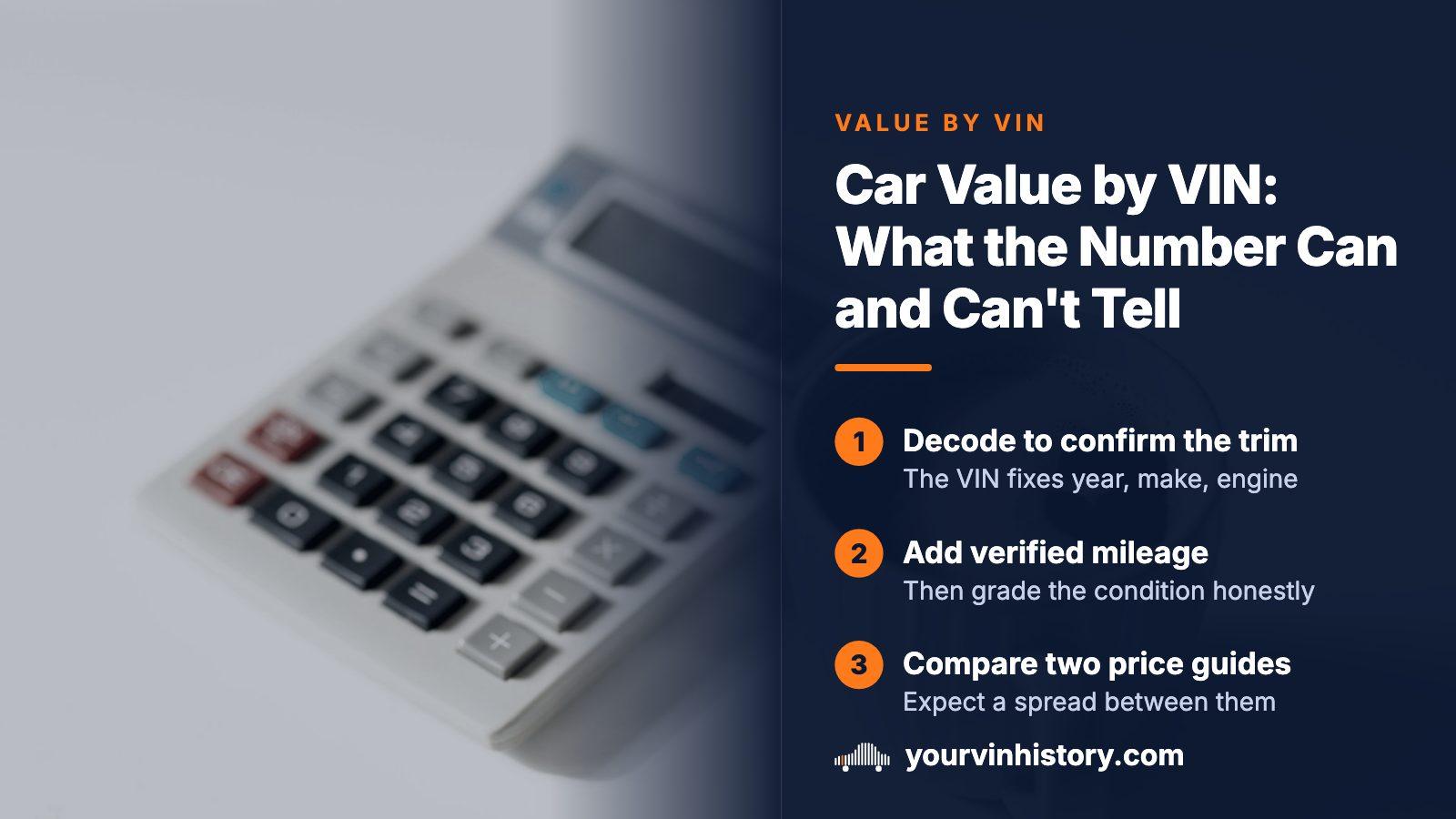
No. A VIN is a factory identity code. It fixes the year, make, model, body and engine, but it carries no mileage, condition, location or sale history. Use the decode to confirm the exact trim, then add a verified odometer reading and an honest condition grade, and compare at least two price guides. Expect the trade-in, private-party and retail figures for one car to differ.
- Inside the VIN
- Year, make, model, body, engine, plant
- Outside the VIN
- Mileage, condition, location, service record
- NHTSA base price field
- New-car price, filled in for some makers only
- Price guides
- Compare two and expect a spread
A VIN settles which car you are pricing
Every modern car carries seventeen characters, and each group answers a manufacturing question: who built it, which body and engine it received, what model year it belongs to and which plant it left. All of that was fixed on the assembly line. A hundred thousand highway miles or a rear-end collision will not change a character.
That makes the VIN a lookup key rather than a price tag. Within one model line, trim and engine can separate two cars by a wide margin, and a listing will sometimes round a base model up to a better-sounding name. Decode the number first, compare the result with the ad, and price the car the VIN describes instead of the one the headline promises.
What NHTSA's decoder returns, and the base price field
NHTSA's vPIC tool is the government's own decoder, the place to learn what a VIN's characters stand for. For a typical car it fills in dozens of fields, from make and body class to engine and plant. Its variable list also includes a Base Price entry, defined as the cost of a new vehicle with standard equipment and the factory warranty, before any option packages.
A spot check of the public API showed how uneven that field is. A Honda and a Toyota came back with a base price, while a Chevrolet, a Ford, a Tesla, a Jeep and a BMW came back blank. Whether you see a number depends on what each maker submitted.
A filled-in base price is still a historical figure
It describes the car when new and sparsely equipped, and knows nothing about wear or the used market today. Use it to sanity-check the original sticker, never as a current value.
The inputs that actually move a used price
A decode gives you the starting line. These inputs decide where the car lands, and only a few can be looked up.
| Input | Where the evidence comes from |
|---|---|
| Odometer reading | Title transfers, inspections and service visits that log mileage |
| Mechanical condition | A test drive and an independent mechanic's inspection |
| Cosmetic condition | A slow walk around the car in daylight |
| Service history | Receipts and records; a long gap counts against the car |
| Title status | Title records and any brand attached to them |
| Trim and options | The VIN decode, plus the window or build sticker |
| Location and season | Local listings for comparable cars |
Only the odometer trail and the title record exist on paper anyone can pull. The rest need eyes on the car.
Mileage needs a second source
For most ordinary cars, mileage moves the price more than any other input. It is a hard number, easy to compare, and also the one figure a dishonest seller can quietly change. Winding back a reading raises the price without touching anything a casual buyer inspects. That incentive is why federal rules require an odometer disclosure when ownership changes, and why NHTSA warns about odometer fraud.
Treat the mileage in a listing as a claim until other dates agree with it. Titles, state inspections and service records each log the odometer at a different moment. A sequence that climbs steadily is reassuring. A reading lower than an earlier record is a reason to stop and ask questions before any price discussion.
Grade the condition the way the buyer will
Valuation tools ask you to rate the car, and owners rate generously. One step on the scale can shift the output noticeably, so the grade is not a formality. Use each tool's own written definitions instead of instinct, and note what a stranger would spot in the first ten minutes: warning lights, worn tires, scuffed wheels, a chipped windshield, odors, stained seats.
A dealer appraising a trade-in is pricing reconditioning and resale risk, so expect a harsher reading than the one you formed behind the wheel. Doing your own grading from that side of the counter first avoids an unpleasant surprise later.
Trade-in, private party and retail are three different sales
| Price type | Who pays it | Why it lands there |
|---|---|---|
| Trade-in | A dealer, against a purchase | Reduced for reconditioning and the risk of reselling |
| Private party | An individual buyer | Higher than trade-in, because the seller takes on the work and the risk |
| Retail | A shopper on a dealer lot | Includes preparation and the dealer standing behind the car |
A seller quoting retail and a buyer holding a trade-in figure can both be reading honest numbers from the same guide. Before any haggling starts, agree which of the three you are talking about.
Why two price guides rarely agree
The published guides were built for different customers, so a gap between them is expected, not a malfunction.
- J.D. Power (formerly NADA): widely used by lenders and dealers
- Kelley Blue Book: the guide most shoppers have heard of
- Edmunds: appraisal tools aimed at retail shoppers
- Auction results: what trade buyers actually paid, when you can see them
Pull at least two and treat the spread as your working range. A dealer's trade offer near the bottom of it is normal. An offer far outside it calls for finding out what the other side knows, or assumes, that you do not.
What title and accident history do to the price
A salvage or rebuilt brand is the heaviest single adjustment in used-car pricing. It sits on the title, follows the car across state lines, and can shrink the pool of lenders and insurers willing to take it on. Reported accident damage without a brand is murkier. Damage nobody reported only affects the price if a buyer or inspector finds it.
That gap between what was recorded and what happened is why the FTC tells shoppers to pay an independent mechanic for an inspection and says a history report is no substitute for one. The report is still the quickest way to see recorded events first. A yourvinhistory report lines up title brands, accidents, odometer readings and a market value, so you can set the paperwork beside a price guide's assumptions.
The one place a future car value goes into a contract
A lease commits a business to a number for one specific vehicle years ahead. The federal rule behind it is the Consumer Financial Protection Bureau's Regulation M, 12 CFR Part 1013. Residual value is the lessor's estimate, set at signing, of what the car will be worth when the term ends, and it feeds the monthly payment. Realized value is what the car actually brings: the price the lessor receives, the highest offer, or its fair market value at the end.
Section 1013.4 forces the gap into the open. Paragraph (k) calls for a statement of any liability you carry when the two figures differ, and paragraph (e) requires an open-end lease to warn that you will owe more if the car's actual value falls short of the residual.
Paragraph (i) covers purchase options. The lease must say whether you have one and the price, or for a mid-term option the price or its method. The official commentary adds that a vague label such as fair market value does not satisfy the rule; the price must be a stated sum or tied to a readily available independent source.
A binding appraisal and a limit on overshooting
Paragraph (l) is the unusual part. When what you owe at the end depends on realized value, the lessor must tell you that you may order a professional appraisal of what the car could fetch at sale, from an independent third party both sides accept, at your expense. The result is final and binding on both parties. The commentary adds that the lessor must say whether wholesale or retail appraisal value will be used.
- The answer settles the question, so you cannot order one and then contest it.
- Owing for unreasonable wear or use does not by itself trigger the right.
Paragraph (m)(2) adds a guardrail for open-end leases. If the residual is higher than the realized value by over three base monthly payments, the law presumes the estimate was neither reasonable nor made in good faith. A lessor can rebut that, and it cannot collect the excess without winning in court and paying your reasonable attorney's fees, unless excess wear or use caused the shortfall.
Scope of this rule
Regulation M covers consumer leases only. It sets no value for a car you own, and no part of it can be read off a VIN. It works here as a calibration point: if a lessor holding the contract is allowed a margin measured in monthly payments, an instant online estimate made without seeing your car is a range, not a figure.
A routine for a number you can defend
Everything above compresses into five steps that cost nothing until you hire the mechanic.
- Decode the VIN with NHTSA's tool and match the trim, engine and body style to the listing. Run NHTSA's recall lookup at the same time, since an open recall is a pending job to ask the seller about.
- Read the odometer, then compare it with a recorded reading from another date.
- Grade the condition with each tool's written definitions, from the buyer's side of the table.
- Pull two guides, choose the transaction type (trade-in, private party or retail) and note the spread.
- Adjust for recorded history, then get an independent inspection before any money changes hands.
Where this information comes from
- NHTSA: vPIC VIN decoder — The federal decoder, including its Base Price variable and the spot checks described above.
- eCFR: 12 CFR 1013.4, content of disclosures — Residual versus realized value, purchase options, the binding appraisal and the monthly-payment presumption.
- eCFR: 12 CFR Part 1013, Consumer Leasing (Regulation M) — The definitions of residual value, realized value and open-end lease, plus the official commentary.
- NHTSA: odometer fraud — Background on why a stated mileage should be corroborated before it supports a price.
- FTC: buying a used car from a dealer — Federal advice on the Buyers Guide and on paying for an independent inspection.
Sources and photos: Facts checked against the sources above in October 2026. Photo by Ben Wicks on Unsplash; diagrams by YourVINHistory.
Keep reading
- NADA value by VINSee how the lender's reference book is built and why it parts ways with the consumer one.
- Kelley Blue Book value by VINLearn what the best-known consumer guide asks for once you have the VIN.
- Odometer rollback checkTest the mileage figure that every price rests on.
- What is a branded title?Understand the title marks that cut value the most.
Frequently asked questions
Can I get a car's exact value from just the VIN?
No exact figure exists. A tool takes the VIN to identify the car, then asks for mileage, condition and ZIP code, because those drive the price. Anything that returns a dollar value from the VIN alone is quietly assuming average mileage and condition, so it describes a typical car rather than yours.
Does the VIN show what the car originally cost?
Sometimes. NHTSA's decoder has a Base Price field, but it is filled in only when the maker supplied it, and it reflects a new car with standard equipment and no option packages. The original window sticker, which lists the options and the full price, is the better record if the seller still has it.
Why is a dealer's trade-in offer lower than the online estimate?
First check which transaction the online figure describes. A dealer's offer subtracts reconditioning, resale risk and its own margin, so it should sit below a private-party or retail number. Compare it with the trade-in figure from the same guide. A gap you can explain is normal; one you cannot is a reason to collect a second dealer's quote.
Is my lease buyout price the same as market value?
Not necessarily. The purchase option in a lease is a contract term, either a stated price or a method for finding one, set before anyone knew how the market would move. It can sit above or below what the same car sells for today, so compare it with current guide ranges and local listings before deciding whether to buy.
Is a free valuation tool accurate enough?
For orientation, yes. The major tools cost nothing and land in the right neighborhood. Accuracy for your own car depends on inputs only you can supply honestly: verified mileage, a candid condition grade and the exact trim. Run two tools and treat the overlap, not either single number, as the range.
Now check the car itself
The guide explains what to look for. The report shows what this VIN has on record.