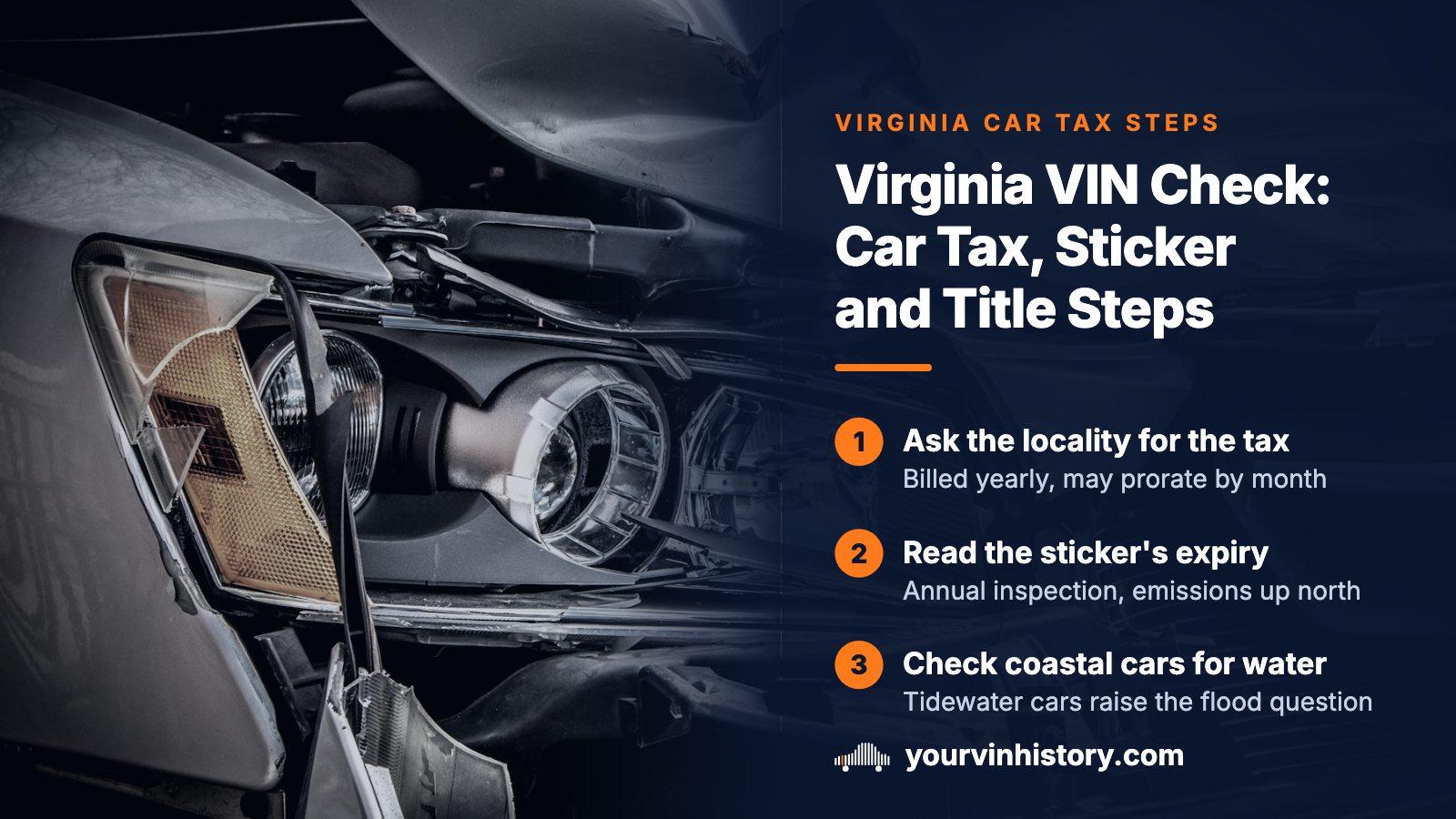
THE SHORT ANSWER
To check a VIN in Virginia, decode it, search NHTSA for open recalls, run the NICB theft and salvage lookup, then pull a national NMVTIS title record from an approved provider. Add the Virginia steps: ask the locality what the annual car tax on that car will be, check when the inspection sticker expires, read the VIN on a door as well as the dash, and inspect any Tidewater car for water damage.
- Car tax
- Billed by the locality every year you own the car
- Mid-year purchase
- Localities may prorate the tax by the month
- Inspection
- Annual sticker, plus emissions testing in Northern Virginia
- Salvage scope
- Late model cars only: current year plus five, or worth $10,000 or more before damage
Why the price on the windshield is only the first bill
Most states collect vehicle tax once, at the counter. Virginia adds a second tax that keeps coming back. Cities and counties levy a personal property tax on cars, the local commissioner of the revenue assigns each vehicle a value, and the treasurer mails the owner a bill. It repeats every year the car stays in your name.
A state relief program trims the bill for qualifying personal-use vehicles by letting localities charge a reduced rate on part of the value. How much relief you see depends on local rates, and a vehicle used for business may be treated differently, so confirm it instead of assuming it.
For a used-car shopper, value drives cost twice. A newer, pricier car costs more on the day you buy it and more in every tax cycle after, while an older car that has lost most of its value carries a smaller assessment. That does not make the cheapest car the right one, but run the numbers before you fall for one.
Your garage address and the purchase month shape the first bill
The tax attaches to the place where the vehicle is kept, not to where the seller lived. A car bought in a low-rate county and garaged in a high-rate city is billed at the city's rate, so look up the rate for your own address.
Timing matters as well. Virginia law lets a locality charge for only the remaining months when a vehicle arrives after the local tax day, and anything over half a month counts as a full one. The same section runs the other way for sellers: when a vehicle leaves the locality or changes title after the tax day, the tax can be relieved by the month, with a refund or a credit toward another vehicle. Ask the treasurer's office whether your locality does this.
Five questions to put to your locality before you shortlist
Call the office that serves the address where the car will live. Most of these take minutes to answer, and the answers can reorder your shortlist.
| Ask about | Why it matters |
|---|---|
| The rate at my address | Rates differ by city and county, and yours is the only one that counts. |
| How this model and year are valued | The bill follows assessed value, so two similar cars can bill differently. |
| Whether this car qualifies for state relief | Personal use is what the relief program is built around. |
| Proration if I buy mid-year | It decides how big the first bill is. |
| When the first bill is due | A due date you did not expect is a bad way to learn the rules. |
Reading the inspection sticker against the sale date
Virginia requires a yearly safety inspection at a licensed station, shown by a sticker on the windshield. The month and year on it mark when the next inspection is due, and it expires on the last day of that month. The state does not mail reminders. Cars garaged in the Northern Virginia counties near Washington face an emissions test on top of the safety check.
- A sticker with months left is a modest positive: someone recently confirmed the listed equipment worked. It guarantees nothing mechanical.
- A sticker about to lapse hands the next inspection to you, so ask the seller what the car would need to pass.
- A car bought out of state must be inspected once it is registered in Virginia, with no grace period, according to state police guidance.
- The inspection checks equipment against a state manual. It says nothing about accidents, brands or odometer history.
The no-cost national lookups to run before you drive over
Three lookups cost nothing and can end the conversation early. Decode the 17-character VIN and confirm it matches the make, year and engine in the ad. Search the NHTSA recall lookup for open safety recalls. Run the NICB VINCheck, which draws on participating insurers for theft and salvage records.
An open recall is a talking point with the seller, not necessarily a deal-breaker. Manufacturers are generally required to repair recalled defects at no charge to the owner, but that federal rule has an age limit, so a very old vehicle may fall outside it. Ask a franchised dealer to confirm before you count the repair as covered.
Know what these lookups cannot see. NICB depends on insurers reporting, so a car wrecked and fixed without a claim leaves no entry.
Adding the national title record
NMVTIS is the federal system built to protect buyers from title fraud and unsafe vehicles. Consumers reach it by buying a report from an approved provider listed on the Justice Department's NMVTIS site. The record matters in Virginia because many cars arrive from elsewhere, and a brand applied by another state follows the VIN, not the license plate.
A yourvinhistory report starts with a preview, and the full report is a one-time purchase. Its title records come from ClearVin LLC, an approved NMVTIS data provider, alongside accidents with a damage map, salvage and auction records with photos, liens, theft, open recalls and odometer readings.
Virginia's salvage rules reach only some cars
The damage tests in Virginia's salvage definition apply to what the Code calls late model vehicles. That group has two doors: the current model year and the five before it, or any vehicle whose actual cash value was at least $10,000 before it was damaged. An owner or insurer can still apply for a salvage certificate on an older car, but the damage tests will not brand it for you.
| Scenario | Damage tests apply? |
|---|---|
| Model year is this year's, or among the five previous | Yes, because of age |
| Older car that was worth at least $10,000 pre-damage | Yes, because of value |
| Older car that was worth under $10,000 pre-damage | No |
The value test looks backward, at what the car was worth before the loss. An insurer or owner set that figure privately, and it sits in no public register. So a missing brand on an older, inexpensive car is weaker evidence than one missing on a recent car: the rules applied to the recent car and found nothing, while on the older one they may never have applied.
Rebuilt, nonrepairable, and the repair bill that skips the engine
Salvage, rebuilt and nonrepairable are three separate statuses, not synonyms for damaged. A rebuilt vehicle is a salvage vehicle repaired for the road, or a late model car repaired after an estimate above 75 percent of its actual cash value, a figure that leaves out damage to the engine, transmission and drive axle assembly.
- A car whose engine and transmission were replaced can stay under the 75 percent line and avoid the rebuilt brand.
- A clean title therefore does not prove the powertrain is original. Ask for invoices and service records.
- Nonrepairable means an insurer or owner judged the vehicle worth nothing beyond parts and scrap metal. It is finished as a candidate for the road.
- Anyone who repairs two or more salvage vehicles within 12 months counts as a rebuilder under the Code, so a seller describing volume work is describing a trade the law has a name for.
A door that displays a VIN counts as a major component
The same Code section names the major components of a vehicle: the front clip (fenders, grille, hood, bumper), the engine, the transmission, the rear clip (quarter panels, floor panels, trunk lid, bumper), the frame, and the air bags. The last entry is the interesting one: any door bearing a VIN is on the list. A VIN on a panel ties part of the car's identity to that panel.
Three readings at the viewing
Check the label on the driver's door, then the plate at the base of the windshield, then the title. All three should show the same seventeen characters. A mismatch, a missing label or a replacement door that does not belong is a reason to stop and ask.
Tidewater cars and the water question
Low-lying Hampton Roads cities such as Norfolk, Virginia Beach and Newport News take storm surge and tidal flooding. A car that flooded and was written off by an insurer may carry a brand. One that its owner dried out and sold privately usually carries nothing, which makes the physical check the one that counts.
- Silt, sand or a waterline in the spare tire well and under the seat rails
- Corrosion or crusty residue on connectors under the dash and in the trunk
- Moisture lines or fogging inside headlights and taillights
- A heavy air freshener masking a musty smell
- Windows, lights or warning lamps that misbehave from time to time
The Virginia check in order, cheapest step first
- Decode the VIN, then run the NHTSA recall lookup and NICB VINCheck.
- Pull the NMVTIS title record for brands from every reporting state.
- Ask the locality for the tax rate and the likely assessment on each candidate.
- Compare the sticker date with the sale date.
- Read the VIN on the door, the windshield plate and the title, and check a Tidewater car for water.
- Pay a mechanic of your choosing to inspect the car once it has cleared the rest, then complete the transfer promptly at the DMV.
A plate lookup is missing from the list on purpose. Federal privacy law limits who may receive owner details from motor vehicle records, so ask the seller for the VIN.
Where this information comes from
- Code of Virginia: salvage, nonrepairable and rebuilt definitions — Source for the late model test, the 75 percent rebuilt test with its powertrain carve-out, and the major component list.
- Code of Virginia: proration of personal property tax — Explains how a locality may charge by the month for vehicles that arrive or leave after the tax day.
- Virginia DMV: titles, registration and inspections — The state agency for titling and registering a purchased car, and for inspection and emissions information.
- Bureau of Justice Assistance: NMVTIS — The federal title database, with the list of approved providers that sell consumer reports.
- NICB: VINCheck — A no-cost theft and salvage lookup fed by participating insurers.
- NHTSA: Recalls — Where to search a VIN for open safety recalls.
Sources and photos: Facts checked against the sources above in October 2026. Photo by Clark Van Der Beken on Unsplash; diagrams by YourVINHistory.
Keep reading
- Virginia title checkThe three title labels and the repair tests behind them, in more depth.
- Virginia platesWhat a Virginia plate can and cannot tell you about a car or its owner.
- Flood-damaged carsA fuller walk through spotting water damage on a car from a coastal area.
- Pre-purchase inspectionHow to hire a mechanic to look at the things no record covers.
Frequently asked questions
How do I run a VIN check on a car in Virginia?
Copy the 17-character VIN from the dash plate and the door label, then decode it and run the NHTSA recall and NICB lookups. A yourvinhistory preview shows whether records exist before you decide on the full report. Then call the locality about the car tax and check the sticker date.
Will I owe car tax on a used car I just bought?
Usually yes, if the car is garaged in a locality that taxes vehicles, and the bill returns each year. When you buy after the local tax day, Virginia law lets a locality charge only the remaining months, so ask the treasurer's office how your first bill will be figured and when it falls due.
Does a car bought out of state need a Virginia inspection?
Yes. State police guidance says a vehicle bought out of state must be inspected once it is registered in Virginia, with no grace period. Ask a licensed station what it would flag before you sign, and build the cost of any needed repairs into your offer.
Can I find a Virginia car's owner from its license plate?
Not as a private buyer. The federal Driver's Privacy Protection Act restricts who can receive owner details from motor vehicle records, and curiosity is not a permitted use. For a purchase, ask the seller for the VIN and the title, and make sure the two agree.
Does a clean Virginia title mean the car was never badly wrecked?
No. It means no brand was recorded. Damage repaid out of pocket never reaches an insurer, older low-value cars may sit outside the salvage definition, and a replaced powertrain can slip under the rebuilt test. Pair the title with service records and an independent inspection.
Now check the car itself
The guide explains what to look for. The report shows what this VIN has on record.