THE SHORT ANSWER
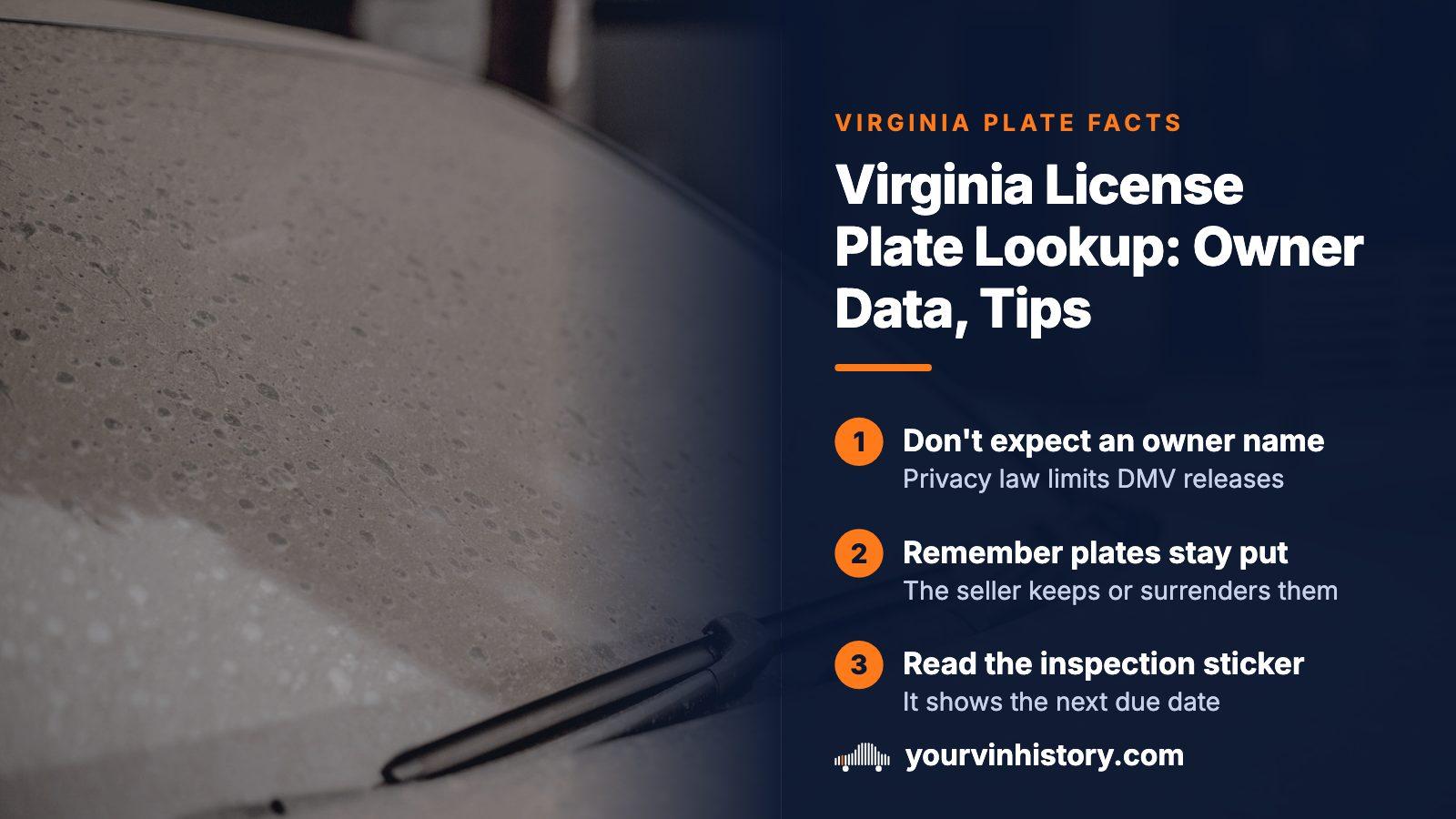
A Virginia plate number will not get a private buyer the owner's name. The federal Driver's Privacy Protection Act lets the DMV release owner details only for permitted uses, such as a court case or an insurance claim. Virginia plates, personalized ones included, stay with the seller, so the plate in the ad photos will not come home with you. Use the 17-character VIN for history checks, and read the inspection sticker for the next due date.
- Owner records
- Released only for uses the federal privacy law permits
- At sale
- Plates stay with the seller, who moves or surrenders them
- Plates shown
- Front and rear on most passenger vehicles
- Inspection
- At least once every 12 months
Why a Virginia plate will not give you the owner's name
Plenty of sites will accept a Virginia plate number, but none has a legal pipeline into the DMV's owner file. The Driver's Privacy Protection Act, found at 18 U.S.C. § 2721, bars a state motor vehicle agency from knowingly releasing personal information drawn from its records, then carves out a defined list of exceptions. Curiosity about a seller, a neighbor or a car parked outside is not on it.
The exceptions that matter in daily life are narrow. Government agencies and courts can request records, insurers can use them on a claim or a rating decision, and parties to a lawsuit can use them to serve papers. Notifying the owner of a towed car, work by a licensed investigator within the permitted purposes, and an employer's check on a commercial driver are covered too. So is consent from the person involved.
A personalized plate changes none of this. Anyone can read its text from the sidewalk, but the registration behind it is as protected as any other. If a driver hit your car and left, give the plate number to the police and your insurer, the channels the law leaves open.
The vanity plate in the photos is not part of the sale
Virginia treats the plates as belonging to the owner. When a car is sold, traded or taken off the road, the DMV expects the owner to move them to another vehicle or give them up. A bare bumper at the handoff is therefore normal, and a bold personalized plate in the listing photos is the one item sure not to be there when you drive away.
Treat the plate as scenery. The signed title is what proves the seller can sell, so compare the name on it with the seller's photo ID before money moves. Do not agree to leave on the seller's plates; that registration was issued to someone about to stop owning the car.
Settle the first drive before you pay. Ask the DMV, or the dealer if you are buying from one, which temporary option covers your purchase. The temporary tag guide listed at the end explains how those permits generally work.
What a seller does with plates once the car is gone
A seller has three realistic paths, and the DMV's rules put money behind the choice.
| Path | How it works | Money |
|---|---|---|
| Move to another vehicle | File the plate application and finish the transaction at a customer service center | The plates stay in service on the replacement |
| Surrender in person | Hand the plates in at a customer service center | A partial refund is possible when six or more months of registration remain |
| Surrender online | Use the DMV's online plate surrender | Not eligible for a refund |
A refund also needs its own request form, and the DMV says payment generally takes about a month. A seller with a long registration left therefore has a reason to remove the plates promptly and walk them in.
Virginia's reputation as the vanity plate state
When the subject is personalized plates, Virginia is the state people cite. The DMV asks only a modest yearly add-on for custom characters, the program has run for decades, and the habit has stuck: roughly one registered vehicle in ten is commonly reported to wear owner-chosen text, the highest share in the country by most rankings. Published figures disagree on the exact percentage, so treat any single number as an estimate.
Two practical points follow. A plate spelling a hobby or a nickname tells you about the owner's taste, not the car, and it vanishes at the sale. And some sellers blur theirs in photos, a privacy habit rather than a warning sign.
Personalized or standard, the rules match
A personalized plate is registered like any other. It is moved or surrendered the same way, and the same privacy law protects its owner.
Two plates on the car, one plate across the border
Virginia law calls for a plate on both the front and the rear of a typical passenger vehicle. Some neighbors differ. Most passenger cars in North Carolina and Tennessee carry a single rear plate, so a Virginia car and a Carolina car look different from the front before you read a single character.
Cars cross those borders constantly, and bumpers keep a record. Mounting holes or a bracket on the nose of a car now titled in a rear-only state suggest time spent somewhere that wanted a front plate. A Virginia car with an untouched front bumper may have started in a rear-only state, or its owner may have removed the bracket. Neither proves anything. Each is a prompt to ask where the car has lived, then compare the answer with the title history under its VIN.
The windshield sticker as a dated promise
Most Virginia vehicles need a safety inspection at least once every 12 months, and the windshield sticker shows the month the next one falls due. The State Police publish an official procedure of more than twenty steps, covering brakes, lights, steering and suspension, tires, mirrors, the horn, glass and wipers, exhaust, seat belts, airbags and the fuel system. Even the rear plate gets attention, since a white light must illuminate it.
A failed car receives a rejection sticker, good for the inspection day plus 15 days. The defects must be fixed and the car reinspected inside that window.
For a buyer, the sticker is a date stamp on the car's condition. A fresh one says a licensed station recently cleared the brakes, lights and tires. One about to lapse means an appointment, and any repairs it uncovers, will land on you. State law also keeps officers from stopping a car over an expired sticker until the first day of the fourth month after it lapsed, so a stale sticker can linger on a windshield.
Price the next inspection into the offer
If the sticker is close to expiring, ask for an inspection before the sale or take the likely repair cost off the price. Get the result in writing.
Plate and sticker clues at a viewing, and the question each raises
Treat these as prompts, not verdicts. A single clue rarely settles anything.
- No plates on the car: normal for a private sale, so ask for the signed title and the seller's photo ID instead.
- Plates on a car whose title carries another name: ask why, and hold your money until the seller shows the right to sell.
- An expired or nearly expired inspection sticker: ask for the last inspection receipt and budget for the next visit to a station.
- A rejection sticker on the glass: the car failed recently, so ask what the defects were and who repaired them.
- Front bumper holes, or none at all: ask where the car has lived, since neighboring states differ on front plates.
- Plate text that reads like a message: ignore it as evidence, because the title and the VIN are the records.
From signed title to plates in your own name
For a private purchase, the sequence runs roughly like this. Confirm current forms and fees on the DMV site before you go.
- Get the title signed by the seller, with the odometer reading disclosed, and match the name to photo ID.
- Compare the VIN on the dashboard, the door label and the title before paying.
- Title and register the car in your name at the DMV. Expect sales and use tax on the price, plus fees and the cost of the plates.
- Choose standard or personalized plates when you order, if you want to join the local tradition.
- Book the safety inspection. The new sticker starts your own annual calendar.
- Watch for the personal property tax bill from your city or county, which Virginia charges on vehicles by value each year.
Where the history lives: the VIN, not the plate
A plate identifies a registration at one moment. The VIN identifies the vehicle for good, which is why title brands, odometer entries and recall status all hang on it. Begin with checks other organizations run at no cost: decode the 17-character number, search the NHTSA recall lookup, and try the NICB VINCheck for theft and salvage records.
Then look at the national title record. NMVTIS is the federal system that pools title data from participating states, aimed at shielding buyers from title fraud and unsafe cars and at keeping stolen ones from being resold. A brand applied in another state follows the VIN into Virginia. A yourvinhistory report, which starts with a free preview and is then a one-time purchase, draws its title records from ClearVin LLC, an approved NMVTIS data provider, and adds accident, salvage, auction and odometer entries.
Recalls and vehicle age
An open recall is a talking point, not proof of a bad car. Ask a franchised dealer whether the repair is covered before you count on it. The federal no-charge repair rule has an age limit, so a very old vehicle may fall outside it.
Where this information comes from
- Virginia DMV: license plates — The DMV's hub for standard, specialty and personalized plates, plate transfers and surrender.
- Virginia State Police: vehicle safety inspection — The inspection steps, the rejection sticker window and what an inspector checks.
- Driver's Privacy Protection Act, 18 U.S.C. § 2721 — The federal limit on releasing owner data from motor vehicle records, and the list of permitted uses.
- NMVTIS: National Motor Vehicle Title Information System — The Justice Department portal for the national title record and where consumers buy a report.
Sources and photos: Facts checked against the sources above in October 2026. Photo by Cole Keister on Unsplash; diagrams by YourVINHistory.
Keep reading
- License plate lookupThe national rules behind plate searches, and where the privacy law draws the line.
- VirginiaThe yearly car tax, inspection timing and title checks that apply to Virginia purchases.
- Temporary tagHow long a new buyer may drive before permanent plates arrive, and why states differ.
- Vanity plate availabilityHow personalized plate requests are checked, and why some get turned down.
Frequently asked questions
Can I find the owner of a Virginia car from its license plate?
Not as a private person who is simply curious. The DMV releases owner records only for uses federal law permits, and a buyer's curiosity is not one of them. If a driver hit your car, give the plate number to the police and your insurer. If you are buying, ask the seller for the VIN and photo ID, then match the name on the title.
Can I drive home on the seller's plates after buying a car in Virginia?
Plan on not doing it. The plates belong to the seller, and the DMV expects them to be moved to another vehicle or surrendered once the car is sold, so they stop vouching for the car when it changes hands. Before you pay, ask the DMV, or the dealer if you are buying from one, which temporary option fits your purchase.
Are any Virginia vehicles exempt from the safety inspection?
Yes. State law lists a number of exemptions, including antique vehicles, so check the category if the car is unusual. For ordinary cars the rule is an inspection at least once every 12 months. A lost, stolen or damaged sticker can be replaced without a new inspection under certain conditions.
Does Virginia require a front license plate?
For most vehicles, yes. The statute calls for plates on the front and rear, with exceptions: motorcycles, mopeds, autocycles and trailers carry one plate on the rear, and tractor trucks carry one on the front. If an ordinary car in an ad has no front plate, ask whether it came from a state that does not require one.
Does a Virginia vanity plate show up on a vehicle history report?
The plate text is not what history searches run on. Title brands from reporting states are keyed to the VIN, so a plate that moves to another car or goes back to the DMV leaves the old car's record unchanged. Use the plate only as a pointer to the car, then run the VIN.
Now check the car itself
The guide explains what to look for. The report shows what this VIN has on record.