THE SHORT ANSWER
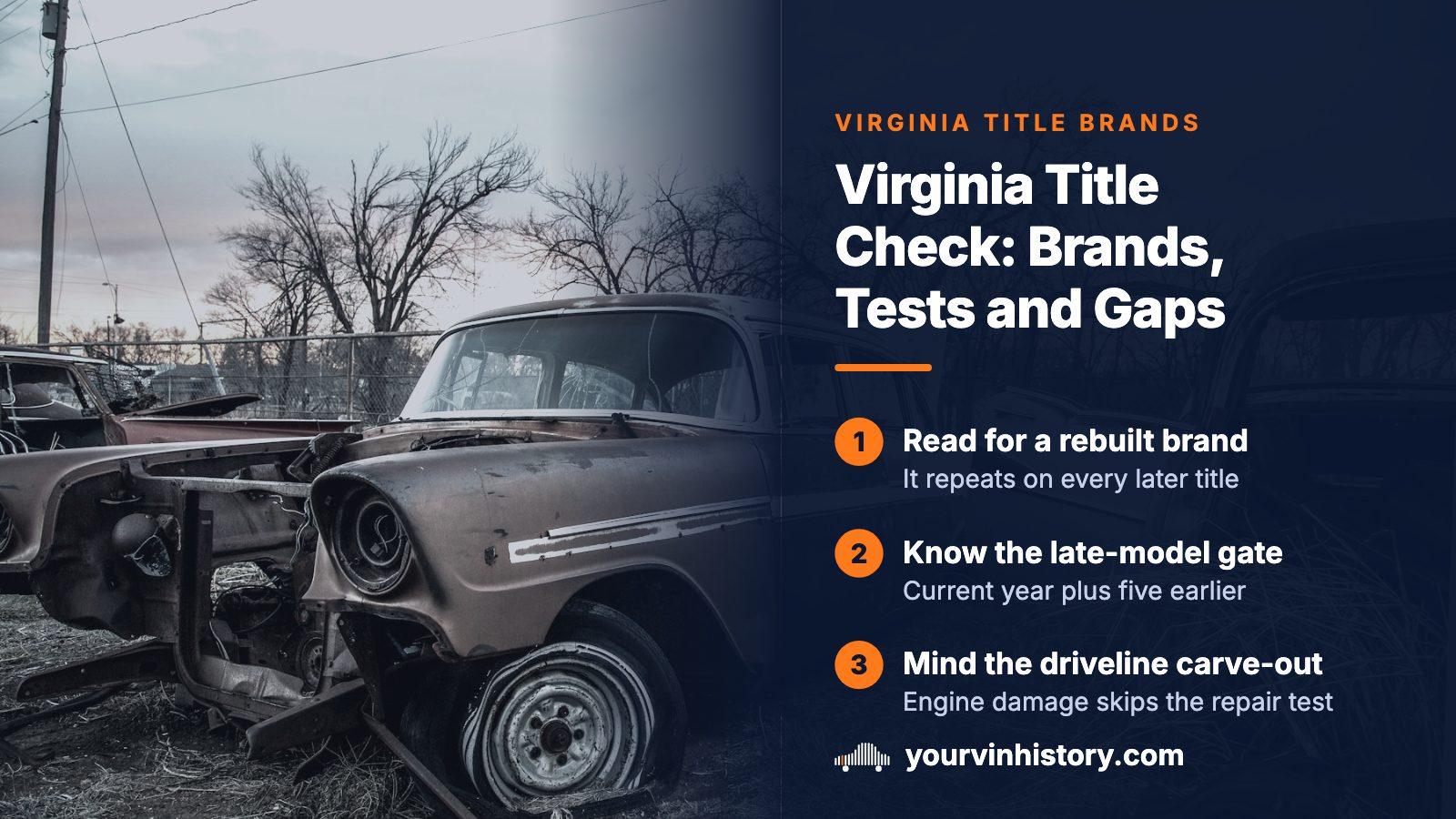
A Virginia title check starts with reading the title for a rebuilt brand, then confirming nothing happened that the brand would miss. The state's rules focus on late model vehicles: the current model year plus five earlier ones, or any car worth $10,000 or more before damage. The 75 percent repair test ignores engine, transmission and drive axle damage, so back the title up with an NMVTIS record and an independent inspection.
- Late model
- Current model year plus five earlier, or worth $10,000 or more before damage
- Left out of the 75% test
- Engine, transmission and drive axle assembly damage
- Rebuilt brand
- Permanent, repeated on every later title
- DMV examination
- An antitheft and antifraud review, not a roadworthiness check
Three labels in the Virginia Code, three different histories
Chapter 16 of Title 46.2 of the Code of Virginia sorts damaged vehicles into three groups, and a title check is mostly the work of figuring out which group a car belongs in. Section 46.2-1600 holds the definitions. Section 46.2-1605 covers what happens when a wreck goes back on the road.
| Label | What the code means by it | What it tells a buyer |
|---|---|---|
| Salvage | A late model vehicle whose repair estimate would beat its pre-damage value net of salvage value, or any vehicle an owner or insurer registers as salvage by applying for a salvage certificate | The owner holds a salvage certificate in place of a title until the car is rebuilt and approved |
| Rebuilt | A salvage vehicle repaired for highway use, or a late model vehicle repaired after an estimate above 75 percent of its value | A permanent brand on the title and on every title after it |
| Nonrepairable | A vehicle its insurer or owner has judged worth only parts and scrap, or one with a nonrepairable certificate issued or applied for | A vehicle the Department generally may not title again |
The late model gate: five model years or a $10,000 car
Most of the code's automatic tests apply to late model vehicles. Virginia defines the term two ways, and meeting either one is enough. The car belongs to the current model year or one of the five before it, or its retail cash value before the damage was at least $10,000.
The value route pulls in older cars. A well-kept pickup that is ten years old can still be worth five figures, which puts it under the same rules as a nearly new sedan. An ordinary older car that was worth less than the threshold falls outside the definition.
An unbranded older title proves less
Outside the late model definition, the repair tests do not apply on their own. An owner or insurer can still move any vehicle into salvage status by applying for a salvage certificate, and a salvage vehicle that gets repaired counts as rebuilt. Even so, a clean title on a cheap older car says less than the same title on a recent one.
How a late model car crosses into salvage
The central salvage test is a comparison. Start with the estimated repair cost, leaving out towing, storage, a rental or loaner, and any diminished value payment. If that figure would exceed the car's pre-damage cash value minus its current salvage value, the car is salvage.
The second number is the unusual one. Current salvage value is what the paying insurer determined the wreck would bring, or, when no insurer is paying, a fixed share of the cash value that the code supplies. Because the bar sits below full value, a repair estimate reaches it sooner than it would reach the full figure.
The definition has other doors too. It names late model vehicles an insurer takes over in the claims process, recovered thefts the insurer acquired where repairs would top 75 percent of value, and any vehicle whose owner or insurer applies for a salvage certificate.
Two ways to end up with a rebuilt brand
Rebuilt is the label most buyers actually meet, and the code reaches it by two routes.
- A salvage vehicle once it is repaired and driven on public roads again, whatever the repair cost.
- Any late model vehicle that was repaired after an estimate above 75 percent of its pre-damage cash value, with engine, transmission and drive axle damage left out of the figure.
By definition, the second route stands on its own. It needs neither an insurer nor a salvage certificate, only a late model car and a repair estimate over the line. The first route follows the paper trail: once a vehicle has been in salvage status and gets repaired, it is rebuilt.
The driveline carve-out inside the 75 percent test
When the 75 percent figure is calculated, the cost of fixing the engine, the transmission or the drive axle assembly is left out. Those parts are expensive. A car that needed a replacement gearbox after a hard hit could show a repair bill far above what the brand rule actually measures.
Two thresholds, two jobs
The $10,000 figure decides which vehicles count as late model. The driveline exclusion belongs to the 75 percent repair test for the rebuilt label. They are separate rules, and the salvage test in the same section lists different exclusions of its own: towing, storage, rental and diminished value.
For a buyer, silence on the title about a driveline repair means little. Ask for the repair paperwork, then have a mechanic look for leaks, fresh fluid, mismatched fasteners and signs of recent work around the engine, transmission and axles.
Nonrepairable means no percentage and no second chance
Virginia gives the nonrepairable label no formula. A vehicle qualifies when its insurer or owner decides it is worth only parts and scrap metal, or when a nonrepairable certificate has been requested or granted. That is a judgment, so you cannot test it with arithmetic.
The consequence is harsher than for the other labels. Except where the chapter provides otherwise, the Department may not issue a title or registration for any vehicle that has ever had a nonrepairable certificate issued. The code even says a vehicle declared nonrepairable stops being a vehicle for purposes of the chapter. A car with that history offered under an ordinary title is a serious red flag, and the explanation belongs on paper before money moves.
What a rebuilt car goes through before it is titled
Section 46.2-1605 sets an order of events, and the second step is narrower than most buyers assume.
- A state safety inspection, done by an inspector with no connection to whoever asked for it.
- A DMV examination covering photos or video of the car before the rebuild if they exist, the paperwork for parts and labor, and the identification number, confidential number, odometer reading and any replaced engine, transmission or electronic modules.
- If the exam finds no irregularities, a title and registration can be issued, and the title carries the rebuilt brand.
- If it finds paperwork gaps or obvious defects, the DMV tells the owner what to correct before the exam can finish.
The statute calls the DMV exam an antitheft and antifraud measure that does not certify safety or roadworthiness. Neither step amounts to a guarantee of repair quality, so an independent inspection still has a job to do.
The narrow exemption from the DMV exam
The exam is not universal. The statute waives it only when three conditions all hold. The rebuilder has been licensed under the chapter for at least 10 years with no penalties, the rebuilt vehicle is at least 10 years old without qualifying as an antique, and its resale value is under $10,000.
A rebuilder who sells a car this way must keep the records the exam would have reviewed and produce them for the Department or any law enforcement official on request. For a buyer, an older, inexpensive rebuilt car may have skipped the DMV's antitheft review. The seller's file of photos, receipts and part sources matters more in that case, so ask to see it.
A permanent brand, and a state record that stops at the border
Virginia brands the title it issues for a rebuilt vehicle, and every later title for that vehicle, permanently. A resale does not wash it out, which helps you: the next buyer will see exactly what you see.
The limit is geography. Virginia's brand covers Virginia titles. A car that was written off and rebuilt in another state before it arrived can carry a Virginia title that reads cleaner than its past. The national NMVTIS record of title brands and reported total losses is where an earlier brand from elsewhere is meant to appear, which is why it belongs in every check.
A Virginia title check in six steps
- Work out whether the car is late model: current model year or the five before it, or worth at least $10,000 before any damage.
- Read the title for a rebuilt brand, and ask the seller whether a salvage or nonrepairable certificate was ever issued for the car.
- Decode the VIN and compare year, make, model and engine with the document and the vehicle itself.
- Pull the national record from an approved NMVTIS data provider. The Justice Department's NMVTIS site lists them and warns that some named companies serve car dealers only, not consumers.
- Look up open recalls by VIN on the NHTSA recall page. The lookup costs nothing and works regardless of title status.
- Ask for repair records, then pay a mechanic to inspect the car with extra attention to the engine, transmission and axles.
A yourvinhistory report pairs NMVTIS title records from ClearVin LLC, an approved NMVTIS data provider, with accident, odometer, salvage and auction records. It starts with a free preview, and the full report is a one-time purchase.
Where this information comes from
- Code of Virginia: § 46.2-1600, definitions — Where the late model, salvage, rebuilt and nonrepairable definitions live, including the $10,000 value gate, the salvage-value comparison and the driveline carve-out.
- Code of Virginia: § 46.2-1605, vehicles rebuilt for highway use — Sets the order of safety inspection and DMV examination, the exemption, the impound power over altered VINs and the permanent brand.
- Bureau of Justice Assistance: Research Vehicle History (NMVTIS) — Lists approved NMVTIS data providers and flags which companies sell only to dealers.
- NHTSA: Recalls — The federal VIN lookup for open safety recalls, separate from anything on the title.
Sources and photos: Facts checked against the sources above in October 2026. Photo by Leo_Visions on Unsplash; diagrams by YourVINHistory.
Keep reading
- Rebuilt title inspectionHow rebuilt inspections work in practice, a useful comparison with Virginia's two-step process.
- Total loss threshold by stateHow Virginia's value-net-of-salvage test compares with the percentage thresholds other states use.
- NMVTIS reportThe national record that shows brands applied before a car reached Virginia.
- Buying a rebuilt title carWhat to inspect and negotiate if the Virginia brand turns up on a car you want.
Frequently asked questions
How do I check a Virginia title for salvage or rebuilt status?
Read the title for a rebuilt brand first. Virginia repeats that brand on every later title, so a branded Virginia title is easy to spot. The gap is a past in another state, or one the state's tests never captured, so confirm with an NMVTIS record from an approved provider and ask the seller directly whether a salvage certificate was ever issued.
Can a Virginia rebuilt brand be removed later?
The statute says no. The title issued for a rebuilt vehicle, and any title issued after it, must be permanently branded. Repairs, age or a new owner do not change that. If you are weighing a branded car, ask your insurer about that specific VIN before agreeing to buy, because coverage terms are set by the company, not by the DMV.
Does a Virginia rebuilt car get a safety inspection?
Yes, and it comes first. A rebuilt salvage vehicle must pass a state safety inspection by an inspector unaffiliated with the person who requested it. The DMV examination follows and targets theft and fraud: identification numbers, odometer reading and repair paperwork. The statute says it does not certify roadworthiness, so an independent mechanic's opinion still adds something.
What happens if a salvage vehicle's VIN looks altered?
The Department may impound a salvage vehicle whose VIN or confidential number is altered, missing or looks tampered with, and nobody may move, sell or tamper with it until the investigation ends. The Department can issue a new VIN if the original proves missing or altered. A car found to be stolen goes back to its owner when one can be identified.
Do towing and rental costs count toward Virginia's salvage test?
No. The repair estimate in the salvage definition excludes towing, storage, a temporary replacement or rental vehicle and diminished value compensation. What gets compared with the car's value is the repair work itself. If you are trying to reconstruct a claim, a large total on an invoice and a salvage decision may not be the same figure.
Now check the car itself
The guide explains what to look for. The report shows what this VIN has on record.