THE SHORT ANSWER
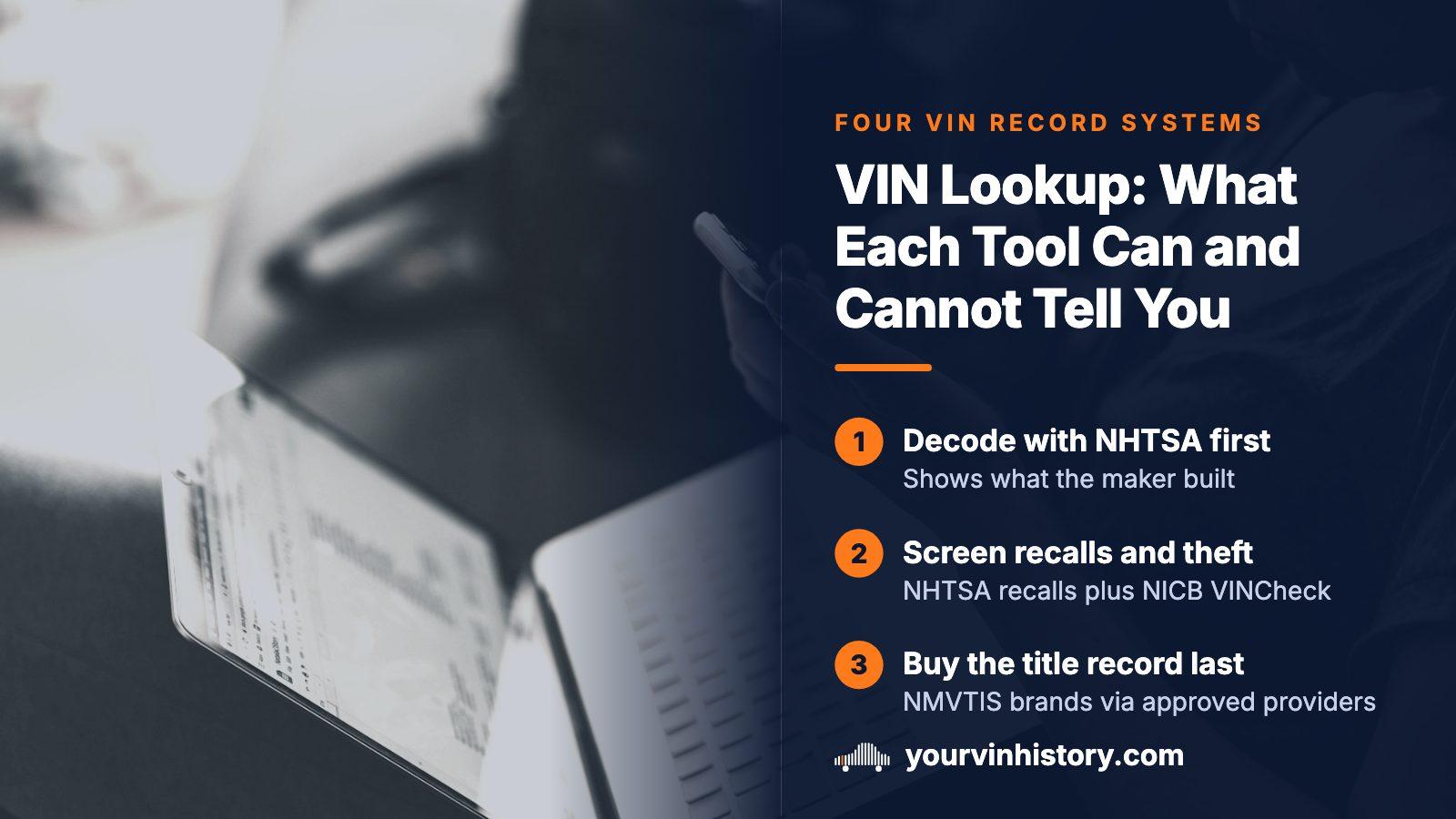
A VIN lookup checks a vehicle identification number against record systems, and what you learn depends on which system the tool reads. NHTSA's decoder returns what the manufacturer built, NHTSA's recall search lists open safety recalls, and NICB's VINCheck screens for theft and insurer total losses. All three cost nothing. Title brands sit in NMVTIS, sold by providers the Justice Department approves. No public lookup names past owners.
- Specifications
- NHTSA vPIC decoder, built from manufacturer reports
- Recalls and theft
- NHTSA recall search and NICB VINCheck, both run by others and both free to use
- Title record
- NMVTIS, bought through a Justice Department approved provider
- Standard length
- 17 characters from the 1981 model year on
One number, four unrelated record systems
Typing seventeen characters into a box feels like a single act, but the number is only a key. Which door it opens depends on the site you picked, and that is why two lookups of the same VIN can return results that look nothing alike.
| You want to know | Record system behind it | Cost to you |
|---|---|---|
| What the factory built | NHTSA vPIC decoder | Nothing |
| Whether a safety recall is still open | NHTSA recall search by VIN | Nothing |
| Whether it was reported stolen or totaled | NICB VINCheck, fed by participating insurers | Nothing |
| What states have recorded on its title | NMVTIS, sold through approved providers | A fee each provider sets |
| Service visits, auction sales, photos | Commercial history databases | Priced by each company |
A federal agency or an insurance-industry nonprofit runs the first three, so a service that charges for them is reselling something you can reach directly. Only the last two carry a price.
Start with the NHTSA decoder
A free decode comes from vPIC, the Vehicle Product Information Catalog kept by the National Highway Traffic Safety Administration. Manufacturers report their vehicles into it, and the agency's own page sends questions about the data back to the maker. That makes it a primary source for how a vehicle left the factory: make, model, body class, engine, assembly plant and the safety equipment fitted.
The decoder also grades your typing. A run returns a status line, and a clean one states that the check digit in the ninth position is correct. A copied character that is wrong shows up at once, instead of yielding the specifications of a different car.
Two quirks help in practice. Partial VINs are accepted, so a number with a worn character can still be decoded as far as the rest allows. And the decoder rejects pre-1981 year attempts, because the seventeen-character format became standard with the 1981 model year.
When the decode comes back thin or fails
A sparse result is common and seldom says anything about the car.
| What you see | Usual cause | What to do |
|---|---|---|
| Trim or series left empty | Trim is often not encoded in the VIN at all | Read the window sticker or ask the seller for the build sheet |
| Several fields blank | The maker did not file those details for that model line | Treat them as unknown, not as a defect |
| An error instead of results | A mistyped character, often I, O or Q, which never appear in a modern VIN | Re-read the plate and retype the number slowly |
| Almost nothing on an old vehicle | Numbers from before 1981 predate the seventeen-character standard | Rely on the paperwork and a hands-on inspection |
One result deserves suspicion rather than patience. A number with the right length and legal characters that still fails its check digit was either copied wrong or never belonged to a real vehicle. On a car you plan to buy, settle that before anything else.
Open recalls are a separate search
NHTSA's recall search takes the same VIN and lists safety campaigns still unresolved on that particular vehicle. It is a different system from the decoder, so a spotless decode says nothing about recalls, and a recall hit says nothing about whether the specifications match the listing.
Treat the result as a question for the seller, not a verdict on the car. Ask whether the repair was done. If not, ask a dealer for that make what the fix involves and what it would cost you, since the answer can differ with the recall's terms and the vehicle's age. Status changes over time, so rerun the search just before you pay.
The theft and total-loss screen
The National Insurance Crime Bureau built VINCheck to show whether a VIN turns up in member insurers' files as an unrecovered theft or as a vehicle written off by an insurer. It costs nothing, so it is worth running on any car that reaches your shortlist.
Read a clean result for what it is. The tool only holds what participating insurers reported, so a loss that never passed through one of them cannot appear. It narrows the odds without ruling anything out. The service also caps how many searches a visitor can run per day, so save it for cars you are seriously weighing.
Title history lives in NMVTIS, not in a decoder
NMVTIS, the federal title database, is the one search here that normally costs money. The Department of Justice does not sell reports itself. It publishes a roster of approved data providers and you buy from one of them. Some providers on the roster serve the public and some serve businesses only, so confirm which group a provider is in before you pay.
It adds the part no free tool touches: which states issued titles for the car and whether any of them applied a brand such as salvage. Titling agencies, insurers and salvage buyers must report into it, which is why a brand from one state follows the car when it is retitled in another. That makes it the main defense against title washing.
Providers set their own prices, and a title-only report typically costs a few dollars, far below a premium history product.
What no public lookup returns: owners, plates and repairs
Everything the decoder reports is a specification. Everything below is an event, and events reach a database only when the party they happened to files a report.
- The names of past owners
- How serious any collision was, and what was repaired afterward
- Mileage at points in the car's life, unless a title or inspection recorded it
- Routine service and repair work done at independent shops
Names stay out for a legal reason, not a pricing one. The federal Driver's Privacy Protection Act limits personal information in motor vehicle records to a list of permitted uses, and curiosity is not on it. That is why history reports describe ownership as a count and a span of dates.
The same law explains why a license plate will not hand you an owner. Some states run a tool that returns the vehicle for a plate without identifying the person, and the seller can just read you the number. A site promising plate-to-owner results is selling outdated scraped data or describing something it cannot lawfully do.
Checking that the number itself is genuine
Buyers use the word verify for two different jobs. One is a formal inspection that a state requires, performed by an authorized person on an official form, which no website can do. The other is the quick sanity check below, and you can finish it standing next to the car.
- Find the number in two places, the dashboard plate by the driver's corner of the windshield and the label on the driver's door frame, and confirm they match character for character.
- Count seventeen characters and make sure none is an I, an O or a Q.
- Decode it and read the status line for the check digit result.
- Compare the decode with the car: model year, cylinder count, body style and drive type should all agree.
- Match the number on the title and registration to the number on the metal.
When the plate, the door label and the title disagree
Stop there. Paperwork and metal that carry different numbers should end a purchase before any money moves, whatever explanation the seller offers.
Why two decoders give two answers
Underneath every decoder sits the same federal data, so the differences come from what each site adds. A site that wants to show paint code, option packages or trim on every result cannot get all of that from vPIC, because manufacturers submit varying levels of detail. It fills the gaps from parts catalogs, build-data feeds or a guess based on model and year.
Those additions are often right, but they are a different grade of evidence than the federal record, and the page rarely says which is which. When engines are described in different words, compare displacement and cylinder count.
A disagreement is a prompt to check, not a finding
Two decoders splitting on trim usually means the VIN never encoded trim. If the difference affects value, such as a towing package, settle it with a factory sticker, a build sheet or the vehicle itself, not with a third website.
The order that keeps spending small
Run the cost-free layers on every car and hold paid ones for finalists.
- Decode the VIN and compare the result with the listing and the car.
- Run the NHTSA recall search on the same number.
- Run the NICB VINCheck screen for theft and total loss.
- For a serious candidate, buy an NMVTIS title record from an approved provider.
- Add a full history report only when service, auction or accident detail could change what you would pay.
- Pay an independent mechanic to inspect it, because no record shows a worn transmission.
A full report at step five is where a service like yourvinhistory fits. It opens with a free preview for the VIN and then charges once for the report, which gathers title brands, accidents with a damage map, odometer readings, salvage and auction records with photos, liens, theft and open recalls. Save it for the shortlist.
Where this information comes from
- NHTSA: vPIC VIN decoder — Shows that decoder data is reported by manufacturers, that partial VINs are accepted, and that pre-1981 decode attempts return an error.
- NHTSA: Recalls — The federal recall search, where a VIN reveals safety campaigns still open on a vehicle.
- NICB: VINCheck — The nonprofit's theft and total-loss screen, built on records from participating insurers.
- Department of Justice: NMVTIS vehicle history — The official roster of approved NMVTIS data providers, split between public sellers and business-only providers.
Sources and photos: Facts checked against the sources above in October 2026. Photo by Michal Biernat on Unsplash; diagrams by YourVINHistory.
Keep reading
- NMVTIS reportThe title record in detail, including what it holds and where its authority stops.
- NICB VINCheck explainedHow to read a VINCheck hit and why a clean result is not a guarantee.
- How to read a VINWalk the seventeen characters and work out the check digit by hand.
- Free vehicle history reportSorts out which parts of a history are free, which cost a little and which do not exist.
Frequently asked questions
Is a VIN lookup really free?
Some of it is. NHTSA's decoder and recall search and the NICB theft and total-loss screen cost nothing to use. The title record is the exception: you buy it from a provider the Justice Department approves, and each provider sets its own fee. Any site that charges for the specifications is repackaging the free federal decode.
Can I look up a VIN if one character is unreadable?
Often yes. The federal decoder accepts partial VINs, and you replace each unknown character with an asterisk. It decodes as much as the remaining characters allow, and the ninth position is not required. Expect fewer fields back. Before buying, find the full number on the car, because a title record needs every character.
Does a VIN lookup show accidents?
The decoder never does, since accidents are events rather than specifications. NICB's screen flags only insurer total losses, and a title record shows brands. Detail on damage depends on whether an insurer, auction or repair shop filed it, so a clean report cannot prove a car was never hit. A mechanic can often spot repair work that no database holds.
Why does the decoder say my VIN is invalid?
Check the characters first. I, O and Q never appear in a modern VIN, and a handwritten letter O is easily mistaken for a zero. A wrong digit also breaks the ninth-position check. If the number is pre-1981, it falls outside the seventeen-character format. Read the number off the vehicle itself rather than an advertisement.
Should I trust a report the seller already ran?
Use it as a lead, not as proof. A report covers only the number typed into it, and a seller could have run a different car or an older printout. Read the VIN from the dashboard plate and door label yourself, run your own lookups on that exact number, and compare the result with the report the seller handed you.
Now check the car itself
The guide explains what to look for. The report shows what this VIN has on record.