THE SHORT ANSWER
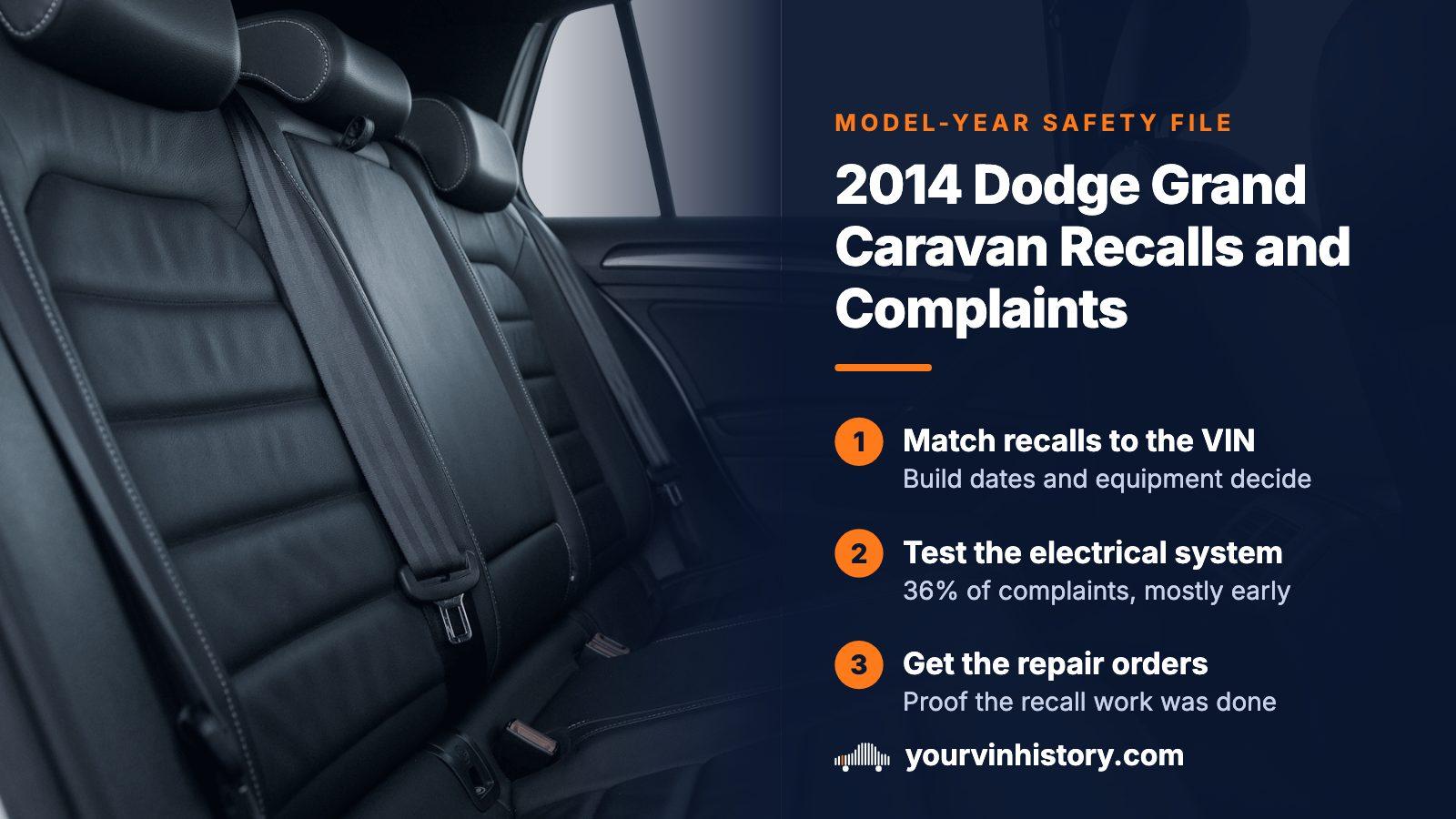
NHTSA lists 5 recall campaigns for the 2014 Dodge Grand Caravan: a door switch that can overheat, a windshield bonding flaw, a tire pressure monitor software error, a fire extinguisher defect and a wheelchair restraint problem. Owners filed 357 complaints, led by the electrical system at 36%. Crash scores are 4 of 5 overall. Recalls follow build dates and equipment, so only a VIN lookup shows which apply.
- Recall campaigns
- 5 on file with NHTSA
- Owner complaints
- 357, led by the electrical system at 36%
- Among Grand Caravan years
- 9th heaviest of 13, at 0.76 times the median year
- Crash rating
- 4 of 5 overall, with a 16.4% rollover probability
What 5 recalls and 357 complaints can and cannot tell you
A recall and a complaint are different kinds of evidence. A recall means the manufacturer has accepted a defect and attached a repair to it. A complaint is one owner's account sent to NHTSA, never checked by the agency. The 2014 Grand Caravan has 5 of the first and 357 of the second in the August 2026 data pull, and neither works as a grade. They show where a mechanic should look first.
Some complaints carry flags drawn from the owner's own description: 11 mention a crash, 13 a fire and 21 an injury. NHTSA also lists 2 investigations touching this model year, which can end in a recall or in nothing at all.
The five campaigns side by side
Each row is a separate NHTSA campaign. Read the coverage column before the problem column: a campaign names a build window or a piece of equipment, never the whole model year. Chrysler's own codes, which older paperwork may use instead, are P25 for the door switch, S02 for the windshield and P63 for the tire monitor.
| NHTSA number | What is wrong | Which vans are named | Who does the repair |
|---|---|---|---|
| 14V234000 | Driver's door vent window switch can overheat | Built August 25, 2010 through October 31, 2013 | Dealer, with a newer switch |
| 16V044000 | Windshield bonded with out-of-date primer | Built August 16, 2014 through December 5, 2015 | Dealer, with a new windshield |
| 14V632000 | Tire pressure monitor software error | Built March 20 through April 22, 2014 | Dealer, by reprogramming the module |
| 17V824000 | Kidde fire extinguisher can clog or fail to discharge | Vans equipped with the named extinguishers | Kidde, by replacement |
| 25V876000 | Wheelchair restraint retractors may not lock | Conversions fitted with QRT-Deluxe or QRT-Max restraints | Rollx Vans, with Q'Straint |
Three recalls tied to when the van was built
The vent window switch campaign, 14V234000, carries a fire risk. The switch in the driver's door armrest can overheat, and the dealer fits a newer version. Named model years run 2010 through 2014, but the build window closes on October 31, 2013, so by the campaign's own terms a 2014 van assembled after that date falls outside it.
The windshield campaign, 16V044000, is the mirror image. It begins with vans built on August 16, 2014, so it reaches only the last-built 2014 vans. Urethane primer past its useful life was used during installation, which could let the glass shift in a crash and fails the federal windshield mounting standard.
The tire pressure monitor campaign, 14V632000, covers vans built between March 20 and April 22, 2014. A software error stopped the system learning where each sensor sat, so the warning lamp could light with healthy tires and a real loss of air might go unannounced.
Two equipment recalls most vans will never meet
Campaign 17V824000 concerns Kidde fire extinguishers with plastic handles or push buttons. NHTSA's summary says they can clog, can need excessive force to discharge, and on some models the nozzle can detach. Owners are told to contact Kidde for a replacement, so a dealer visit is not the route.
Campaign 25V876000 was filed by Rollx Vans, not by Chrysler. Its QRT-Deluxe and QRT-Max wheelchair restraints have retractors that may not lock, letting an unsecured wheelchair move in transit. It applies to wheelchair-accessible conversions, not to a stock passenger van, so on a converted one ask who did the work and whether the notice was handled.
Where the 357 complaints land
NHTSA files each complaint under the component the owner says failed. A common van piles up reports simply by being on the road, so the shape matters more than the sum: one bucket far larger than the rest. The table lists the seven largest; every other category holds 11 reports or fewer.
| Share of total | Reports | Component category |
|---|---|---|
| 36% | 128 | Electrical system |
| 22% | 80 | Engine |
| 17% | 60 | Seats |
| 13% | 47 | Air bags |
| 10% | 34 | Unknown or other |
| 5% | 18 | Power train |
| 5% | 17 | Structure |
Notice what the recalls leave out. Only the door switch campaign falls in the electrical category, one defect inside a bucket of 128 reports, and nothing among the five addresses the engine, seats or air bags, which rank second to fourth. Those reports have no recall behind them, so only an inspection can test them. The electrical category also spans wiring, switches, lighting and modules, so the count cannot name the part.
How old the van was when each problem began
Each complaint includes the date the owner says the problem happened, so subtracting the model year gives the van's age at that moment. Electrical trouble comes early in these medians, and most other systems around the middle of a van's life.
| System | Median age when reported | Reports counted | Share within three years |
|---|---|---|---|
| Electrical system | 2 years | 127 | 54% |
| Engine | 5.6 years | 80 | 25% |
| Seats | 6.6 years | 60 | 7% |
| Air bags | 5.8 years | 47 | 23% |
| Power train | 5.7 years | 18 | 22% |
| Structure | 5.6 years | 17 | 18% |
| Fuel and propulsion | 8 years | 11 | 18% |
More than half of the electrical reports came inside three years, so many likely fell within the original warranty and a well-kept example may have had that work done. Ask for repair orders instead of assuming the trouble lies ahead. Fuel and propulsion arrived latest, at 8 years, though 11 reports is a thin base. None of these medians is a failure rate.
Where the 2014 falls among Grand Caravan years
Measured against the nameplate's own median year, which strips out most of the effect of sales volume, the 2014 sits at 0.76 times the median: the 9th heaviest of the 13 years in the data, 2008 through 2020. Filings peaked in 2015, which often signals an early build or design fault and fits the electrical timing above.
| Measure | Result |
|---|---|
| Rank by complaint volume | 9th heaviest of 13 years |
| The 2014 against the median year | 0.76 times |
| Heaviest year | 2008, at 2.75 times the median |
| Lightest year | 2020, at 0.04 times the median |
The 2020 figure comes with a caveat: it is also the newest year, with the least time to collect reports. The years-to-avoid page ranks every year in one table.
Crash scores, and the driver aids this year lacks
| NHTSA test | Result |
|---|---|
| Overall | 4 of 5 stars |
| Frontal crash | 4 of 5 stars |
| Side crash | 5 of 5 stars |
| Rollover | 4 of 5 stars |
| Rollover probability | 16.4% |
These scores come from a new van in a laboratory, in the front-wheel-drive configuration NHTSA lists as the 2014 Dodge Grand Caravan VAN FWD. They say nothing about a used van that has been repaired after a collision or fitted with aftermarket parts, so treat the stars as a design score, not a condition report. NHTSA's data also shows no forward collision warning and no lane departure warning for this model year.
The age limit on no-charge recall repairs
Dealers repair recall defects at no charge, but only inside limits set by federal law. Under 49 U.S.C. §30120(g), the no-charge duty does not reach a vehicle first sold more than 15 calendar years before the earlier of the manufacturer's notice or an NHTSA order; for tires the span is 5 calendar years. A 2014 van sold new in 2013 or 2014 sits well inside that span for the five campaigns above.
To see what is open on one van, enter its 17-character VIN in NHTSA's recall lookup, a free government tool. The answer is specific to that VIN, which beats any model-year list, including this one. For anything already closed, ask for the dealer's completed repair order.
What a mechanic should check first
Order the pre-purchase inspection by the complaint buckets.
- Electrical system: operate every window, lock, power sliding door and light, scan for stored fault codes, and ask what was already repaired.
- Engine: 80 owners filed, so look for leaks and listen on a cold start.
- Seats: 60 reports, so work every latch, fold and release in the second and third rows.
- Air bags: 47 reports, so confirm the warning lamp lights at start-up, then goes out.
- Recall proof: if the build date falls inside a window, confirm by VIN and repair order that the work was done.
- Heat damage: fire reports exist, so check the driver's door switch area and the engine bay for melted plastic or amateur wiring.
Condition beats the file
At this age maintenance history and physical condition outweigh the federal data. The file points to where problems may be; it cannot show what is actually there.
Minivan wear points and questions for the seller
Add the usual minivan wear points:
- Sliding door tracks, rollers and motors
- Rear hatch struts and the tailgate seal
- Seat latches and the floor wells beneath the folding rows
- Transmission behavior under load
Then ask the seller, and expect paperwork in reply:
- Which of the five campaigns apply to this VIN, and where are the dealer papers?
- Was any part of the electrical system repaired or replaced?
- Is this a wheelchair-accessible conversion, and who did the work?
- Where is it serviced, and may I read the records?
- Did a collision ever lead to an insurance payout?
- Will you let my mechanic inspect it before we settle on a price?
The federal safety file says nothing about title or ownership. A yourvinhistory report for the VIN covers that side: title brands, accidents with a damage map, odometer readings, salvage and auction records, liens and open recalls, with a free preview first.
Where this information comes from
- NHTSA: Recalls — Where to enter a VIN and see which of the five campaigns remain open on that van.
- NHTSA: Vehicle safety and owner complaints — Entry point to the complaint file behind the report counts and component categories used here.
- 49 U.S.C. §30120: Remedies for defects and noncompliance — The statute behind no-charge recall repairs, including the age limit in subsection (g).
- NHTSA: 5-Star Safety Ratings — The federal crash-test program behind the star scores and the rollover probability.
- NMVTIS: Vehicle History — Title and brand records, which sit outside the NHTSA safety file.
Sources and photos: Facts checked against the sources above in October 2026. Photo by Erik Andersson on Unsplash; diagrams by YourVINHistory.
Keep reading
- Dodge Grand Caravan years to avoid: 2008, 2016 and 2010 lead the complaintsCompare the 2014 against every other Grand Caravan year before choosing a listing.
- Recall check by VINStep-by-step use of NHTSA's lookup and how to read the result for one VIN.
- Buying a car with an open recallWhat to do when the lookup shows an unrepaired campaign on the van you want.
- DodgeWhy a Dodge VIN opens with an FCA code, and how to ask for the factory build record.
Frequently asked questions
Is the 2014 Dodge Grand Caravan reliable?
NHTSA data cannot answer that, since complaints are unverified reports and not failure rates. The file shows a middling year, at 0.76 times the Grand Caravan median, with one electrical bucket that mostly surfaced early. Service records, repair orders and a pre-purchase inspection say more than any federal count.
Does a clean recall lookup mean the electrical problems are fixed?
No. A clean lookup only means no open campaign is attached to that VIN. One campaign, the door switch, sits in the electrical category, while 128 owners filed electrical complaints. A van can pass the lookup and still have wiring or switch trouble, so have the electrical system tested and ask for repair history.
Why does NHTSA's live complaint count differ from this page?
This page uses the 357 total from NHTSA data pulled in August 2026. Owners can file at any time, so the live tally can run a little higher. A few added reports do not change the picture: the electrical system stays the dominant category.
Is a wheelchair-accessible 2014 Grand Caravan different to check?
Yes, with an added step. The mobility equipment is not part of the factory van, and campaign 25V876000, filed by Rollx Vans, covers restraint retractors that may not lock. Ask the seller for the converter's name, the make of the securement system and any paperwork showing an inspection or replacement.
How did the 2014 Grand Caravan do in NHTSA's other safety tests?
Beyond the table above, NHTSA's rating data shows 5 stars in the side pole test and lists electronic stability control as standard. It records no forward collision warning or lane departure warning. These are scores for a new example in a laboratory, so earlier collision damage on a used van changes the picture.
Now check the car itself
The guide explains what to look for. The report shows what this VIN has on record.