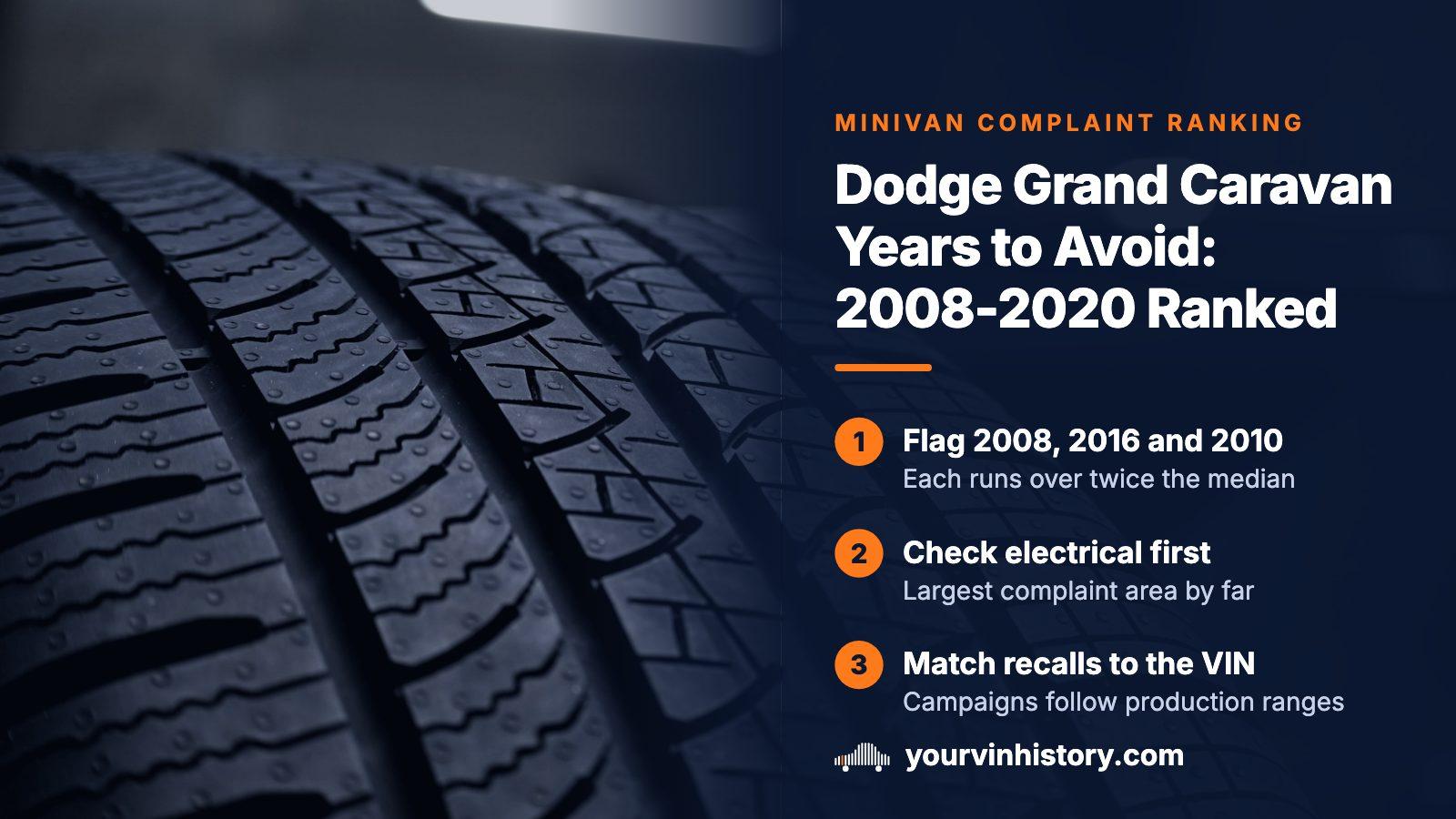
THE SHORT ANSWER
Measured against the Grand Caravan's own median year of 469 complaints, the 2008 (1,291), 2016 (1,155) and 2010 (1,039) model years sit well above the rest. The 2019 and 2020 vans have the lightest records, but they are also the newest in the data. Electrical system is the largest complaint area at 3,459 reports. These are unverified owner reports, not failure rates.
- Complaints on record
- 6,984 for 2008 to 2020
- Median model year
- 469 complaints
- Heaviest year
- 2008, with 1,291 complaints
- Largest complaint area
- Electrical system, 3,459 reports
What this ranking measures, and what it cannot
The raw material is NHTSA's consumer complaint database. For every Grand Caravan model year from 2008 through 2020 there is a count of filed complaints and a count of recall campaigns, and this page lines the 13 years up against one another.
A plain ranking would mostly reward whichever year sold the most vans, so each year is compared with this van's own median instead. That median is 469 complaints. A year's multiple tells you how far it sits from a typical Grand Caravan year, not from some other nameplate that happens to sell in different numbers.
Two limits apply to everything below. A complaint is one owner's unverified account, and a count is never a failure rate or a reliability score. And a year that has been on the road longer has had longer to collect reports, which is why the newest years get a caveat later on.
Every model year, side by side
The table runs in calendar order so you can see where the record changes. The standing column is a plain-word label for how far each year sits from the median.
| Model year | Standing | Complaints | Times the median | Recalls |
|---|---|---|---|---|
| 2008 | Well above the median | 1,291 | 2.75× | 8 |
| 2009 | Around the median | 543 | 1.16× | 7 |
| 2010 | Well above the median | 1,039 | 2.22× | 6 |
| 2011 | Around the median | 530 | 1.13× | 4 |
| 2012 | Around the median | 583 | 1.24× | 6 |
| 2013 | Around the median | 469 | 1× | 4 |
| 2014 | Around the median | 357 | 0.76× | 5 |
| 2015 | Around the median | 278 | 0.59× | 4 |
| 2016 | Well above the median | 1,155 | 2.46× | 6 |
| 2017 | Around the median | 411 | 0.88× | 3 |
| 2018 | Around the median | 268 | 0.57× | 4 |
| 2019 | Below the median | 41 | 0.09× | 4 |
| 2020 | Below the median | 19 | 0.04× | 1 |
The median is 469, and 2013 lands exactly on it. Eight years fall in a broad middle band from 0.57 to 1.24 times the median, three sit far above it, and only 2019 and 2020 fall well below.
The three flagged years: 2008, 2016 and 2010
Each of these years runs more than double the median. The 2008 van is the heaviest at 1,291 complaints, 2.75 times the benchmark, and it also holds the highest recall count in the table at 8. The 2016 van follows with 1,155 complaints and 6 recalls, then the 2010 van with 1,039 and 6.
- 2008: the peak year overall, with electrical system and air bags both prominent in its complaints.
- 2016: second heaviest at 2.46 times the median, with electrical system the most reported area.
- 2010: third heaviest at 2.22 times the median, again led by electrical system.
Flagged is not condemned
Plenty of vans in every one of these years have been looked after well. A high count is a reason to test more carefully and to bargain with a specific reason in hand. It does not condemn a van you have not yet seen.
Spikes, not slopes: the neighbors of a bad year can be calm
Read the counts in order and the flagged years look like peaks with quieter years around them. The 2008 van draws 1,291 complaints, then 2009 drops to 543. The 2010 van jumps back to 1,039, and 2011 falls to 530. The pattern repeats at the end: 2015 sits at 278, 2016 leaps to 1,155, and 2017 settles at 411.
That last step is the largest in the table. A jump that large can reflect a redesign or a mechanical change, although complaint data alone cannot say which happened here. What it does warn you about is assumption: a clean-looking 2015 tells you nothing about a 2016. Ask which side of the break a particular van falls on, and note that 2016 also carries 6 recalls against 4 for 2015.
The calm middle: 2009, 2011 to 2015, 2017 and 2018
Eight years sit around the median, and for most shoppers they form the biggest pool of vans. The loudest of them is 2012 with 583 complaints, 1.24 times the median, with 2009 at 543 and 2011 at 530 close behind. At the quiet end are 2018 with 268, 2015 with 278 and 2014 with 357. The 2017 van lands at 411, and 2013 sits on the median itself.
Recall counts in this group run from 3 for 2017 up to 7 for 2009. That spread says little by itself, because it reflects campaigns issued rather than how many vans needed them. One of these years has a record page of its own: the 2014 model, where the open recall campaigns are named and the complaint total is split by component.
The lightest records, 2019 and 2020, and why to hold back praise
The 2020 van has the thinnest file in the data at 19 complaints, 0.04 times the median, with a single recall. The 2019 van follows with 41 complaints, 0.09 times the median, and 4 recalls. The method deliberately keeps very recent model years out of this list, because a young car has had little time to attract any complaints.
Even so, 2019 and 2020 are the last two years in the table, so part of their quiet is age. Part may also be volume, since the count depends on how many vans were sold and the data here does not show that. Treat them as the lightest records on file, not as proof of a better build. A 2019 or 2020 van with a gap in its service history is still a risk worth pricing in.
Where the complaints land: electrical system by a wide margin
NHTSA files each complaint under a component category, and the categories are broad. Electrical system takes in the battery, wiring, lighting and control modules, so it collects many unrelated faults under one label. These are the six largest across 2008 to 2020.
| Component category | Reports, 2008 to 2020 |
|---|---|
| Electrical system | 3,459 |
| Engine | 911 |
| Unknown or other | 745 |
| Air bags | 642 |
| Power train | 497 |
| Structure | 392 |
Electrical system is the leading area in each of the three flagged years, which makes it the first place a mechanic should look on any Grand Caravan, whichever year you buy. The research behind this page records categories and counts, not owners' own narratives, so the table shows where reports land and not what exactly failed. The narratives are public: search NHTSA's complaint database for your target year and read them before you buy.
What the recall column adds, and its fifteen-year limit
A recall is a defect the manufacturer has acknowledged, which makes it firmer evidence than a single owner's complaint. The 2008 van leads with 8 campaigns, 2009 follows with 7, and 2020 has 1. A high count is not automatically bad news, since each campaign arrives with a remedy, although 2008 pairs its recalls with the biggest complaint total, so there the two signals agree.
The repair is no-charge only within limits. Under 49 U.S.C. §30120(g), a manufacturer need not fix a van at no charge if its first purchaser bought it more than 15 calendar years before the recall notice. A campaign announced early in a van's life is covered; one announced after that window may not be. Ask a dealer before you assume, and remember that campaigns apply to production ranges, not to whole model years.
Inspecting a 2008, 2010 or 2016 van before you make an offer
Start from the complaint areas and work outward. This sequence suits any Grand Caravan and matters most on the flagged years.
- Ask for service records before the test drive. On a minivan this age they outweigh any model-year statistic.
- Run the VIN through NHTSA's recall lookup, note every open campaign, and ask who will do the work and who pays.
- Turn the key without starting the engine and watch the warning lamps. The air bag lamp should light briefly and then go out.
- Work every electrical feature: windows, locks, lights, wipers, power doors and the radio. Note anything that works only some of the time.
- Start the engine cold and listen. If the seller allows it, scan for stored fault codes.
- On the road, pay attention to how the transmission shifts, then pay for an independent inspection on a lift, where body and underbody damage show.
From the model year to the van in front of you
A model year describes a population, and a VIN describes one van. Once you settle on a year you can live with, the facts that decide the purchase belong to that vehicle: which recall campaigns reach its build and whether a dealer completed them, what its title record shows, whether its odometer readings climb without a gap, and what the inspection turns up.
Several checks from others cost nothing. NHTSA's recall lookup covers open campaigns, and NICB's VINCheck screens a VIN for reported theft and total-loss status. The federal NMVTIS site explains where title records come from. A vehicle history report by VIN can then bring title, accident and odometer records together for the exact van you are weighing.
Where this information comes from
- NHTSA: Vehicle safety — The agency behind the owner complaint database that supplies every complaint count and component category on this page.
- NHTSA: Recalls — Where recall campaigns are published and where a VIN is entered to see which ones are open on a single van.
- Bureau of Justice Assistance: NMVTIS — The federal overview of the national title information system, which covers one vehicle's title history rather than a model year.
- NICB: VINCheck — A no-cost lookup that screens one VIN for reported theft and total-loss records.
Sources and photos: Facts checked against the sources above in October 2026. Photo by Pablo Alvarez on Unsplash; diagrams by YourVINHistory.
Keep reading
- 2014 Dodge Grand Caravan recalls: 5 campaigns and 357 owner complaintsThe one Grand Caravan year with its own record page, naming open recall campaigns and complaint components.
- DodgeHow to read a Dodge VIN so you can place a van in the right production range.
- Recall check by VINA step-by-step recall lookup for the exact van you are considering.
- Honda Odyssey years to avoid: why 2018 and 2019 stand outThe same year-by-year ranking for another used minivan, to hold against this one.
Frequently asked questions
Which Grand Caravan model years are worth skipping?
Start with 2008, 2016 and 2010, the three years running more than double the median of 469. Avoid is a strong word for a complaint count, though. A well-documented 2010 van can be a safer purchase than an undocumented 2012, so use the flag to decide how closely to inspect and how far to push the price.
Is the Dodge Grand Caravan reliable?
These figures cannot answer that. NHTSA complaints are unverified owner reports, and the counts here are neither failure rates nor reliability scores. What they show is where owners reported trouble: mostly the electrical system, then the engine. Reliability for one van comes from its maintenance history, its recall status and an independent inspection.
What do Grand Caravan owners complain about most?
By NHTSA category it is the electrical system, with 3,459 reports across 2008 to 2020, well ahead of engine at 911 and unknown or other at 745. Because the category is broad, it names an area of the van rather than a single part. Read owner narratives for your target year to learn the specifics.
Are the 2019 and 2020 Grand Caravans trouble-free?
Their counts are the lowest in the data, 41 for 2019 and 19 for 2020, and 2020 has a single recall. But they are also the newest years in the table, so owners have had the least time to report anything. Low counts are a reason for some optimism, not a guarantee. A recall lookup and an inspection still apply.
How do I check recalls on one specific Grand Caravan?
Enter its 17-character VIN into NHTSA's recall lookup, which lists open campaigns for that exact van. Recalls attach to production ranges, so two vans from the same year can differ. Then ask a dealer about the no-charge repair, because the federal rule stops requiring it once the first sale was over 15 calendar years before the recall notice.
Now check the car itself
The guide explains what to look for. The report shows what this VIN has on record.