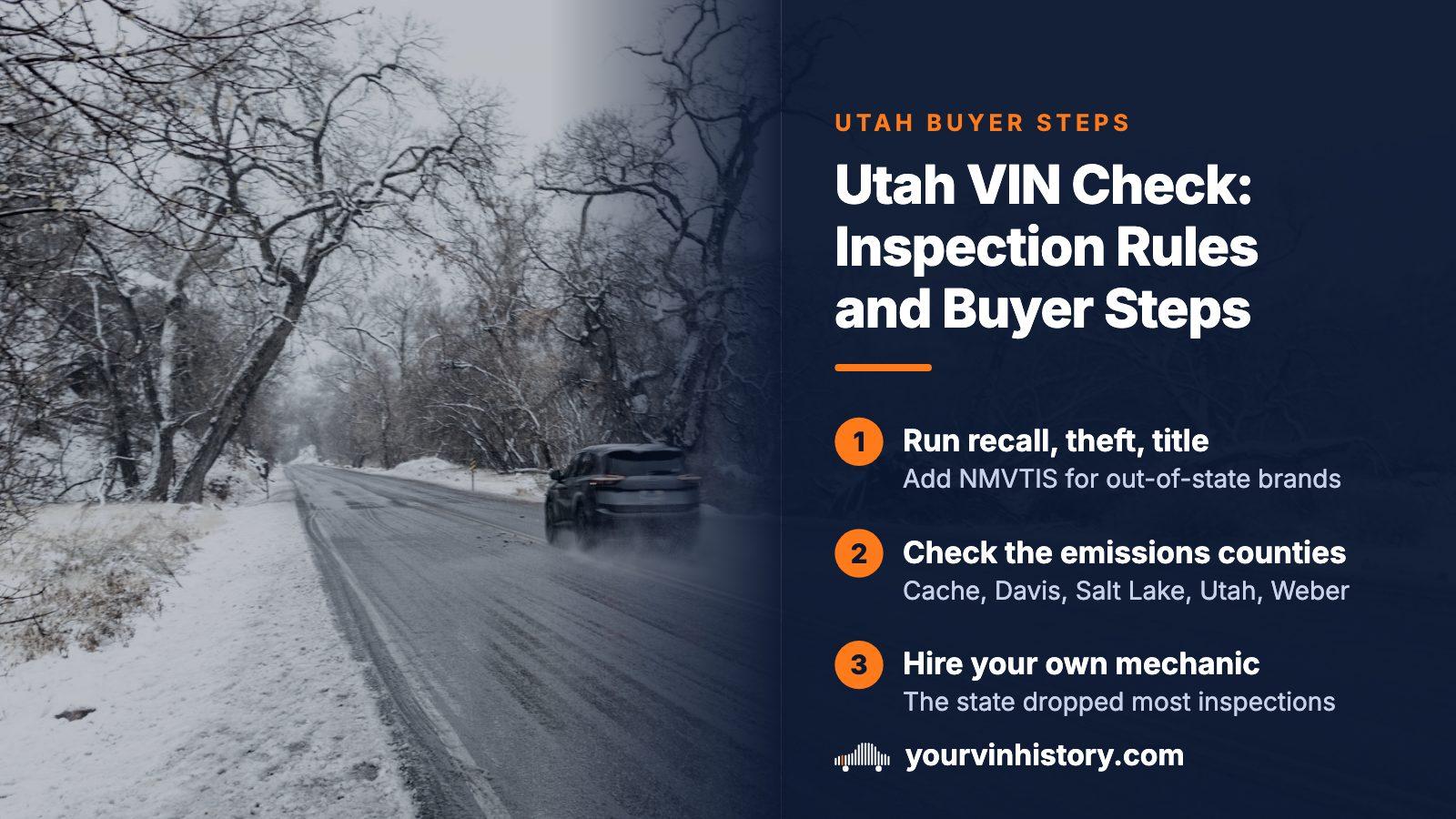
THE SHORT ANSWER
Run the VIN through the NHTSA recall lookup and NICB VINCheck, then pull a national NMVTIS title record from an approved provider to catch brands applied in other states. Utah dropped its general safety inspection effective January 1, 2018, keeping it only for salvage, commercial and recently street legal ATV registrations, so book an independent mechanic yourself. Emissions testing applies only in Cache, Davis, Salt Lake, Utah and Weber counties.
- Safety inspection
- Ended for most vehicles on January 1, 2018
- Still inspected
- Salvage vehicles, newly street legal ATVs, commercial vehicles
- Emissions counties
- Cache, Davis, Salt Lake, Utah and Weber
- Emissions certificate
- Valid for two months from issue
What Utah dropped in 2018 and what stayed on the books
On January 1, 2018, Utah ended the safety inspection that most vehicles once needed in order to be registered. An ordinary car, truck or SUV now passes from seller to buyer to new registration without anyone examining the brakes, tires, lights or steering on the state's behalf.
The repeal was not total. Three groups of vehicles still carry the requirement, and the table shows where each one stands.
| Vehicle | Safety inspection required? |
|---|---|
| Ordinary passenger vehicle | No, exempt since January 1, 2018 |
| Salvage vehicle | Yes |
| Newly street legal ATV | Yes |
| Commercial vehicle | Yes |
ATVs and commercial trucks matter little to most car shoppers. The salvage line is the one that changes how you read a Utah listing, and the next section explains why.
Why a rebuilt car can have more official scrutiny than a clean one
In many states the branded car has the shaky reputation, the clean-title car is the safe baseline, and both face the same periodic exam. Utah breaks that pattern. Salvage vehicles stay on the inspection list, and the Utah Highway Patrol's owner guidance describes the requirement as a single check tied to the first registration as a salvage vehicle.
A rebuilt car has therefore usually been looked at by someone official at least once, while the clean-title car parked beside it may have had no exam since the repeal. That does not make the rebuilt one the better buy. A brand still drags down resale value and can complicate insurance, and one inspection years ago says little about how the car has been treated since.
Treat "it passed inspection" as a claim to verify
If the seller of an ordinary Utah car says it passed inspection, ask for the paper, the date and the shop. Emissions certificates exist in some counties, but they say nothing about brakes, tires or structure.
Where emissions tests still apply
Emissions testing did not disappear with the safety exam, but it is local. Cache, Davis, Salt Lake, Utah and Weber counties require an emissions inspection as a condition of registering a vehicle. Elsewhere in Utah it is not a registration requirement.
Two timing details matter on a purchase. A certificate stays valid for two months after it is issued, so one a seller found in a glovebox may have lapsed before you ever reach the counter. Four of the five add a wrinkle for newer vehicles: a gasoline car or truck under six years old is tested every other year, not annually, in Davis, Salt Lake, Utah and Weber.
- Ask which county the car is registered in today.
- Ask for the latest certificate and read the issue date yourself.
- Ask whether a failed test led to repairs shortly before the sale.
What an emissions record can still tell you
An emissions test is not a safety exam. It will not comment on brake pads, ball joints or a bent frame rail. Even so, in a state that inspects almost nothing else, it is the one recurring official contact a car in those five counties is likely to have, and the paperwork leaves a trail.
Modern tests read the onboard diagnostic system. A car whose readiness monitors have only just reset can look healthy because someone cleared the stored codes not long before testing, and a private seller should be able to explain why. A run of certificates also places the vehicle in a given county on given dates, a quick consistency check against the story in the listing.
Salt, brine and the underside of the car
Utah's populated valleys sit under mountains that bring real winter, and the roads get treated for it. Salt and brine eat steel here the way they do in any cold state, and with no routine inspection, nobody is lifting the car to look.
On any Utah vehicle more than a few years old, ask to have it on a lift before you agree to a price. Corrosion tends to show first at brake lines, fuel lines, rear suspension mounts and exhaust hangers, none of which can be judged from a walkaround in the seller's driveway.
Judge what you see by where it is. Surface rust on a bolt-on part is cosmetic. Flaking or swollen metal beside a mounting point is a structural concern, and a good reason to renegotiate or walk away.
Mountain miles wear a car differently
An odometer reading flattens the difference between kinds of driving. A high number earned on level interstate is an easier life than the same number earned on long climbs and steep descents.
For a car that lived along the Wasatch Front or up a canyon, give extra attention to the brakes, the cooling system and the condition of the transmission fluid. Find out how the car was used and whether it hauled a trailer, since towing on a grade punishes all three.
Heat belongs in this picture too. A cooling system that has worked hard on grades may show it in stained hoses, a weeping water pump or a reservoir that keeps needing a top-up, and a test drive with one sustained hill in it tells you more than a lap around the block.
Start with the free federal searches
Before you drive anywhere, decode the VIN and confirm it matches what the listing says the car is. Then run it through the NHTSA recall lookup, a free federal tool that reports open safety campaigns on that exact vehicle. Nothing in Utah's registration process runs this search for you, so an open recall can sit unnoticed through a sale.
NICB VINCheck is the second stop. It is free as well, and it flags theft and salvage-title indicators. Both searches are narrow, so a clean answer from each is a starting point, not a verdict.
Note the result and the date of each search. If a seller later says a recall was handled, ask for the dealer's record of the completed repair rather than accepting a verbal assurance.
The national title record, for brands from other states
Utah will not re-examine an ordinary car at registration, so a brand applied in another state has to be found by you. NMVTIS, the National Motor Vehicle Title Information System, is where such brands show up, and the Department of Justice page for vehicle history lists the approved providers that sell consumer reports.
A yourvinhistory report is one route. Its NMVTIS title records come from ClearVin LLC, an approved NMVTIS data provider, and the report adds an accident damage map, odometer readings, and salvage and auction records with photos. The preview is free; the report itself is a one-time purchase.
Hire the inspection the state no longer orders
For a clean-title car, the independent inspection you pay for may be the only hands-on exam the vehicle ever gets, so treat it as the central step and not an extra. Choose a shop with no stake in the sale, book it after the records come back clean, and ask for the lift check described above. If the seller objects to an outside mechanic, even one you pay, take that as an answer.
Put together, a sensible order for a Utah purchase looks like this.
- Read the VIN off the car and compare it with the title and the listing.
- Decode the VIN and run the NHTSA recall lookup.
- Run NICB VINCheck for theft and salvage-title indicators.
- Order a national title record from an approved NMVTIS provider.
- Ask which county the car is registered in and request any emissions certificate.
- Pay for an independent inspection, including a lift check of the underside.
What a plate can and cannot do for you
A license plate does not open a registered owner's personal details to the public. Federal privacy rules limit what motor vehicle records may disclose about people, which is why no consumer service will return a name and address from a plate.
What a plate does help with is matching. Compare the plate on the car with the listing, then compare the VIN stamped on the car with the one in the ad and the one on the title. If any of those disagree, stop and settle it before spending money on anything else.
Photograph the plate and the VIN label in the same visit. If the paperwork later turns out to describe a different vehicle, you will have a dated record of what was actually in front of you.
Where this information comes from
- Utah DMV: Vehicle inspections — Lays out the end of the general safety inspection, the vehicles that still need one and the counties that require emissions tests.
- NHTSA: Recalls — The federal lookup for open recalls by VIN, a search no Utah registration step performs on a buyer's behalf.
- U.S. Department of Justice: NMVTIS vehicle history — Explains where consumers can obtain a national title record and lists the providers approved to sell one.
Sources and photos: Facts checked against the sources above in October 2026. Photo by Zoshua Colah on Unsplash; diagrams by YourVINHistory.
Keep reading
- MississippiAnother state where the safety inspection now applies to wrecked vehicles alone.
- NMVTIS reportThe federal title record in plain terms, including who sells it.
- Salvage title VIN checkAn ordered set of checks that catches a brand someone tried to wash off.
- Rebuilt title inspectionWhat passing a rebuilt inspection does and does not say about the repair work.
Frequently asked questions
Does Utah require a safety inspection to register a used car?
Not for most vehicles. The requirement ended on January 1, 2018. It survives for salvage vehicles, commercial vehicles and ATVs that have newly become street legal. If you are buying an ordinary car, assume no state inspector has examined it, and plan to pay a mechanic of your own choosing before any money changes hands.
Which Utah counties require an emissions test?
Cache, Davis, Salt Lake, Utah and Weber. In those counties a passing certificate is a prerequisite for registration and stays valid for two months from the day it is issued. Because the rule follows where a car is registered, ask the seller which county applies and whether the certificate on hand is still current.
Is an emissions certificate proof that a Utah car is in good shape?
No. The test measures what comes out of the tailpipe and reads the diagnostic system, not the brakes, tires, steering or structure. A certificate shows the car met the standard on one day. Check the date, and remember that codes cleared shortly before a test can make a car look cleaner than it is.
Why does Utah still inspect salvage vehicles?
The state kept the requirement for vehicles that already carry a damage brand while exempting ordinary cars in ordinary use. The Utah Highway Patrol describes it as a one-time check at the first registration as salvage. A single exam at that stage cannot show how the repairs hold up later, so a rebuilt car still deserves its own inspection.
Can I find out who owns a Utah car from its license plate?
Not through any consumer service. Federal privacy rules restrict what motor vehicle records may disclose about people, so a plate search will not return the registered owner's identity. Use the plate to confirm the car matches the listing and the VIN, then ask the seller for the title and see whose name is printed on it.
Now check the car itself
The guide explains what to look for. The report shows what this VIN has on record.