THE SHORT ANSWER
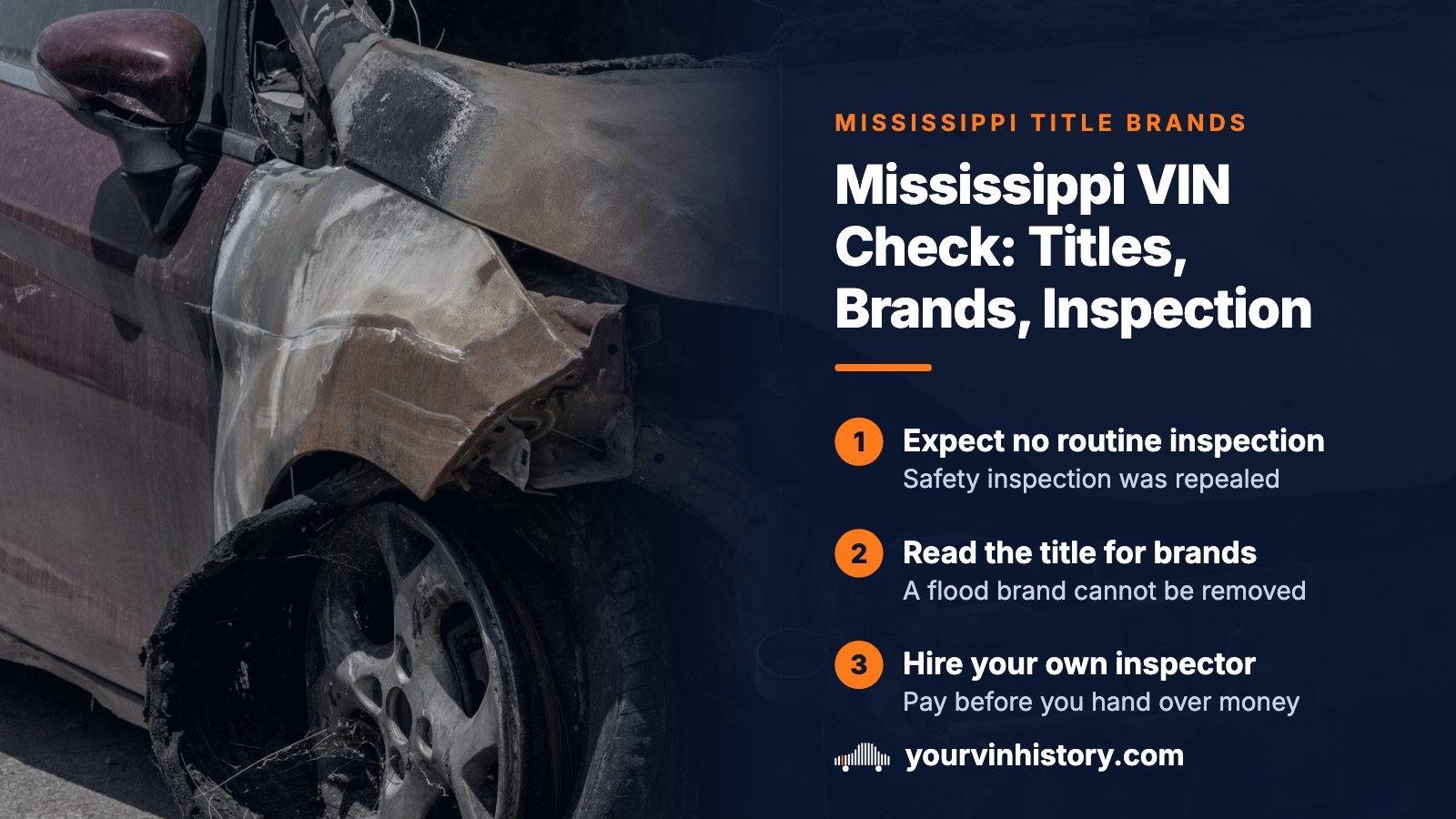
Mississippi no longer requires a periodic safety inspection, and registration does not depend on an emissions test. The Highway Patrol's Salvage Inspection Division still inspects salvage vehicles and handles flood, hail, VIN verification and bonded-title cases. For every other car, run the VIN through national records, read the title for brands, and pay for an independent inspection before you hand over money.
- Routine safety inspection
- Repealed for ordinary vehicles
- Still inspected
- Salvage, rebuilt, flood and hail vehicles
- Titles required since
- 1969
- Flood brand
- Cannot be removed, per the state
What a Mississippi VIN check has to make up for
A VIN check asks one thing: what do the records say about this exact vehicle? In many states a periodic inspection adds a second layer, because someone qualified has looked at the brakes, tires and structure and signed off. Mississippi has no such layer for ordinary cars. Nothing in the state's process will tell you the rear subframe is rotted or the brake lines are seeping.
What the state does keep is title paperwork and one narrow inspection program tied to damage brands. A sound Mississippi check therefore has three parts: national records matched to the VIN, the state title and any brand on it, and an inspection you arrange yourself. The sections below take each part in turn and mark where Mississippi's rules help a buyer and where they stop.
The sticker is gone, and so is the emissions test
The legislature repealed the statute behind Mississippi's Motor Vehicle Safety Inspection Law, and the windshield sticker went with it. The Department of Revenue's motor vehicle FAQ adds a second point: the state does not require emissions testing as a condition of registration. A car can be registered, renewed and resold for years without anyone official recording a pass or a fail.
For a buyer, the loss is a paper trail. Where inspections exist, a failed test sends the owner to a repair shop and leaves a dated record. Here, a vehicle's condition is whatever its owners chose to spend on it. Two cars of the same year and mileage can differ widely, and the registration will not say how.
Where the Highway Patrol still looks at cars
The Salvage Inspection Division is part of the Mississippi Highway Patrol, which belongs to the Department of Public Safety. Its page states the rule bluntly: when the word salvage appears on the title, the vehicle has to be inspected. The purpose of the salvage law, in the division's words, is to make sure the vehicle is repaired to the condition it was in before it was wrecked.
The division's work reaches beyond rebuilt cars. It also handles flood-damaged and hail-damaged vehicles, VIN verifications and bonded-title requests. Each category has its own document list and a flat inspection fee, payable by certified check or money order. The officer will not complete any inspection if a receipt or form is incomplete, incorrect or missing.
What a rebuilt car's paper trail should contain
A Mississippi car that went from salvage to rebuilt should come with a file, and you should ask for it before you discuss price. The division's checklist shows what an honest repair leaves behind.
| Document | What it tells a buyer |
|---|---|
| Original salvage title or insurer retention letter | Where the damage history began |
| Color photos of all four sides, taken before repairs | How the car looked when it was wrecked |
| Original invoices for every part | Where the parts came from, with the donor car's VIN for used ones |
| Work order, notarized if the owner did the work | What was actually done |
| Application for inspection of a salvage or rebuilt vehicle | That the car went before the division |
Each part receipt should name the donor vehicle's VIN, year, make and model, plus the seller's name, address and signature. The division will not inspect a car that is not fully restored, paint included, and it expects the inspection in the state where the rebuild happened. A VIN or component bearing a stolen or altered number gets the vehicle impounded and held as evidence or seized. Shortcuts exist, such as an affidavit when pre-repair photos were never taken, but those cases end with the word rebuilt on the title.
Identity check, not a quality grade
Passing shows the paperwork lines up and the parts were not stolen. It does not certify the welds, the alignment or the airbag work. Paying a mechanic to judge those is your job.
Four brands to look for on a Mississippi title
The Department of Revenue describes a brand as permanent information about a vehicle's condition, printed on the front of the title. When a title is assigned to you, check the front and ask the seller about any brand you find.
- Salvage: issued after an insurer pays a total loss claim. The Highway Patrol's rule is that a vehicle with this word on its title gets inspected.
- Rebuilt: the state ties the label to repairing or replacing one major part and four minor parts, as its salvage regulations list them.
- Flood damaged: the insurer applies for this title in its own name and assigns it to the buyer, who then needs pre-repair photos and an inspection.
- Hail damaged: the same route as flood, with a notarized work order when the buyer did the repairs.
A brand describes the title, not the workmanship. A hail car with fresh paint and a flood car with a spotless interior can both look fine in a driveway. The title is where the state recorded what happened, so read it before you read the car.
Gulf weather and a flood brand that never lifts
Mississippi pairs a Gulf shoreline with a humid climate inland, which puts moisture, salt air and storm flooding on a buyer's watch list. The Highway Patrol's salvage page says the flood brand can never be removed from a title and that it overrides every other brand. That permanence is worth knowing about, and it only helps when the brand was applied in the first place.
The brand comes through the insurer's total loss process. A car that sat in rising water, never produced a claim and was dried out by its owner can reach a lot with a clean title. With no periodic inspection in the state, nobody had a reason to lift the carpet. You do. Look for a musty smell, silt or a waterline in the trunk well and under the seats, rust on bare metal beneath the dash, and moisture inside the headlights.
Old vehicles, the 1969 line and bonded titles
Mississippi has required a title on every motor vehicle since 1969. Older vehicles may be titled voluntarily, so a pre-1969 car can lawfully have no title at all. Heavier trailers and manufactured homes fall under a separate, later titling rule.
The right question depends on age. On a newer car, a missing title is the seller's problem to fix before any money moves. On a pre-1969 car, ask whether a title was ever issued, and if the answer is no, ask the county Tax Collector what proof it accepts for registration before you pay.
When ownership paper is missing on a newer vehicle, the division also inspects bonded-title cases. The applicant supplies an affidavit of ownership, a signed and notarized bill of sale, a title bond form and a valid driver license. A bonded title papers over a gap in the history. It does not close the gap, so price the car accordingly and keep the independent inspection on your list.
Handoff rules that protect the buyer
The revenue department warns against accepting or delivering a title that is incomplete or improperly assigned. Leaving the buyer's name open to be filled in later breaks state law, and it is the usual setup for title jumping. A seller who offers you a title that way is asking you to take part.
For sellers, the state's guidance is to take the plate off when the vehicle changes hands and to keep a copy of the front and back of the signed title. As a buyer, match the VIN on the title to the car before you sign, and photograph the same pages. A car arriving from another state needs that state's title and an odometer disclosure statement, and a vehicle that was never titled needs the manufacturer's certificate of origin. Someone moving in who misses the registration deadline owes a $250 penalty on top of ordinary late charges.
The department's online title status page follows an application you have already filed. It helps after the sale, not before, and it is not a history report.
A buying order that suits a state with little inspection
Free checks go first because they cost nothing and can end a deal early. Spending comes later.
- Read the 17-character VIN off the dash plate and the door label, and match both to the title. A mismatch ends the conversation.
- Run NHTSA's recall lookup and the NICB VINCheck. Both are free tools from other organizations: NHTSA reports open recalls on that VIN, and NICB flags thefts and some salvage records.
- Pull a title-level history built on NMVTIS data. A yourvinhistory report adds brands, accidents with a damage map, odometer readings, salvage and auction photos, liens and open recalls. The preview is free; the full report is a one-time purchase.
- Read the paper title for a brand, a lienholder and the seller's name. If a brand appears, ask for the file listed in the table above.
- Hire an independent mechanic for a pre-purchase inspection, and ask specifically about rust, corrosion and water intrusion.
- Only then handle the money, the bill of sale and the title transfer.
A recall lookup shows open recalls only, and who pays for a repair depends on the recall and the vehicle's age, so confirm with a dealer rather than assuming.
Where this information comes from
- Mississippi Department of Public Safety: Salvage Inspection Division — Which damaged vehicles must be inspected, the document lists, the rebuilt-title test and the permanence of the flood brand.
- Mississippi Department of Revenue: Motor Vehicle Titles — The 1969 titling line, voluntary titling of older vehicles and the warning against incomplete title assignments.
- Mississippi Department of Revenue: Motor Vehicle FAQ — Brand definitions, the absence of an emissions test, out-of-state paperwork and the newcomer penalty.
- NHTSA: Recalls — A no-cost lookup for open safety recalls on a specific VIN.
Sources and photos: Facts checked against the sources above in October 2026. Photo by engin akyurt on Unsplash; diagrams by YourVINHistory.
Keep reading
- Rebuilt title inspectionWhat a passed inspection proves about a rebuilt car, and what it leaves unjudged.
- Flood-damaged carsWhy a flooded car often shows a clean title, and where to look instead.
- TennesseeA neighboring state where nobody official looks at the car anymore either.
- NMVTIS reportThe federal title record that carries more weight where the state inspects less.
Frequently asked questions
Does Mississippi require an inspection to register a car?
Not for ordinary passenger vehicles. The safety inspection law was repealed, and the Department of Revenue says emissions testing is not a condition of registration. Registration for typical passenger vehicles runs through the county Tax Collector, not the Highway Patrol.
What should I ask a seller about a rebuilt car in Mississippi?
Ask who did the repairs, whether the owner or a shop, and request the pre-repair photos, the part invoices with donor VINs, the notarized work order and the inspection application. Ask which state performed the inspection, since the division expects it where the car was rebuilt. A seller who cannot produce the file has told you something useful.
Can I buy a car older than 1969 without a title?
Mississippi does not require titles on vehicles from before 1969, so a missing title is not automatically a defect. It does remove your view of brands, liens and ownership. Get a signed bill of sale that lists the VIN, and ask the county Tax Collector what proof it will accept for registration before you pay anything.
Can a flood brand be removed from a Mississippi title?
The Highway Patrol's salvage page says no: the flood brand stays and overrides all other brands. The gap is the car that never received the brand. If an owner dried out a flooded vehicle without an insurance claim, the title can read clean, so inspect for water damage and check records beyond the title.
How do I check a Mississippi car's history before buying?
Begin with the no-cost tools from NHTSA and NICB, then add a title-level history built on NMVTIS data to see brands, accidents and odometer readings. The state's title status page only tracks pending applications, and federal privacy law keeps a plate from returning an owner, so build the picture from the VIN, the paper title and your mechanic.
Now check the car itself
The guide explains what to look for. The report shows what this VIN has on record.