THE SHORT ANSWER
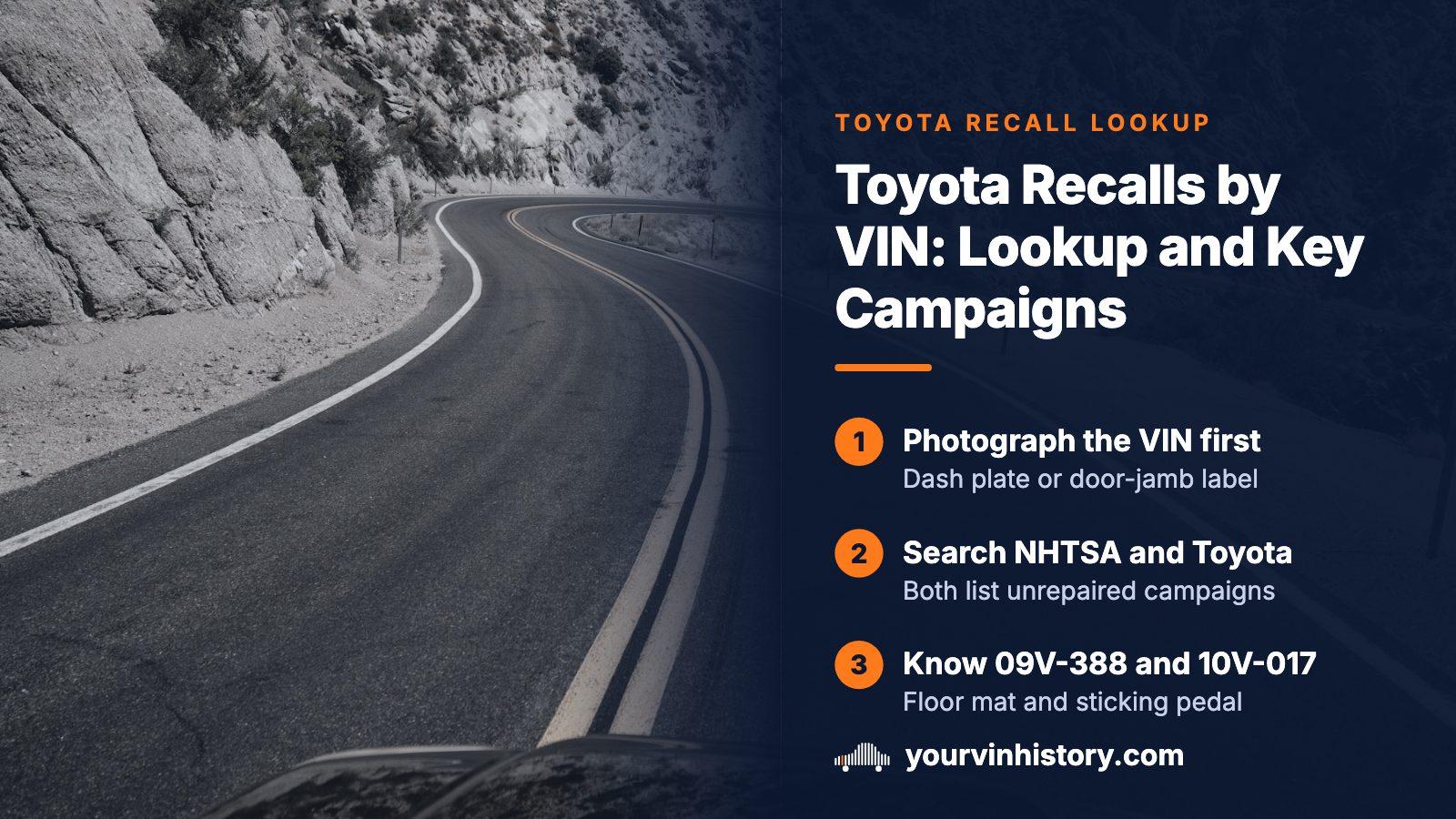
To check Toyota recalls by VIN, photograph the 17-character number from the dashboard plate or the driver's door-jamb label, then enter it in NHTSA's recall lookup and on Toyota's owner website. Both list safety campaigns still unrepaired on that exact car. The two best known are 09V-388, a floor mat that could trap the accelerator pedal, and 10V-017, a pedal that could drag or stick. NASA found no electronic cause.
- Campaign 09V-388
- 4,445,056 vehicles, pedal trapped by a floor mat
- Campaign 10V-017
- 2,230,661 vehicles, pedal that could drag or stick
- NASA review
- Over 280,000 lines of code examined, no electronic cause found
- No-charge repair limit
- Not required when first sold more than 15 calendar years before the notice
Start with the VIN, then read the result
Recalls attach to a vehicle identification number, so a lookup is only as good as the number you feed it. One wrong character returns a different car or nothing at all. The dashboard plate sits behind the windshield and gets read from an awkward angle, so photograph it and zoom in. The driver's door-jamb label is flat and makes a useful cross-check.
- Copy the VIN from a photo rather than retyping it by eye.
- Count the characters; a modern Toyota VIN has 17.
- Enter it into NHTSA's recall lookup and note any campaign listed as unrepaired, along with its campaign number.
- Repeat the search on Toyota's owner website, which adds the maker's own service programs.
- If a result looks wrong for the car in front of you, decode the VIN with NHTSA's vPIC tool to confirm the model and year it describes.
Who holds which piece of the record
| Source | Best at | Blind spot |
|---|---|---|
| NHTSA recall lookup | The federal list of safety campaigns still unrepaired on a VIN, for every maker selling in the U.S. | Toyota's own goodwill and warranty programs, which are not safety recalls |
| Toyota owner website | Open safety campaigns plus Toyota's customer support programs and warranty enhancements | Anything outside Toyota's own records |
| Toyota dealer service desk | Completed campaign work on the VIN, including repairs done for earlier owners | You have to call or visit, and the answer is only as current as the dealer's record |
The last row is the one to use when you want proof. A campaign missing from the open list tells you nothing is outstanding today; it does not say who did the work or when. A dealer record does. Some support programs carry real money value yet never appear federally.
The two campaigns behind Toyota's reputation
Most articles about Toyota recalls circle back to two filings made months apart. Both are logged under vehicle speed control, accelerator pedal, but they describe different defects and different repairs.
| Campaign | Filed | Vehicles | What went wrong |
|---|---|---|---|
| 09V-388 | October 5, 2009 | 4,445,056 | Accelerator pedal trapped by an unsecured or incompatible driver's floor mat |
| 10V-017 | January 21, 2010 | 2,230,661 | Pedal that could turn hard to press, slow to return, or stick part-way down |
Some models, including the Avalon, Camry and Tundra, appear in both, so adding the counts overstates distinct cars. The Department of Transportation put the total for these two defects at nearly 8 million vehicles in the United States, so the two headline campaigns are not the whole tally.
09V-388: a loose mat and a pedal with nowhere to go
NHTSA's record says the accelerator pedal could end up stuck in the wide-open position because an unsecured or incompatible driver's mat trapped it. The stated consequence is very high speed and trouble stopping. The mat was the trigger, but the remedy reached well past it.
Toyota's amended report described a layered fix. Dealers modify the accelerator pedal and, on certain vehicles, reshape the floor surface beneath it. Genuine Toyota and Lexus all-weather mats were replaced with a redesigned version, or bought back from owners who preferred not to keep the new ones. On the Camry, the Avalon and some Lexus sedans, dealers also loaded software so the brake overrides the accelerator when both pedals are pressed. Redesigned pedals were scheduled to follow later, with dealers swapping in the new part on request.
10V-017: the pedal that dragged
This filing concerns the pedal sensor assembly, not the floor. Inside it, a friction lever rubs on a sliding surface that can turn smooth during use. If condensation forms on that surface, which the notice ties to running the heater without the A/C while the assembly is cold, friction rises. The pedal can become harder to press, slower to return, or in the worst case mechanically stuck in a partly pressed position.
The notice names the Avalon, Camry, Corolla, Corolla Matrix, RAV4, Highlander, Sequoia and Tundra. The fix was a reinforcement bar installed in the pedal so it moves smoothly. The same notice sends owners of the Pontiac Vibe to a separate General Motors campaign, 10V-018, which is an early hint of why brand-name searches miss cars.
What NASA's engineers were asked, and what they found
A popular theory blamed faulty electronics rather than pedals. Lawmakers wanted it tested, so NHTSA recruited NASA engineers whose specialties included computer-controlled systems, interference from electromagnetic fields and software integrity. The study took ten months.
The work was physical as well as digital. NASA's team went through over 280,000 lines of Toyota code, and engineers at Goddard Space Flight Center in Maryland tested mechanical parts that could open a throttle unprompted. At a facility in Michigan, whole vehicles were exposed to electromagnetic radiation to see whether it could cause a malfunction. NHTSA staff added tests at its research center in East Liberty, Ohio.
The finding in one paragraph
NASA found no electronic flaw in the tested Toyotas that could open the throttle far enough to cause a dangerous high-speed incident. Sticking pedals and mats that trap pedals were the only causes anyone has identified.
What that means in practice: both defects were physical, so the repairs were physical, and a dealer either performed them on a given VIN or did not. That is exactly what the federal lookup reports.
Rules that grew out of the episode
At the study's release, NHTSA listed steps it was considering, which is different from finished rules:
- Proposed rules requiring brake override systems in passenger vehicles
- Proposed rules standardizing how keyless ignition systems operate
- Proposed rules requiring event data recorders in all passenger vehicles
- Wide-ranging research into how dependable and secure electronic control systems are
- Research on the placement and design of accelerator and brake pedals, aimed at reducing pedal misapplication
Those were stated intentions at the time, so check what applies to a specific model year. The practical echo for Toyota owners is the 09V-388 software remedy: where it was installed, pressing both pedals lets the brake win.
Lexus, Pontiac and the badge problem
Searching by brand and model can sort a car into the wrong pile. The 09V-388 record lists Lexus ES and IS models in the same campaign as the Toyotas, while the 10V-017 notice hands Pontiac Vibe owners to a General Motors campaign with its own number. A search limited to Toyota campaigns gives an incomplete picture of a Lexus, and one limited to 10V-017 misses the Vibe's paperwork.
The VIN avoids the problem. It returns whatever is attached to that one vehicle, regardless of which badge sits on the trunk lid or which maker filed the campaign. Set a Corolla Matrix beside a Pontiac Vibe and the point is plain: one pedal problem, two makers' campaign numbers.
Who pays for the repair, and the 15-year line
The cutoff in plain terms
Federal law requires a manufacturer to provide a recall remedy without charge, but not in every case. The requirement does not apply if the first purchaser bought the vehicle more than 15 calendar years before the manufacturer's notice or an agency order, whichever came first. For tires the figure is 5 calendar years.
The clock runs from the first retail sale to the notice, so later resales do not restart it. A recall issued today on a car first sold long ago may land outside the rule, and a dealer may then quote a price. The measuring date is the notice date, not today's, and Toyota's pedal notices went out in 2009 and 2010, but confirm with the dealer how your specific VIN is handled before you book.
If you paid for a repair that a later recall covered, ask the dealer or Toyota about reimbursement and keep the original receipt.
When the lookup shows an open campaign
Open recalls turn up on used Toyotas all the time and say little about the seller. Letters chase registered owners, owners move, cars sell privately, and a notice ends up at a former owner's address. The campaign does not lapse from neglect; it waits on the VIN.
- Run the VIN before you agree on a price, not after the paperwork is signed.
- Ask the seller to book the repair, or call a Toyota dealer yourself. Any Toyota dealer can take the appointment, not only the one that sold the car.
- Ask if parts are on hand.
- If the seller says the work is done, ask for the repair order or a dealer record.
- Read the notice for any driving instruction and follow it exactly.
Treat the open item as a task with a date attached, not as a reason to walk away.
What a clean recall result leaves out
A recall lookup answers one narrow question well: does a manufacturer owe this vehicle a safety repair right now? It says nothing about crashes, title brands, odometer honesty or liens, which sit in other records. A clean result and a wrecked car can coexist.
NICB's VINCheck is a free tool from others for theft and salvage flags. For title brands, accident entries, odometer readings, liens and open recalls in one place, a yourvinhistory report starts with a free preview and then costs a one-time purchase, with no subscription. Use it beside the recall lookup, not instead of it. A mechanic's pre-purchase inspection covers what no record can, which is the condition of the car today.
Where this information comes from
- NHTSA: Recalls — The federal lookup where a VIN returns safety campaigns that are still unrepaired.
- U.S. DOT: NHTSA-NASA study of unintended acceleration in Toyota vehicles — Describes the ten-month review, the tests run, the finding on electronics and the steps NHTSA said it was weighing.
- NHTSA: vPIC VIN decoder — Free decoder for confirming which model and year a VIN describes before you compare it with campaign lists.
Sources and photos: Facts checked against the sources above in October 2026. Photo by Will Truettner on Unsplash; diagrams by YourVINHistory.
Keep reading
- ToyotaRead a Toyota VIN position by position so you know the number you are checking is the right one.
- Buying a car with an open recallWhat the sale rules do and do not cover once a lookup shows an open campaign.
- Toyota warranty by VINToyota's own service programs and warranty coverage sit outside the federal recall record.
- VIN accident checkA recall result never covers crash history, so this is the next check.
Frequently asked questions
How often should I recheck a Toyota's recall status?
A lookup is a snapshot of one day. Campaigns can be added to models already on the road, so a clean result today can change later. Check once when you shortlist a car, again right before you pay, and then about once a year or whenever you book service.
Can I drive a Toyota with an open recall?
It depends on the notice. Most campaigns carry no driving restriction, but some tell owners to stop driving or to park outside until the repair is done, and NHTSA's campaign data carries flags for those cases. Read the risk description on the result, follow any instruction literally, and call a Toyota dealer for an appointment.
If the acceleration recalls were done years ago, will they still show on my VIN?
A completed repair should no longer appear as an open campaign. A clean lookup on a Toyota of that era therefore means either the work was done or the car was never in scope, and the lookup cannot say which. Ask a Toyota dealer to check the VIN's service record, or ask the seller for the closed repair order.
Did NASA prove Toyota's software could never cause a problem?
No. The finding was narrower. NASA looked for an electronic flaw that could produce the large throttle openings behind dangerous high-speed incidents and did not find one. That covers the vehicles tested and the question Congress posed. The pedal and floor mat defects remained the known causes.
What should I bring to a dealer for a recall repair?
Bring the VIN and the campaign number from the lookup so the service writer can pull the exact repair, plus any recall letter you received. Ask whether parts are on hand before you travel, and ask for a copy of the closed repair order afterward. That paper is the proof the next buyer will want.
Now check the car itself
The guide explains what to look for. The report shows what this VIN has on record.