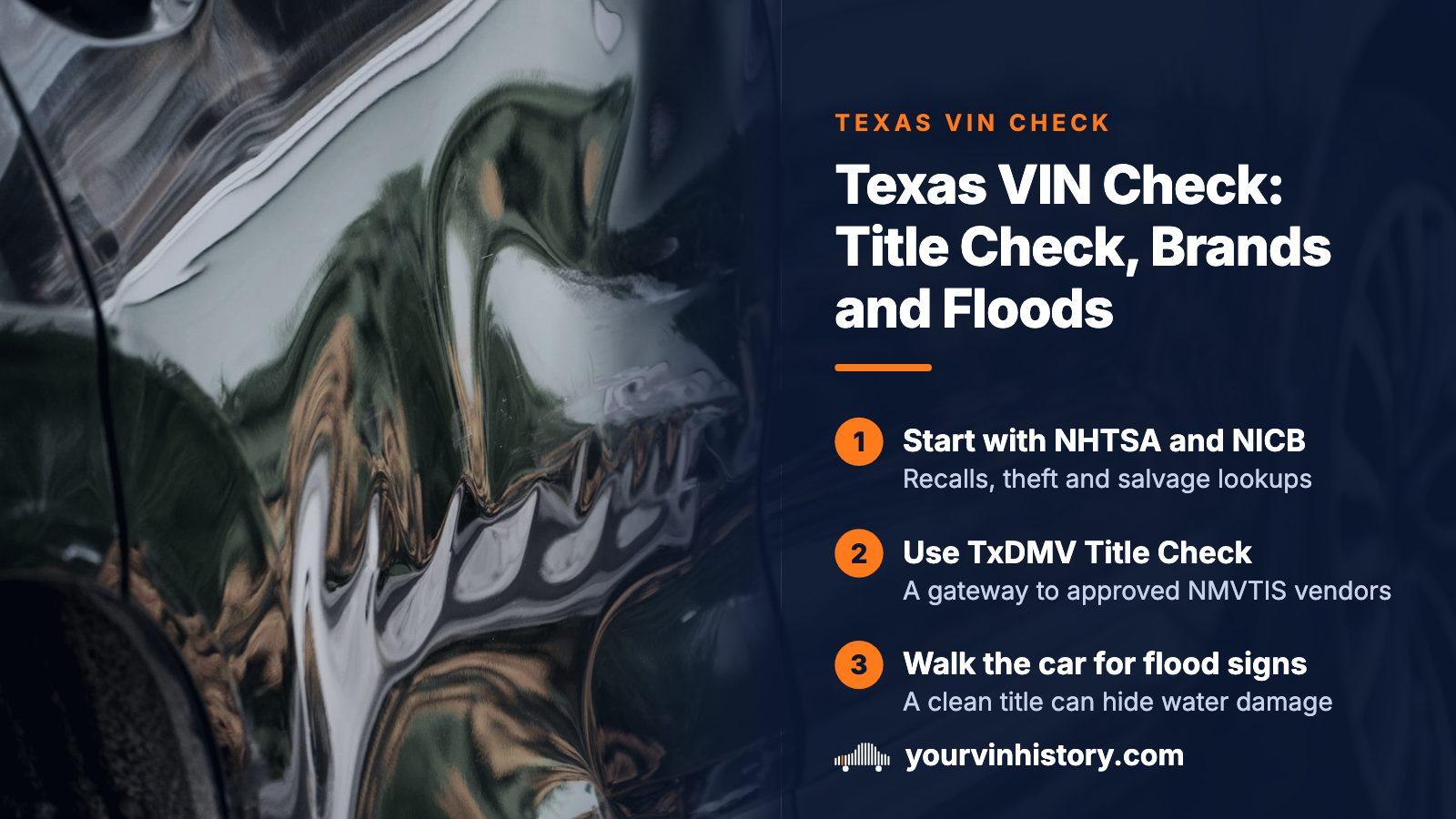
THE SHORT ANSWER
Run the free lookups first: a VIN decode, the NHTSA recall search, and NICB's theft-and-salvage search. After that, pull the title record. TxDMV's Title Check is a gateway to federally approved NMVTIS vendors, not a report the state sells itself, and prices begin at a couple of dollars. If the vehicle lived near the coast, add a physical flood inspection, since a clean title does not rule out water damage.
- Title Check
- A gateway to approved NMVTIS vendors, not a state-run report
- Texas flood brand
- Fresh and salt water flooding both convert to Flood Damage
- Texas rebuilt brand
- Rebuilt Salvage, after the rebuild process and fee
- Weekend sale
- A transit permit covers five calendar days
The order that works for a Texas VIN check
Think of the check as a funnel. The cheap steps come first, and any one of them can end the deal before you spend more.
- Read the VIN from the windshield plate and the door jamb label, then match both to the title the seller shows you, character by character.
- Decode it. On a pickup that means confirming cab style, bed, engine and drivetrain against the listing.
- Search the NHTSA recall lookup for open safety recalls.
- Search NICB VINCheck for theft and salvage reports filed by participating insurers.
- Pull the NMVTIS title record through an approved provider.
- Inspect the vehicle for water damage if it has any Gulf coast or storm-zone history.
Plates are not part of this sequence. Everything above runs on the VIN, and the plate question is answered in the FAQ.
What TxDMV Title Check is, and what it is not
The name suggests a report issued by the state. It is not one. The Texas Department of Motor Vehicles describes a short process: find the VIN, have a credit card ready, pick an approved provider, and pay that provider for the report. Choosing a vendor takes you off the TxDMV website.
Underneath sits NMVTIS, the National Motor Vehicle Title Information System, which TxDMV calls a national consumer protection database fed by states across the country. A report is meant to show whether a vehicle was ever at a junk or salvage yard, or declared a total loss by an insurer. TxDMV says prices begin at only a couple of dollars and suggests comparing what each price includes.
The vendor claim worth weighing is approval by the U.S. Department of Justice. Approved providers read from the same national source, so a higher price mostly buys extras around the title record, not a deeper record.
Four names TxDMV says will not sell you this report
TxDMV warns that Carfax, CVR, DMVDesk and Experian deal with car dealerships only when it comes to NMVTIS title history reports. A private buyer has to go to a different approved vendor.
The page is not perfectly consistent. A second vendor list on it includes some of those same names, so confirm with a provider that a consumer can actually buy the report before you type in a card number.
ClearVin is one of the names on TxDMV's consumer list. It is also the NMVTIS data provider behind the title records in a yourvinhistory report, which pairs them with accident, auction and recall data.
Texas brand names versus the ones on a national report
A report from an approved vendor uses the national brand list. The Texas title uses its own. TxDMV publishes an NMVTIS-to-Texas conversion chart, and these are the translations that matter most to a buyer.
| National report says | Texas treats it as |
|---|---|
| Flood Damaged, Salt Water Damaged | Flood Damage |
| Fire Damage, Totaled, Salvage Retention, Owner Retained | A salvage vehicle: complete the rebuild process and pay the fee to get Rebuilt Salvage, or apply for a salvage or nonrepairable title |
| Rebuilt, Prior Non-Repairable or Repaired | Rebuilt Salvage |
| Junk, Dismantled, Crushed | Nonrepairable title or a Certificate of Authority |
| Gray Market, Export Only | Cannot be titled in Texas |
| Warranty Return, Manufacturer Buy Back | Manufacturer Buyback |
Owner Retained is not a mild entry
An insurer judged the vehicle a total loss, and the owner kept it. Texas routes that code down the same path as salvage. The entry says nothing about whether the car was properly rebuilt, patched up for sale or left as it was, so ask for repair invoices and pay an independent shop to look.
When a Texas title and a national report seem to contradict each other, compare the underlying event, not the label.
Flood history: why the title is the weaker evidence
Hurricane Harvey put flooded vehicles into circulation on a scale that estimates place in the hundreds of thousands. Insured cars that were totaled picked up brands. Uninsured ones were often dried out and sold with nothing on the paperwork.
TxDMV's own Smart Buyer flood guide is blunt about the gaps. Some states do not put a flood brand on titles at all. An owner without full coverage can sell a submerged vehicle without saying so. And some sellers wash a title by re-titling the car through other states.
- A vehicle licensed in several states over a short span deserves suspicion.
- An insurance company listed as a past owner is a prompt to ask why.
- If the seller lives, or lived, somewhere that flooded in recent years, assume the question applies to the car.
- Storms in nearby states matter too, since flooded cars travel to resale lots far from where the water rose.
A flood walk-around, following TxDMV's own list
TxDMV admits there is no foolproof test. It recommends a trusted mechanic's top-to-bottom inspection, and says to walk away from a dealer who refuses one. Before the mechanic, cover the basics yourself.
- Lift the carpet and feel for dampness, mud or stain marks, and ask whether the carpet was replaced.
- Look for rust on seat-mounting screws and console screws, which may have been removed to dry the interior.
- Pull each seat belt all the way out and check for water stains and fading.
- Remove the spare tire and inspect the well, where water pools and cleanup crews often skip.
- Check the engine bay for mud around the alternator, behind wiring harnesses and relays, and near the starter and power steering pump.
- Look under the dashboard for dried mud, mold or a musty smell.
- Examine the rubber drain plugs under the car and at the bottom of the doors for signs they were recently pulled.
- Check headlight and taillight lenses for water lines.
If the title looks clean but the interior tells a different story, a report with insurance and auction records, including photos, is the next place to look for a loss that was never branded.
Free lookups worth running first, and their blind spots
- The TxDMV Salvage Database: TxDMV's consumer guides describe it as a free search covering salvage or junk vehicles, hail, flood or fire damage, some odometer discrepancies and gray market vehicles.
- NICB VINCheck: free, and it shows whether participating insurers reported the vehicle stolen and not recovered, or as a salvage loss. The number of searches per day is capped.
- NHTSA recall lookup: free, and it lists open safety recalls by VIN. It knows nothing about accidents.
None of these is a title history. Each answers a separate question, which is why the NMVTIS step follows them instead of replacing them. Insurer-reported databases also go quiet on damage that never produced a claim, which is where a flooded, uninsured car sits.
Pickups: settle the configuration before the price
A large share of Texas listings are trucks, and on a truck the build details move the price more than the trim name does. Listings get them wrong often. Cab style, bed length, engine and two or four wheel drive can all be checked against the decode in seconds.
Some items the decode will not give you. Rear axle ratio, for instance, is a build-sheet detail, so confirm it from the tag or paperwork rather than the listing. Check the drivetrain by looking underneath, and measure the bed with a tape.
Closing a private sale through the county tax office
TxDMV's advice for private purchases is practical. Collect the signed title, the title application with the sales price filled in, and any lien release or power of attorney that applies. Then take the seller with you to the county tax office.
- A tax office representative can confirm the title is correct and whether salvage or legal issues are attached to it.
- Titling in your name must happen within the deadline Texas sets, and late transfers draw penalties.
- You need proof of liability insurance when you title and register.
- If the sale falls on a weekend and the seller removes the plates, a Vehicle Transit Permit lets you drive to the tax office for five calendar days. Only one is issued per sale.
- Keep a written record with the seller's name and address, the sale date and the VIN.
Imports, border cars and gray market vehicles
Texas moves a lot of vehicles across the border, and a car first sold in Mexico is not suspect by itself. What counts is whether the import was completed properly. TxDMV's chart is firm in two places: a gray market vehicle, built for use outside the United States and then imported, cannot be titled in Texas, and neither can one flagged Export Only.
TxDMV treats a VIN replaced by a new state-assigned VIN more gently. It does not necessarily mean something is wrong, but it calls for more research.
Start by asking whether the vehicle was imported, and request the import paperwork. Confirm that a current U.S. title exists in the seller's name. If the answers are vague, find out from the county tax office what it requires before any money changes hands.
Where this information comes from
- TxDMV: Title Check, Look Before You Buy — Supports the process, the approved-vendor model, the price wording and the dealer-only warning.
- TxDMV: Salvage Vehicles and NMVTIS brands — Defines the national salvage brands, including Owner Retained, and says what Texas does with them.
- TxDMV Smart Buyer: Checking for Flood Damage — Source for the walk-around list and the warnings about missing flood brands and washed titles.
- NMVTIS: National Motor Vehicle Title Information System — The federal system behind every approved title report.
- NICB: VINCheck — Free theft and salvage lookup based on participating insurers.
- NHTSA: Recalls — Free open-recall search by VIN.
Sources and photos: Facts checked against the sources above in October 2026. Photo by Maxim Tolchinskiy on Unsplash; diagrams by YourVINHistory.
Keep reading
- Texas title checkTexas brand definitions, and the history behind the Nonrepairable title.
- Texas platesWhy the windshield sticker tells you more than the plate does.
- Flood-damaged carsA wider look at flood signs, since the title often reads clean.
- NMVTIS reportWhat the federal title record contains, in plain terms.
Frequently asked questions
Is there a free Texas VIN check?
Parts of it are free. A VIN decode, the NHTSA recall search and NICB VINCheck cost nothing, and TxDMV's guides describe a free Salvage Database. The title history itself comes from approved NMVTIS vendors reached through Title Check, which charge a fee. TxDMV does not issue the report directly.
Can I look up who owns a Texas license plate?
Private individuals cannot. Under the Driver's Privacy Protection Act, a federal law, motor vehicle record data is released only for specific permitted uses, and curiosity about a stranger is not on that list. If you are buying, ask the seller for the VIN. A seller who stalls on that request is giving you information too.
What should I ask a seller about an Owner Retained entry?
Ask for the insurer's total-loss paperwork if the seller has it, itemized repair invoices, and photos from before and after the work. Then book an independent inspection that includes a frame and airbag check. The entry proves a professional wrote the car off. It does not describe its condition today.
Does a clean title mean a Texas car was never flooded?
No. Flood history usually reaches a title only when an insurer reports a total loss or a state applies a brand. An uninsured owner can clean a car up and sell it, and a title moved through other states can lose its history. Trust the physical inspection at least as much as the paperwork.
What is a Rebuilt Salvage title in Texas?
It is the Texas brand for a vehicle that was declared salvage and then completed the rebuilt vehicle process, which includes an inspection and a rebuilt fee. TxDMV says a salvage vehicle has to be rebuilt and inspected before it can be driven on the road again. The brand then stays on the record.
Now check the car itself
The guide explains what to look for. The report shows what this VIN has on record.