THE SHORT ANSWER
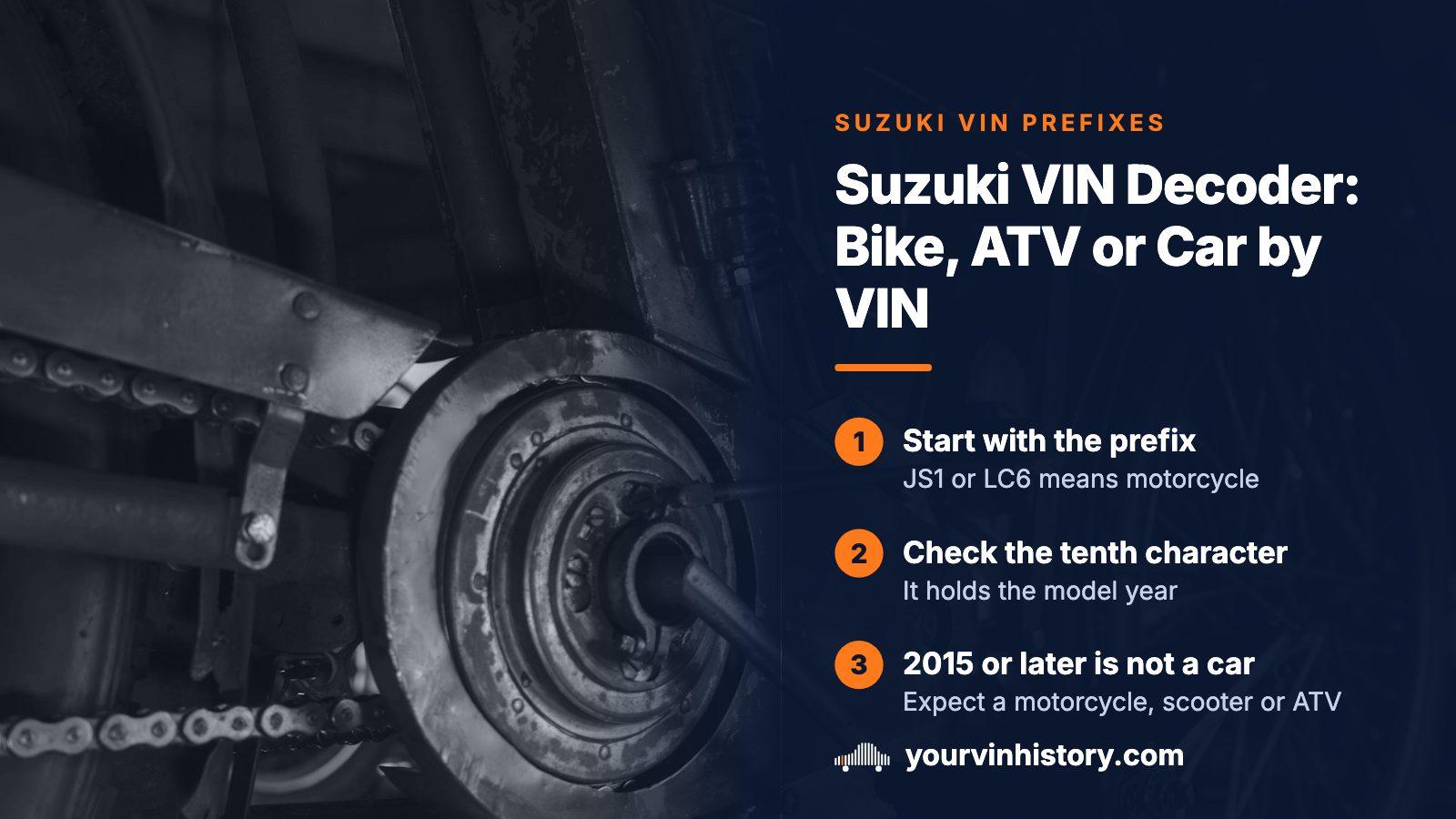
Check the first three characters, then the tenth. JS1 and LC6 decode as motorcycles, JS2 and KL5 as passenger cars, and JS3 and 2S3 as multipurpose vehicles. The tenth character is the model year, and NHTSA lists no Suzuki cars after model year 2014, so a VIN that points to 2015 or later is a motorcycle, scooter or ATV. JSA is the odd one out, because it is listed under Suzuki and Kawasaki both.
- Car cutoff
- No Suzuki cars on NHTSA's list after model year 2014
- Prefixes
- Six decode to Suzuki alone, across four countries
- Shared prefix
- JSA is listed under Suzuki and Kawasaki
- Year check
- Position 10 holds the model year
Sort the vehicle first, then decode it
Suzuki is an unusual name to meet on a VIN, because the badge covers motorcycles, scooters, ATVs, boat engines and, in older model years, cars. A seller may hand you a number belonging to any of them, so settle what the thing is first.
Two checks do most of that work. The first three characters name the manufacturer and the type of vehicle. The tenth gives the model year, which matters more here than on most makes. NHTSA's model list for Suzuki shows no passenger cars from model year 2015 on, yet it still returns 32 Suzuki models for 2024: motorcycles, scooters, quads and a generic low speed vehicle entry. An older number leaves a car possible. A newer one points to powersports.
The six Suzuki prefixes, and what NHTSA calls each one
Each prefix below was run through the DecodeWMI function of NHTSA's vPIC tool, which reports a make, a manufacturer and a vehicle type. The country column is not from vPIC; it follows the usual rule that the first character points to the country of assembly.
| Prefix | Vehicle type in vPIC | Country by first character |
|---|---|---|
| JS1 | Motorcycle | Japan |
| JS2 | Passenger car | Japan |
| JS3 | Multipurpose passenger vehicle | Japan |
| 2S3 | Multipurpose passenger vehicle | Canada |
| KL5 | Passenger car | South Korea |
| LC6 | Motorcycle | China |
Two lookalikes, JS6 and JS7, turn up on enthusiast lists. Both come back empty from vPIC, so treat any chart that lists them as unconfirmed.
Why a Suzuki VIN may not start with JS
The common advice that a Suzuki VIN opens with JS holds only for machines built in Japan. A Canadian-built multipurpose vehicle opens with 2S3, a Korean-built car with KL5 and a Chinese-built motorcycle with LC6. A seller, or a decoder, that insists on JS will wrongly reject all three.
The country reading is a convention, not a federal rule. 49 CFR Part 565 says the opening section of a VIN identifies the manufacturer and the type of vehicle, and the word country is absent from the part. SAE International coordinates the assignment of identifiers under a contract with NHTSA. Treat the first character as a hint about where the vehicle was built and the full prefix as the real identification.
KL5 has a close neighbor. KL1 decodes in vPIC as Chevrolet, made by General Motors LLC. Same country, differing only in the third character, two different makes.
JSA: one prefix, two makes
When vPIC decodes JSA, the make field comes back as Suzuki and Kawasaki together. The manufacturer is listed as Suzuki Motor of America, and the vehicle type is motorcycle.
The practical point is that this prefix does not settle the brand. A prefix names a manufacturer, not a badge, so on a JSA number either name on the paperwork can be legitimate and the answer sits further along in the VIN.
Look at the descriptor block in positions 4 to 8, which carries the model line, and run all 17 characters through vPIC instead of a static chart. Then check that the model, year and engine match the machine and the title.
The tenth character as a car-or-bike test
NHTSA's vPIC lists the models it holds for a make in a given model year. The table counts Suzuki's, one year at a time, and separates cars from everything else, leaving out the generic Low Speed Vehicle entry.
| Model year | Position 10 | Suzuki models on file | Of those, passenger cars |
|---|---|---|---|
| 2012 | C | 39 | 4 |
| 2013 | D | 38 | 4 |
| 2014 | E | 38 | 3 |
| 2015 | F | 33 | 0 |
| 2016 | G | 37 | 0 |
| 2018 | J | 41 | 0 |
| 2021 | M | 46 | 0 |
| 2024 | R | 32 | 0 |
The car count slips from four to three and then to zero, while the total stays between 32 and 46. Every sampled year from 2015 on shows no cars, so one empty year is not a gap in the data.
One caution: the year letters repeat on a thirty-year cycle, so an E can mean 2014 or 1984. On passenger cars and light trucks, position 7 helps separate the cycles, with a letter pointing to the newer one and a digit to the older.
Which characters the rule fixes and which Suzuki chooses
Federal rules set the block layout for every make, which is why one chart fits a Kizashi and a DR650S alike.
| Positions | What they hold |
|---|---|
| 1 to 3 | Manufacturer and vehicle type |
| 4 to 8 | Descriptor block, five characters coded by the maker |
| 9 | Check digit, worked out from the other characters |
| 10 | Year code |
| 11 | Plant code |
| 12 to 17 | Production sequence |
Part 565 says the descriptor section occupies positions 4 through 8. It leaves the choice of characters, and where each one goes, to the manufacturer, as long as the listed attributes can be worked out from information the manufacturer supplies. That is why model line, body and engine can only be read by a decoder that holds Suzuki's own patterns, and why a generic chart goes wrong.
The Suzuki cars you can still meet
With the car line closed, the list of Suzuki cars on the used market is short and fixed. NHTSA's file for model year 2012 holds four nameplates, and by 2014 it holds three.
- SX4, Kizashi and Grand Vitara: all three appear in the lists for 2012 through 2014, the last car years on file.
- Equator: a pickup that shares its design with the Nissan Frontier. It is on file for 2012 and 2013 but not for 2014.
The Equator is the one to decode first. A truck shared between two makers is where a buyer most easily orders the wrong part or takes the wrong value from a pricing guide, and the full VIN shows which maker and model it is recorded as.
All of these cars are more than a decade old, so condition outweighs mileage, and comparable sales for the low-volume nameplates are likely thin.
Checking a Suzuki bike or ATV in person
On powersports vehicles the paperwork and the metal both have to agree. Work through them in this order.
- Find the frame number, not the engine number. A motorcycle's VIN is stamped on the steering head or the frame near the forks, and a label usually repeats it. The engine has a serial of its own that will not decode.
- Match the prefix to the machine. JS1 and LC6 are the motorcycle prefixes. A bike whose number opens with JS2 or KL5, the passenger car prefixes, is not what the ad says it is.
- Read the tenth character. For a Suzuki it doubles as the car test: 2015 or later rules a car out.
- Compare the stamped number with the title and the label. A ground or restamped frame number is among the strongest theft warnings on a motorcycle.
- Run the number through NHTSA's recall lookup and NICB's VINCheck before any money moves.
Quads such as the KingQuad and QuadSport appear in NHTSA's Suzuki list too, but their VIN data tends to be sparse, so lean on the frame label and the paperwork.
Suzuki outboards carry a serial number, not a VIN
Suzuki also builds outboard motors, and some people reach a VIN decoder holding one. An outboard is an engine, not a motor vehicle, so it gets a manufacturer serial number and a VIN decoder returns nothing for it, whatever the seller calls the number.
The boat has its own identifier, issued under Coast Guard rules instead of the highway standard. Engines get fitted years later or moved between boats, so the numbers can have different histories.
- Outboard motor: a manufacturer serial number that will not decode as a VIN.
- Hull: a 12-character hull identification number that belongs to the hull, not the engine.
- Trailer: has a VIN of its own, the one number in this set that a VIN decoder can answer.
Recalls stay with the VIN after a line ends
A safety recall is tied to specific vehicle identification numbers. When a maker drops a vehicle type from the American market, campaigns already open against those vehicles stay open. So on a Suzuki car, the useful question is whether this VIN carries an open recall, not whether the brand still sells cars here.
NHTSA's recall lookup answers that by VIN at no cost. ATV recalls are handled by a different agency, the Consumer Product Safety Commission, so a clean NHTSA result on a quad is not the whole picture.
The no-charge repair has an age limit
Federal law puts an age limit on the obligation to fix a recall at no charge, so a very old vehicle can fall outside it. Ask the manufacturer before counting on a repair that costs nothing.
What a Suzuki decode leaves out
A decode describes the machine as it left the factory. Everything after that lives in other records.
- Crashes, insurance claims and structural repairs
- Title brands such as salvage, rebuilt or flood
- Odometer readings and signs of rollback
- Number of owners and how the vehicle was used
- Liens, impounds and theft records
- Service history, including whether a recall repair was ever performed
A yourvinhistory report covers the title, accident, odometer, salvage, lien and theft side of that list for a VIN, using NMVTIS title records from ClearVin LLC, an approved NMVTIS data provider. A preview comes before any purchase. NICB's VINCheck is a separate no-cost search of theft and salvage reports.
Where this information comes from
- NHTSA: vPIC VIN decoder and API — Source for the prefix lookups, the JSA make listing and the per-year Suzuki model counts used in the tables above.
- eCFR: 49 CFR Part 565, VIN requirements — The federal rule behind the position layout, the maker-chosen descriptor block and the year code.
- NHTSA: Recalls — Where to enter one VIN and see open recall campaigns, whatever the make.
- NICB: VINCheck — A no-cost lookup of theft and salvage reports from participating insurers.
Sources and photos: Facts checked against the sources above in October 2026. Photo by Haberdoedas on Unsplash; diagrams by YourVINHistory.
Keep reading
- KawasakiThe other make that shares the JSA prefix, and how its own numbers run.
- Motorcycle VIN lookupWhere the frame number sits across makes, and how to tell it from the engine number.
- ATV VIN lookupWhat a quad's VIN can and cannot tell you, and checks that still pay off.
- How to read a VINThe position-by-position layout and the check-digit math behind every decoder.
Frequently asked questions
What is the last model year for Suzuki cars in the US?
NHTSA's model list carries Suzuki cars up to model year 2014 and none after, across five sampled later years. A model year is a labeling year, not a sale date, so it dates the VIN, not the dealer sale. For a firm date, read the title and the build label.
Is a VIN that begins with JSA a Suzuki or a Kawasaki?
Either can be right. NHTSA's vPIC lists JSA under both makes, with Suzuki Motor of America as the manufacturer, so the prefix cannot decide. Decode all 17 characters and compare the model with the machine, the frame label and the title. A mismatch there is the warning sign.
Why does my Suzuki number have fewer than 17 characters?
A decoder built on the federal layout cannot read shorter numbers. Common explanations are an engine serial mistaken for the frame number, an outboard motor serial, a 12-character hull number, or a machine too old for the modern format. Go back to the frame stamping first.
Can I decode a Suzuki VIN without paying?
For build data, yes. NHTSA's vPIC returns the make, model year, vehicle type and manufacturer at no charge, for a 2009 Grand Vitara and a current GSX-8R alike. It will not return history: accidents, title brands, odometer readings and liens sit in separate records.
Does a recall still apply to a Suzuki car after the brand left?
Yes, because a recall follows the VIN. Enter the number into NHTSA's lookup and read the result. Whether the repair costs you nothing is a second question, since the federal no-charge rule has an age limit and a very old vehicle can fall outside it. Ask the manufacturer first.
Now check the car itself
The guide explains what to look for. The report shows what this VIN has on record.