THE SHORT ANSWER
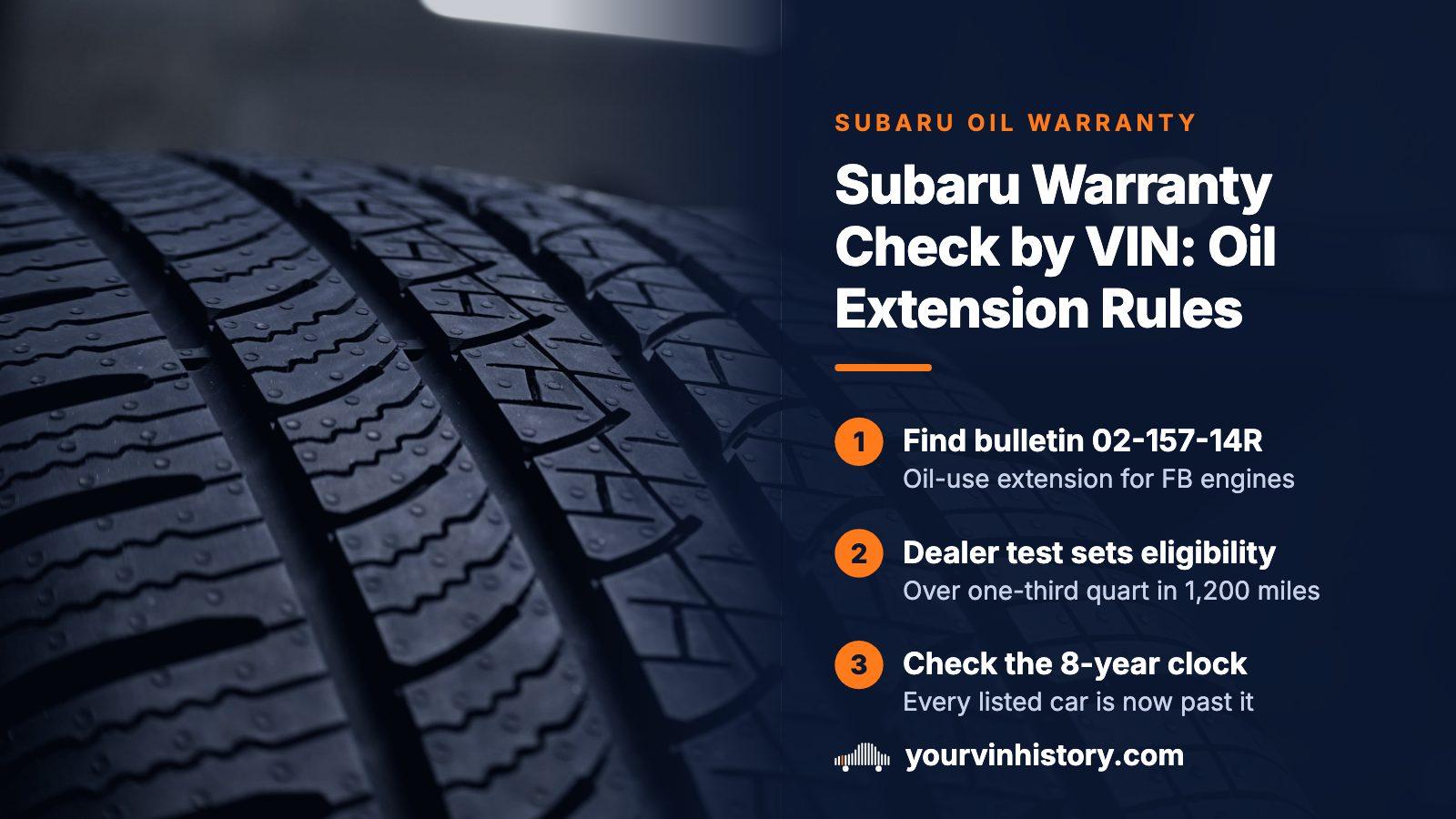
Subaru's bulletin 02-157-14R extends the powertrain warranty for excessive oil use to 8 years or 100,000 miles, counted from the date the car's warranty began. It names specific 2011–2015 models with FB engines, needs a dealer test showing more than one-third of a quart used in 1,200 miles, and takes only manual cars for the 2015 Forester and 2014–15 Impreza and XV Crosstrek. Every listed car is now past the 8-year mark.
- Term
- 8 years or 100,000 miles, counted from the car's warranty start date
- Trigger
- Above one-third of a quart (10.6 fluid ounces) over 1,200 miles
- Manual only
- 2015 Forester, 2014–2015 Impreza and XV Crosstrek
- Repair
- Engine short block replacement
A service bulletin that works as a warranty program
Subaru of America issued bulletin 02-157-14R in August 2014 under the subject line Engine Oil Consumption. Versions dated August 2018 and February 2021 followed, and NHTSA hosts a PDF of each. Most bulletins only instruct technicians. This one also announces a program: the original New Car Powertrain Limited Warranty is stretched for a single condition, excessive oil use, on a defined group of cars.
It carries two built-in limits. Oil use traced to any other cause stays outside the extension. And a bulletin is not a recall: it does not call the problem a safety defect, so NHTSA's recall lookup will not surface it. This is a manufacturer's own decision to lengthen a warranty, with its own conditions.
The five lines on the applicability list
Subaru's applicability block is short, and each word in it does work.
| Model | Model years | Engine | Transmission |
|---|---|---|---|
| Legacy and Outback | 2013–2014 | 2.5L FB | No limit stated |
| Forester | 2011–2014 | 2.5L FB | No limit stated |
| Forester | 2015 | 2.5L FB | Manual only |
| Impreza and XV Crosstrek | 2012–2013 | 2.0 FB | No limit stated |
| Impreza and XV Crosstrek | 2014–2015 | 2.0 FB | Manual only |
The manual-only qualifier is the part that gets lost. An automatic or CVT 2015 Forester shares its engine and model year with a listed car, yet it is not on the list; likewise automatic 2014 and 2015 Impreza and XV Crosstrek cars. The shorthand that every 2011–2015 Subaru got extra oil coverage is wrong twice: it pulls in other engines and adds automatics Subaru left out.
Production cutoffs: the model year is not the whole test
The bulletin also carries a production-change table. Subaru redesigned the piston rings during these years, and the table gives the VIN and engine number where the new rings entered production. Cars built before the cutoff follow the repair procedure. The bulletin says it applies only inside specific production ranges, so a later car falls outside even when model year and engine match.
Cutoffs vary by model, year and transmission, and in several rows automatic or CVT cars hit theirs sooner than manuals. A manual 2014 Forester has no VIN cutoff in the table, for instance, while an automatic one does. To use the table:
- Read the tenth VIN character (the model year letter) and the final six digits (the serial), then compare them with the cutoff for your model, year and transmission.
- Check the engine number as well, stamped on the block near the starter.
- When the figures sit close together, ask a retailer to run the lookup instead of guessing.
The eight-year clock and where it stands today
Subaru states the term as 8 years or 100,000 miles, measured from the car's original warranty start date and not from its model year. Terms written this way normally end at whichever limit arrives first.
An earlier phase no longer matters: for a stated window, every affected car was covered whatever its mileage or warranty start date, and that window closed years ago.
The newest model year on the list is 2015, so even a car sold late that year passed its eighth anniversary of warranty start some time ago, and low mileage cannot revive a term that time has ended. A seller promising that Subaru will still pay for an oil-burning engine is describing a lapsed program.
The measured rate that decides every claim
The bulletin turns on one measurement: consumption above one-third of a quart, which Subaru converts to 10.6 fluid ounces, over 1,200 miles. A dealer's test establishes it, not an owner's impression of the dipstick.
On the list is not the same as covered
A car can match the listed years, engine, transmission and VIN range and still get no repair if its measured use lands at or below the threshold. The list earns a car a test. The result settles the rest.
The test protects owners as much as Subaru, since technicians are warned that mistaking ordinary oil use for a defect leads to repairs nobody needed. A buyer can borrow the logic: a recorded number beats a seller's assurance.
How a dealer runs the consumption test
The bulletin sets the order of work: confirm the complaint, rule out outside causes, then measure.
- Review service history and note the oil level on arrival and any oil added beforehand.
- Look for external leaks and confirm the PCV system works, since either can mimic the problem.
- Change the oil and filter, unless a test is already under way or finished on that VIN.
- Send the owner off to drive until 1,200 miles pass, the low-oil lamp lights, or the level reaches the lower hole on the dipstick.
- Record the outcome on Subaru's test form and decide whether a repair is warranted.
Owners are advised not to top up meanwhile unless the wait will be long, and one documented result is enough. A copy of that form, or a repair order mentioning the test, is a buyer's best proof that a measurement was taken.
What the bulletin treats as ordinary oil use
Subaru says plainly that every engine uses some oil, depending on build tolerances, wear and driving. It names two cases where no test is needed:
- No low-oil lamp fitted, and the dipstick sits on or under the add mark 4,000 miles or more after the last oil change.
- A low-oil lamp that lit 5,000 miles or more after the last recorded change.
It also lists conditions where topping up between changes is expected: a new engine's first 1,000 miles, lower-grade or wrong-viscosity oil, engine braking, hard acceleration and high revs, towing and heavy loads, long idling, stop-and-go traffic and temperature extremes.
None of this makes oil use harmless on a used Subaru. A seller who shrugs and says they all do it is partly echoing the manufacturer, and a measured rate is how to settle it.
The repair: a new short block and a few side effects
When a test confirms excessive use on a car inside the production ranges, the bulletin's remedy is to swap in a new short block, the engine's bottom end. That is a far larger job than a gasket or a top-up. Three details help a buyer read an old repair order.
- Right after the swap, oil use can run above normal while the new piston rings seat; it generally improves within 1,000 miles.
- Every repair under the bulletin includes an engine computer update and a new oil level switch, aimed at the low-oil lamp lighting too early on models that have one.
- The same update and switch go in when a test ends with no engine repair, and the bulletin has its own claim line for that outcome.
A short block, reprogramming and new switch on one order fits work done under this program; a test-only order with the same update suggests the car was measured and needed no engine work.
Why only a Subaru retailer can read the coverage
The bulletin tells retailers to run a Vehicle Coverage Inquiry on Subarunet before anything else and to check the same VIN for open campaigns and recalls. Because the lookup works from the individual VIN, it can say yes to one Forester and no to the one parked beside it.
The bulletin treats it as a retailer tool and mentions no public version. With every listed car past the term, the answer today will mostly confirm the clock has run out, so ask instead what the system shows about earlier engine work on that VIN.
Checking a 2011–2015 Subaru before you pay
- Copy the VIN, all 17 characters, from the windshield base or the driver's door sticker and match it to the title.
- Decode it for model year, engine and transmission. Anything outside the five lines on the list ends the exercise.
- On a 2015 Forester or a 2014–2015 Impreza or XV Crosstrek, confirm the manual gearbox in person, then compare serial and engine number with the cutoff for that model, year and transmission.
- Ask for repair orders and any oil consumption test form, looking for a short block, the computer update and the oil level switch.
- Run NHTSA's recall lookup, which costs nothing. A bulletin like this one will not appear there.
- Pull the federal title record through an approved NMVTIS data provider to see brands and total losses.
On the lot, read the dipstick yourself, but leave the engine switched off for at least 5 minutes first; the bulletin says oil needs that long to drain back.
Pricing the risk when the coverage is gone
With the extension expired, a future short block is a bill for whoever owns the car then, unless a separate service contract says otherwise. That does not make these Subarus bad buys. It makes the evidence about this one engine part of the price.
- A documented short block replacement with the follow-up update and switch is firmer evidence than a seller's memory.
- No records and an admission that it uses a bit of oil call for measured numbers, or a price that allows for an engine job.
A history report covers what a warranty lookup cannot. A yourvinhistory report, which opens with a free preview, lists title brands, odometer readings, accident and salvage records and open recalls for the VIN. It does not list Subaru's warranty claim files, so use it alongside the repair orders, not in place of them.
Where this information comes from
- NHTSA: Subaru Service Bulletin 02-157-14R (revised February 2021) — Source for the model list, production cutoffs, test steps, repair and the 8-year, 100,000-mile term, as printed by Subaru.
- NHTSA: Subaru Service Bulletin 02-157-14R (revised August 2018) — An earlier revision with the same term and model list, handy for comparing versions.
- NHTSA: Recalls lookup — Searches open safety recalls by VIN, a separate matter from this warranty program.
- BJA: NMVTIS approved data providers — Where to find the federal title record, which shows brands and total losses that a coverage lookup does not.
Sources and photos: Facts checked against the sources above in October 2026. Photo by Yvette S on Unsplash; diagrams by YourVINHistory.
Keep reading
- VIN warranty checkHow the in-service date works and which part of a warranty moves to the next owner.
- SubaruPin down the engine family and model year before testing a car against the list.
- TSB vs recallWhy a bulletin like this one never shows up in a recall search.
- Subaru recallsThe safety recalls worth checking alongside the engine question.
Frequently asked questions
Does the Subaru oil consumption warranty extension still apply?
Not on time. The term is 8 years or 100,000 miles counted from the warranty start date, and the newest model year listed is 2015, so the time limit has expired on every listed car. What survives is the paper trail: any test form or repair order from the years when the program was live.
Is the Subaru oil consumption program a recall?
No. It is a service bulletin that extends a warranty, and Subaru does not call the problem a safety defect, which is why NHTSA's recall lookup will not show it. Check that tool separately for open safety recalls on the same VIN.
How can I tell whether a 2015 Forester is a manual?
Look for the clutch pedal, which settles it in seconds. A VIN decode may also report the transmission, though results vary by decoder, so confirm on the car. Only the manual 2015 Forester is on the list, and the same limit applies to the 2014 and 2015 Impreza and XV Crosstrek.
Does the low oil warning lamp prove a Subaru burns oil?
No. The bulletin acknowledges the lamp could light too early, which is why its repairs include a computer update and a new oil level switch. A lamp that comes on with the oil full or nearly full tells you little. A measured rate over 1,200 miles is what the program relied on.
Can I trust a seller who says the engine was replaced under warranty?
Ask for the repair order. It should show a short block, the computer update and the oil level switch, plus the dealer that did the work. A replaced engine bottom end says nothing about the title, so check the NMVTIS record for brands and total losses before accepting the story.
Now check the car itself
The guide explains what to look for. The report shows what this VIN has on record.