THE SHORT ANSWER
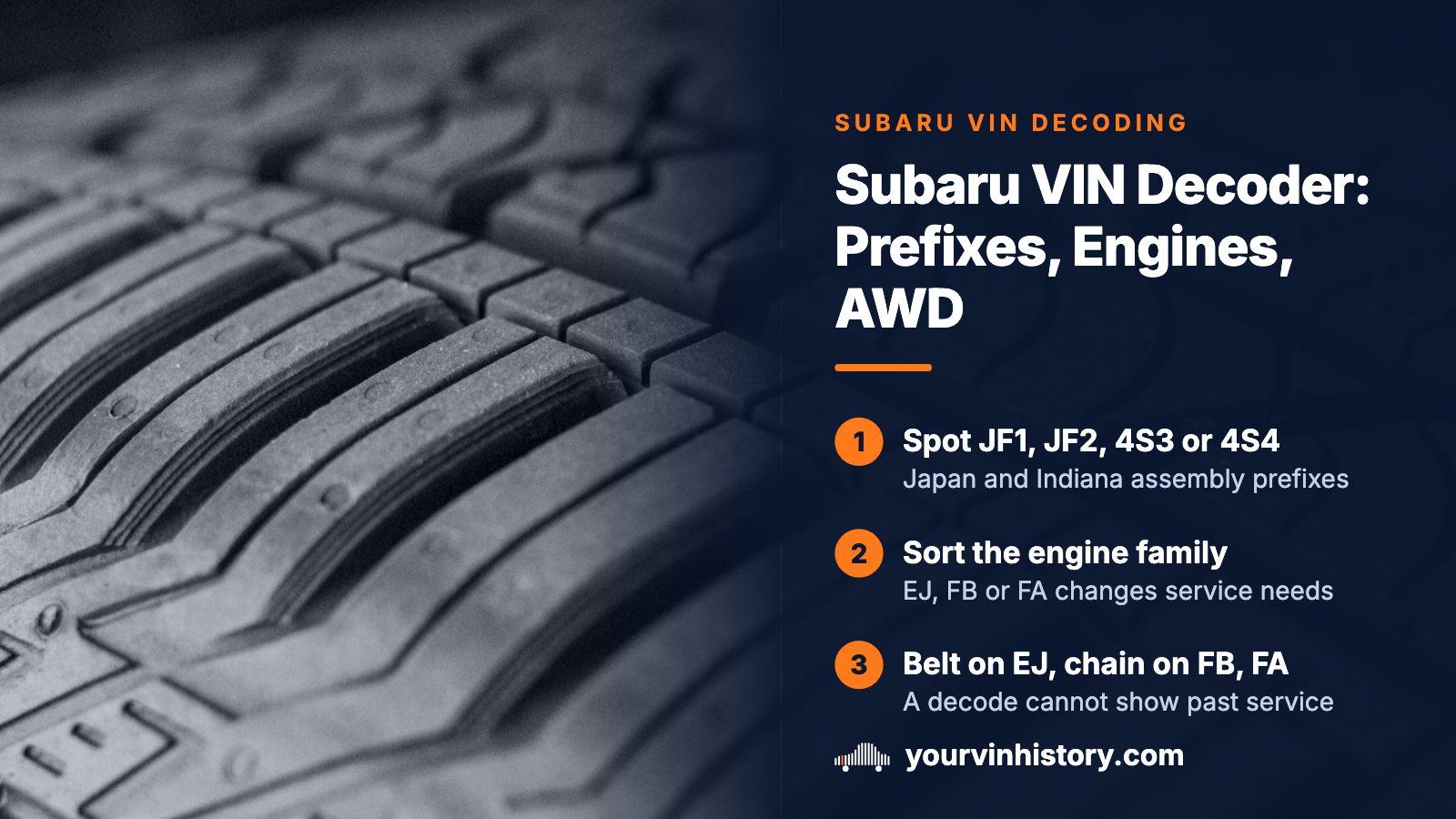
Read a Subaru VIN in blocks. Characters one to three give the maker and the country of assembly, four to eight describe the model and engine, nine is a check digit, ten is the model year, eleven is the plant, and the last six are the serial. A free NHTSA decode returns engine, drivetrain, transmission type and plant. It cannot say whether head gaskets, a timing belt or CVT fluid were ever serviced.
- Prefixes
- JF1 and JF2 (Japan), 4S3 and 4S4 (Indiana)
- Engine families
- EJ, FB and FA, each with its own service profile
- Timing drive
- Belt on EJ engines, chain on FB and FA
- Free decoder
- NHTSA vPIC, no account needed
Reading the seventeen characters on a Subaru
Every Subaru sold new in the U.S. carries a 17-character VIN, and each stretch of it has a fixed job. Positions one to three are the manufacturer code. Four through eight describe the car: model, body style, engine and the restraint system fitted at the factory. Nine is a check digit that exposes mistyped or invented numbers. Ten gives the model year, eleven the assembly plant, and twelve through seventeen the sequence number.
Look where the windshield meets the dash on the driver's side, then compare that number with the sticker on the driver's door frame and with the title. A mismatch is a reason to stop and ask questions before you talk price.
JF1, JF2, 4S3 and 4S4: the Subaru prefixes
Subaru uses four manufacturer codes on U.S.-market cars. Which one you see depends on where the car was assembled and on whether it counts as a passenger car or a multipurpose vehicle.
| Prefix | Class of vehicle | Country and plant |
|---|---|---|
| JF1 | Passenger car | Assembled in Japan |
| JF2 | Multipurpose passenger vehicle, SUV models included | Assembled in Japan |
| 4S3 | Passenger car | Subaru's Indiana plant in the United States |
| 4S4 | Multipurpose vehicle | Subaru's Indiana plant in the United States |
A U.S. prefix is nothing to worry about. Subaru has built cars in Indiana for decades, and a number of its best-selling models for this market come out of that plant. Spend your attention on the engine and the service history instead.
What a free decode returns, and what it leaves out
NHTSA runs a public decoder called vPIC. It works from patterns that manufacturers submit to the agency, so Subaru's own filing is the source, and no account is needed. For a typical Subaru the result lists:
- Model year, model and body class
- Engine size, cylinder layout and whether it is turbocharged
- Drive type, which is all-wheel drive on most Subarus but not on every one
- Transmission type
- Restraint equipment fitted at the factory
- Plant and country of assembly
The decode describes the car as it was built. It cannot see an engine swap, a respray or a repair, and NHTSA says a vehicle never meant for sale in the U.S. returns only a limited result.
Why the flat engine changes what service costs
Subaru builds horizontally opposed engines, usually called boxers, with the cylinders lying flat on either side of the crankshaft. The low, wide shape keeps the center of gravity down, which is a large part of why the cars feel planted in corners. The trade-off lands on whoever pays for repairs: parts that sit on top of an upright engine sit down the sides of a boxer, tight against the inner fenders. Spark plugs are the standard example, and the shop bills for the extra hours.
- Expect more labor time on routine engine work than on a comparable inline car
- A head gasket repair is larger because the engine has two cylinder heads
- Oil leaks show up low on the sides and are easy to blame on the wrong part
- A shop that knows the layout works faster and charges less
- Awkward access tempts owners to put service off, so look for proof it was done
EJ, FB and FA: sorting out the engine family
On a used Subaru the engine family says more than the displacement does, because the families differ in how the cams are driven, how fuel gets in and what tends to need attention. Displacement, turbo status and model year from the decode usually point to the family.
| Family | Timing drive | What a used buyer should know |
|---|---|---|
| EJ | Belt | The older, long-serving family, which also covers the turbo engines in the sportier trims. The belt is a scheduled replacement item, not a lifetime part. |
| FB | Chain | The later naturally aspirated family. A chain removes the belt interval from the budget. |
| FA | Chain | The later turbocharged, direct-injection family. Direct injection adds upkeep around intake deposits. |
Belt-driven engine, unknown belt history
Ask when the belt was last replaced. If the seller cannot say, treat the job as due now and take its cost off your offer. On an interference design, a belt that lets go can destroy the engine, so this is not an item to postpone.
Head gaskets: what the VIN can settle and what it cannot
Search for used Subaru advice and head gaskets turn up almost at once. The worry has a real basis: owners reported failures widely on some older, non-turbo engines, and the reputation stuck to the brand. It belongs to particular engine generations, though, not to every Subaru, and later engine families addressed it. The VIN helps in one way only: it pins down the engine family and year. Whether this particular car had the repair is a records question.
- Decode the VIN and set the engine family and model year against the generations where the problem was reported.
- Ask whether the gaskets were replaced, and ask to see the invoice. On an affected generation, that paper outweighs anything the seller says.
- During the inspection, watch for overheating when the engine works hard, oil and coolant that have mixed, coolant that vanishes without a puddle, or a sweet smell.
- Check the coolant's level and condition. Dirty fluid, or a system that has needed repeated top-ups, points to trouble.
- With no paperwork on an affected generation, pay for a compression or leak-down test before you commit.
A documented repair can work in your favor
A car with an invoice showing the gaskets were replaced, ideally with updated parts and related work done at the same visit, may be a safer purchase than a similar car where the question is still open.
All-wheel drive almost everywhere, plus one coupe that breaks the pattern
Nearly the whole lineup sends power to all four wheels through a symmetrical layout, with the drivetrain running along the car's centerline. The exception buyers meet most often is the rear-wheel-drive sports coupe that Subaru developed with Toyota. The badge says Subaru, but the drivetrain is not the one the brand is known for. The decode returns the drive type, so read it instead of assuming.
Match all four tires
All-wheel-drive systems react badly to tires of different rolling diameter. Two new tires beside two worn ones can strain the driveline. On a used car, confirm that all four match in make, model and wear. A mismatch points to neglect or to a repair bill on the way.
CVT or manual: what to ask before the test drive
Most current Subarus come with a continuously variable transmission, while a smaller share, mostly the performance models, have a conventional manual. A decode generally reports which one the car was built with. CVT fluid is a service item with a set schedule, and skipping it is the kind of neglect that tends to end in a large repair bill, so the fluid invoice is among the most useful papers a seller can hand you.
- Ask when the fluid was last changed and request the receipt
- On the drive, watch for shudder or hesitation under gentle throttle
- Ask whether the transmission was ever replaced or rebuilt
- Check what powertrain warranty remains, since coverage was extended on some model years
- On a manual, note where the clutch engages and any judder when pulling away
WRX and STI: modified cars that thieves like
The turbocharged performance models sell into a different market than the rest of the range. They tend to be modified, driven hard and stolen often enough that a theft lookup is worth running on any private sale. NICB's VINCheck is one free option.
- Ask what was changed and request paperwork for each part
- Engine tuning is common, so ask who did it and whether the original map was kept
- Look for signs of track use, such as uneven brake wear, harness bar holes or cage mounts
- Ask about any turbocharger replacement
- Check how the changes affect insurance and your state's emissions rules
Recalls attach to the VIN, so search by VIN
Recall campaigns cover specific ranges of VINs, not whole model names, and a search by model can show campaigns that do not apply to your car. NHTSA's lookup takes the 17 characters and answers for that one vehicle.
Federal law requires the maker to repair a recalled vehicle without charge, but only inside an age cutoff: the rule does not reach a vehicle first sold more than 15 calendar years before the recall notice. A newer used Subaru will usually be inside that window; an old one may not, so ask the manufacturer before you count on a no-cost repair.
A short checklist for a used Subaru
- Decode the VIN before you drive anywhere, and note engine family, drivetrain, transmission and model year.
- On an affected generation, ask for the head gasket invoice.
- On a belt-driven engine, ask for the timing belt record. No answer means pricing the job into your offer.
- On an automatic, ask for the CVT fluid receipt.
- Check that all four tires match.
- Run the NHTSA recall lookup, plus a theft lookup if the car is a performance model.
The decode covers what the factory built. What happened afterward, such as title brands, accident damage, odometer readings and salvage or auction records, sits in a vehicle history report, and a yourvinhistory report starts from the same VIN.
Where this information comes from
- NHTSA: vPIC VIN decoder — The federal decoder built on the VIN patterns manufacturers submit, and the source for the list of fields a Subaru decode returns.
- NHTSA: Recalls — Where to look up open safety recalls by VIN, which is the right way to match a campaign to one specific car.
- U.S. Department of Energy and EPA: Fuel Economy — Official mileage figures that let you compare one Subaru model across engine and drivetrain setups.
Sources and photos: Facts checked against the sources above in October 2026. Photo by fr0ggy5 on Unsplash; diagrams by YourVINHistory.
Keep reading
- Subaru recallsSubaru campaigns in detail, and which ones to look for on your VIN.
- Subaru warranty by VINHow the extended coverage mentioned for some model years is checked and whether it passes to you.
- Timing belt or chain by VINGoes further on belt versus chain, since knowing which one is fitted is only part of the answer.
- Transmission fluid by VINThe next question once you know the car has a CVT: what fluid it takes and who sets the spec.
Frequently asked questions
Is there a free way to decode a Subaru VIN?
Yes. Type the 17 characters into NHTSA's vPIC decoder. Subaru submits its VIN patterns to the agency, so the result comes straight from the maker's filing and needs no account. Copy the number from the car itself rather than from a listing.
Does the VIN reveal head gasket trouble on a Subaru?
No, it only identifies the engine family and year, which shows whether the car belongs to a generation where failures were reported. Whether this car was repaired depends on paperwork. Ask for the invoice, note which parts were used, and book a compression or leak-down test if the seller has nothing in writing.
Do all Subarus come with all-wheel drive?
Nearly all do, since the symmetrical layout is central to the brand, but the rear-wheel-drive coupe built with Toyota is a clear exception. The drivetrain appears in a decode, so confirm it before you assume. On an all-wheel-drive car, also check that the four tires match, since mixed wear can strain the system.
Can I tell a CVT from a manual using the VIN?
Usually. Transmission type sits in the descriptor section, and a decode generally reports it, but confirm in person too. On a CVT car, the fluid service record is the paper to request. On a manual, test the clutch for a high or vague engagement point and for judder pulling away.
How do I check a Subaru for open recalls?
Use NHTSA's recall page and enter the full VIN, because a model-name search can list campaigns that never applied to your car. Repairs are done at no charge inside the federal age cutoff, which excludes vehicles first sold more than 15 calendar years before the notice.
Now check the car itself
The guide explains what to look for. The report shows what this VIN has on record.