THE SHORT ANSWER
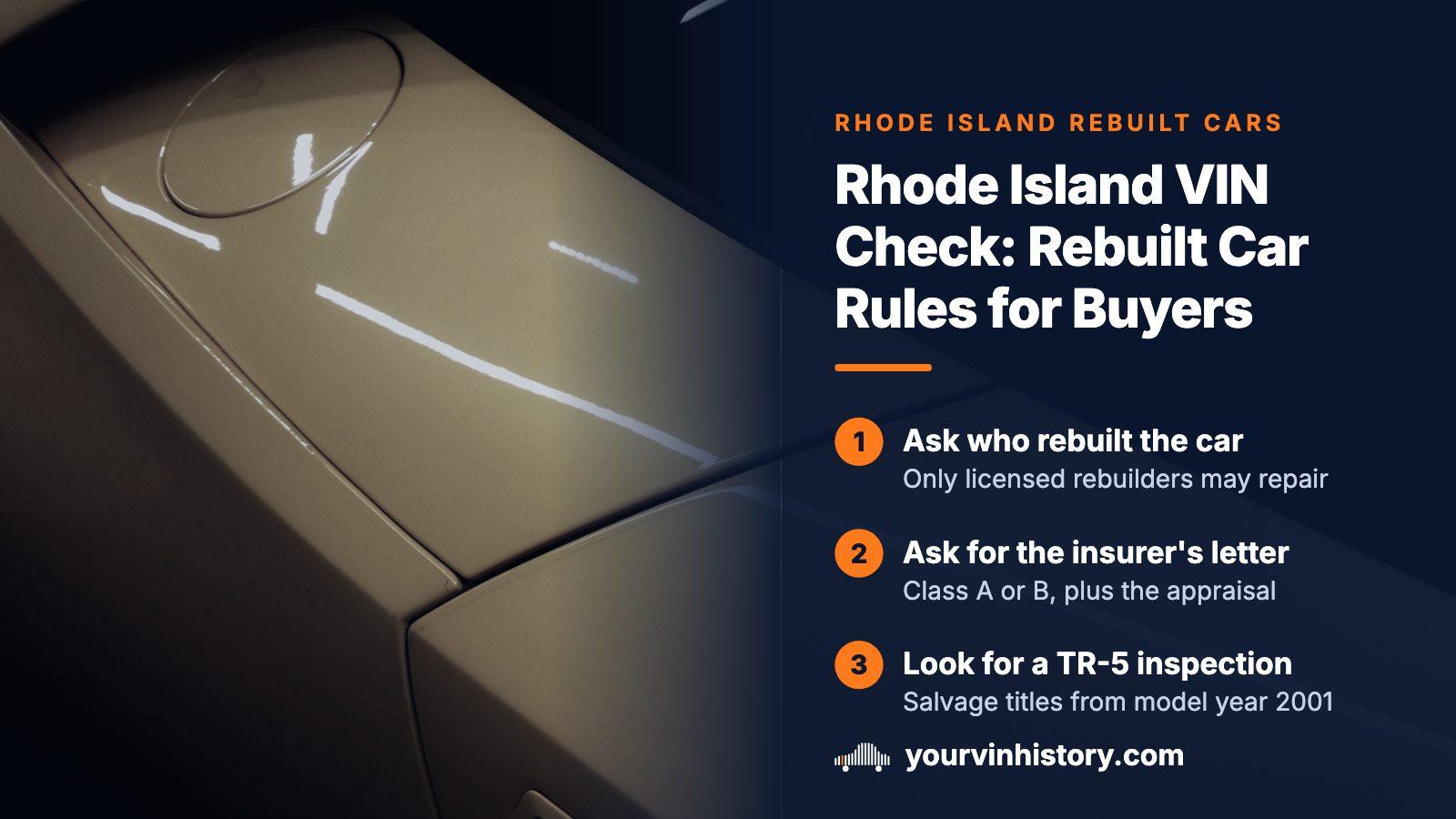
In Rhode Island, only a licensed salvage rebuilder may repair a salvage vehicle, so an owner cannot lawfully rebuild one personally. To check a car, decode the VIN, ask the seller to name the rebuilder, request the insurer's Class A or Class B letter and damage appraisal, confirm a 2001-or-newer salvage title carries a TR-5 VIN inspection, and pull the national NMVTIS title record.
- Who may repair
- A licensed Rhode Island salvage rebuilder
- Class A
- Parts only, per the insurer
- Class B
- Repairable, per the insurer
- VIN inspection
- Salvage titles, model year 2001 and newer, form TR-5
A license on the repairer, not just a stamp on the car
In many states the road from wreck to rebuilt title is simple: buy a damaged car cheaply, fix it in a garage or driveway, pass an inspection, and register it. Rhode Island closes that road at the first step. Anyone repairing a salvage vehicle here has to be a licensed Rhode Island salvage rebuilder, which rules out the owner-rebuilt project altogether.
That changes what a buyer should ask. Passing an inspection tells you about one afternoon; a rebuilder's license tells you the work went through a business the state knows by name. The license belongs to the repairer, though, and nothing about it is stamped onto the car. The proof has to come from paperwork and from the seller's willingness to name the shop.
How the state words its definition of a salvage vehicle
The state's definition is worth reading slowly. In the state's terms, a salvage vehicle is one its insurer wrote off as a total loss and that now sits with a Rhode Island salvage rebuilder for repair. The repair route is built into the term itself, not added as a separate rule afterward.
That wording explains why the rebuilder keeps turning up in the paperwork. If a seller calls a car a rebuilt salvage vehicle, the definition itself says a licensed rebuilder belongs somewhere in the story. When the story has no such business in it, the seller is describing a car that sits awkwardly with how the state frames the whole subject.
Safe repairs and stolen parts: the two reasons for licensing
The Department of Business Regulation, which licenses rebuilders, points to two aims. One is that cars put back together for retail buyers are repaired in a safe way. The other is to keep stolen vehicles and stolen parts out of the rebuilding trade.
Those are different problems. Poor workmanship hurts the next driver. Stolen parts hurt whoever owned the car they came from, and they taint the car you are about to buy. An inspector can catch a mismatched component on a given day. A business that stays under a state license has more to lose from sloppy sourcing than a one-off project does, which is the logic behind regulating the trade rather than only the finished car.
Class A and Class B on the insurer's letter
When an owner keeps a car the insurer has declared a total loss, Rhode Island expects the insurer's letter to cover three points: the car was written off, the owner is keeping it, and one of the two classes applies. The insurer makes that call, not the owner.
| On the letter | Meaning | What it means when you shop |
|---|---|---|
| Class A | Parts only | Not meant to return to the road as a whole car. Question any listing that offers it as one. |
| Class B | Repairable | Can come back through a licensed salvage rebuilder, so expect that business to appear in the history. |
| Total loss, owner retaining | The owner kept the wreck instead of handing it over | The letter should still state the class. |
| No letter available | No class on record that you can see | Ask for it before you talk price. |
Class B is the label to understand best, because it is the one attached to cars you might actually be offered after repair.
The damage appraisal shows what the class label leaves out
Alongside the classification letter, the state expects the insurer's written estimate or appraisal of the damage. The two documents answer different questions. The letter delivers a verdict: parts only or repairable. The appraisal is the evidence behind it, listing what was actually wrong with the car.
Treat the appraisal as the most useful page in the folder. Read it against the car in front of you. If the estimate lists structural or front-end damage, ask to see the rebuilder's invoices for those areas, then have a mechanic look at them on a lift. A seller who holds only the verdict is offering a summary with nothing behind it, and the price should reflect that.
The model year 2001 line and form TR-5
For salvage titles on vehicles of model year 2001 or newer, Rhode Island requires a salvage VIN inspection, logged on form TR-5. Vehicles older than that sit outside the rule.
To learn which side of the line a car sits on, decode the VIN first; the tenth character stands for the model year. A car from the 1990s will have no TR-5 inspection, and that says nothing bad about it. It means one verification step you might have assumed was done never applied, so your own inspection carries more of the load. For a 2001 or newer car with a salvage history, ask whether the inspection took place and when.
Confirm the current rule
Forms, thresholds and licensing details get revised. Before you buy or sell a car with a salvage history, check the present requirements with the Rhode Island DMV, which publishes the salvage inspection rules.
Questions that make a seller name the rebuilder
A lawful rebuild leaves a trail, so ask for it. These questions have specific answers, and a seller who knows the car will not hesitate.
- Which licensed Rhode Island salvage rebuilder did the repairs, and what is the business name?
- Can I see the insurer's letter showing Class A or Class B?
- Do you have the insurer's damage estimate or appraisal?
- If the car is model year 2001 or newer, did a salvage VIN inspection get logged on form TR-5?
- Do the repair invoices show where the replacement parts came from?
- Where was the car registered and repaired before it reached you?
A pause is not proof of wrongdoing, since plenty of sellers inherited a car and never saw its file. Still, vague answers mean you would be buying on trust. Lower your offer or walk away.
A small state with busy borders
Rhode Island is small and sits between Massachusetts and Connecticut, so plenty of cars on its roads have lived, been insured or been repaired next door. The licensing rule covers rebuilding done in Rhode Island. A car repaired across the line carries whatever rules applied where the work took place, and Rhode Island's approach should not be assumed there.
Treat out-of-state history as likely until a record says otherwise. A brand applied in another state can sit on the national title record even when nothing local shows it, which is why that record belongs in every check here. Compare the states and dates on it with what the seller says about where the car has been.
Two no-cost lookups and the national title record
Two no-cost lookups come first, and both work the same in any state. NHTSA's recall lookup takes the VIN and shows whether manufacturer safety recalls are still open on that exact car.
NICB's VINCheck is a no-cost search that screens a VIN against theft and salvage records. It has gaps, so a clean result narrows your doubt without ending it.
The third step is the national title record under NMVTIS, which gathers the brands that reporting states have recorded. Because it follows the VIN across state lines, it is the check that can expose history from Massachusetts, Connecticut or farther away.
A buying sequence for a rebuilt Rhode Island car
Order matters, because the early steps are cheap and the late ones involve money. Work through them in this sequence.
- Decode the VIN and note the model year, since that decides whether a TR-5 inspection should exist.
- Run the NHTSA recall lookup and the NICB VINCheck.
- Ask the seller for the rebuilder's name, then ask the Department of Business Regulation whether that business holds a license.
- Collect the insurer's classification letter and the damage appraisal.
- Pull the national title record and compare its states and brands with the seller's account.
- Pay a mechanic with no stake in the sale to inspect the car before any money moves.
Where a paid history report fits
A history report answers the question of where the car has been. A yourvinhistory report lists title brands, accident records with a damage map, salvage and auction records with photos, odometer readings and open recalls, and its title records come from ClearVin LLC, an approved NMVTIS data provider. The preview is free and shows whether records exist for a VIN before you decide to buy.
Do not expect a title record to name the rebuilder or vouch for a license. That answer sits in the seller's folder and with the state, which is why the questions above still matter when a report comes back showing a brand.
Where this information comes from
- Rhode Island DMV: Salvage inspections — The state's own wording on what a salvage vehicle is, who may repair one, and which model years need the VIN inspection.
- Rhode Island DBR: Auto salvage rebuilder licensing — Where the rebuilder license comes from and the safety and stolen-parts aims behind it.
- NHTSA: Recalls — The federal lookup for open manufacturer recalls on a specific VIN, separate from any state process.
- Bureau of Justice Assistance: NMVTIS — The national title information system that gathers brands from reporting states, useful when a car has crossed borders.
Sources and photos: Facts checked against the sources above in October 2026. Photo by Franck V. on Unsplash; diagrams by YourVINHistory.
Keep reading
- Connecticut VIN checkThe neighboring state, where rebuilding rules work differently.
- MassachusettsThe other neighbor, and a likely place for a Rhode Island car to have lived.
- Buying a rebuilt title carHow to judge whether a rebuilt car's discount is real value.
- Salvage title VIN checkA short sequence for catching a brand that moved across state lines.
Frequently asked questions
Can an owner rebuild their own salvage car in Rhode Island?
Not lawfully. The state ties repairs on a salvage vehicle to a licensed Rhode Island salvage rebuilder, so there is no owner-rebuilt route to a road-legal title. If you own a written-off car and want it back on the road, speak with the DMV and a licensed rebuilder before you buy parts or start any work.
What is the difference between Class A and Class B?
They are the insurer's own sorting of a written-off car: Class A is parts only, while Class B is repairable. The insurer chooses, and its letter should name the class. If a seller says a car was Class A and is now on the road, ask for documents, because that combination would need explaining.
Does a Rhode Island salvage title need a VIN inspection?
For model year 2001 and newer, yes: the inspection gets logged on form TR-5. Older vehicles are not covered by that rule. Use the tenth VIN character to confirm the model year, and if the car is older, put more weight on a hands-on inspection by an independent mechanic.
How do I confirm a rebuilder is licensed in Rhode Island?
Start with the business name on the seller's repair paperwork. The Department of Business Regulation handles auto salvage rebuilder licensing, so ask it whether that business holds a license. The license belongs to the business, not the car, so do not expect a VIN decode to show it. A seller who cannot supply a name has told you something.
How do I vet a used car sold in Rhode Island?
Start by decoding the VIN, then use the NHTSA recall lookup and the NICB VINCheck, and finish with a national NMVTIS title record. Many Rhode Island cars spent time next door in Massachusetts or Connecticut, which is why a record covering several states tells you more than a local search could. Book a mechanic's inspection before you pay.
Now check the car itself
The guide explains what to look for. The report shows what this VIN has on record.