THE SHORT ANSWER
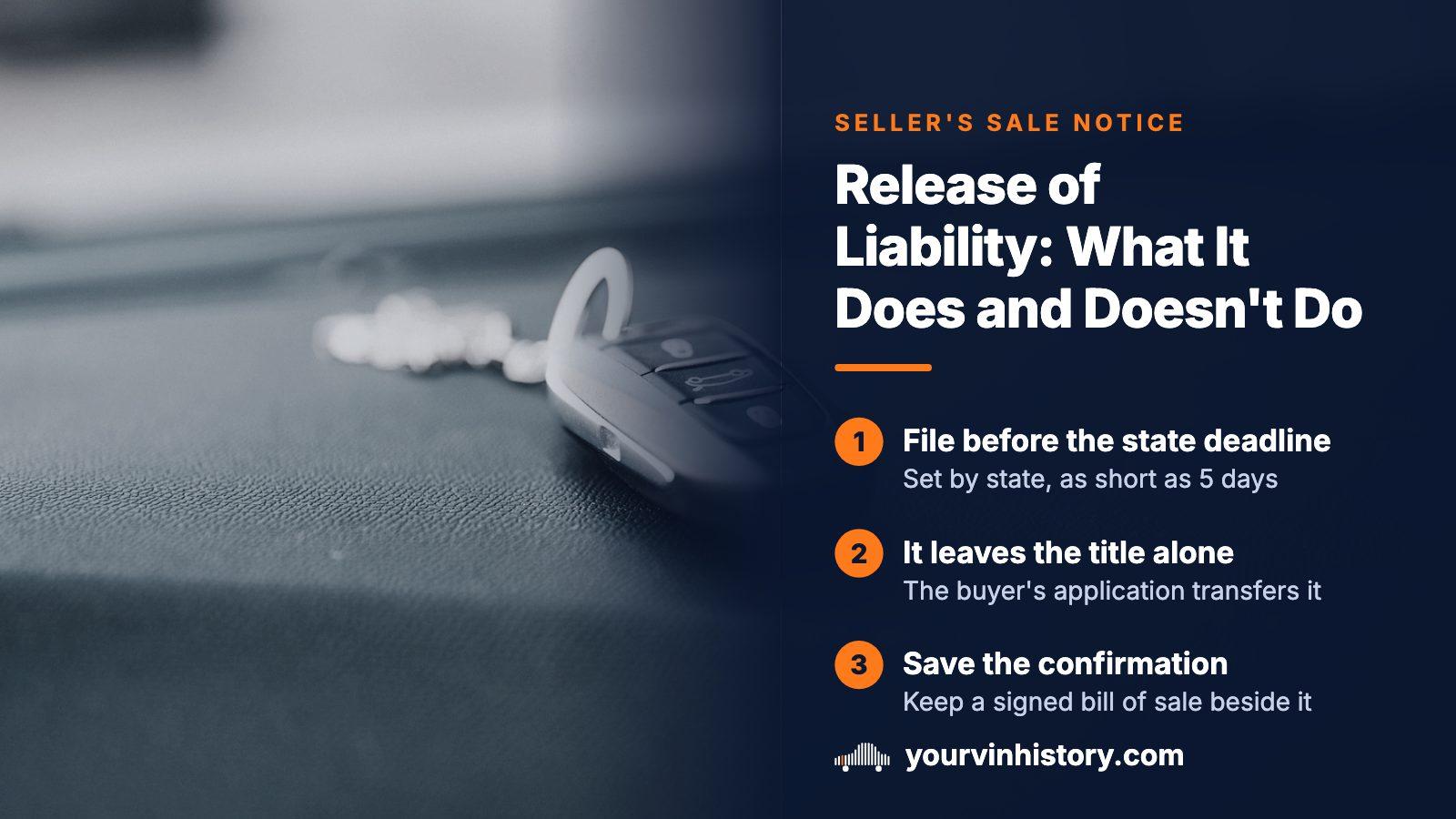
A release of liability tells your state that a car was sold, to whom, and on what date. It does not transfer ownership, because only the buyer's title application does that. The deadline is as short as 5 days or as long as 30, and New York has no seller filing at all. File promptly, save the confirmation, and keep a signed bill of sale beside it.
- Deadline range
- 5 to 30 days, set by the state
- Effect on the title
- None until the buyer applies
- Strongest wording
- Texas, where proof of filing is a complete defense
- No filing at all
- New York, where the plates come off instead
The same filing goes by a different name in each state
No national form exists, so the label depends on where the car is registered. Search for the wrong phrase in the wrong state and you may decide your state asks for nothing.
| Official name | State |
|---|---|
| Notice of Transfer and Release of Liability | California |
| Report of Sale | Washington |
| Vehicle Transfer Notification | Texas |
| Notice of Sale (form HSMV 82050) | Florida |
| No seller filing exists | New York |
The labels mislead in both directions. Texas has the mildest name and the strongest statutory language for sellers, while California's name sounds like a clean break and delivers something more conditional. These five states are a sample, so yours may differ.
It records the sale and leaves the title where it was
Many sellers assume the filing finishes their side of the job. It does not. The state treats it as a statement that a sale took place, and the title moves only when the buyer applies.
The Texas statute bars the department from issuing a title or registering the vehicle before the purchaser applies to the county assessor-collector. Florida's clerk manual agrees from the counter: once the notice is processed the database shows the car as sold, yet the seller stays listed until a title application arrives. You end up with a dated entry and nothing more. If the buyer never visits the DMV, your name can stay on the record for years.
Deadlines run from five days to thirty, and the count matters
Every state sets its own clock and none advertises the others. A thirty-day habit from Texas makes you late in California by the following Wednesday after a Friday sale.
| State | Deadline |
|---|---|
| California | 5 calendar days |
| Washington | 5 business days |
| Texas | 30 days |
| Florida | 30 days |
| New York | No filing required |
Washington counts business days from the sale, gift, trade or donation, and it cares about arrival. A report counts only once the department holds it, with proof of receipt, by the fifth business day and with the fee paid. A form mailed on day four and delivered on day six is late. The agency's seller page says five days, so plan around the shorter reading.
Washington charges a fee
The Department of Licensing publishes the fee as $18, and payment is required before a report is accepted. An envelope with no payment inside is not a filing. The other three filing states covered here charge nothing.
Texas treats proof of filing as a complete defense
Texas goes furthest of the five. A seller who files the transfer notice carries no vicarious civil or criminal liability for what a later driver does with the car, and the statute calls proof of the filing a complete defense to claims about later use or abandonment. The evidence it accepts is a copy of the filed form, so file online and save the confirmation. The form asks for these details.
- A description of the vehicle
- Your own name and address
- The buyer's name, address and phone number
- The date possession changed hands
- Your signature and the date you signed
One condition is easy to miss. The presumption that the named buyer is the owner applies only if the notice reaches the department within 30 days and includes the buyer's phone number. Ask for it at the curb.
California offers more than one route to protection
California Vehicle Code section 5602 shields a seller who made a genuine sale and delivered the car from liability for parking, abandonment and operation afterward, provided one of several steps was taken.
- Sign the certificate of ownership over correctly and deliver it to the buyer
- Mail the department the transfer notice under section 4456(b), 5900 or 5901
- Send the paperwork and fees that register the car to the new owner
The notice most sellers worry about is one choice among several, and a properly signed title can satisfy the section alone. The DMV says the notice shifts tickets and civil lawsuits after the sale date to the buyer, and that an electronic submission updates the record within 1 business day. If a lawsuit or complaint follows, the court rules on whether you complied. The filing is evidence, not a switch.
On towing bills, Washington's website and statute part ways
The agency's seller page presents the report of sale as protection from towing charges and from liability for the new owner's actions. That is why most people file it.
The statute is more careful. A report of sale alone does not prove a completed transfer when the state recovers towing, storage and auction costs on an abandoned vehicle and nothing shows the buyer accepted the car. What does establish responsibility is a receipt, a purchase or wholesale order, a contract both parties signed, the title itself, or other proof of acceptance.
Why a signed bill of sale matters
Every item on the statute's list involves the buyer. A report of sale is the one document a seller can produce alone, which is exactly why it cannot carry a towing bill by itself. Get the buyer's signature on a bill of sale before the car leaves.
Florida: requirement met, name still listed
Florida's statute asks an owner who sold or transferred a vehicle to notify the department within 30 days on the prescribed form, and notice given that way satisfies the requirement for limiting liability. That is a good reason to file.
The TL-52 procedure also tells clerks that the department keeps no copy of form HSMV 82050, so yours may be the only one. Satisfying a rule and clearing your name are different outcomes. Two situations need no notice: a trade-in or sale to a licensed dealer, and a vehicle an insurance company takes over under a policy.
When a dealer is on the other side of the sale
Plenty of cars leave through a dealership, and that changes who sends the notice.
| State | What happens with a dealer |
|---|---|
| California | The dealer reports electronically within five calendar days, starting the day after the sale |
| Texas | The dealer submits the notice when you sell to one |
| Florida | After a trade-in, the dealer has 30 days to file |
| Washington | The dealer may file for you but is not required to, and collects the fee from you if it does |
Ask the dealership in writing whether it will file, and keep the reply. A Washington dealer can decline, which leaves the duty and the running clock with you.
The copy you keep is worth more than the filing
Disputes over a sold car rarely show up early. They arrive when a toll authority, parking office or tow yard traces a plate to a record that still names you. By then your paperwork is the evidence.
- File online where the state allows it, so you get a timestamped confirmation and no argument about postmarks.
- Save the confirmation as a PDF or screenshot, stored with your tax records. An open browser tab will not survive.
- Keep a signed bill of sale, which shows the buyer took part.
- Photograph the odometer and the endorsed title before the buyer drives off.
- Write down the buyer's name, address and phone number while they are standing there.
If you sold the car and never filed
In some states the picture is brighter than expected. Texas says plainly that not reporting a transfer does not by itself create liability for the former owner; you lose only the complete defense. In California, a correctly endorsed and delivered title satisfies section 5602 without the notice.
- File late anyway if the state accepts it, since a dated record beats none
- Find anything the buyer signed and treat it as your main evidence
- See whether the buyer ever put the title in their own name, and when
- Find out whether the plates were ever surrendered
- Write down the sale date and buyer's details now
The third step changes the most. If the record names the buyer, your exposure has largely closed. If it lists you even years afterward, the sale never finished on paper, the pattern behind title jumping.
Plates, registration and insurance are separate jobs
Under New York Vehicle and Traffic Law section 420, a registration expires when ownership transfers and the seller must remove the number plates. Nothing is filed, because the plate that identifies the car to a parking officer or toll camera leaves with you. Other states let plates stay with the vehicle, so check what yours expects.
Keep the insurance active until the plates and registration are dealt with. Some states treat a lapse on a still-registered vehicle as a violation of its own, so canceling the policy first can bring a suspension notice.
The same event seen from the buyer's side
A seller's notice also starts a clock for the buyer. In Texas, once a proper notice is on record, the named buyer is presumed to be the owner and answerable for later use of the car, though the presumption can be rebutted. Washington expects a buyer to apply for a new title within 15 days of delivery, and waiting past 45 days is a misdemeanor, counted again for each day.
Before paying, confirm that the seller matches the name on the record and that no lien sits behind them. A vehicle history report on the VIN lists title events by date and state, so a car sold in March whose title moved the next February stands out as a gap. It will not show the seller's notice, which lives in one state's own file. The yourvinhistory.com preview is free; the full report is paid.
Where this information comes from
- California Vehicle Code 5602 — Lists the steps that shield a seller after a genuine sale, including a signed and delivered title.
- California DMV: Notice of Transfer and Release of Liability — The agency's own account of the deadline, the one-business-day electronic update and the court's role.
- RCW 46.12.650: Report of sale — Source for the business-day count, the receipt test, the towing limit, optional dealer filing and buyer deadlines.
- FLHSMV Procedure TL-52: Mark Title Sold — Clerk instructions covering Florida's 30-day notice, the dealer and insurer exceptions and why the seller stays listed.
- Texas Transportation Code, chapter 501 — Where the transfer notification, the complete defense and the equitable-title rule are written.
- New York Vehicle and Traffic Law 420 — Explains why New York sellers remove plates instead of filing a notice.
Sources and photos: Facts checked against the sources above in October 2026. Photo by Bence Balla-Schottner on Unsplash; diagrams by YourVINHistory.
Keep reading
- Bill of sale for a carThe two-sided paper that backs up your filing, especially in a towing dispute.
- Title jumpingWhat it means when a buyer never puts the car in their own name.
- Car title vs registrationWhy closing one record does not close the other.
- Car title checkWhat the title shows, since the buyer's application depends on it.
Frequently asked questions
What is a release of liability for a car?
It is a notice telling the state you sold one particular vehicle, to a named buyer, on a stated date. Some states call it a Report of Sale or a Notice of Sale. It usually carries the mileage too, a federal odometer disclosure. It does not change the title.
What is the deadline for a release of liability?
The state that issued the plates sets it. California allows 5 calendar days, Washington 5 business days, and Texas and Florida 30 days. New York has no filing. Dealer sales can run on a different clock, so filing on the day of the sale removes the question.
Does filing a release of liability change who owns the car?
Not in the public record. Ownership moves there only when the buyer applies for a title. Washington even sends its revenue department a periodic list of cars reported sold with no transfer on file, so the gap is a tracked problem.
What happens if I never file a release of liability?
In Texas, failing to report a transfer does not create liability on its own, though you lose the complete defense. In California a correctly signed and delivered title covers the same ground. You do lose a clean, dated record, so file late if the state allows it.
Will a release of liability stop a towing bill?
Not reliably. Washington's statute says a report of sale alone does not prove a transfer when the state recovers towing, storage and auction costs and nothing shows the buyer accepted the car. A signed contract, title or receipt does the real work.
Now check the car itself
The guide explains what to look for. The report shows what this VIN has on record.