THE SHORT ANSWER
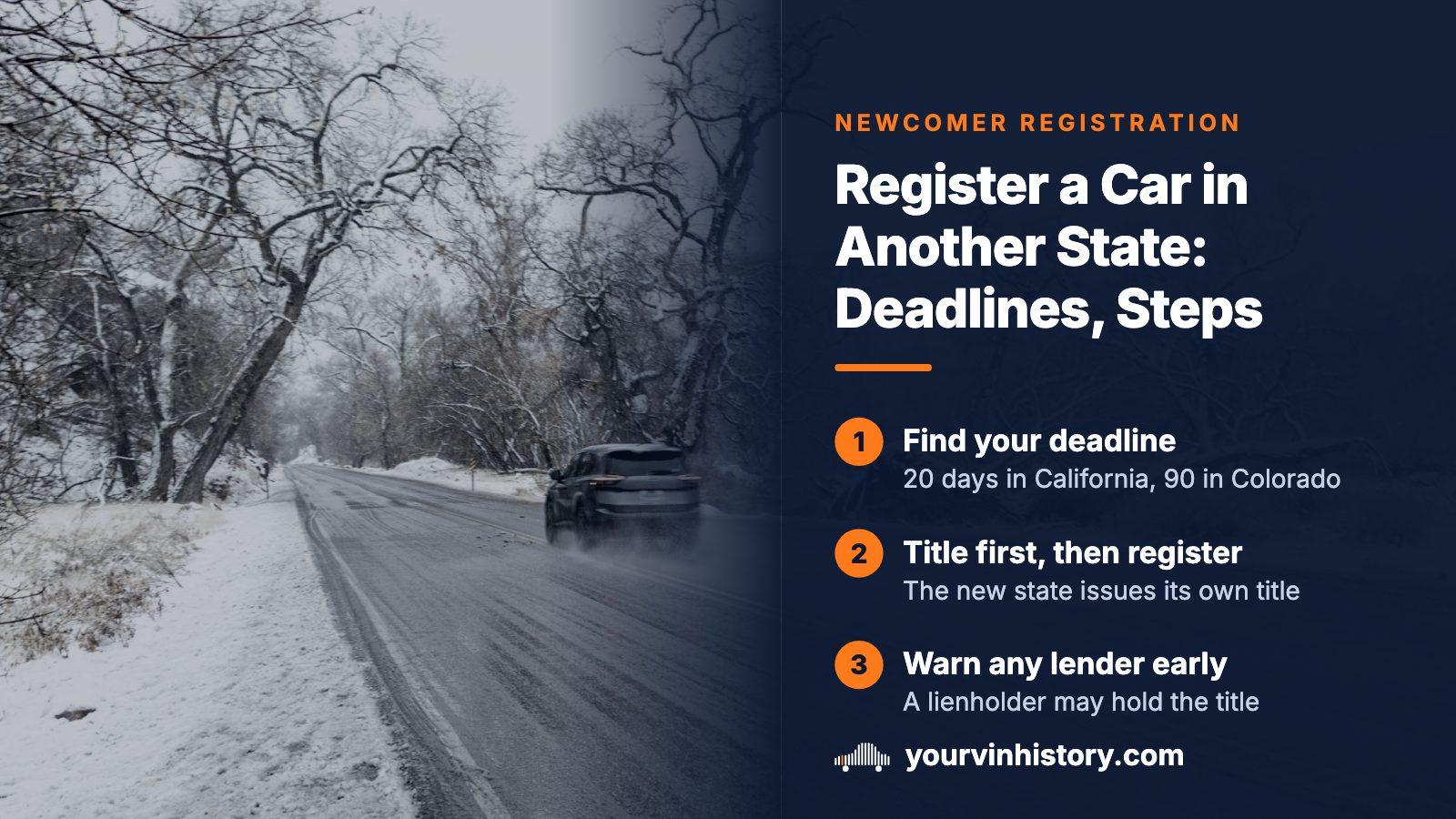
Each state sets its own deadline for a newcomer's vehicle, from 20 days in California to 90 in Colorado, with 30 in Texas, Virginia and Washington. The new state issues its own title first and the registration after it, and it queries the national title record, as federal rules require, before it titles the car. Tell any lender early, expect an inspection in some states, and file in the first week.
- Shortest clock covered
- 20 days, California
- Longest clock covered
- 90 days, Colorado
- Order of documents
- Title first, registration second
- Federal check
- Runs before an out-of-state title issues
The title comes first, and registration follows it
Moving a car between states feels like a registration errand, and that is the first mistake. A registration goes to the person a title names, so the new state has to create its own certificate of title before it can issue plates.
That is why a visit booked as vehicle registration so often ends with a second appointment: the clerk is stuck on title work. Most states take the old title back when they issue theirs, so you never hold two. That is deliberate, since two live titles on one VIN is the situation the national title record exists to stop.
Deadlines from 20 days to 90, depending on the state
No national number applies. Each figure below comes from a state statute or an agency manual, and the gap between the shortest and longest is 70 days.
| State | Days | What starts the count |
|---|---|---|
| California | 20 | Taking a job there or establishing residency, whichever comes first (Vehicle Code 6700(a)) |
| New York | 30 | A grace period inside the non-resident exemption (Vehicle and Traffic Law 250) |
| Texas | 30 | Buying the vehicle or becoming a resident (Transportation Code 502.040(a)) |
| Virginia | 30 | Buying the vehicle or moving in, per the DMV manual |
| Washington | 30 | Becoming a resident (RCW 46.16A.140) |
| Colorado | 90 | Becoming a resident (C.R.S. 42-3-103(4)) |
Read the last column before the day count. California can start counting when you accept a job there, before the furniture arrives. Colorado's long window has a cost: fees can be prorated back to the date you became a resident, so waiting is billed, not forgiven.
When you count as a resident
Most of those clocks start at residency, and states define the word loosely. New York calls a resident someone who lives there intending a fixed and permanent home, then adds a presumption: holding a residence there for at least 90 days is evidence of residency. Washington looks for intent to live in the state on more than a temporary basis, and presumes residency once a person meets two conditions from a list, such as keeping a home there or holding a Washington license.
Both presumptions work from where you physically are, not from what you meant.
Count from the earlier date
A lease, a home purchase, a job start, a voter registration or a school enrollment can each point to residency. If two starting points are possible, treat the earlier as yours.
The federal check the new state runs on your car
A rule at 28 CFR 25.54 puts two duties on every state. It must send its titling data, brands included, to the national title system, NMVTIS, once every 24 hours. And before it issues a title to someone who bought the car from an out-of-state owner, or in a transfer, it must run a verification through that system.
The state sends in the VIN. The answer can address whether the title document is valid, whether the vehicle is or has been listed as junk or salvage, whether the odometer reading agrees with the system's records, and whether lienholder details line up.
You never see this step and cannot speed it up. It runs between agencies while your application waits, which is part of why a title outlasts one counter visit. A brand, a lien or an odometer mismatch brings questions.
If a lender is holding the title
A car with a loan usually has no title in your desk drawer. The lienholder keeps it, on paper or as an electronic record in the old state, and you cannot hand it over yourself. States handle this routinely. Virginia's DMV manual says a registration card can bring a car into Virginia when it is titled to the owner elsewhere and a lienholder holds the title. The owner gets no printed title until the old state's title is submitted, and Virginia mails liened titles to the lender.
- Raise it with the lender before the move, since out-of-state transfers are rarely quick.
- Ask the new DMV what it accepts in place of the title, such as a registration card or a request to the old state.
- Expect the lien to be recorded again on the new title record. It follows the car.
- Do not count on holding the new title. With a lien recorded, the printed copy typically goes to the lender.
Inspections that vary by state
The federal check is identical everywhere, and the rest is local. These requirements catch people arriving from states that never asked.
| State | What is added | Stage |
|---|---|---|
| Texas | The county office confirms the car passed required inspections, or that the owner had an identification number inspection | Before the car can be titled (Transportation Code 501.030(a)) |
| California | A certificate of compliance or noncompliance, the smog paperwork, for a car last registered elsewhere | On registration (Vehicle Code 4000.2(a)) |
| Washington | A State Patrol inspection for a car whose papers from another state show a total loss or salvage with no valid registration reissued since | Before the title application is accepted (RCW 46.12.560(1)(a)) |
Washington's trigger is the paperwork rather than the calendar: a car with a salvage past meets the inspection because its own papers say so. For California, settle the smog question before the car ships.
Brands follow the car across the line
Some owners hope a state line resets a car's history. The two federal duties work against that. States report every brand on a title into the national record, and the receiving state consults it before issuing a title, so a salvage brand normally arrives with the car.
Cases where a brand really did disappear exist, and the title washing guide describes the pattern. The labels themselves are sorted out in the branded title guide.
Keeping the old registration alive is not a workaround
Some owners keep the old state's registration current and skip the retitle. It fails, because that registration rests on living in the old state. Driving on it after the move leaves you with an unregistered car as far as your new state is concerned.
Paperwork and fees to gather first
- The out-of-state title, or the current registration card plus the lender's contact details if a lender holds it
- Identification, plus proof of where you now live, which also anchors your residency date
- Insurance in your name at the new address, meeting the new state's minimums
- An odometer reading, plus disclosure paperwork if ownership changed during the move
- Any safety, emissions or VIN inspection result the state asks for
- Fees for the title, registration and plates, plus a use or excise tax where the state charges one
The tax line is where budgets break. A number of states tax the arrival of a vehicle owned by a new resident, crediting sales tax paid elsewhere in some cases and not in others. You cannot estimate it from another state's web page, so ask your own state before you plan.
What missing the deadline costs
The penalty is usually money rather than drama. Late fees are the common outcome, and Colorado's proration means the months of delay are billed rather than waived. The quieter risk sits with your insurer: a policy priced for an address you left invites a dispute when a claim arrives.
If you are already past the date, file now. The rules discussed here are written around the application, and a late filing leaves you in a better position than none. Better still, start in the first week, so the title work and national check finish inside the window.
Buying across state lines and other exceptions
You can land here without moving at all. Buy a car in another state and Texas and Virginia start the clock at purchase, not at residency. The federal verification applies squarely, since it names buyers from out-of-state owners. Expect the work to center on the sale: a temporary tag or transit permit to drive home, a bill of sale a distant state accepts, and an odometer disclosure on the title. If the seller has no title, stop; that problem has its own route.
Some people sit outside the ordinary rule, so check the specific provision.
| Situation | Why the usual rule may not fit |
|---|---|
| Active-duty military | Federal and state rules often let a servicemember keep the home registration during a posting elsewhere |
| Students | Many states treat a student domiciled elsewhere as a non-resident, though definitions differ |
| Seasonal residents | A length-of-stay presumption, like New York's 90 days, can reach someone who never thought of themselves as having moved |
Look up the record before the clerk does
The state will query your car's record, so query it first. Start with a VIN decode, which confirms the number is valid and matches the vehicle in front of you; if the VIN and the car disagree, no later paperwork fixes that. Then look at the history. For a car you have owned for years, nothing new should surface. For one bought recently or cheaply, a brand or lien is better found on your own schedule than at the counter.
A yourvinhistory report covers title brands, accidents, odometer readings, salvage and auction records, liens and open recalls, and it starts with a preview before any purchase.
Where this information comes from
- eCFR: 28 CFR 25.54, responsibilities of the states — The federal rule behind the 24-hour title reporting, the inclusion of brands and the title verification run before an out-of-state title issues.
- California Legislature: Vehicle Code 6700 — Source for California's 20-day application period and the two events that can start it.
- New York Senate: Vehicle and Traffic Law 250 — Shows how New York treats its 30 days as an exemption period and how 90 days of abode works as evidence of residency.
- Washington Legislature: RCW 46.16A.140 — Gives new Washington residents 30 days to register and lays out how residency is defined and presumed.
- Washington Legislature: RCW 46.12.560 — Explains when a State Patrol inspection is required for a vehicle arriving with total loss or salvage paperwork.
- Virginia DMV: VLIC-3.510, evidence of ownership — Describes how Virginia handles a vehicle whose out-of-state title is held by a lienholder.
Sources and photos: Facts checked against the sources above in October 2026. Photo by Zoshua Colah on Unsplash; diagrams by YourVINHistory.
Keep reading
- Car title vs registrationShows why the two documents differ and why the title has to settle first.
- Register a car without a titleThe route to take when the title from the old state is missing altogether.
- Buying a car out of stateCovers the sale itself when the car crosses a state line before you do.
- Title washingDescribes how a brand occasionally gets lost between states and what the pattern looks like.
Frequently asked questions
Can I keep my old plates while I wait for the new title?
Inside the deadline, generally yes, since the period works as a grace window. New York's statute frames its 30 days as a continuation of the exemption non-residents already enjoy. Once the window closes, the old plates stop covering you. Whether a pending application stops the clock differs by state, so ask the DMV.
Will a salvage brand show up if I don't mention it?
It is likely to. States report title brands to the national record, and the new state queries it before titling the car, so the clerk does not depend on what you say. Washington adds a State Patrol inspection when the old papers show a total loss or salvage. Occasional gaps exist, which is what title washing describes.
Do I get the driver license or the registration first?
They run on separate deadlines, and the order is a state-by-state matter. Washington gives new residents 30 days for each: RCW 46.16A.140 covers vehicles and RCW 46.20.021(1) covers licenses. Many counters ask for a local license or proof of a local address at registration, so doing the license first can save a trip even where no law requires it.
Should I update my car insurance before I register?
Yes, and early. Registration usually needs proof that your coverage meets the new state's minimums. A policy still rated for a garaging address you left can become a dispute at claim time. Call your insurer when you sign the lease or close on the house, and ask for the proof document your new state accepts.
Can I see my car's title record before the DMV does?
In part. The state queries the national title system directly, and consumers can see title-record data through approved providers. The title records in a yourvinhistory report come from ClearVin LLC, an approved NMVTIS data provider, so title brands that states have reported can show up before you reach the counter.
Now check the car itself
The guide explains what to look for. The report shows what this VIN has on record.