THE SHORT ANSWER
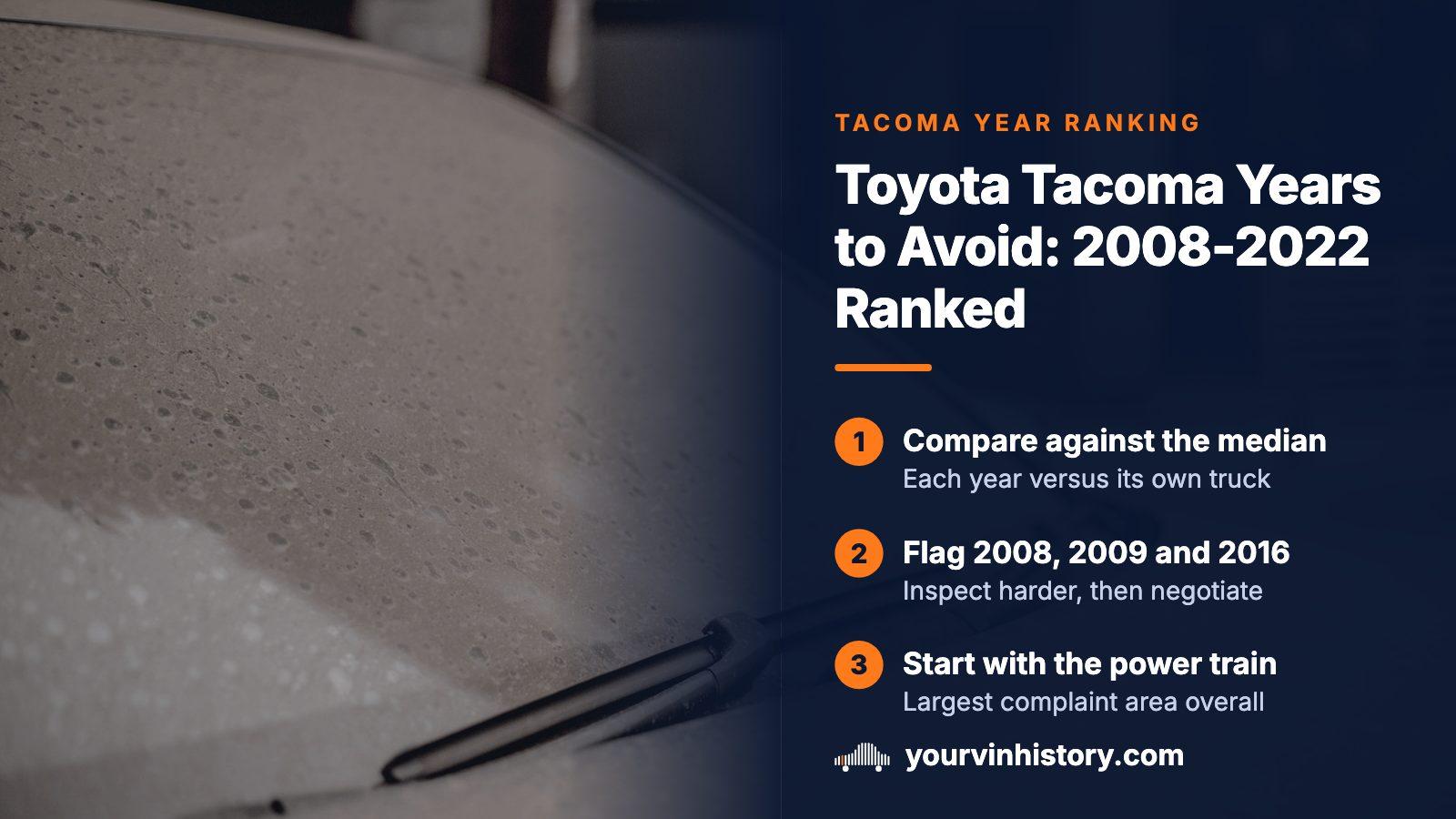
The Tacoma years to approach carefully are 2009 (518 complaints), 2008 (445) and 2016 (323), with 2012 and 2010 also above the pack. The median year logs 202 complaints, so those three run between 1.6 and 2.56 times normal. The lightest records belong to 2022, 2021, 2020, 2014 and 2015. Power train is the most-reported area overall. A complaint count is a reason to inspect harder, not a failure rate.
- Complaints on record
- 3,245 across 2008–2022
- Median model year
- 202 complaints
- Peak year
- 2009, with 518
- Sharpest jump
- 100 in 2015 to 323 in 2016
What a Tacoma complaint count does and does not measure
Each complaint in the NHTSA database is a single owner's account of what went wrong, filed without proof. In bulk that is useful. Taken one report at a time it is shaky. Across the 2008 to 2022 Tacoma model years the database holds 3,245 of them.
Raw totals mislead for two reasons. A popular model year has more owners available to file, and an older one has had longer to collect filings. To soften both effects, this page finds the median Tacoma year, 202 complaints, and states every other year as a multiple of it. A figure of 2.56 means that year drew 2.56 times what the typical Tacoma year drew. Nothing here is a failure rate or a reliability score. It is a way to decide where to look harder.
All 15 Tacoma model years side by side
The table below runs from the 2008 truck to the 2022 truck. Recall counts sit beside the complaints because the two measure different things.
| Model year | Multiple of median | Complaints | Recalls | Where it sits |
|---|---|---|---|---|
| 2008 | 2.2× | 445 | 11 | Heavy |
| 2009 | 2.56× | 518 | 13 | Heavy |
| 2010 | 1.44× | 291 | 13 | Elevated |
| 2011 | 0.92× | 185 | 9 | Mid-pack |
| 2012 | 1.46× | 294 | 7 | Elevated |
| 2013 | 0.61× | 124 | 6 | Mid-pack, lean side |
| 2014 | 0.46× | 93 | 4 | Light |
| 2015 | 0.5× | 100 | 4 | Light |
| 2016 | 1.6× | 323 | 4 | Elevated |
| 2017 | 1.17× | 237 | 5 | Mid-pack |
| 2018 | 1× | 202 | 3 | Mid-pack |
| 2019 | 1.05× | 212 | 4 | Mid-pack |
| 2020 | 0.43× | 86 | 1 | Light |
| 2021 | 0.39× | 78 | 0 | Light |
| 2022 | 0.28× | 57 | 3 | Light |
The figures come from NHTSA complaint and recall filings for these model years, pulled on 2026-08-15. A multiple near 1 is an ordinary Tacoma year, since 2018 sits exactly on the median.
2009, 2008 and 2016: the years that stand out
Three model years sit clearly apart. The 2009 truck is the peak at 518 complaints, 2.56 times the median, and owners most often filed it under suspension; exterior lighting also showed up prominently that year. The 2008 truck follows with 445 (2.2 times), again led by suspension. The 2016 truck is third with 323 (1.6 times), but its leading area changes to power train.
- 2012: 294 complaints, 1.46 times the median, with engine the most-reported area.
- 2010: 291 complaints, 1.44 times the median, with suspension the most-reported area.
Those two sit above the median without reaching the heights of the first three. Notice that 2008, 2009 and 2010 all put suspension on top, so a buyer shopping that stretch of years has one obvious system to examine. None of this makes any single truck from these years a bad one. It means the used examples deserve a closer look and a lower opening offer.
The jump between 2015 and 2016
Complaints climb from 100 for 2015 to 323 for 2016. A step that sharp rarely happens by drift. It usually marks a redesign or a mechanical change, so the first job with any Tacoma near that line is to learn which side of it the truck was built on. The complaint data cannot say what changed; a VIN decode of the specific truck shows the build.
After 2016 the counts ease but stay well above the 2014 and 2015 level for a while: 237 for 2017, 202 for 2018 and 212 for 2019, then down to 86 for 2020. Recalls tell a different story from complaints here. The 2010 truck carries 13 recalls and 291 complaints, while the 2016 truck carries only 4 recalls against its 323 complaints. The two measures do not rise and fall together. This site keeps a separate record for the 2016 truck, covering its recall campaigns and complaint areas.
The quietest Tacoma records
Five model years carry the lightest complaint records: 2022 with 57 complaints (0.28 times the median), 2021 with 78 (0.39), 2020 with 86 (0.43), 2014 with 93 (0.46) and 2015 with 100 (0.5). Their recalls run from none for 2021 to 1 for 2020, 3 for 2022 and 4 each for 2014 and 2015.
Read that list with age in mind. A cleanest list built on young trucks proves little, because owners have had so little time to file anything. That is why the newest model years are kept out of any ranking of the cleanest, and why 2020 through 2022, the youngest rows in the table, deserve less weight than 2014 and 2015. Those two older years have been on the road long enough to collect a record, and they still stayed near 100.
Where owners say the trouble is
Counted across all 15 model years, power train draws the most reports, ahead of suspension. Because it leads the whole run, it is the first place a mechanic should look on any Tacoma, whatever the year.
| NHTSA component area | Reports, 2008 to 2022 |
|---|---|
| Power train | 484 |
| Suspension | 412 |
| Unknown or other | 324 |
| Engine | 301 |
| Structure | 268 |
| Service brakes | 224 |
These are the leading areas only. Each is an NHTSA category covering many parts: power train spans more than the transmission, and engine takes in any engine fault, so no row counts one specific failure. The unknown-or-other row is a catch-all and says nothing about cause.
What recalls add that complaints cannot
Each complaint is a single owner's unconfirmed account. A recall is different: the maker has acknowledged a defect and must repair it without charge. That duty has an edge. Under 49 U.S.C. §30120(g), a manufacturer need not fix a vehicle at no cost if it was first bought more than 15 years before the recall was announced, so an old recall can still carry a no-charge repair while a newer one on an older truck may not.
Recalls also follow production ranges rather than whole model years. A Tacoma from a recall-heavy year may have had every campaign completed, while one from a quiet year may have an open campaign nobody ever scheduled. A year with many recalls and few complaints can simply mean problems were caught and repaired early; 2013 shows that shape, with 6 recalls and 124 complaints. Whether a particular truck was repaired is answered by its VIN on NHTSA's recall lookup, not by the model year.
Five ways these numbers can mislead you
- Sales volume: a popular year gathers more reports than a rare one of identical quality, which is why each year is scored against the Tacoma's own median instead of against other trucks.
- Time on the road: older years have had longer to collect filings, so young ones look better than they have earned.
- Unverified accounts: a complaint records what an owner believed happened. That helps in aggregate and falters one report at a time.
- Recalls point the other way: the maker acknowledged them and pays for the repair, so a high count is not automatically bad news.
- Silence about your truck: a year's totals say nothing about the vehicle in front of you, which has its own maintenance and title history.
A flagged year is a bargaining position, not a verdict
Every Tacoma year, 2009 included, contains well-kept trucks and neglected ones. Let the flag sharpen your inspection and your price. Do not let it rule out a truck you have not yet seen.
What to check on a Tacoma from a high-complaint year
The complaint areas show where inspection time pays off. Ask the seller for service records first, then work through this list on a lift with a mechanic you chose.
- Suspension, the leading area for 2008, 2009 and 2010: drive over rough pavement and listen for knocks, check the tires for uneven wear, and have the front and rear components examined from underneath.
- Power train, the leading area for 2016 and for the whole run: note how the transmission shifts cold and warm, look for fluid leaks, and test the four-wheel-drive system if the truck has one.
- Engine, the top area for 2012: start it cold, listen for rattling or ticking, scan for stored fault codes, and ask what engine work has been done and when.
- Lighting, which stood out in 2009: switch on every lamp, including brake lights and turn signals.
- Structure and brakes: have the frame and underbody checked for damage or corrosion, and test the brakes on a road you know.
- Recalls: look up the VIN and confirm each campaign was completed.
From the model year to the exact truck
A model year describes a population. The truck you are buying has a recall status, a title history, an odometer sequence and a repair history of its own. Run its 17-character VIN through NHTSA's recall lookup to see open campaigns. NICB's VINCheck screens the same VIN for theft and total-loss records, and both tools cost nothing. NMVTIS holds the national title records, which is where brands a seller's paperwork leaves out tend to surface.
A yourvinhistory report gathers title brands, accident records with a damage map, odometer readings, salvage and auction records and open recalls for that VIN. The preview is free; the full report is a one-time purchase. Records cannot see worn parts, so pair whichever checks you run with the inspection above.
Where this information comes from
- NHTSA: vehicle safety and owner complaints — Where owner complaints are filed and searched; the 3,245 Tacoma reports counted here come from this database.
- NHTSA: recalls — The lookup for open recalls by VIN, and the source of the recall counts shown for each model year.
- NMVTIS: national title information system — The federal title-record system behind brand and title history for one specific truck, which model-year data cannot show.
- NICB: VINCheck — A no-cost screen for theft and total-loss records on a single VIN.
Sources and photos: Facts checked against the sources above in October 2026. Photo by Erik Mclean on Unsplash; diagrams by YourVINHistory.
Keep reading
- 2016 Toyota Tacoma recalls, power train complaints and what to checkThe record for the year after the biggest jump, with its recall campaigns and the components owners filed against.
- Toyota Tacoma timing chain replacement cost: what each quote really buysEngine is a leading complaint area, and this prices one engine repair and what the record does and does not show.
- Toyota recallsHow to look up open Toyota recalls for the exact truck you are considering.
- Ford F-150 years to avoid: 2013, 2011 and 2018 draw the most complaintsThe same median method applied to another popular pickup, for a like-for-like comparison.
Frequently asked questions
What are the worst Toyota Tacoma years to buy?
On complaint volume, 2009, 2008 and 2016 stand out, with 2012 and 2010 also above the median of 202. Avoid is a strong word, though. A high count is a cue to demand service records, inspect harder and negotiate. A well-kept 2009 can beat a neglected 2019, and a flagged year with thin records is the one to walk away from.
Which Tacoma years are the most reliable?
The data ranks complaint volume, not reliability. By that measure 2022, 2021, 2020, 2014 and 2015 have the lightest records. Lean on 2014 and 2015 for evidence, since the newest years have had little time to collect reports. How one truck holds up depends on maintenance and use, which only service records and an inspection can show.
What do Tacoma owners complain about most?
By NHTSA category, power train, with 484 reports across the 2008 to 2022 run, followed by suspension at 412. The category is broad and covers more than a single part, so it points a mechanic toward the drivetrain rather than naming a failure. Suspension tops the list for 2008, 2009 and 2010 instead.
Does the Tacoma have fewer complaints than the F-150?
Its total is lower, 3,245 against 19,248 for the F-150, but totals follow sales and years on the road as much as quality, so the gap proves little. The comparison that holds up is each year against its own truck's median. Judge the Tacoma by that yardstick and the F-150 by its own, not by each other's raw totals.
How do I check a specific Tacoma before buying?
Start with the VIN. Look up open recalls on NHTSA's recall page, run NICB's VINCheck for theft and total-loss flags, and pull the national title record, since it can show brands a seller does not mention. Then pay a mechanic to inspect the truck on a lift. A flagged model year changes how hard you inspect, not whether the paperwork matters.
Now check the car itself
The guide explains what to look for. The report shows what this VIN has on record.