THE SHORT ANSWER
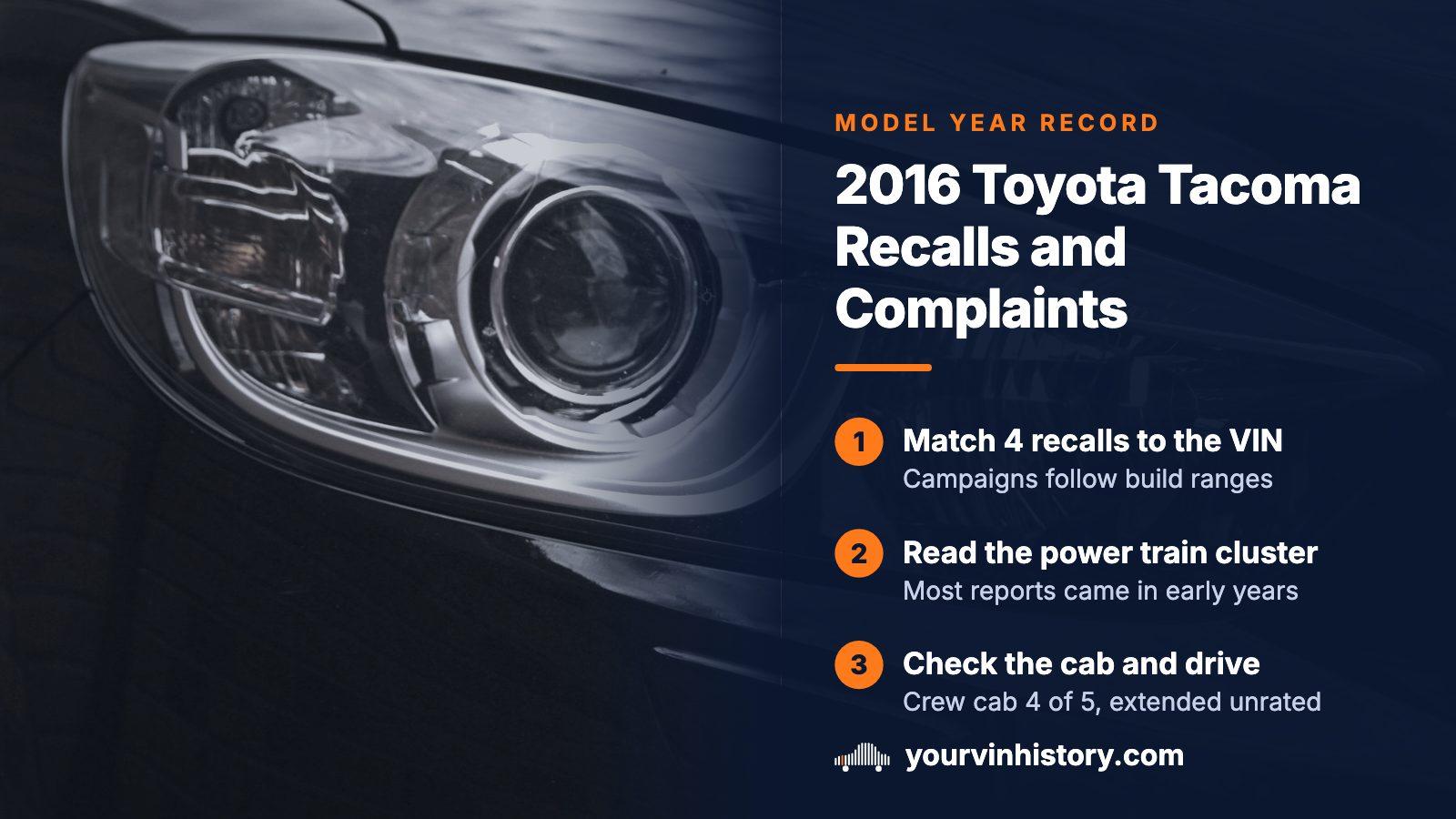
NHTSA lists 4 recall campaigns for the 2016 Tacoma: a stall risk on six-cylinder engines, a rear differential oil leak, wrong knee air bag bolts on trucks built in late summer 2015, and hood scoops that can detach. Owners filed 323 complaints, 42% of them about the power train. Only the crew cab versions carry an overall crash rating, 4 of 5. Which campaigns touch a given truck depends on its VIN.
- Recall campaigns
- 4 on file with NHTSA
- Owner complaints
- 323, with 42% filed under power train
- Against other Tacoma years
- Third heaviest of 15, at 1.6 times the median
- Overall crash rating
- 4 of 5 for crew cab, not rated for extended cab
What NHTSA's file on this Tacoma contains
Federal records on a model year come in two kinds. A recall campaign is a defect the manufacturer has acknowledged and agreed to repair, so it works as a to-do list for one truck. A complaint is whatever an owner typed into NHTSA's database, unchecked, so the pile is a rough map of where owners felt let down. This model year has 4 campaigns and 323 complaints.
Among the filings, 4 mention a crash, 4 a fire and 1 an injury. Those labels reflect the owner's own account, and one event can be reported twice, so read the full entries on NHTSA's site. NHTSA also shows 1 investigation touching this model year, which is a hint rather than a verdict.
The four campaigns side by side
Each recall has an NHTSA number, and Toyota or the distributor keeps its own short code for the same campaign. A service advisor can look up either one.
| NHTSA number | Fault | Trucks covered | Repair began | Maker's code |
|---|---|---|---|---|
| 15V656000 | Wrong bolts on the driver's knee air bag module | 2016 trucks built August 20 to September 10, 2015 | November 19, 2015 | F0T |
| 17V285000 | Oil seeping at the rear differential carrier joint | Certain 2016 and 2017 Tacomas | June 19, 2017 | H0G |
| 17V356000 | Crank position sensor can fail and stall the engine | Certain 2016 and 2017 trucks with six cylinders | July 26, 2017 | H0H |
| 17V425000 | Adhesive on an accessory hood scoop can let go | Tacomas and 4Runners from 2011 to 2016 with the distributor's scoop | September 1, 2017 | SET17B |
Only the knee air bag bolt campaign comes from 2015. The other three began in 2017.
Six-cylinder trucks and the crank sensor stall risk
Campaign 17V356000 reaches certain 2016 and 2017 Tacomas with a six-cylinder engine. Toyota found that the crank position sensor can malfunction, and the engine may stall when it does. NHTSA's wording is that a stall raises the risk of a crash, which is easy to picture on a highway ramp.
Dealers fit a redesigned sensor at no charge. A four-cylinder truck sits outside the campaign, so settle which engine is under the hood first. If it is the six, ask for the work order, which should mention the campaign or Toyota's code H0H. Engine is also a complaint category with 47 filings, 15% of the total, but the category is broad and those filings do not all describe a sensor.
The rear differential leak and the power train cluster
Campaign 17V285000 deals with oil seeping from the joint where the rear differential carrier meets the axle housing. A differential running low on oil can seize, and NHTSA calls that a loss-of-control risk. Dealers inspect first. They either tighten the fastening nuts or swap the nuts and gasket, and if parts inside are damaged, the whole carrier assembly goes in.
NHTSA files this campaign under power train, the same category as the largest complaint group. That link is only a label. Power train also takes in the transmission and other drivetrain parts, and the data does not say which one each owner meant. What the overlap does justify is a look under the rear axle for a damp film of oil.
A knee air bag bolt batch and a dealer-fitted hood scoop
The oldest campaign, 15V656000, is narrow. Toyota used incorrect bolts to mount the driver's knee air bag module on 2016 Tacomas from the late-summer 2015 build window in the table above. The bolts can loosen, and a loose module may not do its job in a crash, which raises the risk of driver injury. Dealers fit the correct bolts. A VIN lookup settles whether a truck falls inside the build window.
Campaign 17V425000 is a different animal. Southeast Toyota Distributors issued it, not Toyota, and it covers accessory hood scoops that the distributor or its dealers installed. The remedy is a mechanical fastening. A truck with no scoop, or with a scoop from another source, is not part of it.
Where the 323 complaints cluster
Owners pick the category themselves when they file, so the table shows what people believed had failed, not what a technician confirmed.
| Category | Share | Filings |
|---|---|---|
| Power train | 42% | 136 |
| Engine | 15% | 47 |
| Electrical system | 11% | 36 |
| Structure | 7% | 22 |
| Seats | 7% | 22 |
| Service brakes | 6% | 18 |
| Exterior lighting | 5% | 17 |
Another 50 filings, 15%, sit under unknown or other. Power train outnumbers engine and electrical system put together, and a tight concentration like that is a stronger signal than the same count scattered thinly. The brake entries are owners reporting brake defects, not ordinary pad wear.
How old the truck was when each system drew complaints
Each complaint carries the date the owner says the problem happened, so subtracting the model year gives a rough age. Filings peaked in 2017.
| System | Median age in years | Dated reports | Filed inside three years |
|---|---|---|---|
| Power train | 1.3 | 135 | 86% |
| Service brakes | 1.3 | 18 | 72% |
| Engine | 2.4 | 47 | 62% |
| Unknown or other | 2.7 | 50 | 54% |
| Exterior lighting | 3.6 | 17 | 41% |
| Electrical system | 3.9 | 36 | 44% |
| Structure | 4.5 | 22 | 27% |
| Seats | 5.2 | 22 | 18% |
The early rows were mostly somebody else's warranty problem, so a well-kept truck may already have had the work done. Ask for the paperwork instead of assuming the bill is ahead of you. Seats come last at 5.2 years, the line to budget for on a truck this age. The power train row uses 135 dated reports, one fewer than its 136 filings.
A median is not a forecast
These ages describe when the owners who complained say something broke. They do not tell you how likely any failure is. A truck with full service records can outlast every number here, and a neglected one can fail sooner.
Where 2016 stands among Tacoma model years
Raw complaint counts mostly follow sales, so a fairer test sets each year against the same truck's own median year. By that yardstick the 2016 Tacoma is the third heaviest of 15 model years on record, from 2008 through 2022, at 1.6 times the median. The heaviest is 2009 at 2.56 times. The lightest is 2022 at 0.28, though a truck that young has had little time to collect reports.
A year above the median is a reason to read the details closely, not a verdict on any single truck.
Crash ratings depend on the cab and the drive
NHTSA lists four configurations for this model year, and they do not score alike. The one behind the model-year summary is the extended cab 2WD, with no overall, frontal or side rating.
| Configuration (NHTSA code) | Overall | Rollover |
|---|---|---|
| Extended cab, 2WD (PU/EC) | Not rated | 4 of 5 |
| Extended cab, 4WD (PU/EC) | Not rated | 4 of 5 |
| Crew cab, 4WD (PU/CC) | 4 of 5 | 4 of 5 |
| Crew cab, 2WD (PU/CC) | 4 of 5 | 4 of 5 |
Crew cab trucks also carry a frontal rating of 4 and a side rating of 5. The tested extended cab shows a rollover probability of 14.7%, and the four-wheel-drive versions show a higher probability than the two-wheel-drive ones. Stability control was standard. Forward collision warning and lane departure warning were not offered.
No-charge recall repairs and the VIN lookup
NHTSA runs a recall lookup that takes the truck's 17-character VIN and shows which campaigns apply to it and whether an earlier owner already had the repair done. Use the VIN, not the model year, because every campaign above is tied to certain production ranges.
Dealers do recall repairs at no charge, within a limit. Under 49 U.S.C. §30120, the duty to repair without charge does not apply to a vehicle whose first buyer bought it more than 15 calendar years before the earlier of the owner notice or NHTSA's order. A Tacoma sold new in 2015 or 2016 has not reached that cutoff as this page is written, but a dealer can confirm a specific truck.
A mechanic's checklist for a used 2016 Tacoma
Start with what owners reported, then add the checks any pickup needs.
- Transmission and driveline: a long test drive with several stops, noting odd shifts or vibration.
- Rear differential housing: an oil film at the carrier joint, plus paperwork for the 17V285000 repair.
- Six-cylinder engines: stored fault codes and the work order for the crank sensor swap.
- Engine bay and wiring: heat damage or amateur splices, since fire reports exist for this model year.
- Seats: frames, adjusters and upholstery.
- Frame rails and crossmembers: rust here is the expensive kind.
- Bed mounts and tailgate hardware: wear that shows whether the truck spent its life hauling.
- Hitch wear, a transmission cooler or wiring splices: signs of towing the odometer will not show.
Questions for the seller before any money moves
- Were all 4 campaigns repaired, and is there dealer paperwork for each?
- Which engine does it have, and was the crank sensor replaced?
- Has anything in the drivetrain been rebuilt or swapped, and who did it?
- Any collision history, and did an insurer pay for repairs?
- May my own mechanic look it over before we agree on a price?
- Does the title carry your name alone, with no lien listed?
A safety file never shows title brands, accident history, liens or odometer readings. A vehicle history report for the VIN fills that gap: yourvinhistory gives a preview first and sells the full report as a one-time purchase.
Where this information comes from
- NHTSA: recalls lookup — Where a VIN is entered to see which of the four campaigns apply to a truck and whether the repair has been made.
- NHTSA: vehicle safety and consumer complaints — Entry point to the owner filings behind the 323 total, the category counts and the crash, fire and injury flags.
- 49 U.S.C. §30120: remedy without charge — Statute text for the no-charge repair and its cutoff of 15 calendar years from the first purchase.
- NHTSA: 5-Star Safety Ratings — The federal program behind the cab-by-cab ratings and the rollover probability described above.
- NMVTIS: national title information system — Federal source for title brands, which a safety record leaves out.
Sources and photos: Facts checked against the sources above in October 2026. Photo by Sara Kurfeß on Unsplash; diagrams by YourVINHistory.
Keep reading
- Toyota Tacoma years to avoid: 2009, 2008 and 2016 stand outRanks all 15 Tacoma model years against the median and shows where 2016 falls.
- Toyota recallsCovers checking any Toyota by VIN for open recall campaigns.
- Toyota Tacoma timing chain replacement cost: what each quote really buysPrices large Tacoma engine quotes and looks at oil leaks on later six-cylinder trucks.
- Buying a car with an open recallExplains what to do when the lookup shows one of these campaigns was never repaired.
Frequently asked questions
How many recall campaigns cover the 2016 Tacoma?
NHTSA lists 4 campaigns for the model year. Three began in 2017 and one, the knee air bag bolt recall, began in 2015. Each covers certain VINs, so only a lookup on the truck's own number shows which apply and whether the work was done.
What problems do 2016 Tacoma owners report most?
Power train leads with 136 of 323 filings, ahead of unknown or other at 50, engine at 47 and electrical system at 36. The category is wide, so the total does not name one failed part. Most power train reports arrived within three years, so ask whether the work was already done.
Is the 2016 Toyota Tacoma safe?
NHTSA gives crew cab versions 4 stars overall, with 4 for the front and 5 for the side. The extended cab it tested has no overall, frontal or side score, and all four versions earn 4 stars for rollover. A blank rating is missing data, not a failed test, so judge an extended cab by its inspection and recall status.
Do I pay for a 2016 Tacoma recall repair?
Not when a campaign applies to the VIN and the truck is inside the federal limit. Toyota customer service (1-800-331-4331) is the contact named for the knee air bag, differential and sensor campaigns. Southeast Toyota Distributors (1-954-429-2000) is named for the hood scoop. Confirm the status by VIN before booking, so you know which campaigns are still open.
Where does the information on this page come from?
The figures come from NHTSA's public recall file, its consumer complaint database and its crash-test ratings, as read in August 2026. Complaint totals creep up as owners keep filing, so a lookup later may differ slightly. Title brands live elsewhere, in NMVTIS records, which none of those NHTSA files include.
Now check the car itself
The guide explains what to look for. The report shows what this VIN has on record.