THE SHORT ANSWER
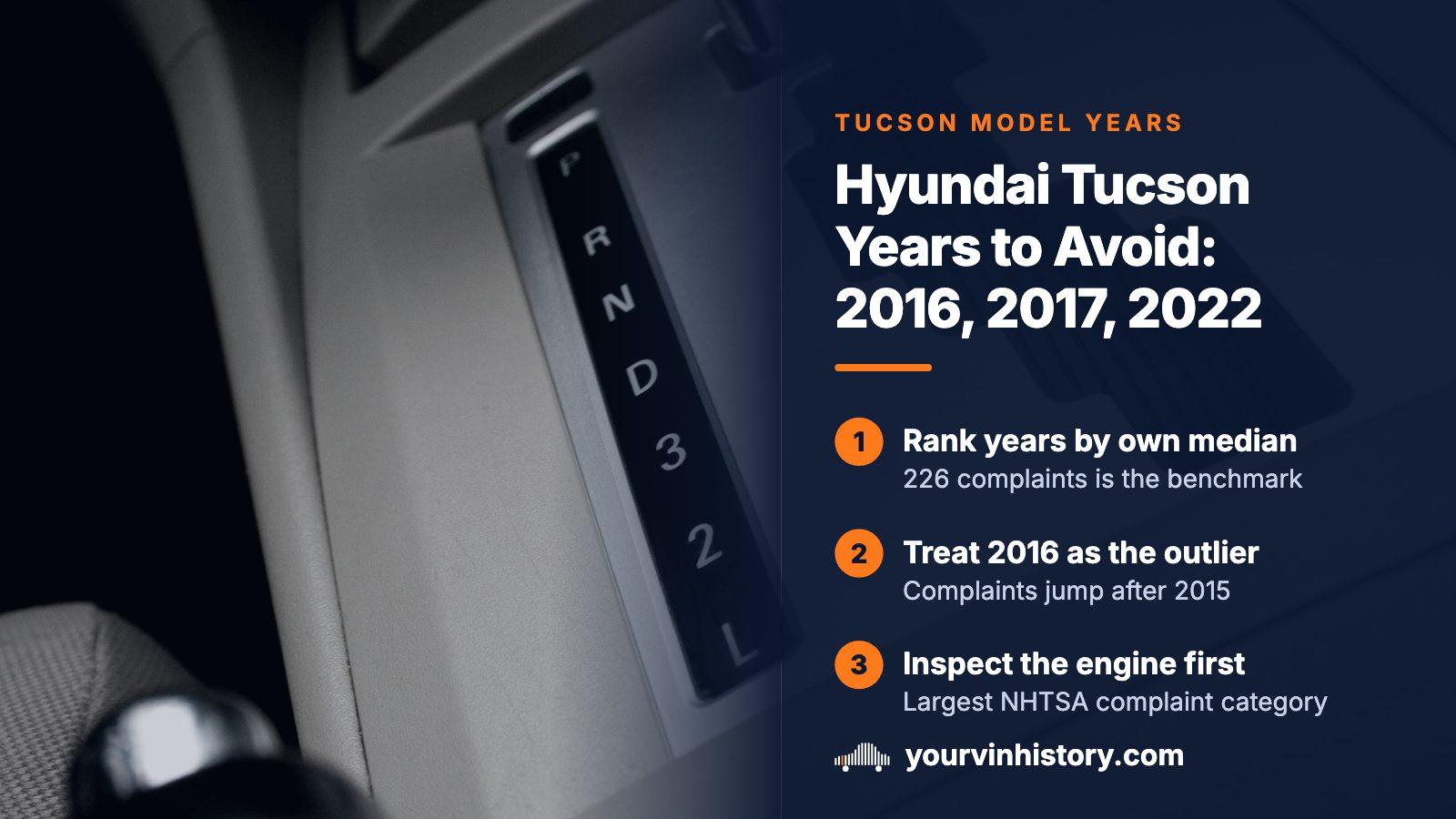
The 2016, 2017 and 2022 Hyundai Tucson model years draw the heaviest NHTSA complaint volume, with 2016 far ahead at 1,615 reports against a median year of 226. The 2009, 2008 and 2010 years carry the lightest records among the older cars. Engine is the largest complaint category at 2,292 reports. A complaint is an unverified owner account, not a failure rate, so a heavy year calls for a harder inspection, not automatic rejection.
- Complaints on record
- 5,380 across 2008 to 2022
- Median year
- 226 complaints
- Heaviest year
- 2016, with 1,615 complaints
- Top complaint area
- Engine, 2,292 reports
The step between 2015 and 2016
In the Tucson's complaint history, one transition dominates everything else. The 2015 model year has 226 filings, which happens to be the median for the whole run. The very next year, 2016, jumps to 1,615, or 7.15 times the median, and 2017 still holds 1,079.
A cliff this size usually points to a redesign or a significant mechanical change rather than slow drift. The data here cannot say which change it was, so treat the 2015 and 2016 boundary as a seam: a Tucson on one side belongs to a very different complaint picture than one on the other.
How each model year gets scored
Raw totals mislead because popular years pile up filings by selling more cars. To soften that, each Tucson year is measured against the Tucson's own median year instead of being set beside other nameplates. The median here is 226 complaints. A year at 1 times the median is ordinary for this vehicle; 2016, at 7.15 times, drew far more than usual.
The pool is every NHTSA consumer complaint for the 2008 through 2022 model years, with duplicates removed using NHTSA's ODI complaint number. The data was pulled on 2026-08-15, so anything filed later is missing. Recall counts sit alongside because they record something different, as the recall section explains.
All fifteen model years side by side
The table runs from the most complaints to the fewest. Standing is a plain-word label for the multiple: Heavy for years well above the median, Elevated for years above it, Typical for years near it and Light for years under it.
| Model year | Standing | Complaints | Times the median | Recalls |
|---|---|---|---|---|
| 2016 | Heavy | 1,615 | 7.15× | 5 |
| 2017 | Heavy | 1,079 | 4.77× | 3 |
| 2022 | Heavy | 487 | 2.15× | 3 |
| 2018 | Elevated | 388 | 1.72× | 1 |
| 2019 | Elevated | 371 | 1.64× | 1 |
| 2013 | Typical | 266 | 1.18× | 3 |
| 2012 | Typical | 254 | 1.12× | 3 |
| 2015 | Typical | 226 | 1× | 1 |
| 2014 | Typical | 201 | 0.89× | 2 |
| 2020 | Typical | 175 | 0.77× | 1 |
| 2011 | Typical | 124 | 0.55× | 5 |
| 2021 | Light | 76 | 0.34× | 1 |
| 2010 | Light | 57 | 0.25× | 4 |
| 2008 | Light | 43 | 0.19× | 1 |
| 2009 | Light | 18 | 0.08× | 1 |
| Median year | Benchmark | 226 | 1× | n/a |
The 2015 row is the median itself. Sorted this way, three heavy years lead, two elevated ones follow, a broad middle comes next, and four light years close the list.
2016, 2017 and 2022: the heavy years
Three model years sit well above the Tucson's median, and they are not all neighbors.
- 2016: 1,615 complaints, 7.15 times the median, with 5 recalls. Power train is the most reported area that year, and engine also stands out.
- 2017: 1,079 complaints, 4.77 times the median, with 3 recalls. Engine is the most reported area.
- 2022: 487 complaints, 2.15 times the median, with 3 recalls. Engine again leads.
Consecutive years at this level suggest the same cause may be at work in 2016 and 2017, though counts alone cannot prove it. The 2022 figure deserves a second look for another reason: it is the newest year in the set, and young cars have had the least time to collect complaints, so a count this high stands out.
The middle band and the two elevated years
Most of the Tucson's history sits between the heavy years and the lightest ones. The 2011, 2012, 2013, 2014 and 2015 years land at 124, 254, 266, 201 and 226 complaints, or 0.55, 1.12, 1.18, 0.89 and 1 times the median. The 2020 year joins this band at 175 complaints, 0.77 times.
Two years sit a notch higher. The 2018 year logs 388 complaints, 1.72 times the median, and 2019 logs 371, or 1.64 times, each with a single recall and engine as the most reported area. Next to 2016 these are mild flags, a reason to ask pointed questions rather than walk away.
The lightest records, and why to read them gently
The three lightest records belong to 2009 with 18 complaints (0.08 times the median), 2008 with 43 (0.19 times) and 2010 with 57 (0.25 times). The 2021 year follows with 76 complaints, 0.34 times the median.
Each needs a caveat. An 18-complaint year is a tiny sample, and few filings can mean few cars sold as easily as few problems. The 2010 year carries 4 recalls, more than most years. The 2021 year is among the youngest in the data, so its low count says more about time on the road than about the cars. The older trio has had the longest time to attract reports and still shows little, which is mildly encouraging, though it settles nothing about one example.
Where owners filed: engine first, power train second
NHTSA sorts each complaint into a component category when it is filed. Across 2008 to 2022, the Tucson's six largest categories rank as follows.
| NHTSA category | Reports | How to read it |
|---|---|---|
| Engine | 2,292 | Covers any engine fault, not a single part |
| Power train | 1,124 | Includes the transmission and other drive parts |
| Unknown or other | 651 | Filings with no clear component |
| Electrical system | 544 | Battery, wiring, lighting and control modules |
| Service brakes | 467 | Owner-reported brake defects, not routine pad wear |
| Hydraulic | 251 | The smallest of the six listed |
Engine leads by a wide margin, and in 2016 both engine and power train filings stand out. In every other flagged year, engine is the top category. These buckets are broad, so a count shows where to look, not which part fails.
What the recall column adds
A recall is a defect the maker has acknowledged and must repair at no charge to the owner, within limits. Federal law at 49 U.S.C. §30120(g) puts an age ceiling on that promise: it lapses 15 years after first sale. On the oldest Tucsons that can matter, so confirm with the dealer who pays before agreeing to recall work.
Counts run from 1 to 5 across the years. The 2011 and 2016 years top the list at 5 each, 2010 has 4, and 2012, 2013, 2017 and 2022 have 3. The two columns can diverge: 2010 shows 4 recalls beside only 57 complaints, a pattern that often means the defects were handled early. Campaigns also follow production ranges, not whole model years, so only a VIN lookup shows whether a particular Tucson is covered and whether the repair was done.
Five ways these numbers can mislead you
- Sales volume: a popular year collects more filings than a scarce one of identical quality, hence the Tucson's own median as the yardstick.
- Time on the road: older years have had longer to attract reports, so the youngest rows look tidier than they have earned.
- Unverified accounts: a complaint records what an owner believed happened. In bulk it reveals a pattern; singly it can be wrong.
- Not a rate: a complaint count is neither a failure rate nor a reliability score.
- One car is not a population: the Tucson in front of you has a history no model-year table can show.
A heavy label is a bargaining position
Every year in this table includes well-kept Tucsons and neglected ones. Treat a heavy label as a prompt to examine the car more closely and negotiate with more care, never as a reason to turn away a Tucson you have not looked at.
Inspecting a Tucson from a heavy year
The category counts show where to point a mechanic. For a 2016, 2017 or 2022 car, a sensible order is as follows.
- Enter the 17-character VIN into NHTSA's recall lookup first. Campaigns follow production ranges, so only the VIN shows which apply and whether the dealer completed them.
- Ask for service records. On an SUV this age, a documented maintenance history outweighs any model-year statistic.
- Have an independent mechanic start with the engine: a cold start, stored trouble codes, oil level and condition, and a look for leaks.
- On a 2016, add the power train. A test drive should cover cold and warm shifting, hesitation at low speed, and any slipping or harsh engagement.
- Check the electrical system, the fourth-largest category: warning lights, windows, exterior lighting, and the battery and charging condition.
- Finish the drive with the brakes, confirming the car stops straight and firm, since brake filings total 467.
Building a shortlist, then checking the car
If the budget allows, begin with the years closest to the median and away from the heavy trio: 2020 at 175 complaints, 2014 at 201 and 2015 at 226. The light older years, 2008 to 2010, make fair candidates too when condition and records back them up. A heavy-year Tucson with thorough paperwork at a sensible price can still be a good buy; a lightly reported year without records is no bargain.
A model year describes a population, while a VIN describes one vehicle. NHTSA's recall lookup lists open campaigns, NICB's VINCheck is a no-cost screen for reported theft and total loss, and the federal NMVTIS site explains the national title record. For the car's own history, a free preview on this site shows what records exist for a VIN, and the one-time paid report adds accident records with a damage map, odometer readings, title brands and liens.
Where this information comes from
- NHTSA: Vehicle safety — The federal home of the owner complaint database that supplies the 5,380 filings ranked on this page.
- NHTSA: Recalls — Where the yearly recall counts come from, and the place to enter a VIN to see open campaigns on one Tucson.
- Bureau of Justice Assistance: NMVTIS — Federal overview of the national title record, which covers the title history of a single car.
- NICB: VINCheck — A no-cost check for reported theft and total-loss status on one VIN.
Sources and photos: Facts checked against the sources above in October 2026. Photo by Shadow Photography on Unsplash; diagrams by YourVINHistory.
Keep reading
- 2016 Hyundai Tucson: five recalls, 1,615 complaints and a 5-star crash scoreThe peak year's own record page, with its recall campaigns and its complaints split by component.
- Hyundai recallsHow to look up open Hyundai recalls by VIN, the first check on any Tucson.
- Hyundai engine warrantyEngine is the biggest complaint area here, and this guide covers Hyundai's engine warranty programs and how a VIN check applies.
- Hyundai Santa Fe years to avoid, ranked from 6,353 NHTSA complaintsAnother Hyundai SUV ranked the same way, handy for comparing against the Tucson.
Frequently asked questions
Which Hyundai Tucson years are worth steering clear of?
Judged by complaint volume, 2016, 2017 and 2022 call for the most caution, led by 2016 with 1,615 reports. The 2018 and 2019 years rate as elevated but milder. Avoid is a strong word, though. Any of these can be worth buying with full service records, a clean recall lookup and a price that reflects the added risk.
Which Hyundai Tucson years have the lightest complaint records?
The 2009, 2008 and 2010 years come out lightest, at 18, 43 and 57 complaints, with 2021 next at 76. Those counts are small, so some of the quiet reflects few cars sold, and 2021 reflects youth. No year earns a reliability label from complaint data, but 2011 through 2015 and 2020 sit near the median.
What goes wrong most often on a Hyundai Tucson?
Engine, at 2,292 reports across 2008 to 2022, followed by power train at 1,124. Both are broad NHTSA buckets covering many faults, so they say where owners filed, not which part broke. Whatever the model year, ask the mechanic to begin with the engine and, on a 2016, to spend extra time on how the transmission shifts.
Should I rule out a 2016 Hyundai Tucson?
Not automatically. The 2016 year logs 1,615 complaints and 5 recalls, which justifies a harder look, but the count blends many owners and many different issues. Run the VIN through NHTSA's recall lookup, read the service history for repairs in the flagged areas, and have a mechanic test the engine and power train. A documented car at a lower price can still make sense.
How do I check a specific Hyundai Tucson before buying it?
Begin with the 17-character VIN. NHTSA's lookup shows open recalls, NICB's VINCheck screens for reported theft and total loss, and the NMVTIS site explains the national title record. Add the seller's service records and an independent inspection. The table describes a group, so the car in front of you needs its own checks.
Now check the car itself
The guide explains what to look for. The report shows what this VIN has on record.