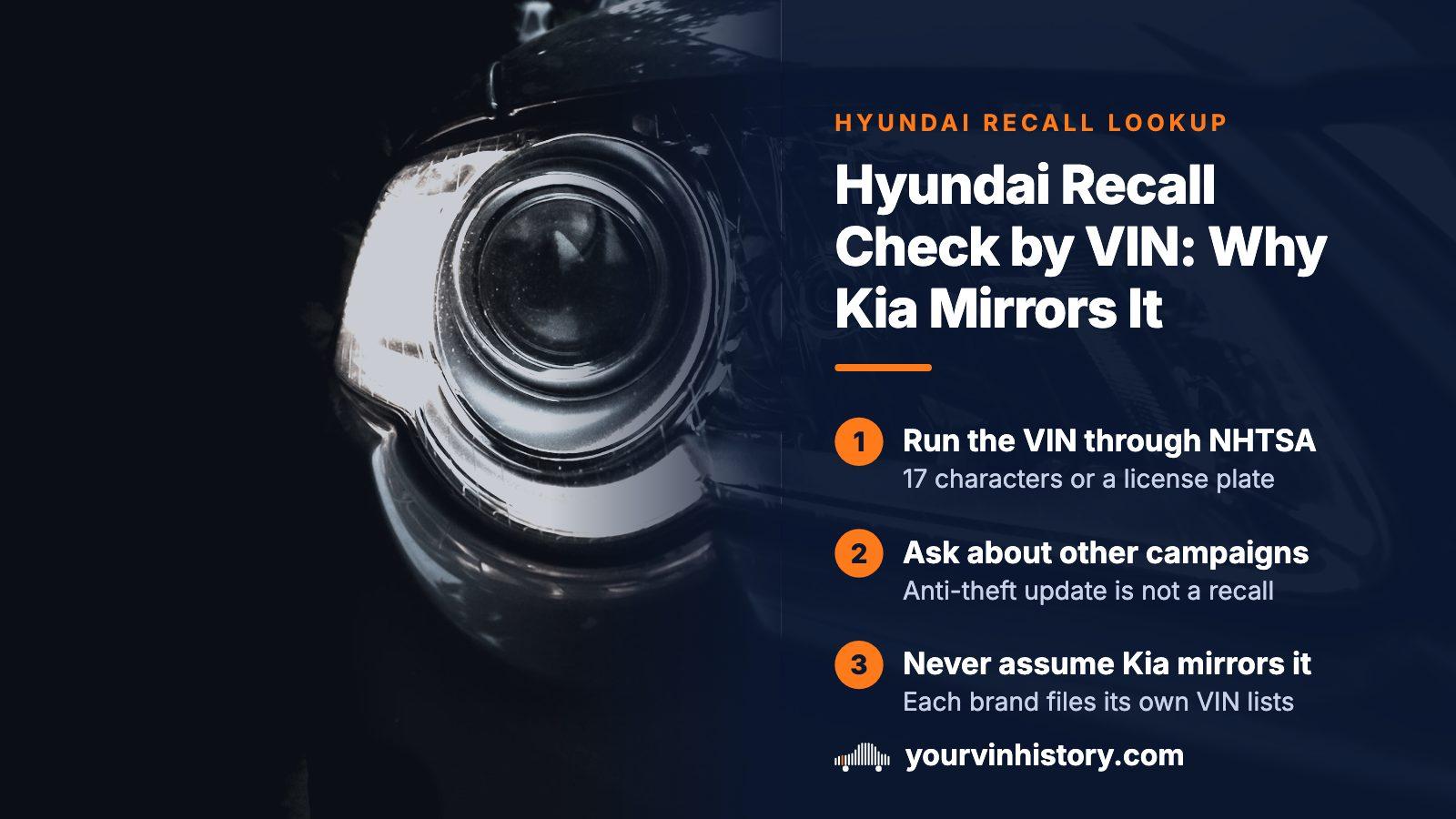
THE SHORT ANSWER
Enter the 17-character VIN into NHTSA's recall lookup, then ask Hyundai or a dealer about campaigns that are not safety recalls, such as the anti-theft software update. Kia campaigns often mirror Hyundai's because the two brands share platforms, engines and parts, but each brand files its own VIN lists, so only your VIN settles the question. Federal law sets a no-charge repair rule for the current owner, with an age ceiling.
- Lookup input
- A 17-character VIN or a license plate, on NHTSA's recall page
- Kia link
- Shared group, platforms and parts, but separate campaigns and VIN lists
- Federal lookup gap
- Skips customer-service campaigns and, unless the maker offers more, recalls over 15 years old
- No-charge rule
- Does not reach a car first bought more than 15 calendar years before the notice
Get the VIN off the car, then run NHTSA's lookup
Read the number from the vehicle itself rather than the listing. NHTSA says the 17-character VIN sits at the lower left of the windshield, and it also prints on the registration card and may appear on the insurance card. A sticker in the driver's door frame carries it too. Photograph it instead of retyping.
Enter it on NHTSA's recall page, which accepts a VIN or a license plate. That search answers a narrow question: does this specific vehicle have a recall waiting for repair. A car with none gets a message saying so. A search by year, make and model returns general results for the whole model, including investigations and complaints that may never touch your car.
Decode the VIN once before reading results. NHTSA's vPIC decoder returns the basic details the manufacturer reported for that number, so you can confirm it belongs to the Hyundai in front of you.
Why Hyundai and Kia campaigns arrive in pairs
The two brands sit inside one corporate group and build many vehicles on shared platforms, with engines and components drawn from the same pool. When a defect is traced to a shared part, each brand has to file for the vehicles it sold. The outcome is two campaigns describing the same hardware trouble under different badges.
NHTSA's announcement of the anti-theft software update shows the pattern. One release covered both brands, and each ran its own rollout and phone line. Parts and fixes tend to match. The lists of affected VINs do not.
| If you are | What the Kia connection tells you |
|---|---|
| Reading about a Kia problem | Treat it as a lead. The matching Hyundai often uses the same part, so ask about a parallel campaign. |
| Checking the Hyundai you own or plan to buy | Run that VIN. A sister brand's recall list says nothing about your car's status. |
| Choosing between a Hyundai and a Kia | Similar hardware means similar exposure. Compare the specific model and build, not the badge. |
Why a model-level story is not an answer about your car
Recall populations are drawn by VIN, frequently by plant and build date. A widely reported problem with a Hyundai model can skip the one you drive, and a car that looks identical on the lot can sit on the other side of a cutoff. News about a Kia relative works the same way: it raises a question, and only the VIN answers it.
Timing matters too. A new recall can go live before every affected VIN is loaded, so a clean result is a snapshot rather than a verdict. NHTSA suggests checking twice a year, and its SaferCar app can alert you when a recall appears for a vehicle you entered.
What NHTSA's lookup does not show on a Hyundai
NHTSA spells out the limits of its VIN and plate search. Several matter more on a used Hyundai.
- Recalls that were already repaired, so a clean result cannot say what work was done or when.
- Recently announced recalls whose affected VINs are still being added.
- Safety recalls more than 15 years old, unless the maker offers more coverage.
- Manufacturer customer-service campaigns and other non-safety programs.
- Recalls involving a vehicle built for another country, which is worth remembering with an import.
The customer-service gap is where Hyundai and Kia buyers get caught. Their best-known owner programs, including the anti-theft update, sit outside the federal safety-recall list. For those, ask Hyundai through its owner site, or ask a dealer service department, which can read the campaign history against the VIN, including work earlier owners had done.
Four kinds of Hyundai program and who pays for each
Owners tend to lump every notice together, but the instruments differ, and the difference decides the bill.
| Program | Behind it | Who usually pays | Where to find it |
|---|---|---|---|
| Safety recall | Manufacturer, with NHTSA oversight | Manufacturer | NHTSA lookup by VIN |
| Service campaign or product improvement | Manufacturer alone | Usually the manufacturer | Hyundai owner site or a dealer; often absent from federal data |
| Technical service bulletin | Guidance written for technicians | You, unless warranty applies | A dealer; it is not a recall |
| Extended coverage on a known issue | Manufacturer | Manufacturer, within its terms | A dealer checks it against the VIN |
The bulletin row surprises people. A bulletin tells technicians how to diagnose a known problem, but it does not oblige the maker to pay, so a bulletin repair outside warranty can land on you. A recall repair inside the age limit does not work that way.
The anti-theft update sits outside the recall system
Certain Hyundai and Kia model years were sold without an engine immobilizer, and a social media challenge spread the method for starting them without a key. NHTSA announced the response as a service campaign, not a safety recall. The software extends the alarm and requires the key in the ignition before the vehicle will switch on.
NHTSA also pointed owners to local law enforcement, since the makers had supplied steering wheel locks to some agencies. Because this is a service campaign, a clean NHTSA lookup says nothing about it. Ask a dealer, using the VIN:
- Is this VIN eligible for the software update?
- Has the update already been applied, and when?
- Are steering wheel locks offered for this car, and through whom?
- Does an insurer price this model differently before and after the update?
A clean recall result is not a theft clearance
NICB's VINCheck asks a separate question: whether participating insurers have reported the VIN as stolen and not recovered, or as salvage or flood-damaged. It reflects insurance records only, with five searches a day per IP address.
Engine programs: ask what was done on this VIN
Hyundai has run engine-related campaigns for particular engine families and model years, and press attention has made them familiar to many owners. Whether your VIN sits inside an affected group, and whether the remedy was performed, are separate facts, and neither shows up in a model-level article.
Put these questions to a dealer service department, and to a seller if you are buying:
- Does this VIN fall inside any engine campaign?
- Was the work performed, and on what date?
- Has the engine ever been replaced under a program?
- Did extended coverage attach to this vehicle?
- Where is the repair order?
A used Hyundai whose engine work was done but never documented leaves you guessing. Settle missing paperwork before the sale, not after.
Who pays for a recall repair, and where the rule stops
When a maker decides a safety defect exists, federal law requires it to remedy the problem at no charge to the owner, and the duty follows the car rather than the first buyer. The maker picks the remedy: a repair, a replacement, a refund or, rarely, a repurchase.
The no-charge rule has a ceiling. The statute lifts it when the first purchaser bought the vehicle more than 15 calendar years before the notice or order. An old Hyundai can therefore carry an open recall that no federal rule makes anyone fix at no cost, and NHTSA's lookup already omits safety recalls past that age unless the maker offers more. Some makers repair older cars anyway, so call Hyundai with the VIN and ask.
If a dealer quotes a price on a recall visit, ask for the recall work and any other work itemized separately. Extra repairs may be reasonable, but they are not part of the recall.
When the lookup shows an open Hyundai recall
An open recall on a used car is common and rarely sinister. Makers notify registered owners by mail, and a letter sent to a previous owner's old address never reaches the person who can act on it. A recall does not lapse from neglect.
- Read the recall text for interim guidance about driving or parking the car, and follow it literally.
- Call any Hyundai dealer with the VIN. You need not return to the selling dealer, and you need not be the original owner.
- Ask whether the remedy parts are on hand for your VIN before you book, so the visit is not wasted.
- Keep the repair order. It records the campaign and the date, which helps you now and a buyer later.
- Rerun the VIN a few weeks afterward to confirm the recall no longer shows as open.
Shopping for a used Hyundai: what to settle first
Do the recall search from your couch, before the test drive. An open recall is a task you inherit rather than a bill you absorb, provided the car is inside the age rule, and it hints at how closely earlier owners read their mail.
- Search NHTSA by VIN first, then ask Hyundai or a dealer about campaigns the federal list skips.
- Ask the seller to complete any open recall before delivery. A refusal tells you something.
- Request paperwork for engine campaign work and for the anti-theft update.
- Check warranty status on the same VIN, since warranty and recalls are separate questions.
- Price an insurance policy using the real VIN, particularly for a model year known for thefts.
A yourvinhistory report lists open recalls beside title brands, accidents and odometer readings for the same VIN, which helps when you are sorting several candidates. It does not replace asking about programs outside the federal list.
Where this information comes from
- NHTSA: Check for recalls — Where to find the VIN, what the VIN and plate search returns, and the list of things it leaves out.
- NHTSA: Hyundai and Kia anti-theft software update — Shows the theft program running as a service campaign across both brands, with what the software changes.
- GovInfo: U.S. Code, Title 49, section 30120 — The statute behind the maker's choice of remedy and the age limit on the no-charge rule.
- NHTSA: vPIC VIN decoder — Confirms what the maker reported for a VIN before you read its recall list.
- NICB: VINCheck — Insurer-reported theft, salvage and flood records, and the daily search cap.
Sources and photos: Facts checked against the sources above in October 2026. Photo by Alexandru Goman on Unsplash; diagrams by YourVINHistory.
Keep reading
- HyundaiRead the VIN markers and powertrain details, and screen for the theft program.
- KiaThe sister brand's decode, useful when a campaign on one badge raises questions about the other.
- Hyundai engine warrantyThe engine coverage question that follows an engine campaign.
- Buying a car with an open recallWhat to do when the seller's car already has a recall open.
Frequently asked questions
How do I check my Hyundai for recalls by VIN?
Find the 17-character VIN at the lower left of the windshield or on the registration card, then enter it on NHTSA's recall page. Afterward, ask Hyundai or a dealer about anything outside safety recalls. NHTSA's SaferCar app can also alert you when a recall is added later, so you need not remember to search again.
Why do Hyundai and Kia recalls look so alike?
The two brands share a corporate group, platforms, engines and parts, so a flaw in one shared component can affect both lineups. Each brand files for the vehicles it sold, which means separate notices and separate VIN lists even when the repair is identical. A Kia notice therefore never confirms or clears a Hyundai.
My Hyundai shows no recalls, yet I heard one exists. Why?
Recalls cover specific VIN ranges, so your car may sit outside the group in the story. A clean result also means no unrepaired recall on file at that moment, and brand-new announcements may not have every VIN loaded yet. Check again in a few weeks, and ask a dealer about customer-service campaigns.
Can I trust a seller who says the anti-theft update was installed?
Ask for the dealer paperwork, or have a dealer confirm it against the VIN. Because the update is a service campaign, NHTSA's lookup will not verify it either way. Without proof, treat the car as not updated and allow time to book the work.
Does a Hyundai more than 15 years old still get recall repairs at no charge?
Not necessarily. The federal no-charge rule stops reaching a vehicle first bought more than 15 calendar years before the recall notice, and NHTSA's lookup omits safety recalls that old unless the maker offers more. Hyundai may still choose to do the work, so call with the VIN and ask whether the car is covered.
Now check the car itself
The guide explains what to look for. The report shows what this VIN has on record.