THE SHORT ANSWER
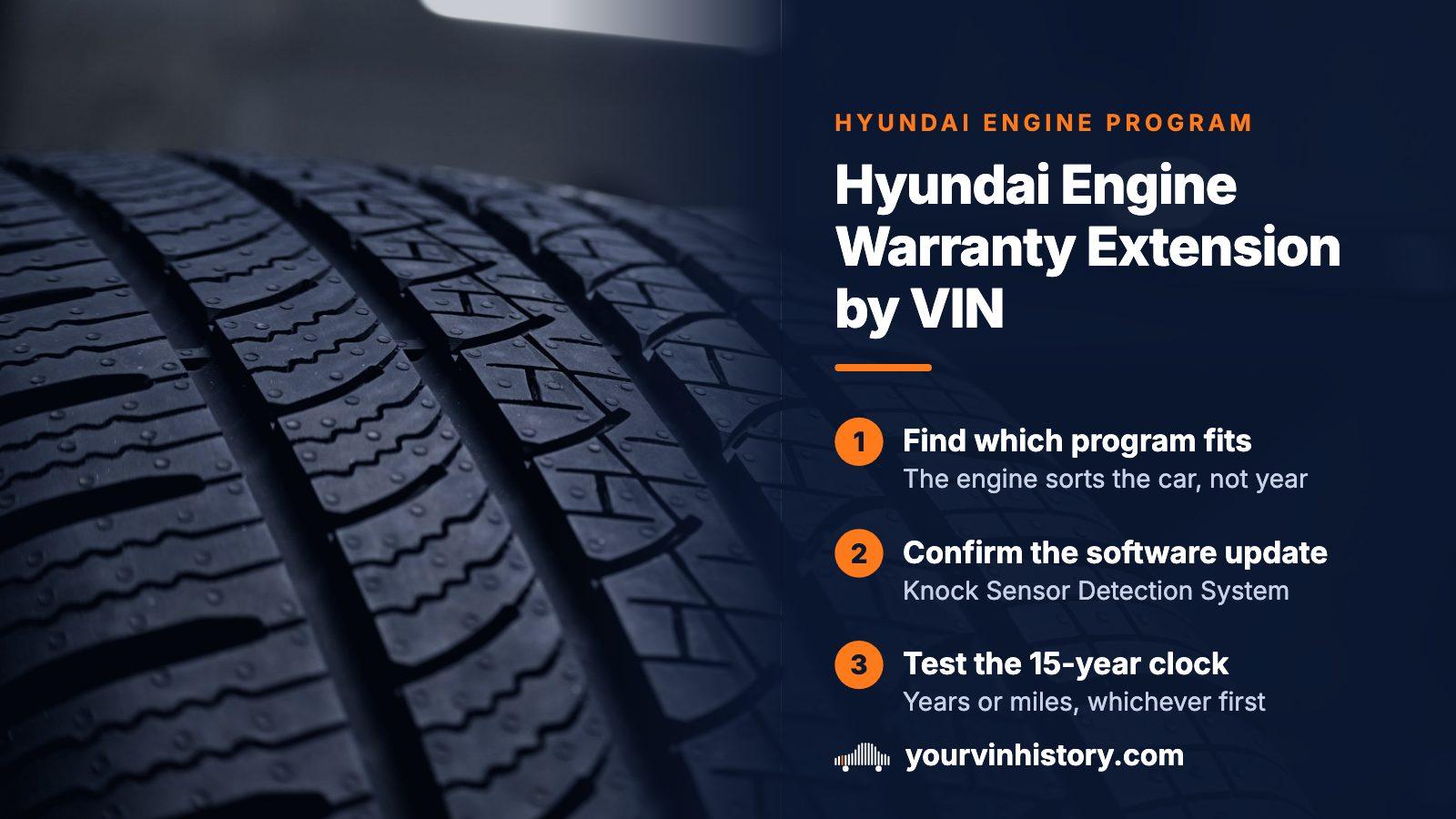
Two programs exist. Certain Tucson, Santa Fe, Santa Fe Sport and Sonata models with Theta II engines carry a limited lifetime warranty on the engine long block for connecting rod bearing wear. A larger settlement group, including Elantra, Veloster and other Tucson models, gets 15 years or 150,000 miles. Both reach later owners, and both generally depend on the Knock Sensor Detection System software update having been installed.
- Lifetime group
- Limited lifetime, engine long block, rod bearing wear
- Settlement group
- 15 years or 150,000 miles, whichever comes first
- Usual condition
- Knock Sensor Detection System software installed
- Who can claim
- Original and later owners, with exclusions
Two Hyundai programs, two different terms
Hyundai's dealer paperwork describes two engine programs, though the extension is usually discussed as one. The earlier bulletin covers engine long block repair or replacement when a connecting rod bearing wears and the engine is damaged or malfunctions, on certain Theta II engines, and it sets the term as a limited lifetime warranty. The later bulletin follows the Engine II class action settlement and sets a time and mileage limit instead, for a longer list of vehicles.
| Question | Theta II lifetime program | Engine II settlement program |
|---|---|---|
| How long does it last? | Limited lifetime | 15 years or 150,000 miles, whichever comes first |
| When does the clock start? | No date or mileage cutoff appears in the bulletin | At original retail delivery or first use, whichever is earlier |
| Who can claim? | Original and later owners | Original and later owners, minus some exclusions |
| Where does it come from? | A dealer bulletin tied to a class action | A July 2023 dealer bulletin tied to a second class action |
Both came out of class actions, and the bulletins state that Hyundai was not found liable; the parties settled voluntarily. That history explains the conditions attached.
The engine, not the model year, sorts a car into a program
Take the Sonata. The YF generation from the 2011 through 2014 model years, with the 2.4-liter or the 2.0 Turbo, sits in the lifetime group. A Sonata Hybrid from 2011 through 2015 uses a Theta II 2.4-liter hybrid engine and lands in the 15-year group. From 2016 to 2019 the gasoline LF is on the lifetime list, while the hybrid and plug-in versions, built around the Nu 2.0-liter GDI, are on the other.
The Tucson splits too. Examples from 2014 and 2015 fitted with the 2.4-liter are lifetime cars, but any Tucson running the Nu 2.0-liter GDI from 2014 through 2021 belongs to the settlement list. One badge and one model year can mean different coverage.
Ask for the engine by name
A listing that says the car has the engine warranty extension means little until someone names the engine. Positions 4 through 8 of the VIN describe the model, body and engine, and a decoder turns them into a name you can match against Hyundai's lists.
The lifetime group: six model lines on the dealer list
The earlier bulletin puts the word certain in front of every line it names, so eligibility is settled vehicle by vehicle and a matching badge is only the first filter. Grouped by engine, the list reads as follows.
- With the 2.0 Turbo and the 2.4-liter: Santa Fe Sport AN (model years 2013 through 2018), the 2019 Santa Fe TM, Sonata YF (2011 through 2014) and Sonata LF (2015 through 2019).
- With the 2.4-liter only: Tucson LM (2014 and 2015) and Tucson TL (2018 and 2019).
Body codes matter because the nameplates changed generation inside these windows. The lists also skip years: the 2.4-liter Tucson from 2016 and 2017 is named in neither bulletin, so a car from those years needs a direct answer from Hyundai rather than a guess.
The 15-year group reaches well past Theta II
The settlement list is wider and includes two other engine families, which is where many summaries go wrong. Sorted by engine, it looks like this.
| Engine | Models and model years |
|---|---|
| Theta II 2.4-liter MPI | Santa Fe, 2010 to 2012; Tucson, 2010 to 2013 |
| Theta II 2.4-liter, hybrid version | Sonata Hybrid, 2011 to 2015 |
| Nu 2.0-liter GDI | Tucson, 2014 to 2021; Elantra Coupe, 2014; Elantra, 2014 to 2016; Elantra GT, 2014 to 2020 |
| Nu 2.0-liter GDI, hybrid version | Sonata Hybrid and Sonata Plug-In Hybrid, 2016 to 2019 |
| Gamma 1.6-liter GDI | Veloster, 2012 to 2017 |
Notice went out by mail and email beginning in May 2023, so a car that changed hands afterward may have a new owner who never heard of it. Check the VIN yourself rather than trusting that the seller was told.
The software update both programs lean on
Both bulletins tie coverage to the Knock Sensor Detection System, shortened to KSDS in Hyundai's paperwork. It is a software update installed at a dealer under a service campaign, and its status is the first thing to find out about any car on these lists.
For the lifetime program, the earlier bulletin lists two qualifications. The update must be complete, and the car must show either a lit check-engine lamp with a particular trouble code or an engine concern linked to rod bearing wear or damage. An open KSDS campaign on the VIN means the update never happened, and dealers are told to say the engine falls outside the extended warranty.
- The settlement bulletin calls KSDS generally required for the extended warranty and says it should be done before engine trouble appears.
- Vehicles that were part of Recall 198 or Recall 209 are excused from the KSDS condition.
- Dealers are told to send a prior approval request on every applicable car inside the 15-year window, whether or not KSDS was done.
- In July 2023, with the settlement awaiting final approval, Hyundai said it would use discretion on engine damage that happened before KSDS was installed. The bulletin presented that leniency as temporary, so ask what the rule is today.
What the coverage pays for, and what it does not
The extension is narrow by design. The settlement bulletin names the symptoms that start a claim: a check-engine lamp with a specific trouble code, abnormal engine noise, or a no-crank, no-start condition related to rod bearing wear or damage. A technician then reads codes and inspects the engine, and the result decides between replacing the engine and updating the engine control software.
Dealers are told to warn customers at write-up that every repair is subject to inspection first.
A noise is not automatically a claim
Only trouble traced to connecting rod bearing wear falls under either program. If the technician finds something else, such as oil consumption, the repair follows ordinary warranty rules, and the dealer is told to explain in detail why it was turned down.
Oil-change receipts can decide a borderline claim
The settlement bulletin contains a records review that catches owners off guard. If the engine's condition gives a dealer reasonable grounds to suspect neglected maintenance, the dealer has to say so and ask for all oil-change receipts. How and when that conversation happened goes on the prior approval form. The owner then gets up to 10 business days to collect paperwork, although Hyundai can decide sooner if the owner confirms the records were already handed over or do not exist. Hyundai, not the dealer, makes the final call.
For a buyer, that makes the seller's folder of receipts part of what is being sold. For a seller, a dated stack of oil-change invoices is the cheapest way to make the coverage believable.
The fifteen-year clock may already be spent
The settlement program measures from original retail delivery or first use, whichever is earlier, and the 150,000-mile limit applies as well. Coverage ends at whichever limit arrives first. That matters most on the oldest cars on the list. A 2010 Santa Fe or Tucson that was delivered new in 2010 is already past its fifteenth year, and the early Sonata Hybrids are at or near that line. Being on the list is not the same as holding live coverage.
The lifetime bulletin states no date or mileage cutoff, but the word limited is doing real work: it covers one failure type, with the conditions described above.
Exclusions in the settlement program: dealers, renters and salvage
One line in the settlement bulletin gets little attention. Commercial entities and individuals engaged in buying, selling, leasing or renting motor vehicles are ineligible for the extended warranty, and so are salvaged vehicles. The first exclusion looks at the person or business holding the car. The second looks at the car's own history.
The bulletin does not define salvaged vehicles, so ask Hyundai whether a rebuilt title counts before you pay for a car with a branded past. A title history is where a salvage brand would show up. A yourvinhistory report includes title records from ClearVin LLC, an approved NMVTIS data provider.
Checking one specific Hyundai, step by step
- Read the engine from the VIN. Positions 4 through 8 describe the model, body and engine, and a yourvinhistory report lists the factory specs it finds for that VIN.
- Match model line, years and engine to the two lists above, remembering that certain means not every car.
- Run the VIN through the NHTSA recall lookup for open safety recalls. The extension itself is a warranty term, not a recall, so it will not appear there.
- Ask a Hyundai dealer to look up open and completed campaigns for the VIN and whether an engine extension applies. For the settlement group, the settlement website named in Hyundai's bulletin offers a VIN eligibility check.
- If a KSDS campaign is open, schedule it before anything goes wrong, and ask the service desk to confirm the price in advance.
- Collect the service records, and get the dealer's answer in writing.
Where this information comes from
- NHTSA: Engine Warranty Extension (TXXI) dealer best practice — Hyundai's dealer bulletin for the lifetime program: the vehicle list, the two qualifications and the open-campaign rule.
- NHTSA: Engine II settlement warranty extension dealer best practice — The bulletin behind the 15-year term, the engine table, the KSDS policy, the maintenance review and the exclusions.
- NHTSA: Recalls lookup — The federal VIN search for open safety recalls, which is separate from a warranty extension.
Sources and photos: Facts checked against the sources above in October 2026. Photo by JavyGo on Unsplash; diagrams by YourVINHistory.
Keep reading
- HyundaiFind the engine code in the VIN before you compare the car with Hyundai's lists.
- Hyundai recallsSafety recalls on the same brand are a separate question from the engine extension.
- Kia engine warrantyThe sister brand has its own engine program, with different terms.
- VIN warranty checkIn-service dates and the parts of a warranty that pass to a buyer.
Frequently asked questions
Is the Hyundai engine warranty extension really for life?
For one group of cars, yes, with a qualifier. The lifetime term applies to certain Theta II vehicles and covers engine long block repair or replacement tied to connecting rod bearing wear. It is not a blanket promise on every engine part. The wider settlement group gets 15 years or 150,000 miles instead, so confirm which list your VIN lands on.
Does the engine extension transfer to a second owner?
Both bulletins extend coverage to original and later owners, so a used buyer can hold it. The settlement program has exclusions, though: businesses and individuals in the trade of buying, selling, leasing or renting vehicles, and salvaged vehicles, are ineligible. Conditions such as the KSDS update and maintenance records still apply to whoever owns the car when the claim is made.
Will an NHTSA recall lookup show the Hyundai engine warranty extension?
No. The lookup lists safety recalls by VIN, and a warranty extension is a different thing. A recall search is still worth running on any used Hyundai. For the engine program, though, the better sources are a Hyundai dealer, which can see campaign and warranty history for the VIN, and the settlement website for cars in the 15-year group.
What happens if the KSDS update was never installed?
Under the lifetime program, the dealer is told to explain that the engine is not covered while the campaign is open. Under the 15-year program, the July 2023 bulletin said Hyundai would still consider cases for the time being, with a policy update expected afterward. Policies move, so ask Hyundai what applies now and get the update done before any symptom appears.
Does the extension cover oil burning or other engine problems?
Not under these programs. Both target damage or malfunction traced to connecting rod bearing wear. The settlement bulletin gives oil consumption as an example of an unrelated condition that goes through standard warranty procedures instead. Those cases follow the regular warranty rules, which depend on the car's age and mileage, so a high-mileage car may have no cover for them at all.
Now check the car itself
The guide explains what to look for. The report shows what this VIN has on record.