THE SHORT ANSWER
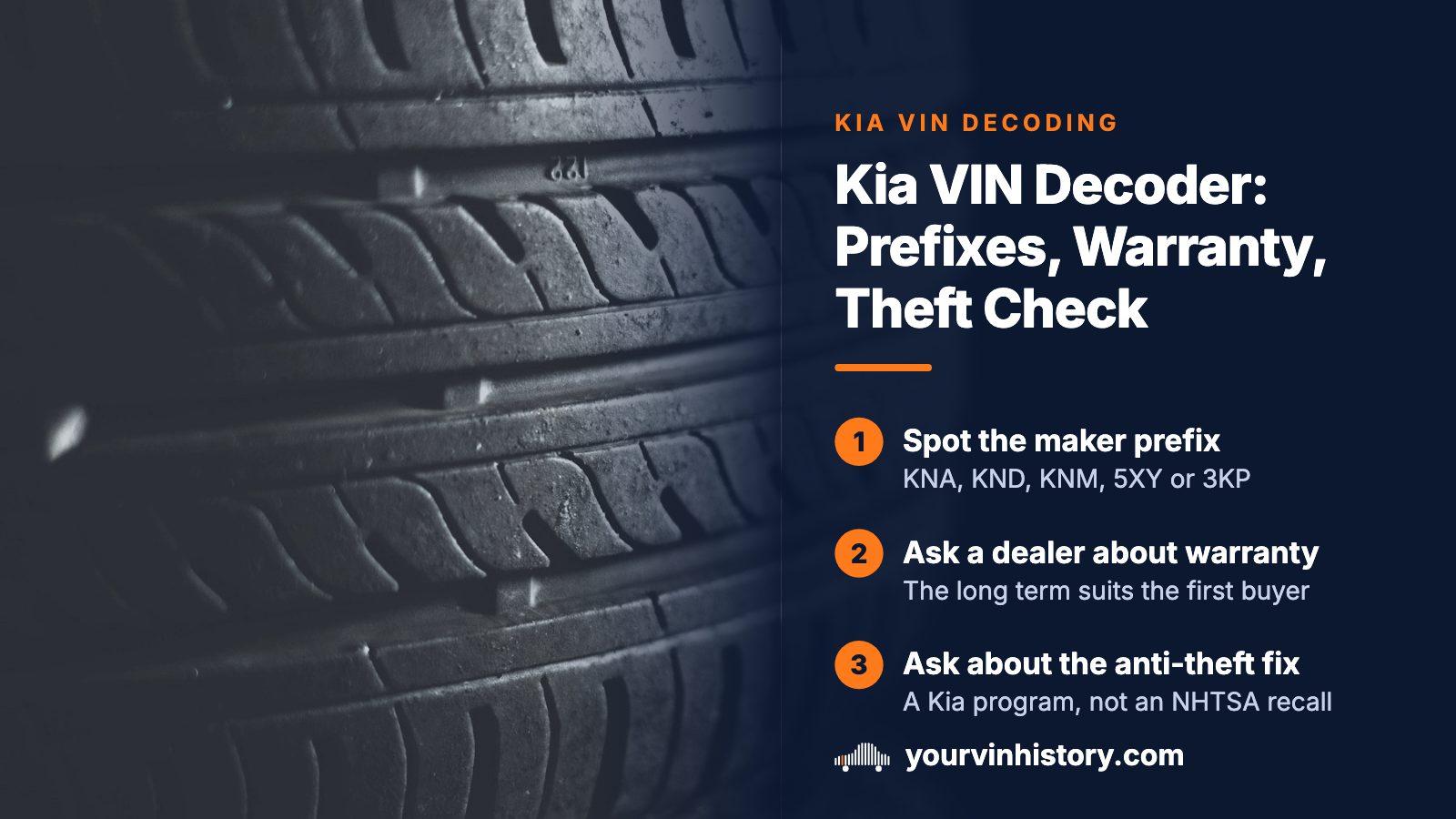
Read a Kia VIN in blocks. Positions 1 to 3 name the maker and country (KNA, KND and KNM for Korea, 5XY for the Georgia plant, 3KP for Mexico), 4 to 8 describe the vehicle, 9 is the check digit, 10 is the model year, 11 is the plant, and 12 to 17 are the production sequence. A free NHTSA decode returns the build. Remaining warranty and the anti-theft update need a Kia dealer to look up the VIN.
- Kia prefixes
- KNA, KND and KNM (Korea), 5XY (Georgia), 3KP (Mexico)
- Warranty catch
- The long powertrain term is written for the first buyer
- Anti-theft update
- A manufacturer program, not an NHTSA recall
- Free decode
- NHTSA vPIC, built on Kia's own filings
Reading a Kia VIN from left to right
A Kia VIN has 17 characters, and each stretch of them does one job. The first three are the world manufacturer identifier, which names Kia and the country of assembly. Positions 4 through 8 describe the vehicle: model, body and engine, as Kia filed them with NHTSA. Position 9 is the check digit, a calculated character that lets software reject a mistyped or invented number. Position 10 is the model year, position 11 is the assembly plant, and positions 12 through 17 are the production sequence.
Two places carry the number: a plate you can read through the glass at the lower corner of the windshield, driver's side, and a sticker on the door jamb. Check both against the title, character by character. If any two of the three disagree, stop talking price until someone explains why.
The prefixes Kia uses: KNA, KND, KNM, 5XY and 3KP
The first three characters depend on where the car was assembled. A Kia built in Korea starts with K, the country code for Korea, and the full prefix is KNA, KND or KNM. A Kia from the plant in Georgia starts with 5XY, and one built in Mexico starts with 3KP.
| Prefix | Where the car was built |
|---|---|
| KNA, KND, KNM | Korea, at Kia's home plants |
| 5XY | United States, at the Georgia plant |
| 3KP | Mexico |
A United States prefix is normal on a Kia. Its Georgia plant turns out some of the most popular models sold here, so a 5XY start is routine. Position 11 then points to the specific plant, which is worth comparing with where the seller says the car was made.
What a free decode returns, and what it leaves blank
Kia files its VIN patterns with NHTSA, and the agency's public vPIC decoder reads them back to anyone who asks. No account is needed. A decode lists the model year, model and body class, engine displacement, cylinder count and fuel type, whether the drivetrain is front-wheel or all-wheel drive, the restraint system fitted at the factory, and the country and plant of assembly.
That is a description of the car as built. Four answers a buyer often wants are missing from it:
- How much warranty remains for you as a later owner
- Whether the anti-theft software update has been applied
- How healthy the traction battery is on a hybrid or electric model
- What happened after the car left the factory: title brands, accidents, odometer readings
The last item belongs to history records. A yourvinhistory report gathers title brands, accident records, odometer readings, salvage and auction records and open recalls for a VIN. A preview comes first, and the full report is a one-time purchase.
The long warranty belongs to the first buyer
Kia is best known for a powertrain warranty of up to 10 years, with a mileage cap, and that headline figure is written for the original purchaser. Kia's own warranty page names the original purchaser and buyers of Certified Pre-Owned Kias. An ordinary second owner is not on that list, and in practice generally receives a substantially shorter powertrain term.
The powertrain clock runs from the date of first service, so the age of the car, not your purchase date, decides how much time is left. Sellers repeat the long figure in good faith, because it is what they heard at the dealership. Even so, a three-year-old Kia advertised with years of powertrain coverage left may hold only a fraction of that after the sale. Price the car on the term that applies to you, not on the brochure number.
Getting the real coverage figure from a dealer
Only Kia can say what applies to one particular car, and a dealer can look it up by VIN. Go through the call in this order.
- Give the dealer the full VIN and ask for the in-service date, because the coverage clock starts there.
- Ask what applies to you as a subsequent owner, not what the first buyer received.
- Treat each coverage as its own question. Basic, powertrain, corrosion and emissions coverage each get a separate answer, as does the battery on a hybrid or EV, because the schedules differ.
- Write down the answer and the name of the person who gave it.
- Do all of this before you negotiate. A seller who built the asking price around leftover warranty may have to come down once the true figure is known.
Of all the steps in this guide, this one moves the price most often, and it costs a phone call.
Model years built without an engine immobilizer
An immobilizer is the electronic link between key and engine: without the right key, the engine will not start. Certain Kia model years were built without one. Thieves noticed, a wave of thefts followed, and the episode drew heavy press coverage. The company's fix was a software update, plus hardware measures for the cars involved.
On paper, an affected car looks like any other. The VIN decodes normally, the title can be clean, and the car may drive well. Whether the update was done is a separate fact that a dealer can look up by VIN.
A clean recall result does not cover this
The update comes from Kia itself and is not a federal safety recall. NHTSA's lookup may not list it at all, so an empty result there says nothing about whether this car was updated.
The anti-theft questions to ask before agreeing a price
Treat these as a short script for the phone call and the test drive.
- Ask a dealer whether this VIN qualifies for the anti-theft software update.
- Find out if the update has already been done on this exact car.
- Ask about the steering wheel lock that came with the program.
- Get an insurance quote using the actual VIN, since some insurers priced the affected years differently.
- Search the VIN at NICB's VINCheck, a no-cost theft lookup that matters most on the affected years.
- On a purchase, confirm the update before you agree a price.
None of these answers appears in the federal recall search, so each one has to come from a person or from a separate database.
Hyundai research counts for a Kia too
Kia and Hyundai sit inside one parent group, which is why they use common platforms, many of the same engines and a lot of shared parts. Each still has separate manufacturer codes, styling and trim ladders, yet under the skin the two lines overlap heavily.
For a buyer that widens the pool of evidence. A fault documented on a Hyundai that uses the same engine tends to carry over to the equivalent Kia, and recall campaigns frequently move in step at both brands when one shared component is at fault. If you find little about your Kia's engine, look up the Hyundai that uses it, then confirm anything you learn against the Kia's own VIN.
Hybrid, plug-in and electric Kias
The Kia range includes hybrids, plug-in hybrids and all-electric models. A decode tells you which powertrain the car left the factory with, but not the condition of the traction battery, which is the biggest swing factor in what an electrified car is worth.
- Ask what battery and hybrid-system coverage is left on this VIN.
- Find out if that coverage passes to a later owner, and under what conditions.
- Ask if the traction battery was ever swapped for a new one.
- Compare the range or fuel economy you see with the original rating.
- On an EV, check that the charger you plan to use at home matches the car's needs.
Open recalls attach to the VIN, not the model
Recalls cover VIN ranges rather than a model name, so two Kias of the same year can differ: one with an open recall, one already repaired. NHTSA's lookup answers at the VIN level, and the tool costs nothing to use. Campaigns often run alongside Hyundai's when a shared part is involved.
On cost, the federal rule has an age limit. A maker need not repair at no charge when the first purchaser bought the vehicle more than 15 calendar years before the recall notice or order. Inside that window the repair is the manufacturer's expense, and the clock starts at the first sale, so your own purchase date does not reset it. For a very old Kia, ask a dealer what applies before assuming anything.
Keep the boundary in mind: manufacturer programs, the anti-theft update included, sit outside that database.
A used-Kia checklist, in the order that saves money
- Decode the VIN and confirm that the model year, engine and drivetrain match the listing.
- Compare the windshield VIN and the door jamb sticker with the title.
- Call a Kia dealer and request the in-service date plus the terms that apply to a later owner.
- Ask whether the anti-theft update applies to the VIN and whether it was done.
- Run NHTSA's recall lookup and NICB's theft search.
- Read up on the Hyundai that shares the engine.
- Price insurance using the VIN, especially if the model year is one of the affected ones.
- Pull a vehicle history report for title brands, accidents and odometer readings before any money moves.
If time is short, start with the dealer call. It takes minutes and has the biggest effect on what you should pay.
Where this information comes from
- NHTSA: Recalls — The federal lookup that reports open safety recalls for one VIN, and the reason a clean result does not speak for manufacturer programs.
- NHTSA: vPIC VIN decoder — The public decoder built from the VIN patterns manufacturers submit, which sets how much a decode can return.
- NICB: VINCheck — A no-cost theft search by VIN, relevant to the Kia model years with a theft history.
Sources and photos: Facts checked against the sources above in October 2026. Photo by Marvin Sagisi on Unsplash; diagrams by YourVINHistory.
Keep reading
- HyundaiThe sister brand's prefixes, powertrains and its own theft-program screen.
- Kia engine warrantyKia's engine extensions, which follow the vehicle rather than the owner.
- VIN warranty checkHow the in-service date works and which parts of a warranty pass to you.
- Most stolen carsWhich models thieves favor and what a buyer can check.
Frequently asked questions
Can I decode a Kia VIN at no cost?
Type all 17 characters into NHTSA's vPIC decoder. It needs no account and returns what Kia filed: model year, model, body class, engine, drivetrain and plant. Anything Kia did not file can come back blank, and the tool says nothing about the car's past owners, accidents or title.
Does Kia's 10-year warranty transfer to the next owner?
Not in full. Kia's warranty page names the original purchaser and Certified Pre-Owned buyers for the long powertrain term, and a later owner generally gets a substantially shorter one. Ask a Kia dealer to look up the VIN, and get a figure for each coverage type before you agree a price.
What does KNA mean in a Kia VIN?
KNA is one of three Korean prefixes, along with KND and KNM; the K stands for Korea. A Kia assembled in Georgia starts with 5XY instead, and Mexican builds start with 3KP. The prefix tells you the maker and the country; positions 4 to 8 describe the model.
Does a clean NHTSA recall check mean the anti-theft update was done?
No. Kia runs the update itself, outside the federal recall system, so NHTSA may not list it at all. Ask a Kia dealer whether the VIN is eligible and whether the update was applied, and an insurance quote on the VIN can show how a carrier rates that model year.
Does a Hyundai recall mean my Kia has the same recall?
Not automatically. Campaigns often run in parallel when the brands share a part, but each recall attaches to specific VIN ranges. Enter your Kia's own VIN at NHTSA rather than reasoning from the Hyundai notice, then use the Hyundai news only to know what to ask about.
Now check the car itself
The guide explains what to look for. The report shows what this VIN has on record.