THE SHORT ANSWER
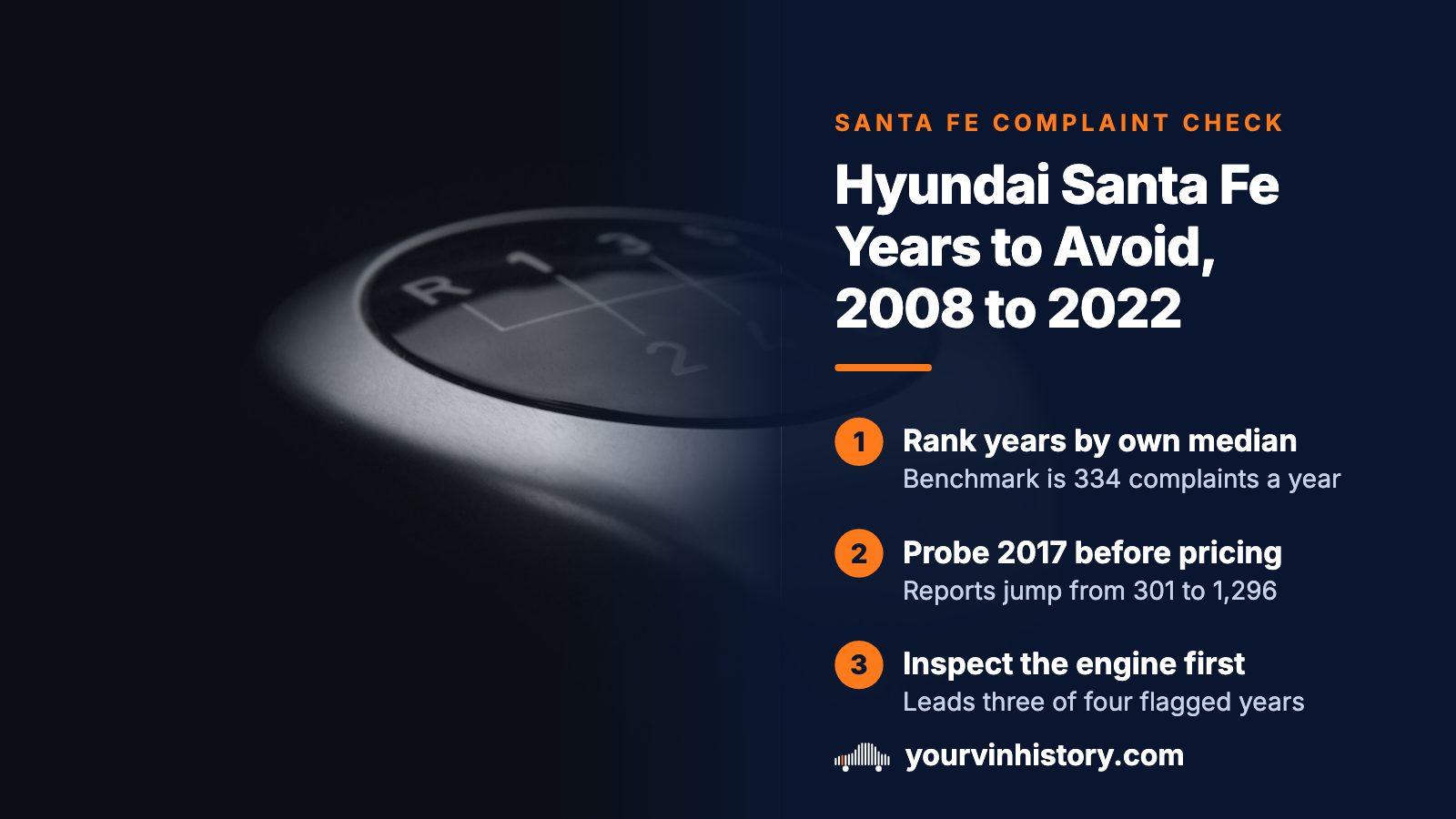
Owners filed 6,353 NHTSA complaints on the 2008 to 2022 Santa Fe, and four years sit above the nameplate's own median of 334: 2017 (1,296), 2013 (799), 2014 (653) and 2008 (541). No settled year is clearly cleaner than the rest. Engine is the biggest complaint category at 2,924 reports. A complaint count is not a failure rate, so use these figures to decide where to inspect harder.
- Total filed
- 6,353 complaints, 2008 to 2022
- Benchmark
- 334 complaints in the median year
- Peak
- 2017, with 1,296 reports
- Largest category
- Engine, 2,924 reports
What this ranking measures, and the yardstick it uses
Setting the Santa Fe beside a different SUV mostly reveals which one sold more, so this ranking holds the Santa Fe up against itself. Each of the 15 model years from 2008 to 2022 has a complaint total, and the middle total, 334, becomes the yardstick. Every year is written as a multiple of it: a year at 1× drew a typical amount of filing, while a year at 3.88× drew far more.
The pool is 6,353 consumer complaints filed with NHTSA, the federal vehicle safety agency. Duplicates were removed using the agency's complaint number, and the data was pulled in mid-August 2026, so later filings are missing. Recall counts sit beside the complaints because they record a different kind of evidence.
All 15 model years in one table
The last column turns each multiple into a word. Years from 0.54× to 1.28× fall in the normal range, the two at 1.62× and 1.96× are high, and the two at 2.39× and 3.88× are very high.
| Model year | Recalls | Complaints | Multiple of median | Standing |
|---|---|---|---|---|
| 2008 | 6 | 541 | 1.62× | High |
| 2009 | 3 | 357 | 1.07× | Normal range |
| 2010 | 3 | 257 | 0.77× | Normal range |
| 2011 | 3 | 181 | 0.54× | Normal range |
| 2012 | 1 | 352 | 1.05× | Normal range |
| 2013 | 3 | 799 | 2.39× | Very high |
| 2014 | 3 | 653 | 1.96× | High |
| 2015 | 2 | 334 | 1× | Normal range |
| 2016 | 3 | 301 | 0.9× | Normal range |
| 2017 | 6 | 1,296 | 3.88× | Very high |
| 2018 | 2 | 426 | 1.28× | Normal range |
| 2019 | 2 | 217 | 0.65× | Normal range |
| 2020 | 2 | 202 | 0.6× | Normal range |
| 2021 | 7 | 184 | 0.55× | Normal range |
| 2022 | 5 | 253 | 0.76× | Normal range |
| Median year | n/a | 334 | 1× | Benchmark |
Two details are easy to miss. The 2015 year lands exactly on the median, which is simply what happens when a median is taken from 15 values. And 2021 carries 7 recalls, the most of any year, beside one of the smallest complaint totals.
The cliff between 2016 and 2017
Scan the complaint column and one move dwarfs the rest: 301 reports for 2016, then 1,296 for 2017. Nothing else in the table comes close to that step. Swings like this tend to coincide with a new design or a significant mechanical revision, but a complaint table cannot say which one happened here.
It does make the model year a real dividing line when you shop. Engine and power train were both prominent in 2017, and the year also logged 6 recalls. The tenth character of the VIN encodes the model year, so read it off the car or the paperwork instead of trusting the headline of a listing.
2013, 2014 and 2008: the other years above the line
Three more model years sit above the median, and two of them are neighbors.
- 2013 logged 799 complaints, 2.39 times the median, with 3 recalls. Engine is its most reported area.
- 2014 logged 653 complaints, 1.96 times the median, with 3 recalls. Engine leads again.
- 2008 logged 541 complaints, 1.62 times the median, with 6 recalls. The fuel and propulsion system category tops this one.
Two back-to-back years above the line, followed by a fall to the median itself in 2015, is a pattern worth noting, although the table cannot explain it. Engine leads three of the four flagged years. None of this condemns a given car. A high multiple is a reason to inspect harder and bargain, and each of these years includes sound, well-kept examples.
Why no model year earns a clean bill
Buyers often want one cleanest year, and this record does not supply a convincing one. The smallest tallies belong to 2011 with 181 complaints, 2021 with 184, 2020 with 202 and 2019 with 217. Yet each falls in the same normal range as years with noticeably heavier filing, so none stands clearly apart.
Age muddies the low end further. The 2021 and 2022 totals come from the youngest cars in the table, which have had less time to collect reports, so a low count there is partly a matter of time. Set those two aside and no older year looks reliably light either. The 2012 year has the fewest recalls, a single one, while 2011 comes closest to the floor at 0.54×.
With years this evenly matched, a car's maintenance history and condition will tell you more than the model year on its title.
Where the complaints cluster by component
NHTSA files every complaint under a component category. These six lead across the whole 2008 to 2022 run.
| Component category | Reports | What the label can cover |
|---|---|---|
| Engine | 2,924 | Any engine fault, since the label names no single part |
| Unknown or other | 589 | Complaints that do not fit a listed component |
| Power train | 585 | The transmission and other drive components |
| Service brakes | 568 | Owner-reported brake defects, not routine pad wear |
| Electrical system | 534 | Battery, wiring, lighting and control modules |
| Fuel / propulsion system | 481 | Fuel delivery and related propulsion faults |
Engine stands apart. Its 2,924 reports sit far beyond the runner-up, unknown or other, at 589. Engine is also the leading area in 2017, 2013 and 2014, and power train is prominent in 2017 too. Because the labels are wide, a count tells a mechanic where to start looking. It does not name a failed part or say how many cars were affected.
What the recall column adds, and its 15-year limit
A recall is the maker's acknowledgment of a safety defect, and dealers carry out the repair at no charge to the owner. That is stronger evidence than a single complaint, which rests on a single owner's word. A year can show many recalls beside few complaints, as 2021 does with 7 recalls and 184 complaints, which can point to defects found and handled early.
The no-charge promise has an expiry. Under 49 U.S.C. §30120(g), the maker's duty to repair for free ends once a vehicle is 15 years past its first sale. Some of the oldest Santa Fe years may now sit on the wrong side of that line, so ask a Hyundai dealer to confirm coverage before you count on a recall repair.
Recalls follow production ranges
A model year is not a recall status. Campaigns apply to specific production ranges, so two Santa Fes from the same year can differ in which ones apply. Enter the full VIN in NHTSA's recall lookup and ask for proof of any completed repairs.
Five ways the counts can mislead
- Sales volume. A popular year draws more filings than a scarce one of equal quality. The nameplate's own median softens that effect without removing it.
- Time on the road. Older years have had longer to pile up reports, which flatters the newest rows.
- Unverified accounts. A complaint records what the owner believed happened. In bulk it shows patterns, but alone it proves little.
- Recalls point the other way. The maker has acknowledged them and repairs them at no charge within federal limits, so plenty of recalls on a year is not automatically alarming.
- One car is not a population. The Santa Fe in front of you has its own repair, ownership and title history.
Above all, a complaint count is not a failure rate or a reliability score. It cannot say how many Santa Fes of a given year ran without trouble, because the number of cars on the road is missing from the math.
What to check on a 2017, 2013, 2014 or 2008 Santa Fe
Aim the first part of an inspection at each year's leading complaint area, then cover the shared ground.
- 2017, 2013 and 2014: start with the engine. Ask for oil-change receipts, look for seepage around the engine, listen during a cold start, and note any warning light that stays on.
- 2017: give the power train attention too. On the test drive, watch for hesitation, harsh shifts or odd noises.
- 2008: look at the fuel and propulsion system. Check for fuel odors, hard starting or rough running.
- Any year: have an independent mechanic scan for stored fault codes and put the car on a lift. Brakes and electrical features both rank among the leading complaint categories.
- Any year: run the VIN through NHTSA's recall lookup, ask for paperwork on finished recall repairs, and ask a Hyundai dealer whether any engine-related campaign or warranty program applies.
None of these steps proves a defect or clears a car. They turn a statistic into checks that fit in an afternoon.
From a model year to the one Santa Fe you are buying
A model year describes a population, while a VIN describes one vehicle. NHTSA's recall lookup is free and shows open campaigns for a VIN. NICB's VINCheck is also free and screens a VIN for reported theft and total-loss records. The federal NMVTIS program holds national title records, which a ranking like this cannot reach.
For the history of one particular Santa Fe, the preview on this site is free for any VIN, and the one-time paid report adds accident records with a damage map, odometer readings, title brands and liens. Compare what it shows with what the seller has told you.
Where this information comes from
- NHTSA: Vehicle safety — Home of the federal consumer complaint database, where each owner report counted in this ranking was filed.
- NHTSA: Recalls — The source of the recall counts by model year, and the place to enter a VIN and see which campaigns are still open on one car.
- Bureau of Justice Assistance: NMVTIS — Federal overview of the national title information system, which holds the per-vehicle history a model-year ranking cannot show.
- NICB: VINCheck — A no-cost lookup that screens a single VIN for reported theft and total-loss status.
Sources and photos: Facts checked against the sources above in October 2026. Photo by Matthias Speicher on Unsplash; diagrams by YourVINHistory.
Keep reading
- 2017 Hyundai Santa Fe: seven recalls and an engine-heavy complaint fileThe peak year's own record page, with its recall campaigns and the complaint components behind the 1,296 total.
- Hyundai engine warrantyEngine is the Santa Fe's largest complaint area, and this guide covers Hyundai's engine warranty programs by VIN.
- Hyundai recallsHow to run a Hyundai recall check by VIN, the first step on any Santa Fe.
- Hyundai Tucson years to avoid: 2016 and 2017 top the NHTSA complaintsThe same year-by-year median comparison for another Hyundai SUV that shoppers weigh against the Santa Fe.
Frequently asked questions
Which Santa Fe model years are the ones to skip?
On NHTSA complaint volume, 2017 stands out most, with 1,296 reports against a median of 334, followed by 2013 at 799 and 2014 at 653. The 2008 year also sits above the line at 541. Treat these as years to inspect closely and price with care rather than years to rule out, since sales and age feed the totals alongside quality.
What is the most reliable Hyundai Santa Fe year?
The complaint record cannot name one. Every settled year falls in the same normal range, from 0.54× to 1.28× the median, and the newest years are young enough that their low counts mean less. A complaint tally is not a reliability score either, so favor the individual car with the best service receipts and a clean inspection.
Which problem do Santa Fe owners report most often?
Engine, by a wide margin. NHTSA's engine category holds 2,924 reports across 2008 to 2022, ahead of unknown or other at 589 and power train at 585. The label spans every kind of engine fault, so it does not point to one failing part. On any used Santa Fe, ask for oil-change records and have a mechanic scan for stored codes.
Does a dealer fix a Santa Fe recall at no charge?
Dealers do recall repairs at no charge, but within federal limits. Under 49 U.S.C. §30120(g) the maker's duty ends 15 years after first sale, so an older Santa Fe may fall outside it. Because campaigns follow production ranges, look up the exact VIN on NHTSA's recall page and have a Hyundai dealer confirm coverage before booking the work.
How do I check one Santa Fe before buying it?
Start with the VIN. Run it through NHTSA's recall lookup and NICB's VINCheck, both free, then pull the national NMVTIS title record for brands and odometer history. Add service receipts and an independent inspection. A model-year table sees none of this, because it describes a whole group of cars, not the single one you are about to pay for.
Now check the car itself
The guide explains what to look for. The report shows what this VIN has on record.