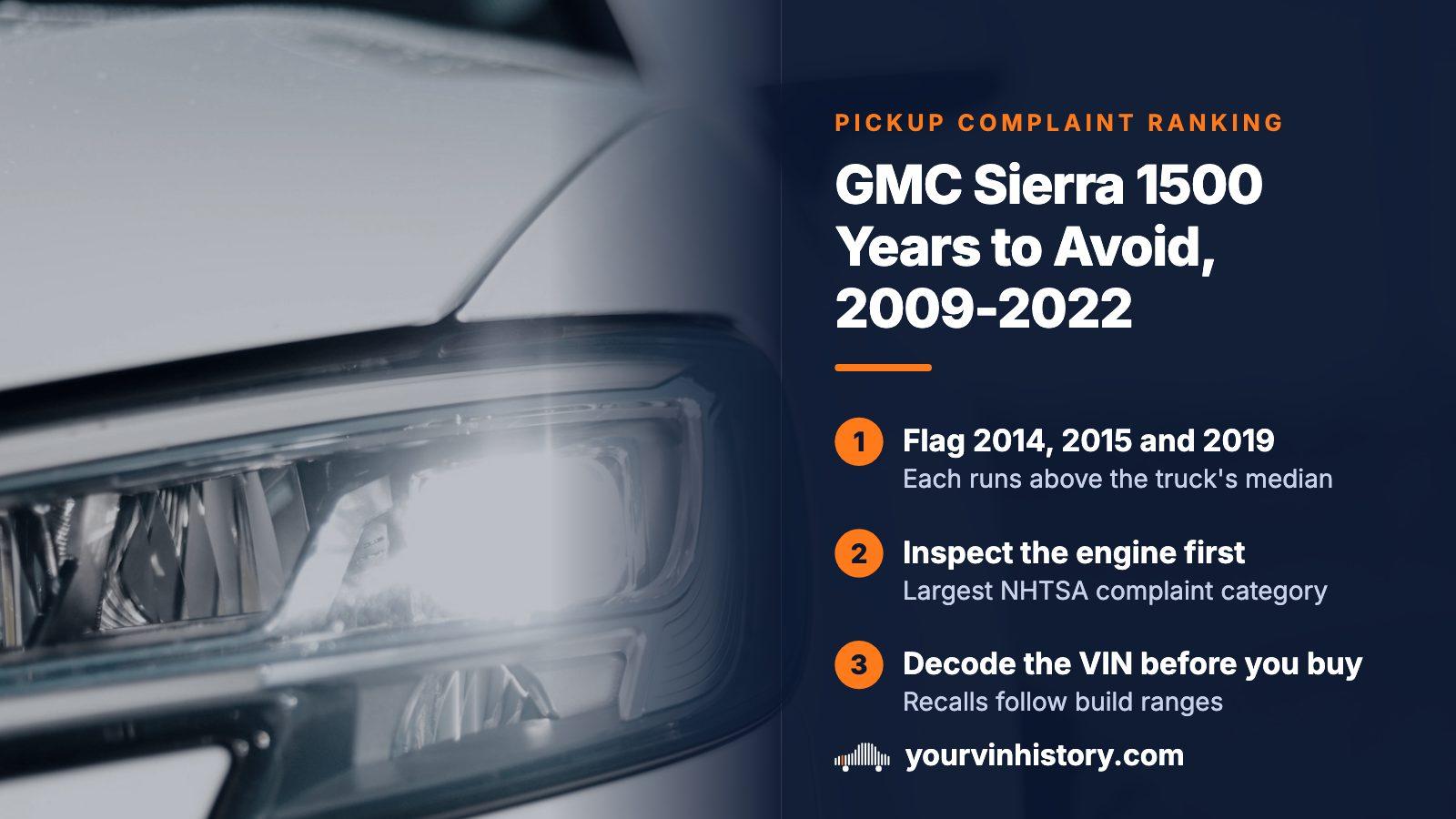
THE SHORT ANSWER
Three model years run high on NHTSA complaints: 2014 with 857, 2015 with 811 and 2019 with 619, against a yearly median of 426. The 2016, 2012 and 2013 trucks have the lightest settled records. Engine is the biggest complaint area at 1,187 reports. Complaints are unverified owner accounts, not failure rates, so a flagged year calls for a harder inspection and a firmer price, not an automatic pass.
- Complaints on record
- 5,544 across 2009 to 2022
- Median year
- 426 complaints
- Heaviest year
- 2014, with 857 complaints
- Top complaint area
- Engine, 1,187 reports
Why each year is judged against the truck's own median
A raw complaint total is partly a sales figure. A bestselling year piles up more filings than a slow one even when the trucks are equally sound, and an older year has simply had longer to collect them. So this ranking asks a narrower question: how does each model year compare with a typical year for this same pickup?
The yardstick is the Sierra 1500's median year, which is 426 complaints. The pool is every NHTSA consumer complaint filed against the 2009 through 2022 models, 5,544 in all, with duplicates removed by ODI complaint number and the data pulled on August 16, 2026. Later filings are not counted. None of it is a failure rate or a reliability score, because each complaint is one owner's version of events, unchecked.
All thirteen model years in one table
The last column puts the multiple into plain words: near the median, above it, far above it, or well below it.
| Model year | Times the median | Complaints | Recalls | Standing |
|---|---|---|---|---|
| 2009 | 0.66× | 280 | 4 | Near the median |
| 2011 | 0.86× | 366 | 5 | Near the median |
| 2012 | 0.36× | 152 | 3 | Well below |
| 2013 | 0.39× | 167 | 3 | Well below |
| 2014 | 2.01× | 857 | 9 | Far above |
| 2015 | 1.9× | 811 | 9 | Above |
| 2016 | 0.11× | 47 | 7 | Well below |
| 2017 | 1× | 426 | 5 | Near the median |
| 2018 | 0.69× | 296 | 7 | Near the median |
| 2019 | 1.45× | 619 | 10 | Above |
| 2020 | 1.04× | 443 | 12 | Near the median |
| 2021 | 1.25× | 534 | 7 | Near the median |
| 2022 | 1.28× | 546 | 6 | Near the median |
| Median year | 1× | 426 | n/a | Yardstick |
One year inside the span has no row: the data holds nothing for the year between 2009 and 2011, so this ranking cannot speak for a truck from that year. Two details are worth a second look. The 2017 trucks land exactly on the median at 426. And 2021 and 2022, at 1.25 and 1.28 times it, are above the line without reaching the 1.45 that earns 2019 its flag.
The cliff between 2013 and 2014
The sharpest feature of this data is a cliff, not a peak. The 2013 trucks have 167 complaints and the 2014 trucks have 857. Recalls move the same direction, from 3 to 9. A jump of that size tends to follow a redesign or a big mechanical revision, not a slow drift, but the counts cannot say which one happened.
For a shopper, that makes it a dividing line. Before paying for a truck from either side, find out what differs across the break and decode the VIN, whose tenth character gives the model year, instead of trusting the wording of a listing.
The three years that run high
Three model years sit clearly above the median: 2014 at about twice it, 2015 just behind, and 2019 at 1.45 times. The most-reported area differs from one to the next, which tells an inspector where to look first.
| Year | Most-reported area | Complaints | Times the median |
|---|---|---|---|
| 2014 | Exterior lighting | 857 | 2.01× |
| 2015 | Service brakes | 811 | 1.9× |
| 2019 | Engine | 619 | 1.45× |
Steering also stands out in 2014, the peak year. Recalls run 9, 9 and 10 across the three, so each has defects the maker has acknowledged. Those campaigns attach to production ranges, though, so a given truck may or may not be covered. Plenty of sound examples exist in every one of these years.
The quiet years, and one count that looks too low
Three settled years carry records well under the median: 2012 with 152 complaints, 2013 with 167 and 2016 with 47. That is 0.36, 0.39 and 0.11 times the median, with 3, 3 and 7 recalls.
The 2016 row is the odd one. It has the fewest complaints of any year, yet 7 recalls, and the years on either side are far louder: 811 for 2015 and 426 for 2017. The data gives no reason for a dip that deep, so treat it as thin evidence rather than a seal of approval. A low count means few filings. It does not mean a trouble-free truck.
The newest three years are still collecting complaints
The 2020, 2021 and 2022 trucks are kept off the cleanest list on purpose. Young vehicles have had little time to draw filings, so a modest count says less than it seems to, and those totals will keep climbing.
They are not especially modest anyway. The 2020 trucks have 443 complaints at 1.04 times the median, 2021 has 534 at 1.25, and 2022 has 546 at 1.28. The 2020 year also lists 12 recalls, the most of any year in the table. Call all three provisional: records still being written, not records that came out clean. Trucks this recent sit well inside the 15-year limit on no-charge recall repairs, so an open campaign on one is a dealer appointment, not a bill.
Where owners file, by NHTSA category
Across every model year, complaints bunch up in a few NHTSA categories.
| NHTSA category | Reports, 2009 to 2022 |
|---|---|
| Engine | 1,187 |
| Power train | 876 |
| Service brakes | 740 |
| Electrical system | 719 |
| Unknown or other | 587 |
| Air bags | 367 |
These are filing buckets, not diagnoses. Engine leads, but the category covers every kind of engine fault, so it shows where owners went to complain rather than which part failed. Power train takes in the transmission and more. Unknown or other is a catch-all, not a system. Even so, a concentration like this is the most useful thing in the data, because it tells a mechanic where to start on any Sierra, whatever the year.
What to test on a 2014, 2015 or 2019 truck
Use the flag as an inspection map. These checks follow the areas above, and a good independent shop can run most of them while the truck is on a lift.
- Engine, every year: ask for oil-change records, check the oil level and condition, look for leaks, listen to a cold start and have stored fault codes read.
- 2014: confirm every exterior light works on both beams, then drive a straight road with loose hands to see whether the steering tracks true and feels tight.
- 2015: judge the brake pedal for firmness and pulsing, watch for a pull under braking, and ask to see pad and rotor thickness.
- 2019: watch for warning lights, rough idle or hesitation, and for harsh or slow shifts that point toward the drivetrain.
- Air bags: the warning light should glow at start-up and then go out. A light that stays lit is a repair item to price in.
A seller who can hand over invoices is worth more than any year ranking. On a pickup this age, service history outweighs a model-year statistic.
Recalls and complaints measure different things
A recall is a defect the manufacturer has acknowledged and must remedy at no charge, but not forever: under 49 U.S.C. §30120(g) that duty lapses 15 years after first sale. A complaint is an unchecked owner report. The two columns therefore disagree in places. The 2020 year leads on recalls with a median-sized complaint count, and 2016 pairs 7 recalls with just 47 complaints. Many recalls beside few complaints often means defects were caught and repaired early.
Campaigns also follow build ranges, not whole model years, so only the VIN shows whether one applies to a truck. NHTSA's recall page takes a VIN and lists open campaigns. The oldest trucks in the table may already sit outside the no-charge window for any new campaign, so ask a dealer about the specific one.
How the Sierra sits beside other pickups
Totals across pickups mostly reflect sales and the span of years covered, so compare each truck's years against its own median, not one total against another. For context, here are the complaint pools behind the other pickup rankings on this site.
| Pickup | Complaints on record | Model years |
|---|---|---|
| GMC Sierra 1500 | 5,544 | 2009 to 2022 |
| Chevrolet Silverado 1500 | 12,743 | 2008 to 2022 |
| Ram 1500 | 12,186 | 2011 to 2022 |
| Toyota Tacoma | 3,245 | 2008 to 2022 |
| Ford F-150 | 19,248 | 2008 to 2022 |
The Sierra's 5,544 is well under the Silverado 1500's and the F-150's, but the spans differ and sales volume is not part of the data, so the gap says nothing about quality. The ranking page for each of these trucks uses the same median method as this one.
From the model year to the truck on the lot
A model year describes a population. The VIN identifies one truck, and everything that decides the purchase belongs to that truck. Work through it in this order:
- Decode the 17-character VIN to confirm the model year and build.
- Run it through NHTSA's recall lookup for open campaigns.
- Screen it with NICB's VINCheck for theft and total-loss flags.
- Pull the title and odometer history; a yourvinhistory report starts with a free preview and, once purchased, adds title brands, accidents, liens and odometer readings.
- Pay a mechanic for a lift inspection aimed at the areas above.
A flagged year is a reason to haggle, not a verdict
Every year in this ranking includes well-kept trucks and neglected ones. Use a flag to inspect harder and bargain sharper, not to dismiss a truck you have not seen.
Where this information comes from
- NHTSA: Vehicle safety — The federal home of the consumer complaint database behind every owner-report count in this ranking.
- NHTSA: Recalls — Where the recall counts by model year come from, and where a VIN lookup shows open campaigns on one truck.
- Bureau of Justice Assistance: NMVTIS — The federal overview of the national title record, which covers the history of an individual vehicle.
- NICB: VINCheck — A no-cost screen for reported theft and total-loss status on a single VIN.
Sources and photos: Facts checked against the sources above in October 2026. Photo by Nathan Dumlao on Unsplash; diagrams by YourVINHistory.
Keep reading
- 2015 GMC Sierra 1500 recalls, complaints and buying checksOpen recall campaigns and complaint areas for 2015, the second-heaviest year in this ranking.
- Chevrolet Silverado 1500 years to avoid: 2014, 2015 and 2019 stand outThe same year-by-year method applied to Chevrolet's full-size pickup, for a side-by-side look.
- GMCHow a GMC VIN breaks down, handy for confirming a Sierra's model year and build.
- Recall check by VINA step-by-step recall lookup by VIN, the check that settles which campaigns apply to one truck.
Frequently asked questions
Are any GMC Sierra 1500 model years worth steering clear of?
On complaint volume, the 2014, 2015 and 2019 trucks stand out, with 2014 highest at 857 against a median of 426. Avoid is a strong word for a count of unverified owner reports. If one of those years is the truck you can get, plan a harder inspection, ask for service records and let the price reflect the added risk.
Which GMC Sierra 1500 year has the fewest complaints?
The 2016 trucks, at 47, followed by 2012 at 152 and 2013 at 167. Handle the 2016 figure with care: it sits beside 7 recalls and between two much louder years, so the low count is thin evidence. The newest model years are left out of this comparison because young trucks have had little time to collect reports.
What goes wrong most often on a GMC Sierra 1500?
Engine, with 1,187 NHTSA reports across 2009 to 2022. Power train follows at 876, service brakes at 740 and electrical system at 719. Because these are broad filing categories, they do not name a failed part. They do suggest looking under the hood first on any Sierra, whatever its model year.
Will a dealer fix a Sierra 1500 recall at no charge?
Within limits. Federal law, 49 U.S.C. §30120(g), ends the no-charge duty 15 years after a vehicle's first sale, so recalls on the oldest trucks in this ranking may not qualify. Look up the VIN on NHTSA's recall page to see open campaigns, then ask a dealer whether that particular campaign still carries a no-charge repair.
How do I check one GMC Sierra 1500 before buying it?
Start with the 17-character VIN. NHTSA's recall lookup shows open campaigns, and NICB's VINCheck screens for theft and total loss. A vehicle history report adds title brands, accidents, liens and odometer readings. Finish with a lift inspection by a mechanic you choose, and ask the seller for service invoices before you hand over money.
Now check the car itself
The guide explains what to look for. The report shows what this VIN has on record.