THE SHORT ANSWER
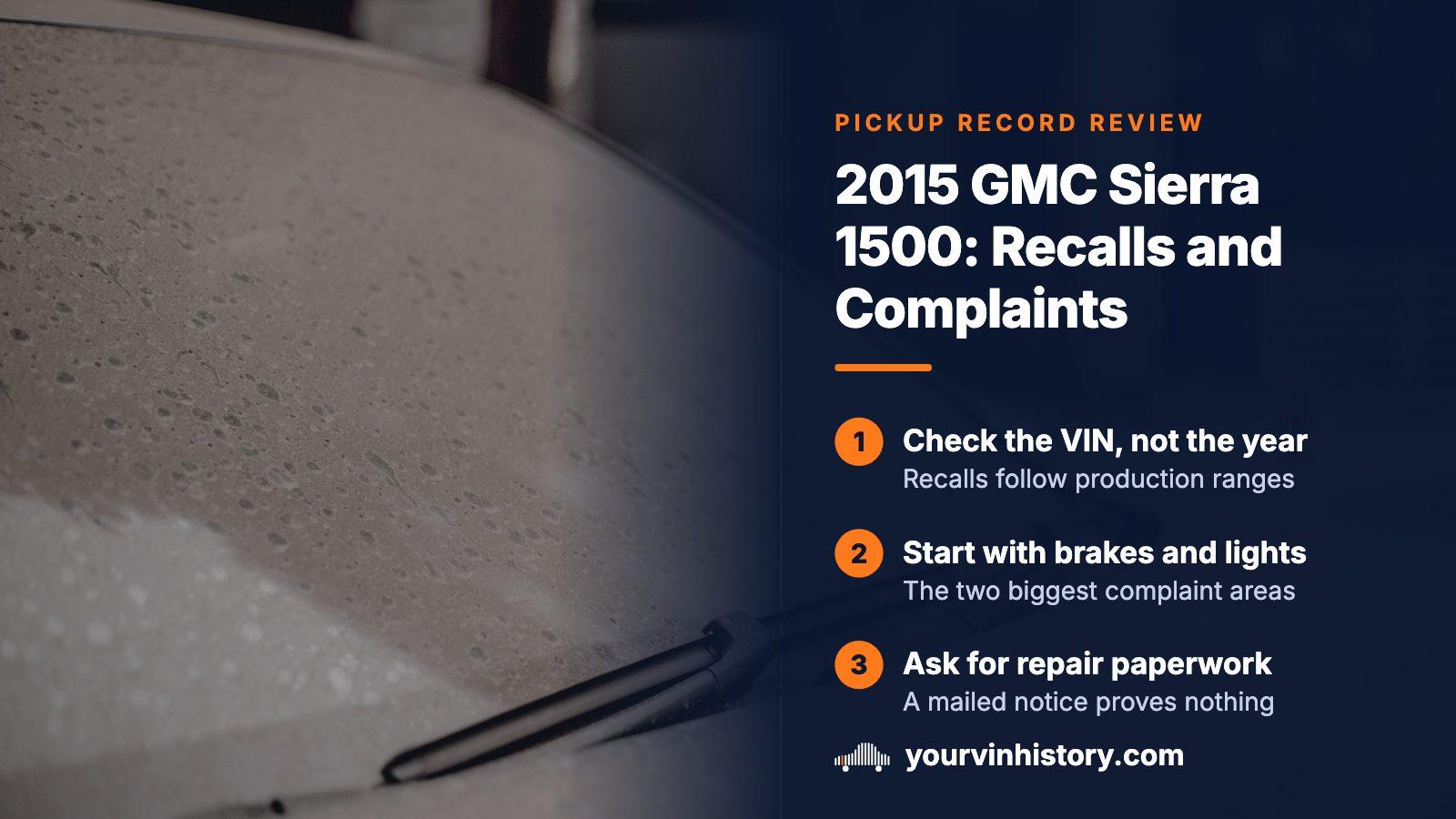
NHTSA lists 15 recall campaigns and 812 owner complaints for the 2015 GMC Sierra 1500. Service brakes lead the complaints with 243, about 30% of the total, and the agency publishes no overall crash rating for this configuration. Recalls follow VIN ranges, so only the VIN of the truck you are looking at shows which ones apply and whether the repair was done.
- Recall campaigns
- 15 on NHTSA's record
- Owner complaints
- 812, unverified reports
- Top complaint area
- Service brakes, 243 reports
- NHTSA overall rating
- None for this configuration
Recalls and complaints answer different questions
A federal safety file has two halves, and buyers tend to blur them. A recall is a defect the manufacturer has accepted and agreed to repair at no charge, inside limits that federal law sets. A complaint is an owner's report to NHTSA that nobody has verified. The 2015 Sierra 1500 carries 15 of the first and 812 of the second.
Use recalls as a to-do list for the truck you are inspecting, and complaints as a rough map of which systems owners blamed. Owners also flagged what happened: 29 filings mention a crash, 10 a fire and 14 an injury. One incident can generate several filings and none of the flags is an NHTSA finding, but read those filings in full on NHTSA's site before you commit.
The 15 campaigns sorted by the system they touch
Sorted by system, restraints dominate: seven of the 15 involve seats, belts or air bags.
| System | Campaign numbers | What NHTSA files it under |
|---|---|---|
| Seats, belts, air bags | 14V446000, 16V209000, 21V245000, 16V651000, 17V437000, 20V736000, 21V504000 | Seats; seat belts; frontal air bags; curtain air bag inflators |
| Brakes | 19V645000, 19V761000 | Vacuum power assist for the hydraulic brakes; antilock wheel speed sensor and tone ring |
| Steering | 14V719000, 18V586000 | Electric power assist, both campaigns |
| Driveline | 14V819000, 14V374000 | Rear axle shaft; four-wheel-drive transfer case |
| Engine and ignition | 14V007000, 15V640000 | Engine cooling and exhaust; ignition |
In NHTSA's recall data, nine of the 15 sit under the model name Sierra 1500 and six under plain Sierra, so a model-name search can return a partial list. Campaigns follow production ranges, which is why the VIN is the only dependable key.
Three campaigns with published detail
Campaign 14V819000 is narrow. GM recalled certain 2015 Silverado 1500 and Sierra 1500 trucks built on November 24 and 25, 2014, because an improper heat treatment could let a rear axle shaft fracture while driving. A fractured shaft can free the rear wheel from the axle and raise crash risk. Dealers examine the rear axles and swap out any shaft with the bad heat treatment, and the recall began on December 17, 2014.
The roof-rail air bag problem runs through two campaigns. In 20V736000, the end cap of the curtain inflator could detach on 2015 and 2016 Sierra 1500 and Silverado 1500 trucks, and escaping gas can then throw the cap into the cabin. GM later filed 21V504000, which supersedes the first, adds the chance of the inflator sidewall rupturing, and has dealers replace both the left and right modules. Trucks once listed under 20V736000 are now repaired under the newer number.
NHTSA's summary describes interim owner letters mailed on December 22, 2020 and August 18, 2021, then remedy letters in two phases, the second expected on May 31, 2022. That summary is dated, so whether a given truck already has its new modules is a VIN question.
Where the 812 complaints land
Owners choose the component when they file, so each row records what people believed had failed. A filing can name several components, so the counts add up to more than 812; read each row as its own tally.
| Complaints | Component named | Share of 812 |
|---|---|---|
| 243 | Service brakes | 30% |
| 130 | Exterior lighting | 16% |
| 113 | Power train | 14% |
| 102 | Electrical system | 13% |
| 89 | Steering | 11% |
| 87 | Engine | 11% |
| 72 | Unknown or other | 9% |
| 43 | Air bags | 5% |
| 31 | Structure | 4% |
| 21 | Visibility and wipers | 3% |
| 19 | Suspension | 2% |
| 16 | Seat belts | 2% |
Brakes sit alone at the top. The category holds defect reports, not pad-and-rotor wear logs, so 243 filings is a signal about this model year. Two of the 15 recalls touch the brake system, though the counts cannot show how many filings involve the recalled parts. Lighting and power train follow, and a tight cluster tells a buyer more than a large number spread thinly.
How old the truck was when owners say it failed
Every complaint carries the failure date the owner gave, and the gap from the 2015 model year is the truck's age at that moment. These are medians for the eight largest categories.
| System | Median age in years | Dated reports | Reported within 3 years |
|---|---|---|---|
| Service brakes | 4.3 | 243 | 12% |
| Exterior lighting | 1 | 129 | 81% |
| Power train | 5.8 | 113 | 29% |
| Electrical system | 5.3 | 102 | 18% |
| Steering | 5.2 | 89 | 22% |
| Engine | 6.4 | 87 | 11% |
| Unknown or other | 4.4 | 72 | 19% |
| Air bags | 6.6 | 43 | 16% |
Lighting is the outlier. Most of its reports came in the first three years, when the original warranty would normally apply, so a well-kept truck may have had that repair made already; request the receipts rather than assuming it lies ahead. Air bag reports arrive latest, at 6.6 years, with engine at 6.4: the late-life items to price in on a truck this age.
Medians, not forecasts
These ages summarize unverified owner reports. They say when people who filed place the failure, not how likely it is, and a truck with full service records can outlast every figure here.
The 2015 against the rest of the Sierra 1500 run
NHTSA's record spans 13 Sierra 1500 model years, 2009 through 2022. Measuring each year's complaints against that nameplate's own median year removes most of the effect of how many trucks were sold. On that yardstick the 2015 ranks second-heaviest, at 1.9 times the median.
| Position in the run | Model year | Multiple of the median |
|---|---|---|
| Heaviest year | 2014 | 2.01 |
| This truck | 2015 | 1.9 |
| Lightest settled year | 2016 | 0.11 |
Filings for the 2015 peaked in 2019. Reports that arrive early usually point to factory faults already handled by warranty work or a recall, while late arrivals show age and mileage wearing parts down, the stage a second or third owner inherits. The Chevrolet Silverado 1500 appears in the same axle and roof-rail air bag campaigns, and its 2014 model year carries 20 recalls and 1,557 complaints.
No crash rating on file
NHTSA has not published a crash-test rating for this particular 2015 Sierra 1500 configuration. Its New Car Assessment Program rates only some trims and body styles in a given year, so a blank means untested, not poorly rated. Do not read the gap as a warning or as reassurance; it is missing data.
With no score to lean on, put the effort into the restraint hardware itself. Seats, belts and air bags account for seven of the 15 campaigns, and a documented repair for each is worth more than any star count. What the government does hold on this truck is the recall and complaint record.
A test drive and inspection plan built from the record
Each item follows a component the record flags, so it earns mechanic time before the generic used-truck checklist.
- Brakes: note any hard or spongy pedal, watch for an antilock warning lamp, and ask whether 19V645000 and 19V761000 were completed.
- Lighting: run every exterior lamp and ask whether early lighting repairs were done under warranty.
- Driveline: confirm by VIN whether axle campaign 14V819000 reaches this truck, since it covers a two-day build window, and ask for proof of 14V374000 on a four-wheel-drive model.
- Steering and electrical: watch for dash warning lamps at start-up and feel for smooth steering assist.
- Engine bay and wiring: owners of this model year have filed fire reports, so look for heat marks, melted insulation and amateur splices.
- Paperwork: a mailed notice is not proof of a repair, so ask for dealer records on all 15 campaigns.
Pickup wear the federal record cannot see
Complaints and recalls describe defects, not a working life, and a truck can be hard used without a single filing. These checks apply to any pickup and belong beside the ones above.
- Frame rails and crossmembers: rust starts here, and structural repair is never cheap.
- Bed mounts and tailgate hardware: dents and wear show hauling rather than commuting.
- Towing evidence: a worn hitch receiver, an added transmission cooler or spliced trailer wiring each suggest the drivetrain did more work than the mileage shows.
- Rear leaf springs and differential: sag or seepage should lower the price more than faded paint does.
Checking the one truck in front of you
Everything above describes a model year. Your truck has its own VIN, and the VIN decides which campaigns apply. Enter it in NHTSA's recall lookup, a free government tool that lists open recalls for that exact vehicle, and run it again on the day you pay, because new campaigns get added.
Dealers make recall repairs at no charge, but only within the federal rule. Under 49 U.S.C. §30120, the no-charge requirement does not apply when the first purchaser bought the vehicle more than 15 calendar years before the recall notice went out. The test compares first purchase with notice date, not with today.
Recall data says nothing about title or ownership. A yourvinhistory report covers that side, including title brands, accident and odometer records, and use type, which matters on a truck that may have worked for a living. The preview is free; the full report is a one-time purchase. Before paying, also put these to the seller:
- Ask for dealer paperwork showing each of the 15 campaigns was completed.
- Ask whether the brakes were ever repaired or replaced, and by whom.
- Ask about any collision or insurance-paid repair, and confirm the title is in the seller's name with no lien.
- Ask to take it to your own mechanic.
Where this information comes from
- NHTSA: recalls by vehicle — Where a VIN is entered to see which campaigns remain open on one specific truck.
- NHTSA: vehicle safety and consumer complaints — The agency behind the owner complaint database whose filings are tallied in this record.
- 49 U.S.C. §30120: remedy without charge — The statute text that sets the no-charge repair requirement and its 15-year limit.
- NHTSA: New Car Assessment Program ratings — The federal crash-test program, which tests only some trims and body styles each year.
- NMVTIS: national title record — The federal title database, covering brands and history that recall data leaves out.
Sources and photos: Facts checked against the sources above in October 2026. Photo by JavyGo on Unsplash; diagrams by YourVINHistory.
Keep reading
- GMC Sierra 1500 years to avoid, ranked by NHTSA complaintsRanks every Sierra 1500 model year against its own median, so you can see where 2015 sits.
- 2014 Chevrolet Silverado 1500 recalls, steering complaints and what to inspectThe Chevrolet twin from the year before, with its own recall and complaint file to compare.
- Recall check by VINWalks through running a VIN for open campaigns, step by step.
- Buying a car with an open recallFor the case where the lookup turns up a repair nobody ever made.
Frequently asked questions
How many recall campaigns cover the 2015 GMC Sierra 1500?
NHTSA's record shows 15 campaigns. Each applies only to a production range, and several are shared with other GM trucks. Because NHTSA files some campaigns under Sierra and others under Sierra 1500, a model-name search can undercount. The VIN is the reliable way to learn what applies.
Are recall repairs on a 2015 Sierra still done at no charge?
Generally yes for campaigns inside the federal rule. Under 49 U.S.C. §30120, the no-charge requirement lapses if the first purchaser bought the truck more than 15 calendar years before the notice date. A remedy may not be ready when the notice goes out, so phone a dealer's service desk with the VIN before booking.
What do owners complain about most on the 2015 Sierra 1500?
Service brakes lead with 243 reports, then exterior lighting with 130 and power train with 113. The lighting reports skew early, with 81% inside three years, while engine and air bag reports tend to arrive later. All of it is unverified owner testimony, so use it to decide where to look, not as a verdict on the truck.
Should I skip a 2015 Sierra 1500 because of its recall count?
Not on the count alone. A long recall list matters less than whether the repairs on the truck in front of you were done and documented. The 2015 does sit above its own median year for complaints, so inspect carefully, but a truck with a clean paper trail can beat one with no records at all.
How do I check one 2015 Sierra 1500 for open recalls?
Read the VIN off the windshield or the title paperwork and enter it in NHTSA's recall lookup. The result lists campaigns not yet repaired on that exact truck. Save a copy, and ask the seller for dealer paperwork covering anything already completed, since a previous owner may have booked some repairs.
Now check the car itself
The guide explains what to look for. The report shows what this VIN has on record.